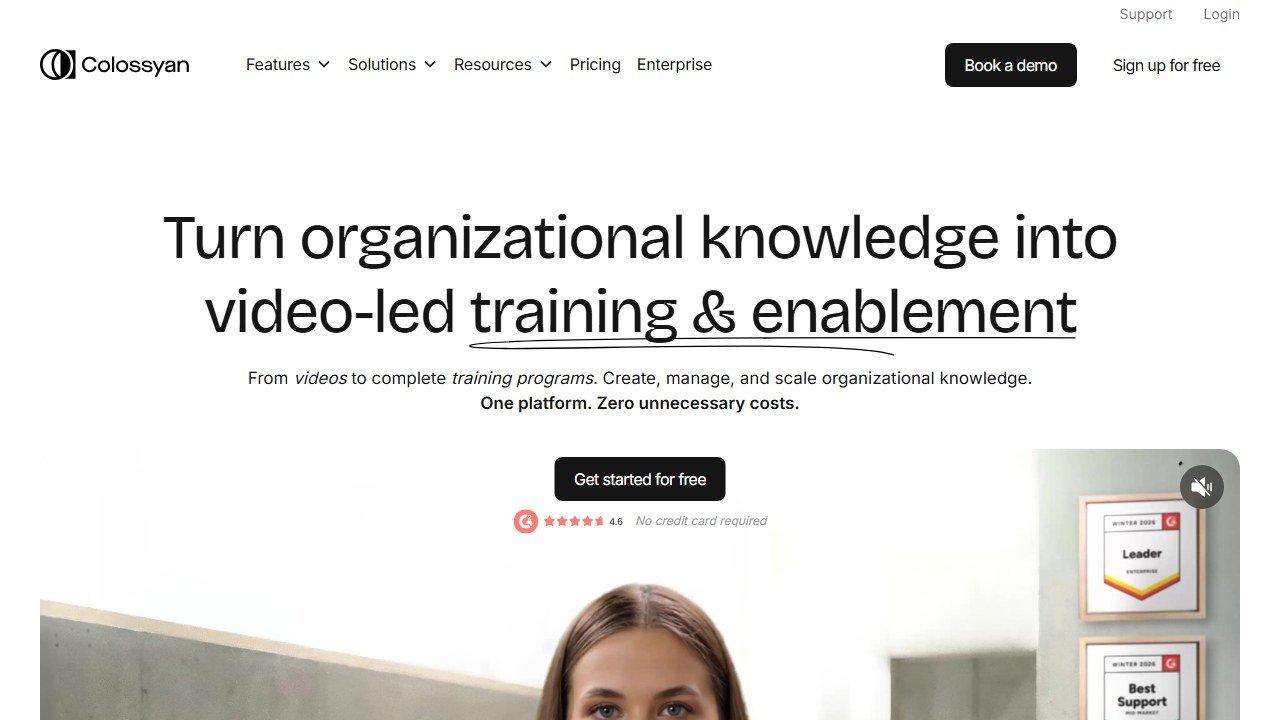
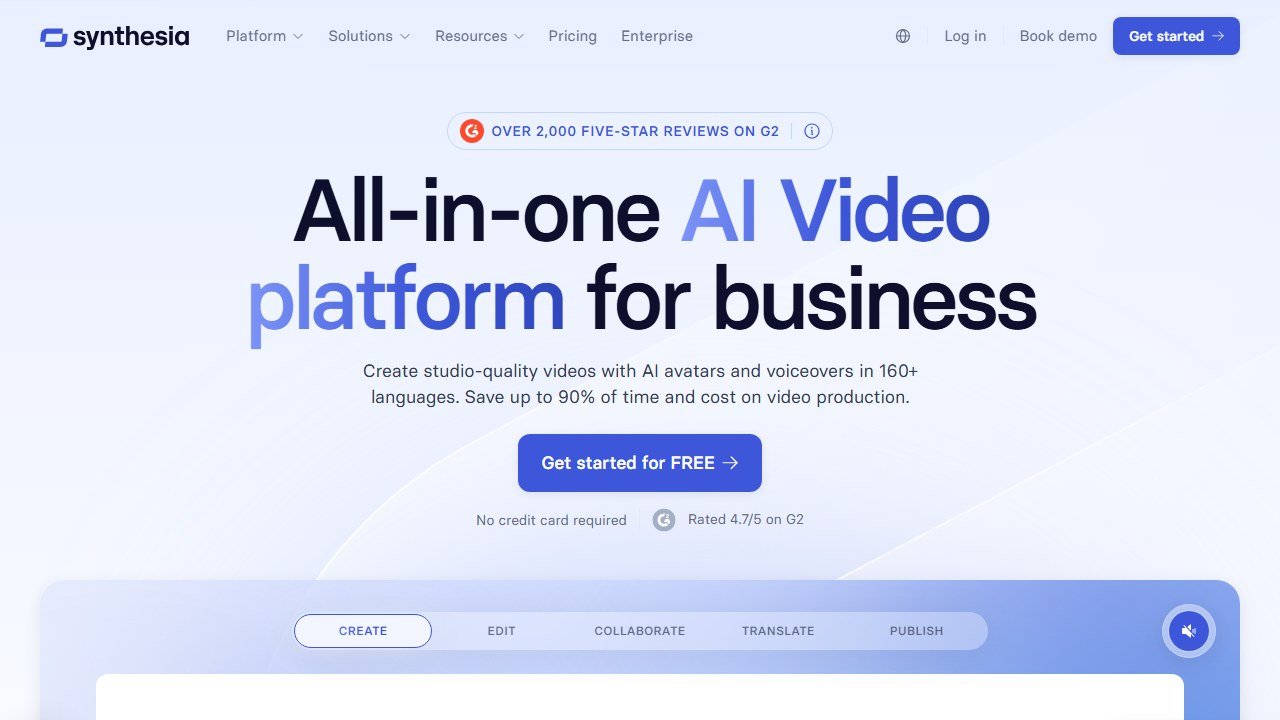
Quick verdict: Synthesia suits polished, multilingual training videos at scale; Colossyan suits interactive, scenario-based training. Both now have free plans. Synthesia Starter costs $29 a month or $264 a year. Colossyan Professional costs $59 a month billed annually and includes SCORM export, which Synthesia lists on Enterprise. Prices read 17 September 2026.
Synthesia and Colossyan both generate AI avatar training videos, but they serve different L&D needs. Synthesia is the better pick for enterprises that need polished, linear training videos at global scale, with up to 240+ avatars, 160+ languages, and adoption by 90% of Fortune 100 companies. Colossyan is the better pick for L&D teams building interactive, scenario-based training, thanks to built-in branching scenarios, quizzes with pass/fail scoring, a free Starter plan with its full avatar library, and SCORM export from its Professional plan. If your priority is consistent multilingual rollout, go with Synthesia. If your priority is learner engagement through decision-based content, go with Colossyan.
Related: Best AI roleplay tools for corporate training
Quick Comparison Table
| Feature | Synthesia | Colossyan |
|---|---|---|
| Starting Price | Free plan; Starter $29/mo or $264/yr | Free Starter; Professional $59/mo (annual) |
| AI Avatars | Up to 240+ stock avatars (Enterprise) | 300+ avatar library, including on the free plan |
| Languages | 160+ | 70+ |
| Interactive Branching | Yes (basic branching paths, CTAs) | Yes (deep scenario trees with decision-based outcomes) |
| Built-in Quizzes | Yes (embedded quizzes, knowledge checks) | Yes (multiple-choice, open-ended, video response, pass/fail scoring) |
| SCORM Export | Listed on Enterprise | Professional (5 a month) and Enterprise |
| Compliance | SOC 2 Type II, ISO 27001, ISO 42001, GDPR | SOC 2 Type II, ISO 27001, ISO 42001, GDPR |
| PowerPoint Import | Yes | No |
| G2 Rating | 4.7/5 (2,375 reviews) | 4.6/5 (488 reviews) |
| Best For | Enterprise video production at scale | Deep interactive scenario-based L&D |
Pricing Comparison
Both platforms now start with a free plan, sell paid tiers by plan, and put their largest customers on annual Enterprise contracts. The figures below were read on each vendor’s pricing page on 17 September 2026. Synthesia’s plan cards showed rupees from our Indian IP address, so its US dollar figures come from the answers in its own pricing FAQ. Colossyan’s come from its pricing page.
For more free options, including HeyGen, see best free AI image to video tools.
| Plan level | Synthesia | Colossyan |
|---|---|---|
| Free | Free plan | Starter is free and includes the full 300+ avatar library |
| First paid plan | Starter: $29 a month or $264 a year, 10 video minutes a month | Professional: $59 a month billed annually, 30 NEO and 10 NEO2 minutes a month, up to 3 editors |
| Next tier | Creator: $89 a month or $804 a year | None published between Professional and Enterprise |
| Enterprise | Annual contract, unlimited minutes | Custom, unlimited minutes, SSO, data residency |
| SCORM export | Listed on Enterprise | 5 a month on Professional, unlimited on Enterprise |
| Custom avatars | One personal avatar with annual Starter and Creator; some avatar options are a $1,000 a year add-on | Instant custom avatars on any active plan; studio avatars are a $1,000 a year add-on |
Faz says: Both tools start free now, so the entry price no longer decides this. SCORM does. If your LMS needs SCORM files, compare Colossyan Professional at $59 a month with Synthesia Enterprise, not the two starter plans.
Features Head-to-Head
AI Avatars
Synthesia lists up to 240+ stock avatars on its Enterprise plan, including its Express-2 model with realistic micro-expressions, natural eye contact and coordinated hand gestures. Colossyan says its whole 300+ avatar library is available even on its free Starter plan. Both support custom avatars: Colossyan includes instant custom avatars on any active plan, while Synthesia includes one personal avatar with annual Starter and Creator plans.
Languages and Localization
Synthesia supports 160+ languages compared to Colossyan’s 70+. For global enterprises rolling out compliance training across dozens of regions, that gap matters. Synthesia also offers multilingual dubbing that preserves avatar consistency across languages, reducing the need to re-record or re-edit for each locale.
Interactive and Branching Features
Both platforms now support interactive features, but Colossyan goes significantly deeper. Synthesia added branching paths, CTAs, chaptering, and embedded quizzes to its interactive video toolkit. These work well for basic knowledge checks and guided navigation. Colossyan takes interactivity further with full branching scenarios where learners make decisions that affect the video path, multiple-choice quizzes, open-ended questions, and video response questions where learners record their own answers. If your training requires simple interactivity (choose a path, answer a question), either platform works. If you need deep scenario-based assessments with pass/fail scoring and multiple question types, Colossyan is the stronger option.
SCORM and LMS Integration
Both platforms export SCORM packages for LMS delivery, but on different plans: Colossyan includes 5 SCORM exports a month on Professional and unlimited on Enterprise, while Synthesia’s pricing page lists SCORM export on Enterprise. Beyond that, the difference is depth. Colossyan’s SCORM export includes pass/fail logic tied to quiz scores, meaning your LMS can automatically mark a module as complete or failed based on learner performance. Synthesia’s SCORM export tracks completions, quiz scores, branching paths, and time spent, but Colossyan’s configurable pass marks and multi-format question scoring give L&D teams more granular control over training outcomes.
Editor and Workflow
Synthesia supports PowerPoint import, letting teams convert existing slide decks into avatar-presented videos quickly. This is a significant time-saver for organizations sitting on libraries of training slides. Colossyan’s Conversation Mode places multiple avatars in a single scene (supervisor and employee, for example), which is useful for modeling workplace interactions. Both platforms include AI script generation.
Where Synthesia Wins
Synthesia is the stronger choice when scale, consistency, and enterprise governance are the priorities.
- Express-2 avatars: Realistic facial movements and lip-sync accuracy across long scripts.
- More languages (160+ vs 70+): Nearly double the language support, with multilingual dubbing that maintains avatar consistency.
- Enterprise footprint: Used by 90% of Fortune 100 companies, with 60,000+ customers and a $4B valuation that signals long-term platform stability.
- ISO 42001 first-mover advantage: Synthesia was among the first AI video platforms to achieve ISO 42001 certification for AI management systems.
- PowerPoint import: Convert existing slide decks into avatar videos without rebuilding content from scratch.
- Content moderation: Every video goes through human review before publishing, which adds time but reduces brand risk.
Where Colossyan Wins
Colossyan is the stronger choice when learner engagement, interactivity, and training effectiveness measurement are the priorities.
- Interactive branching scenarios: Learners make choices that change the video path, practicing real-world decision-making instead of passively watching.
- Built-in quizzes with scoring: Multiple-choice, open-ended, and video response questions with configurable pass marks. No third-party quiz tool needed.
- Training-first design: The platform is built specifically for L&D teams, not repurposed from a general video creation tool.
- SCORM on a published plan: A free Starter plan, then SCORM export on Professional at $59 a month billed annually, without an Enterprise contract.
- Pass/fail SCORM logic: Quiz scores flow directly into LMS completion data, giving L&D managers actual performance metrics instead of just “watched” or “not watched.”
- Conversation Mode: Multiple avatars in one scene for modeling workplace dialogues, customer interactions, or manager-employee scenarios.
Saru says: The ROI math here depends on what you measure. If your KPI is “videos produced across languages,” Synthesia’s 160+ language support and PowerPoint import deliver more output per dollar. If your KPI is “learner knowledge retention,” Colossyan’s quiz pass rates and branching completion data give you measurable proof that training actually worked. Enterprises with Novartis, Vodafone, and Cisco on Colossyan’s client list are clearly prioritizing that second metric.
Compliance Comparison
Both platforms have invested heavily in enterprise security certifications. Here is the current status.
| Certification | Synthesia | Colossyan |
|---|---|---|
| SOC 2 Type II | Yes | Yes |
| ISO 27001 | Yes | Yes |
| ISO 42001 | Yes (first-mover) | Yes |
| GDPR | Yes | Yes |
The compliance gap between these platforms is narrow. Both hold SOC 2 Type II, ISO 27001, ISO 42001, and GDPR compliance. Synthesia’s edge is timing: they achieved ISO 42001 earlier, which may matter to procurement teams that weigh certification history. Both platforms store data in accordance with GDPR requirements, and both offer enterprise-grade access controls on their highest tiers.
For regulated industries like finance, healthcare, or pharma, either platform meets the baseline security requirements. The decision should come down to features and workflow fit, not compliance gaps.
The Verdict
Choose Synthesia (read our full Synthesia review) if you need a safe, proven enterprise pick for producing linear training videos at global scale. Its up to 240+ avatars, 160+ languages, PowerPoint import, and adoption by 90% of Fortune 100 companies make it the default for organizations that prioritize consistency, multilingual reach, and brand governance. The $4B valuation and 60,000+ customer base signal a platform that will be around for the long haul.
Choose Colossyan (read our full Colossyan review) if you are an L&D specialist building interactive, scenario-based training where learner engagement and knowledge retention are the primary goals. Deep branching scenarios, quizzes with configurable pass/fail scoring, video response questions, Conversation Mode, and granular SCORM completion logic give training teams a level of interactivity depth that goes beyond what Synthesia currently offers. Backed by $28.2M in funding and used by Novartis, Vodafone, and Cisco, Colossyan is purpose-built for corporate learning.
Most organizations do not need to choose exclusively. Teams that produce both compliance explainers (linear) and onboarding simulations (interactive) may find value in using Synthesia for the first and Colossyan for the second. For a full ranked list of tools in this space, see our best AI corporate training tools guide.
When to choose Synthesia over Colossyan
Picking between Synthesia and Colossyan comes down to four factors: team size, budget, integration needs, and how much customization you want. Use the framework below to map your situation to the right tool.
Pick Synthesia if:
- You’re an individual operator or a small team and you want the fastest setup path.
- Your budget favors a lower entry tier or a strong free plan over premium features you may never use.
- Your existing stack is light, and you prefer a tool that works well out of the box.
- You value simplicity over feature breadth.
Pick Colossyan if:
- You’re a growing or mid-sized team and you need room to scale without switching platforms.
- You’re willing to pay more upfront for advanced features, integrations, or higher usage limits.
- You already have a mature stack and you need a tool that plugs into it cleanly.
- You’d rather have power and configurability than the simplest possible setup.
What we’d switch for
The most common reasons we see teams move between tools in this category: (1) pricing changes that push the cheaper option out of reach, (2) a missing integration that becomes a daily friction, (3) hitting a usage cap on the lower tier, (4) a feature ship from the alternative that closes a gap users had been working around.
If you can avoid those four switching triggers with your initial pick, you’ve made the right call. If any of them are likely in your first 12 months, plan for them now and pick accordingly.
Why the price you see may not be the price we saw
This deserves its own section because it affects several tools in this category and almost no comparison article accounts for it.
What we actually observed
When we read Synthesia’s pricing page on 4 September 2026, every plan figure was in rupees, because our captures run from an Indian IP address and the site served local pricing automatically. HeyGen went further: a request to heygen.com/pricing redirected to its /en-in/ locale even when we sent a United States language header, meaning the routing is by IP rather than by browser preference.
Why this breaks most price comparisons
An article quoting a single global figure for a geo-priced tool is describing one country’s rate card and presenting it as the price. Regional pricing is not usually a straight currency conversion either; vendors set local rates deliberately, so the ratio between two markets can differ considerably from the exchange rate. That means you cannot fix the problem by converting, and we do not attempt to.
How to check your own number in thirty seconds
Open the vendor’s pricing page yourself, from the country where the contract will sit, and look at the currency symbol before you look at the number. If the URL contains a locale segment such as /en-in/ or /en-gb/, you are on a regional page. Where a vendor offers a currency selector, note that changing it sometimes changes the plan structure and not merely the symbol.
What to ask when the contract is cross-border
If your company is registered in one country and the team is in another, ask which entity is billed, in which currency, and whether the rate is fixed for the term or moves with a published exchange rate. Ask whether taxes are included, because several vendors here publish figures excluding tax. These questions are dull and they are the difference between a budget that holds and one that drifts by a fifth.
Authoring tools and the per author licence model
Course authoring is priced per author per year, not per learner, which makes it one of the easier budgets to calculate and one of the more expensive to get wrong. Here is where the two best-known authoring tools sit, read 4 September 2026.
iSpring publishes the clearest per author rates
iSpring publishes iSpring Suite at $970 USD per author per year, iSpring Suite AI at $1,290 and iSpring Cloud AI at $720. Because the meter is authors rather than learners, the arithmetic is simple: two instructional designers on Suite AI is $2,580 a year regardless of whether you train fifty people or five thousand. That is the friendliest structure in this category for an organisation with a large workforce and a small L&D team.
Articulate is currently showing a limited-time offer, not a standard price
This one needs care. Articulate‘s canonical pricing URL redirected us to a special offer page on 4 September 2026, showing $1,198 USD per user per year against a struck-through $1,749, described as 31% off and a limited time offer, with an FAQ headed “Who is eligible for this special pricing offer?”. So the published figure is promotional. Ask what the price is outside the offer and what it renews at, because a 31% discount in year one against an undiscounted year two is a materially different deal from a $1,198 rate card.
The add-ons are priced separately and are not small
Articulate publishes Localization starting at $5,000 a year and Reach Pro starting at $3,600 for 1,200 active learners a year. Localization is the one that surprises people: if you train a multilingual workforce, translation management can cost more than the authoring seats. Price the combination you would actually deploy rather than the headline seat.
Per author is only cheap if authoring is centralised
The model rewards a small team of dedicated designers and punishes a federated approach where every department wants to build its own content. Decide which you are before buying. If fifteen people across the business each need to publish occasionally, a per author licence is the wrong shape and you should be looking at a tool priced differently, or accepting a bottleneck by design.
Bottom line
Synthesia is the more accessible starting point. Colossyan is built for the stage after you’ve outgrown a simpler tool. Most teams should start with the tool that matches today’s needs and move when (and if) they hit a real wall, not based on what they think they might need in two years.
Sources
Final pick for AI video creators in 2026
Synthesia is the established market leader with the broadest avatar library, language coverage, and enterprise feature depth. Colossyan is the faster-evolving challenger with stronger interactive video and conversational scene features. For corporate training videos with traditional structure: Synthesia. For interactive learning videos with branching and scene control: Colossyan. Both produce high-quality AI video and the right choice depends on use case sophistication.
Pricing comparison: Synthesia Starter is $29 a month or $264 a year and Creator is $89 or $804, with Enterprise on an annual contract. Colossyan Starter is free and Professional is $59 a month billed annually. Both have free plans, so use them to judge avatar quality for your own content.
Looking at other AI video tools? See HeyGen vs Synthesia and our roundup of the best Synthesia alternatives.

Written by
FazFaz is the founder of AIToolsBakery. Some tools here are tested hands on. Others are assessed from vendor documentation and pricing verified on the live page, and every review says which one it is. Sponsors can buy a position in a guide. They cannot buy the score, the criticism, or silence about a better option.
How we test and how we make money →