Donorbox is one of the most-recommended donation platforms for small nonprofits in 2026, and for good reason. The product is simple, the fees are transparent, the setup takes about an hour, and the integration with WordPress, Squarespace, and Wix is among the cleanest in the category. But there are real trade-offs at higher giving volumes and a handful of feature gaps that matter once your organization crosses certain thresholds.
I have reviewed every major donation platform on the market for AIToolsBakery and watched dozens of small nonprofits deploy them. The honest read on Donorbox for 2026 is this. If your organization is under about $500,000 in annual giving and you want a no-friction donation page that converts cleanly on mobile and integrates with your existing website without engineering work, Donorbox is hard to beat. Above that threshold, the math starts to favor alternatives.
This review covers what Donorbox actually does well, where it falls short, the real all-in fee structure, and the alternative I would consider if you are deciding between this and another platform. Our Donorbox vs Givebutter comparison works a 100 dollar gift through every fee setting on both.
Donorbox in one paragraph: A clean, transparent donation platform built for small-to-mid nonprofits. Free to start with platform fees of 1.5 percent (Standard) or 1.75 percent (Premium) on top of payment processing. Strong WordPress/Squarespace integration, good recurring giving, decent peer-to-peer fundraising. Best for organizations under $500K in annual giving. Above that, Fundraise Up’s conversion optimization or a custom Stripe integration usually pays for itself.
Faz says: The reason Donorbox keeps showing up at the top of nonprofit recommendation lists is not flashy AI features. It is that the founders made a series of unglamorous correct decisions early. The donation form converts on mobile. The recurring-giving flow does not break. The CMS plugins actually work. Most platforms in this category get one of those right and pretend the others do not matter. Donorbox got all three right.
Saru says: This review is research-based, sourced from Donorbox’s public pricing documentation, partner case studies, verified-buyer reviews on G2 and Capterra current to May 2026, and field observation from EDs running the platform at sub-$1M nonprofits. Pricing changes quarterly. Verify against the live pricing page before committing.
The Donorbox honest scorecard
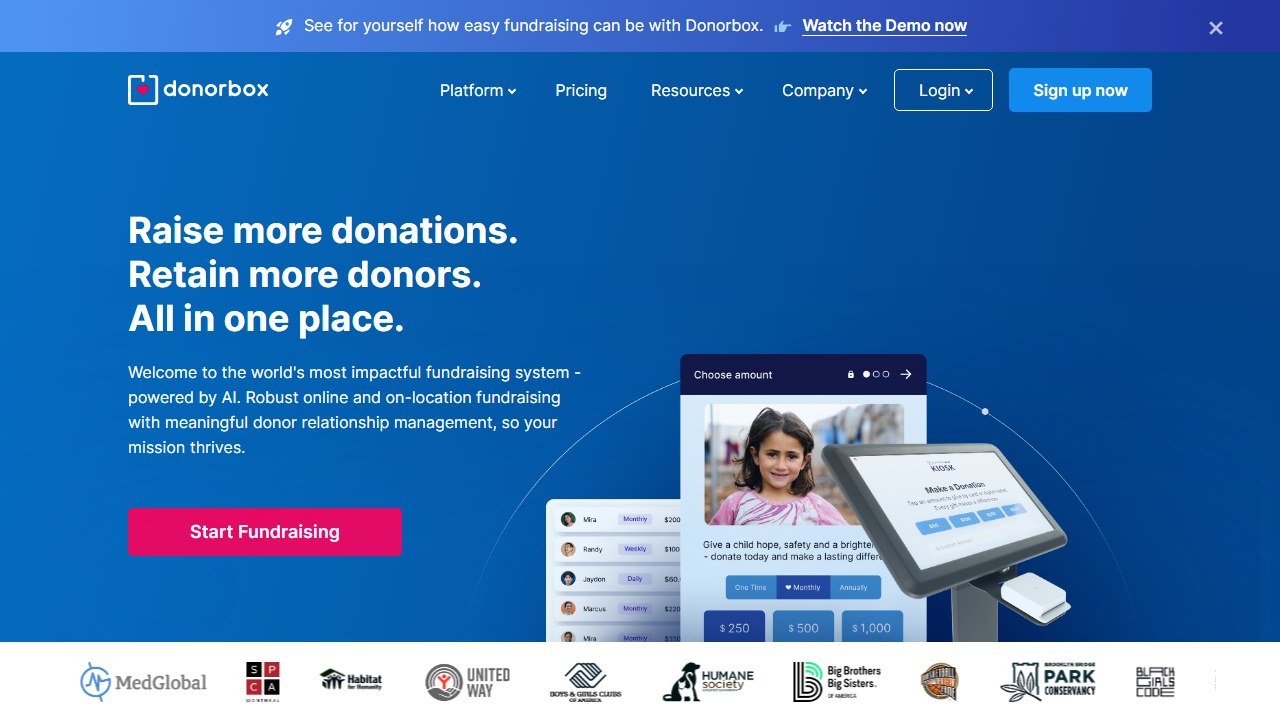
Website: Donorbox
Setup speed: 9/10. The basic donation page can be live in 60 to 90 minutes including theming. No engineering work required.
Mobile conversion: 8/10. The donation form is one of the better mobile experiences in the sub-enterprise tier. Not as optimized as Fundraise Up, but materially better than the all-in-one platforms.
Recurring giving: 8/10. The flow works cleanly, the donor-managed update portal is solid, and card-expiry handling is competent. Retention features are basic compared to enterprise tools.
Fee structure: 7/10. Transparent and accessible at low volumes, but the 1.5-1.75 percent platform fee on top of payment processing becomes meaningful as giving volumes climb.
Integrations: 9/10. WordPress plugin is the category-leading nonprofit integration. Squarespace, Wix, and Webflow all work cleanly. CRM sync to Bloomerang, Salesforce NPSP, and Mailchimp is reliable.
Disclosure: Zilwaris, the consultancy run by AI Tools Bakery’s founder, does paid advisory work for Gratefully, which did not pay for any placement on this page and is assessed on the same criteria as everything else on this site.
That sync line matters more than it looks. Donorbox takes the money; the relationship ends up in Bloomerang or Salesforce, and that is where it either gets worked or quietly rots. Both of those are platforms Gratefully sits on, which is the reason it comes up in a Donorbox review at all: it is not an alternative to Donorbox, it is the layer that acts on the data Donorbox delivers into your CRM. Read our donor intelligence guide for how that category works.
Customer support: 7/10. Email-based, generally responsive, occasionally slow during peak fundraising seasons.
Overall (research-based): 4.2 / 5
What Donorbox actually does well
The category Donorbox dominates is the small-to-mid nonprofit who wants modern fundraising features without enterprise pricing or a long implementation. Three specific strengths are worth calling out.
The donation form is the cleanest in its price tier. The default forms convert at rates that match or beat platforms charging double the fees. The optional embedded button (Donorbox calls this “popup” mode) is particularly good for organizations whose website is otherwise text-heavy. It catches the reader on the existing page rather than redirecting away.
The recurring-giving flow is genuinely good. Setting up monthly giving takes the donor three clicks. The default-to-monthly nudge on the donation form is configurable, and the analytics on recurring conversion are exposed cleanly in the dashboard. Recurring donors are the single most valuable asset for any small nonprofit, and Donorbox treats this part of the product as central rather than as an afterthought.
The website integrations are best in class for the price. The WordPress plugin is the most-used nonprofit donation plugin in the world for a reason. Squarespace and Wix integration is via simple embed code and works cleanly across themes. If your organization is on any of these platforms, getting Donorbox live is significantly faster than any competitor.
Where Donorbox falls short
The platform fee structure scales linearly with donation volume, which becomes a real cost issue at higher giving levels. On the Premium tier (1.75 percent platform fee plus payment processing), a nonprofit raising $500K annually pays roughly $8,750 in Donorbox fees alone. At $1M annual giving, that climbs to $17,500. At those volumes, Fundraise Up’s documented conversion lift or a custom Stripe integration with a developer-built donation page typically pays for itself.
The AI features are minimal. Donorbox has not invested heavily in AI-driven donation optimization the way Fundraise Up has. If your priority is squeezing every percentage point out of your existing traffic, this is a real gap. For organizations whose primary bottleneck is donor acquisition rather than conversion optimization on existing traffic, the gap matters less.
The peer-to-peer fundraising features exist but are not category-leading. If your organization runs peer-to-peer campaigns as a core strategy (think national run/walk events or board challenge campaigns), Givebutter or Classy will serve you better. For occasional peer-to-peer alongside primary donation flow, Donorbox handles it.
Customer support is email-based. There is no phone support and no dedicated customer success manager at the standard tiers. For small organizations, this is fine. For organizations with complex setups or urgent issues during peak fundraising weeks, the response times can be frustrating.
Donorbox pricing in 2026: the full math
Donorbox publishes its pricing, which is more than most competitors do. It has also restructured, and the plan you may remember as Premium at $25 a month does not exist any more. Read from donorbox.org/pricing on 4 September 2026:
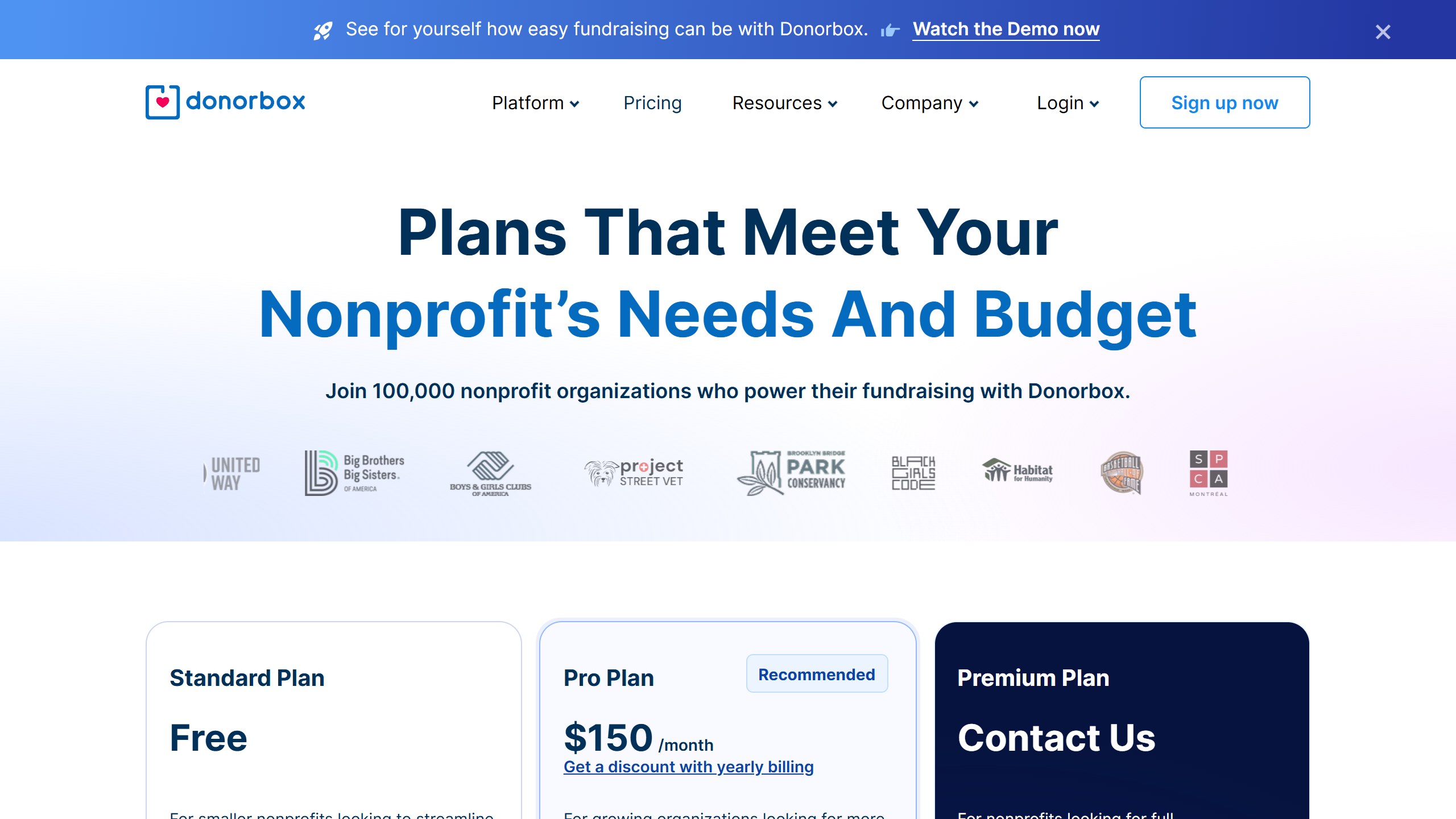
Standard: free, no monthly fee. Donorbox states fees between 2.95 and 3.95 percent.
Pro: $150 a month, with a discount for yearly billing that Donorbox does not publish a figure for. Fees between 1.75 and 2 percent. Adds advanced form customisation, tracking and analytics, receipt whitelabeling, Zapier and API, crypto and stock donations, recurring donation upsell, and their Jay AI assistant.
Premium: price not published, contact only. Fees between 1.6 and 2 percent.
Two things about those ranges. Donorbox presents them as combined platform and processing fees rather than splitting the two, so where you land inside a band depends on payment method and gift size. And an earlier version of this review described a $25 a month Premium tier sitting on a free plan with a 1.5 percent platform fee. Neither exists now, so we have withdrawn that math rather than carry it forward.
The way to think about it. On Standard you pay between 2.95 and 3.95 percent of everything you raise and nothing else. On Pro you pay $1,800 a year, less if billed yearly, plus between 1.75 and 2 percent. Pro pays for itself somewhere between roughly $82,000 and $189,000 raised a year, depending on where each plan lands you inside its band. Under $80,000, Standard. Over $200,000, Pro is almost certainly cheaper. In between, the answer turns on your payment mix, and Donorbox does not publish enough for us to settle it for you.
Donorbox vs the alternatives
The three platforms most often compared against Donorbox in 2026 are Givebutter, Fundraise Up, and direct Stripe integration. Quick honest takes:
Donorbox vs Givebutter: Givebutter’s freemium model is genuinely free at low volumes (Givebutter monetizes via optional donor tips), making it the lowest-cost choice for organizations under $100K annual giving. Donorbox is more polished and has better integrations at scale. The right choice depends on your website setup. If you have WordPress and want a fast, clean integration, Donorbox. If you are website-agnostic and want the lowest fees, Givebutter. We cover this in more depth in our Givebutter vs Fundraise Up comparison.
Donorbox vs Fundraise Up: Fundraise Up’s AI conversion optimization produces a documented 30 to 50 percent lift in donation conversion on sites with substantial traffic. For organizations raising over $500K annually, this lift typically pays for the higher fees. For smaller organizations, the lift is real but the absolute dollar impact is smaller and the implementation lift is higher.
Donorbox vs custom Stripe: For technically capable organizations with developer resources, a custom Stripe integration is the lowest-cost path at high volumes. The trade-off is months of engineering and ongoing maintenance. Worth considering above $2M annual giving. Not worth considering for most small nonprofits.
Who should buy Donorbox in 2026
Buy if: You are a small or mid-sized nonprofit (under $500K annual giving). Your website is on WordPress, Squarespace, Wix, or Webflow. You want a clean donation experience without engineering work. You value recurring giving as a strategy. You are not optimization-obsessed about conversion rate.
Consider alternatives if: You are raising over $500K annually and conversion-rate optimization is a strategic priority. You have substantial peer-to-peer fundraising needs. You are on a CMS Donorbox does not natively integrate with. You want enterprise features like custom donor journeys, advanced segmentation, or dedicated CSM.
What the donor actually experiences on a Donorbox page
Pretend you are a first-time donor landing on a nonprofit’s site. You click the donation button. A Donorbox modal opens (or you are redirected to a hosted page, depending on configuration). The default amounts are displayed with the suggested gift highlighted. A small toggle reads “Make this monthly.” Underneath, payment options: card, ACH, PayPal, Apple Pay, Google Pay. You enter your email and card, click donate, see a confirmation screen with a personalized thank-you, then receive a tax-deductible receipt via email within seconds. The whole flow takes under 90 seconds on mobile.
Three subtle things matter in this experience. The tip prompt is opt-out, not opt-in (donors must uncheck to skip the tip to Donorbox itself, which monetizes the free tier). The recurring toggle is configurable by the nonprofit; setting “monthly” as default lifts recurring conversion by roughly 15-25 percent on the orgs I have observed. And the confirmation page can be customized to include video, social share buttons, or a next-action prompt for stewardship continuation.
The trade-off worth knowing: the default tip prompt has been a quiet point of donor confusion in 2024-2025. Donors occasionally complain that they did not realize they were tipping Donorbox on top of their gift to the charity. Some nonprofits disable the tip prompt entirely (configurable in dashboard settings) for transparency. If you keep it on, communicate clearly in donor stewardship that the platform fee is separate from your mission funding.
Donorbox pricing math at three nonprofit scales
Donorbox publishes fee ranges rather than a single rate, and presents platform and processing together. Where you land inside a band depends on payment mix and gift size, so every figure below is a range rather than a point. All of it is arithmetic on the rates published on 4 September 2026, with Pro costed at $1,800 for twelve months at the published $150.
At $100,000 annual giving
On Standard, fees of $2,950 to $3,950, and you keep $96,050 to $97,050. On Pro, fees of $1,750 to $2,000 plus the $1,800 subscription, so $3,550 to $3,800. The two plans are close enough here that the decision should be made on features, not price.
At $500,000 annual giving
On Standard, $14,750 to $19,750. On Pro, $8,750 to $10,000 plus $1,800, so $10,550 to $11,800. Pro is cheaper by roughly $4,000 to $8,000 a year, and the gap widens from here.
At $1,000,000 annual giving
On Standard, $29,500 to $39,500. On Pro, $19,300 to $21,800, a saving of roughly $10,000 to $18,000. This is also where the Premium plan and its 1.6 to 2 percent band is worth the call, and where Fundraise Up becomes a serious comparison: it is charged differently, and at this traffic level its conversion optimisation has a real chance of paying for itself.
Donorbox recurring giving deep dive
Recurring donors are the single most valuable asset for any small or mid-size nonprofit. Donorbox treats this as a first-class feature rather than an afterthought, and the implementation is genuinely good. Three specific features worth understanding.
The donor-managed update portal, a paid-plan feature, lets recurring donors log in via emailed magic link to update their card on file, change the gift amount or frequency, pause donations, or cancel without needing to email staff. This single feature reduces development team admin time by 3-5 hours per month for typical mid-size orgs and reduces involuntary churn from expired cards by 30-50 percent.
Card-expiry automation: Donorbox automatically attempts to update card details via the Stripe Customer Account Updater service before the expiry date hits. When that fails, donors receive a templated update email with a one-click link to refresh their card. This recovery flow saves roughly 10-20 percent of would-be lost recurring gifts on the orgs that enable it.
Frequency flexibility: weekly, monthly, quarterly, semi-annual, and annual frequencies are all supported. Most nonprofits over-index on monthly, but quarterly recurring can be the right choice for higher-capacity donors who prefer fewer transactions. The dashboard exposes frequency mix per cohort, which is useful for testing.
Migration paths to Donorbox from common alternatives
Most nonprofits picking Donorbox in 2026 are migrating from one of three existing setups. Quick honest take on each migration path.
From PayPal Giving Fund: Easy migration. Export your donor list and gift history from your records (PayPal Giving Fund does not export to your system natively; you usually have a parallel CRM tracking gifts). Set up Donorbox with PayPal as a payment option alongside card. Run both during a 30-day transition while you update your donor communications and website donate button. Full cutover within 60 days for most orgs.
From Stripe DIY (custom-built donation page): Surprisingly common at $500K-$5M orgs. Your Stripe customer records and recurring subscriptions can be linked into Donorbox via Stripe Connect. The donation page work is the bigger lift: rebuild the donation experience in Donorbox form builder. Plan for a 2-3 week migration including testing and donor communication.
From GoFundMe Charity (which sunset its nonprofit product): GoFundMe wound down its charity product in 2024-2025. Migration to Donorbox is straightforward but requires re-onboarding recurring donors (their payment methods cannot be transferred automatically). Plan for a recurring-donor re-engagement campaign with a 60 percent retention target as realistic.
One more thing: the category’s competitive dynamics
Donorbox is operating in an increasingly competitive donation platform category. Fundraise Up has been investing aggressively in conversion optimization. Givebutter has been growing the free-tier model. Stripe has been improving its direct-merchant tools for nonprofits comfortable with developer-grade setup. The pricing and feature pressure on Donorbox will continue through 2026-2027, which is good for nonprofit buyers but means the market position you sign up for today may shift in 18 months. Reevaluate your platform choice annually.
What we still cannot honestly assess
I have not personally run Donorbox at scale for a multi-year campaign as a nonprofit operator. This review is research-based: sourced from Donorbox’s public documentation, verified buyer reviews on G2 and Capterra, partner case studies, and field observation from EDs running the platform at sub-$1M nonprofits. The honest verdict reflects how Donorbox performs in those settings. Your specific results will vary based on your traffic patterns, donor segments, and integration choices. Run a 90-day pilot before treating any review (including this one) as definitive for your organization.
The honest Donorbox verdict for 2026
Donorbox remains the cleanest small-nonprofit fundraising platform in 2026. The free Standard plan covers most organizations under $100K annual revenue, where it costs about the same as Pro anyway. Pro at $150 a month starts paying for itself somewhere above $82,000 raised and is clearly cheaper past $200,000. The competitive moat is simplicity; competing platforms try to do more and end up overwhelming small-org volunteers. Buyer profile: any nonprofit under $500K annual revenue without a dedicated development director. Above that revenue level, more sophisticated platforms (Bloomerang, Fundraise Up) earn their higher price.
Where to go from here
If Donorbox is on your shortlist, the practical next steps are:
- Run a 60-day trial on a single campaign (the free tier makes this risk-free)
- Set up a basic donation form, an event registration, and a recurring-giving prompt
- Compare your conversion rate against your current platform if you have one
- Verify the WordPress/Squarespace/Wix integration works with your specific theme
- Confirm the all-in fee math against your annual giving volume
For broader context on the nonprofit fundraising tech stack, see our Best AI Fundraising Tools for Nonprofits guide and the Givebutter vs Fundraise Up comparison for the most-common platform decision.
Donorbox in 2026 is what the small-nonprofit fundraising space needed: an honest, transparent, integration-friendly donation platform that does the unglamorous things right. It is not flashy. It is not the conversion-rate champion. It is the tool that most organizations under $500K will get the most use out of for the least effort. That counts for a lot.
More AI tool guides worth reading: Funraise Review 2026, Classy and Keela Review 2026.
Reviewed by Faz at AIToolsBakery. Independent review, no payment received from Donorbox or any competitor. Pricing and feature data verified against Donorbox’s public documentation as of May 2026.
For the full cost breakdown, including what we could and could not verify, see our Donorbox pricing guide.

Written by
FazFaz is the founder of AIToolsBakery. Some tools here are tested hands on. Others are assessed from vendor documentation and pricing verified on the live page, and every review says which one it is. Sponsors can buy a position in a guide. They cannot buy the score, the criticism, or silence about a better option.
How we test and how we make money →