
If your reps sell on the phone all day, the “customer” they need to practice against is a voice that pushes back, interrupts, and goes cold. If your reps sell over Zoom and in the room, the customer they need is a face that folds its arms when the pitch drags. Hyperbound and Second Nature both build that customer with AI, but they build it for two different rooms.
This is not a case where one platform is good and the other is filler. Both are credible, enterprise-grade tools that sales orgs pay real money for. The honest answer to “which one wins” is that it depends on how your team sells, how big your team is, and whether you want to start today or run a procurement cycle. Below we compare them on pricing, roleplay depth, features, integrations, and fit, then give a final pick by buyer type.
At a glance
| Dimension | Hyperbound | Second Nature |
|---|---|---|
| Roleplay format | Audio-first calls (cold, warm, discovery) | 3D animated avatars, video-style |
| Free / self-serve plan | Yes, free tier with pre-built bots | No, enterprise-only |
| Custom bot setup | First bot in minutes, self-serve builder | Built with vendor during onboarding |
| Real-call scoring | Yes, scores live recorded calls | Focused on roleplay simulations |
| Adoption model | Rep-led practice, manager scorecards | Gamified leaderboards, L&D dashboards |
| Pricing | Free tier, then quote-based enterprise | Quote-based enterprise only |
| Best for | SDR/BDR and high-volume calling teams | Large multilingual, video-selling orgs |
What each one actually is
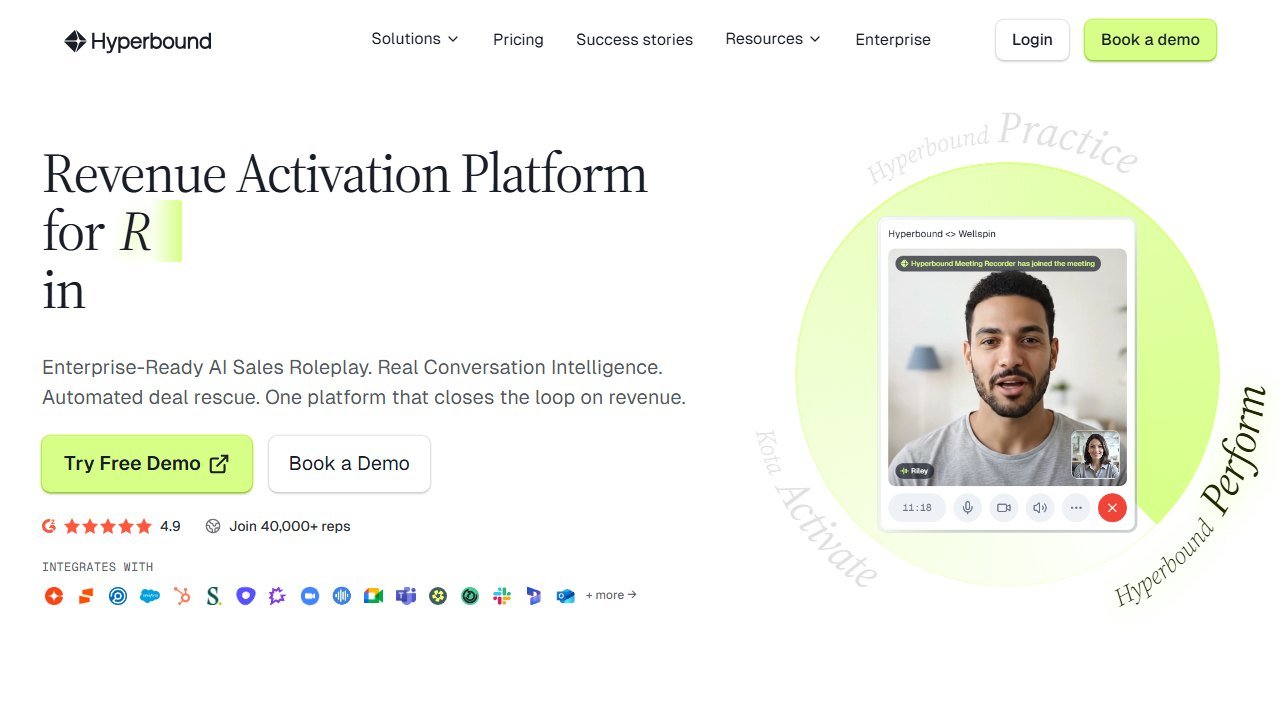
Hyperbound is an AI sales roleplay and call-scoring platform built around audio. A rep picks a scenario, dials into an AI buyer, and runs a cold call, warm call, or discovery call against a persona that talks back in real time. The buyers are trained on a very large corpus of real B2B sales conversations, so they do not read from a fixed script. They stall, object, and disengage the way real prospects do. On top of roleplay, Hyperbound scores real recorded calls against the same scorecards, which ties practice to live performance.
Second Nature is an AI sales training platform built around 3D animated avatars. A rep opens a scenario and holds a conversation with an on-screen avatar that has facial expressions and body language, and the avatar reacts visually as the conversation goes well or badly. It is sold as an enterprise L&D product, with manager dashboards, gamified scoring, and multilingual support, and it counts large global sales organizations among its customers. We cover it in depth in our Second Nature AI review.
Both belong in the wider category we map in our AI sales roleplay tools guide and our best AI roleplay tools for corporate training roundup.
Pricing
Neither platform makes pricing easy to pin down, but they differ in one way that matters a lot for smaller teams.
Hyperbound offers a genuine free tier. You get a set of pre-built roleplay bots with unlimited call time, full transcriptions, and AI coaching feedback, with no credit card required. That means a single rep or a small team can start practicing the same day without a contract. The real product, custom bots, custom scorecards, the bot builder, real-call scoring, and integrations, sits behind a quote-based enterprise plan. Public figures are not listed, so treat any number you see quoted elsewhere as an estimate and get your own quote rather than budgeting off a rumor.
Second Nature does not publish pricing at all and does not sell a self-serve plan. Every deal is a custom annual enterprise contract negotiated directly, typically with minimums that put it out of reach for very small teams. You will not get a price without a sales conversation, and the evaluation is oriented toward a buying committee rather than a quick trial.
Because both real products are quote-based, the useful question is not “what is the sticker price” but “what drives the quote.” For both vendors the number moves on a handful of levers. Seat count is the obvious one, since these are per-user platforms and the price per seat usually softens as the team gets larger. Contract length is another, because an annual or multi-year commitment tends to earn a better rate than a short term. The amount of custom build matters too. A library of bespoke personas, custom scorecards mapped to your own methodology, and integrations into your CRM and LMS all add professional-services and configuration weight, whereas leaning on pre-built content keeps the deal lean. On Second Nature specifically, the enterprise, L&D-led delivery model means onboarding and scenario-building support are baked into the engagement, which is part of what you are paying for. On Hyperbound, real-call scoring and heavier integration work are the pieces that push a free-tier user toward a paid enterprise agreement.
For ROI, think in terms of what the practice replaces and what it protects. The replacement math is straightforward. Structured roleplay compresses ramp time, so a rep who reaches quota-ready confidence a few weeks earlier is a few weeks of production you did not previously get. The protection math is about pipeline. Reps who rehearse objection handling and discovery before they dial tend to burn fewer live prospects while they are still learning, and in a phone-heavy motion those saved conversations are the scarcest resource you have. A sensible way to frame either quote is to divide the annual cost by your headcount, then ask whether that per-rep figure is smaller than the value of shaving a week or two off ramp and losing fewer early-stage deals to rookie mistakes. For most funded sales teams the honest answer is yes, but you should run that number against your own ramp cost and average deal size rather than accept a generic claim. Do not buy either tool on a promise of direct revenue lift you cannot measure. Buy it on faster ramp, more reps hitting the bar, and cleaner, more consistent live calls, then instrument those things so you can prove the return at renewal.
Net: if budget visibility or a low-friction start matters, Hyperbound has the clear edge because you can try it for nothing. If you are already running an enterprise procurement process, the lack of a public price is normal for both.
Roleplay depth and realism
This is where the “it depends” really bites, because the two platforms optimize for different senses.
Hyperbound optimizes for the ear. Its buyers are voice-first and trained on a huge volume of real calls, so the pushback, the awkward pauses, and the “we already use someone for that” brush-offs feel like the phone. For SDRs and BDRs grinding cold and discovery calls, that is exactly the muscle they need to build. The scenario building is where this depth shows. You can shape a buyer around a specific industry, seniority, and set of pain points, then dial in a personality so one persona is a rushed, skeptical VP who wants you off the phone in ten seconds while another is a friendly but non-committal manager who will happily chat and never commit. The AI persona realism comes from the fact that these buyers improvise. They interrupt mid-sentence, they change their mind, and they go cold if you talk too much, so a rep cannot memorize a winning path. Hyperbound also supports multiparty roleplays, letting a rep practice a call with more than one AI stakeholder at once, for example a champion and an economic buyer, which maps well to complex B2B deals where you are managing several people on one call. On feedback mechanics, a rep finishes a call and gets a scored breakdown against the rubric plus a full transcript, so the coaching is tied to specific moments rather than a vague grade, and because the same scorecard grades real calls the practice feedback speaks the same language as live feedback.
Second Nature optimizes for the eye. Its 3D avatars carry facial expressions and body language, so when a rep talks price too early or skips discovery, the avatar’s posture and expression shift. Scenario building here leans on the vendor-assisted model, so scenarios tend to arrive as polished modules that walk a rep through a structured conversation, which is a strength when you want a consistent curriculum rather than freeform improvisation. The AI persona realism is visual first. Seeing a “customer” frown, look bored, or nod along gives a video or in-person seller cues that an audio call cannot, and for pitch and demo practice that visual read is the whole point. On scoring and feedback mechanics, Second Nature grades the roleplay against the dimensions L&D cares about, such as whether the rep hit required talking points, handled the objection, and covered product knowledge, and it surfaces that as a score with review notes managers can inspect. The feedback is oriented toward completing a defined scenario well rather than surviving an unpredictable live-style call, which fits a training-program mindset more than a boiler-room one.
Neither is objectively more realistic. A phone team will find Hyperbound more realistic. A video-selling or field team will find Second Nature more realistic. Match the format to how your reps meet customers.
Custom scenarios and setup
Hyperbound is built for self-serve customization, and the setup effort is deliberately low at the start. You can turn an ICP description into a working AI buyer quickly, configure industry, seniority, pain points, and personality, and build a custom scorecard for your own methodology without writing anything technical. Standing up your first bot and scorecard is a same-session task, so a rev-ops or enablement lead can have something reps can use before the day is out. Building out a full library of personas, modules, and real-call scoring is a larger project that takes roughly two weeks of iteration on average, but the key point is that the work is front-loaded onto your own team rather than gated behind a vendor calendar. That autonomy cuts both ways. You move fast, but the quality of your scenarios depends on how much thought your team puts into them, so a rushed persona will feel shallow and a well-specified one will feel sharp.
Second Nature scenarios are typically built with the vendor during onboarding, in line with its enterprise, L&D-led model. That means less DIY speed and a longer runway to first use, but also more hands-on help shaping scenarios for a large, structured program, and less risk that a busy internal team ships thin content. If you have a dedicated enablement team that wants a partner to build a polished curriculum, that model fits and the upfront effort buys you consistency across a big org. If you want to move fast and iterate yourself between Monday and Wednesday, Hyperbound’s builder is the friendlier surface. The trade is real: vendor-built means slower but more guided, self-serve means faster but more on you.
Coaching, scoring, and analytics
Both platforms score reps against structured rubrics and give managers dashboards, but they draw the boundary of “what counts” differently.
Hyperbound scores both roleplays and real recorded calls against the same scorecards, so a manager can see whether the skill a rep drilled in practice actually shows up on live calls. That closed loop between rehearsal and reality is Hyperbound’s strongest analytics story, and it is the piece Second Nature does not directly replicate. In practice a manager can set a scorecard once, watch reps drill against it in roleplay, then pull the same rubric across the team’s live recorded calls and spot exactly where the practiced behavior is holding up or falling apart in the wild. The common critique of Hyperbound is that its analytics can feel activity-focused, counting calls run and scores hit, and do not always tie training cleanly to downstream revenue, so set expectations on what the numbers prove and pair them with your own pipeline data.
Second Nature’s scoring is oriented around the roleplay itself, graded on the dimensions L&D cares about such as discovery quality, objection handling, product knowledge, and closing technique, with rich manager review and adoption analytics. If your goal is a measurable, auditable training program that leadership can track, Second Nature’s dashboards are built for that reporting layer, and they make it easy to show completion, improvement over attempts, and participation across a large population. What they do not do is grade the live call, so the link between a strong roleplay score and a strong real conversation stays an inference rather than something the platform measures directly.
Integrations and languages
Both integrate with the enterprise sales stack, including CRM and LMS connections, so training data can flow into the systems your team already uses and completion or scoring records can live alongside the rest of your enablement reporting. The practical difference is setup ownership again. Hyperbound leans self-serve, so an admin can wire up the connectors that ship with their plan, while Second Nature’s integrations are usually stood up as part of the vendor-led onboarding. Either way, confirm the specific connectors you depend on during your own evaluation, since integration scope often varies by plan tier and the connector you assume is included may sit one tier up. If a single-sign-on provider, a particular CRM object, or an LMS standard is a hard requirement, put it in writing before you sign.
On language, both now support wide multilingual roleplay. Hyperbound advertises support across 25 or more languages, and Second Nature is built for multilingual enterprise teams as well. If you run a global sales org, either can handle non-English practice, so treat multilingual support as a checkbox both pass rather than a differentiator, and validate the exact languages and quality you need in a trial. Coverage counts are not the same as quality, so have a native speaker on your team run a scenario in each language you actually sell in and judge whether the buyer’s phrasing and the scoring hold up.
Adoption: getting reps to actually practice
The best roleplay platform is the one your reps open twice a week, so adoption mechanics matter as much as features.
Second Nature’s answer is gamification. Leaderboards, points, and visible progress turn practice into a competition, and that consistently lifts participation, which is why L&D teams like it for large rollouts where voluntary practice is otherwise a hard sell. When your core problem is getting hundreds of reps to rehearse at all, that motivational layer does real work and takes pressure off managers to chase people individually.
Hyperbound’s answer is lower friction. The free tier and fast builder mean reps and managers can start immediately, and real-call scoring gives reps a reason to keep using it because it grades the calls they are already making. For a self-driven or high-volume team, that is often enough, since the tool plugs into work reps already do rather than asking for a separate training ritual. For a large org where practice needs to be pushed top-down, Second Nature’s gamified layer does more of the motivational work for you.
For the broader playbook on driving adoption, see our guides on AI sales onboarding tools and AI sales training software.
Where each one is weaker
No honest comparison skips the limitations.
Hyperbound is audio-led, so if your reps need to rehearse on-camera presence and body language, the video experience is thinner than Second Nature’s. Its analytics can lean toward activity rather than proven revenue impact, and the deepest capabilities all sit behind the quote-based enterprise plan, so the free tier, useful as it is, is a starting point rather than the full product. And because so much of the setup is self-serve, the payoff depends on your team investing the time to build good scenarios.
Second Nature’s biggest limitation is access. There is no self-serve or free plan, so small teams and individual reps are shut out, and the enterprise-only model means a slower start and a heavier buying process. The vendor-led scenario building that helps large programs is the same thing that slows down a team that wants to iterate on its own. And because scoring lives inside the roleplay, you do not get Hyperbound’s direct link from practice to live calls. If you want to try before you commit, you cannot do it the way you can with Hyperbound.
A few questions come up on almost every buying call for these two, so it is worth answering them in the open. Buyers ask whether they can start small and grow, and the honest answer is that Hyperbound lets you do exactly that through its free tier while Second Nature expects an enterprise commitment from the outset. They ask which tool their managers will actually use, and that usually comes down to whether managers want live-call scoring, where Hyperbound leads, or a structured curriculum with leaderboards, where Second Nature leads. They ask how long until reps are practicing, and the split is same-day self-serve for Hyperbound versus a vendor-guided onboarding runway for Second Nature. They ask whether the AI will feel fake to a seasoned rep, and the fair answer is that both improve fast but you should have a skeptical senior rep test-drive a scenario before you decide, because that person’s reaction predicts adoption better than any feature list. Finally they ask how to justify the spend, and the answer is to tie it to ramp time and call quality you can measure, not to a revenue number the platform cannot prove on its own.
Final pick by buyer type
Choose Hyperbound if you run a high-volume calling team of SDRs, BDRs, or AEs who sell on the phone. Choose it if you want a free or low-friction start, a self-serve bot builder, and real-call scoring that connects practice to live performance. It is the better fit for smaller teams and for enablement leads who want to build and iterate scenarios themselves.
Choose Second Nature if you run a large, L&D-led sales org that sells over video or in person and needs polished 3D-avatar roleplay, gamified adoption, and enterprise reporting across a big multilingual team. Choose it when you have a dedicated enablement function and a procurement process, and when getting reps to practice is your core challenge, because the leaderboard mechanics do that work well.
If neither is a clean fit, browse the full field in our best AI roleplay tools for corporate training roundup, the AI sales roleplay tools guide, or start from the top with our best AI corporate training tools pillar. For a different head-to-head, see Mindtickle vs Yoodli.
Why the price you see may not be the price we saw
This deserves its own section because it affects several tools in this category and almost no comparison article accounts for it.
What we actually observed
When we read Synthesia’s pricing page on 4 September 2026, every plan figure was in rupees, because our captures run from an Indian IP address and the site served local pricing automatically. HeyGen went further: a request to heygen.com/pricing redirected to its /en-in/ locale even when we sent a United States language header, meaning the routing is by IP rather than by browser preference.
Why this breaks most price comparisons
An article quoting a single global figure for a geo-priced tool is describing one country’s rate card and presenting it as the price. Regional pricing is not usually a straight currency conversion either; vendors set local rates deliberately, so the ratio between two markets can differ considerably from the exchange rate. That means you cannot fix the problem by converting, and we do not attempt to.
How to check your own number in thirty seconds
Open the vendor’s pricing page yourself, from the country where the contract will sit, and look at the currency symbol before you look at the number. If the URL contains a locale segment such as /en-in/ or /en-gb/, you are on a regional page. Where a vendor offers a currency selector, note that changing it sometimes changes the plan structure and not merely the symbol.
What to ask when the contract is cross-border
If your company is registered in one country and the team is in another, ask which entity is billed, in which currency, and whether the rate is fixed for the term or moves with a published exchange rate. Ask whether taxes are included, because several vendors here publish figures excluding tax. These questions are dull and they are the difference between a budget that holds and one that drifts by a fifth.
Where the figures on this page come from
Every price here was read from the vendor’s own pricing page on 4 September 2026 and carries that date. Where a page served us regional pricing we say so rather than converting it, because regional rates are set deliberately and are not a currency conversion.
The pages we read
Yoodli publishes $8 and $20 a month billed annually plus a free tier. Colossyan publishes a free plan and Professional at $59 a month annually with $30 per additional member. HeyGen publishes $0, $29, $49 and $149 a month with team seats at $20. iSpring publishes $970, $1,290 and $720 USD per author per year. Deputy publishes $5, $6.50 and $9 per user per month excluding tax. Synthesia served us rupee pricing, reported as such above.
The ones that publish no figure
Second Nature, Hyperbound, Mindtickle, Highspot and Visier all declined to show us a price, and Allego publishes a pricing page with no currency figure on it at all. Articulate publishes only a limited-time offer, currently $1,198 per user per year against a struck-through $1,749. Treat any other figure for those seven as unverified.
What we do not do
We do not convert currencies, and we do not carry a figure we cannot source to the vendor. Where a number circulates and cannot be traced, we say so and withdraw it rather than repeating it with a hedge.

Written by
FazFaz is the founder of AIToolsBakery. Some tools here are tested hands on. Others are assessed from vendor documentation and pricing verified on the live page, and every review says which one it is. Sponsors can buy a position in a guide. They cannot buy the score, the criticism, or silence about a better option.
How we test and how we make money →