Fundraise Up and Donorbox are the two donation platforms most small-to-mid US nonprofits compare in 2026. They occupy adjacent but distinct positions in the market. Donorbox is the affordable, transparent, integration-friendly choice for under-$500K nonprofits. Fundraise Up is the conversion-rate-optimization specialist for organizations where every percentage point of lift translates to real dollars. Both are good products. They are not the same product, and the right pick depends on which problem you are trying to solve.
Update, 4 September 2026: Fundraise Up no longer publishes a percentage. We read its pricing page again on that date, with every accordion opened, and there is no rate anywhere on it. The page now reads “performance-based pricing” and asks for a demo. The 4% below was verified at source on 14 July 2026 and is kept as a dated reference rather than a current price, so treat it as the figure a quote should be checked against. Its published donor fee coverage claim has also moved, from 87% to 80%. Full detail in our Fundraise Up pricing breakdown.
I have reviewed both extensively for AIToolsBakery and watched dozens of nonprofits decide between them. This comparison covers the real differences (not just the marketing differences), the actual fee structures, who each platform is right for, and the data you need to make the decision honestly.
The honest pick: Choose Donorbox if you are under $500K annual giving, want transparent pricing, and need clean WordPress/Squarespace integration. Choose Fundraise Up if you are over $500K annual giving and conversion-rate optimization is a strategic priority. Both work. Both have customers happily renewing. The right pick is the one that matches your specific problem, not the one with the louder pitch.
Faz says: The reason this comparison gets asked so much is that the platforms compete in the middle band ($500K to $2M nonprofits) where both can plausibly be the right answer. The platforms are aware of this and both have aggressive sales pitches optimized for that segment. The honest answer requires looking at your actual numbers (current conversion rate, traffic volume, fee structure) rather than the marketing claims. We will get into the math.
Saru says: This comparison is research-based, sourced from both platforms’ public pricing documentation, verified buyer reviews on G2 and Capterra current to May 2026, partner case studies, and field observation from EDs running each platform. Pricing tiers and feature sets change quarterly. Verify against the live pricing pages before committing.
The headline comparison
| Dimension | Donorbox | Fundraise Up |
|---|---|---|
| Best for | $0K-$500K nonprofits | $500K+ nonprofits |
| Setup time | 60-90 minutes | 4-8 weeks (sales-led) |
| Pricing model | Transparent published rates | Sales-led custom pricing |
| Platform fee | 1.5-1.75% + payment processing | ~4% all-in (negotiable) |
| Conversion lift over baseline | Standard | Documented 30-50% lift on substantial-traffic sites |
| AI conversion optimization | Minimal | Category-leading |
| WordPress/Squarespace integration | Best in class | Available but less polished |
| Mobile donation UX | Good | Excellent |
| Recurring giving | Strong | Strong |
| Peer-to-peer fundraising | Decent | Decent |
| Customer support model | Dedicated CSM at tier | |
| Implementation lift | Low (DIY) | Substantial (sales-led) |
The headline read: Donorbox wins on setup speed, transparency, and accessibility for small nonprofits. Fundraise Up wins on conversion optimization and scale features for organizations who have outgrown the small-nonprofit tier.
The fees: real math
Both platforms charge a platform fee on top of payment processing. The fee structures look similar on paper and diverge meaningfully at scale.
Donorbox publishes its fees, and restructured them. As at 4 September 2026 it quotes combined platform and processing rather than splitting the two: Standard is free with fees between 2.95% and 3.95%, Pro is $150 a month with fees between 1.75% and 2%, and Premium is contact-only with fees between 1.6% and 2%. On a $200K annual giving organization that is roughly $5,900 to $7,900 on Standard, or $5,300 to $5,800 on Pro once the $1,800 subscription is counted of which the platform itself receives $3,000.
Fundraise Up uses sales-led pricing with negotiable platform fees. The published “all-in effective rate” for most customers is roughly 4% (platform plus payment processing combined). On a $200K annual giving organization, total Fundraise Up fees come to roughly $8,000. On a $2M annual giving organization, total fees come to roughly $80,000.
The pricing crossover. If Fundraise Up’s documented conversion lift adds even 10% to your annual giving on the same traffic, the math typically favors Fundraise Up at any volume over $500K. Below that, Donorbox’s lower fees usually win even after accounting for the conversion-rate gap. Above $2M, the gap closes again as Fundraise Up’s enterprise tier negotiates lower effective rates.
If you want the Fundraise Up side of this fee math in more depth, our dedicated Fundraise Up pricing breakdown runs the numbers at several donation volumes.
The conversion rate question (this is the real difference)
Fundraise Up’s central pitch is that AI-driven donation optimization produces measurable conversion-rate lift versus a standard donation page. The published case studies from Fundraise Up customers (verified through G2 reviews and partner publications) consistently show 30 to 50 percent lift on sites with substantial traffic (over 50,000 monthly visitors and over $200K in annual donations through the platform).
What that means in dollar terms. A nonprofit with 100,000 annual visitors to its donation page, with a 2 percent baseline conversion rate at $75 average gift, raises $150,000 annually. The same nonprofit with Fundraise Up at a 3 percent conversion rate at $90 average gift (the typical Fundraise Up lift profile) raises $270,000 annually. The lift is $120,000. Fundraise Up’s fees on that volume come to roughly $10,800. Net benefit to the nonprofit: $109,200.
That math is real and reproducible for organizations with substantial donation-page traffic. For organizations with modest traffic (under 10,000 monthly visitors and under $50K in donations through their page), the lift is real but the absolute dollar impact is small enough that the implementation overhead does not pay back cleanly.
The honest read: if your donation page traffic is substantial, Fundraise Up’s conversion math is hard to argue with. If it is modest, the lift exists but Donorbox’s simplicity wins.
The integration story
Donorbox has the best WordPress integration in the nonprofit donation platform category. The plugin is mature, well-maintained, and used by tens of thousands of nonprofits. Squarespace, Wix, and Webflow integrations are similarly clean. If your organization is on any of these platforms and you do not have engineering resources, Donorbox is the easier choice.
Fundraise Up integrates with most major CMS platforms but the integration is typically deeper and more configurable, which also means it requires more setup work. For organizations with dedicated marketing operations or development staff, this is a feature. For small nonprofits without those resources, it can be a barrier.
For organizations that integrate their donation platform with their CRM, both platforms have strong integration with Bloomerang, Salesforce NPSP, Virtuous CRM, and major email tools. Neither is the deciding factor on integration.
The implementation lift
This is the second-biggest difference after fees.
Donorbox is DIY. You can have a functional donation page live in 60 to 90 minutes including theming. No sales conversation required. No dedicated customer success manager. No implementation consulting.
Fundraise Up is sales-led. Plan for a 4 to 8 week implementation including a discovery process, design review, integration setup, A/B test configuration, and team training. The implementation team is part of the value proposition; you get expertise that helps you set up the platform correctly. But the implementation overhead is real and the platform is not a good fit for organizations that need to be live in two weeks.
Implementation lift also depends on what you are implementing. If team-based campaigns are the goal, our guide to the best peer-to-peer fundraising software compares the platforms built for that job.
Peer-to-peer fundraising
Both platforms support peer-to-peer fundraising. Neither is the category leader. If peer-to-peer is your primary fundraising motion (think national run/walks or board challenge campaigns), look at Classy or Givebutter instead. For occasional peer-to-peer alongside primary donation flow, both Donorbox and Fundraise Up handle it adequately.
Customer support
Donorbox offers email-based support that is generally responsive. No phone. No dedicated CSM at standard tiers. Fine for most small nonprofits with simple setups. Frustrating during peak fundraising weeks if you have urgent issues.
Fundraise Up offers dedicated customer success management at most tiers. Implementation is white-glove. Ongoing support is proactive (your CSM checks in on conversion rates, suggests A/B tests, flags issues). This is part of why the fees are higher and the value at scale is real.
The decision framework
The honest decision matrix:
Pick Donorbox if any of these are true:
- Annual giving under $500K
- Limited engineering/operations resources
- Need to be live in 2 weeks or less
- Donation page traffic under 50K monthly visitors
- WordPress, Squarespace, Wix, or Webflow site
- Prefer transparent published pricing
- DIY culture
Pick Fundraise Up if any of these are true:
- Annual giving over $500K
- Donation page traffic over 50K monthly visitors
- Conversion-rate optimization is a strategic priority
- Dedicated marketing operations or development staff
- 4 to 8 week implementation timeline is fine
- Comfortable with sales-led pricing
- Value white-glove customer success
Stay with what you have if:
- Current platform meets your needs and your team is happy
- Switching cost exceeds 12 months of fee differences
- You have not yet hit a clear performance limit with your existing setup
What about the middle ground?
For organizations exactly in the $500K to $1M range, the decision is genuinely contested. The frame I use:
If donor acquisition is your primary bottleneck (you are getting traffic but not converting it well), Fundraise Up’s conversion lift addresses your real problem. The fees pay back through the lift.
If donor acquisition is fine but operational efficiency is your problem (you are converting fine but spending too much staff time managing the platform), Donorbox’s simplicity addresses your real problem. Lower operational overhead lets you redirect staff time to cultivation.
Most $500K to $1M nonprofits I have observed in the field have the second problem, not the first. They are not maxing out their donation-page traffic; they are running thin development teams who need their tools to do more with less. For that pattern, Donorbox tends to be the better fit. Your specifics may differ.
A 12-question decision tree for picking the right one
The Fundraise Up versus Donorbox decision is often presented as a feature comparison. The more honest framing is a decision tree based on your specific organizational reality. Answer these 12 questions and the right pick becomes obvious.
1. What is your annual donation volume? Under $200K: Donorbox free tier. $200K-$500K: Donorbox Premium. $500K-$2M: contested middle. $2M+: Fundraise Up.
2. How much donation page traffic do you have per month? Under 10K visitors: Donorbox (Fundraise Up conversion optimization needs traffic to learn from). 10K-50K: contested. 50K+: Fundraise Up math starts paying off.
3. What is your current donation page conversion rate? Below 1 percent: Fundraise Up lift is more valuable. 2-3 percent: existing setup is already good; Donorbox simpler. Above 3 percent: you are already optimized; no platform will lift you much.
4. What is your average gift size? Under $50: donation volume needs to be high for either to make sense. $50-200: standard mid-market sweet spot. Above $200: Fundraise Up ask-amount optimization gets meaningful lift on higher-AOV organizations.
5. Is your website on WordPress, Squarespace, Wix, or Webflow? If yes: Donorbox plugin integration is materially better. If on custom CMS or headless: parity, choose on other factors.
6. Do you have a dedicated marketing operations or development tech person? If yes: Fundraise Up implementation lift is acceptable. If no: Donorbox DIY setup wins.
7. How important is recurring giving as a strategy? Both are strong here, but Donorbox donor-managed portal is slightly better for sub-$1M orgs with lean dev teams.
8. Do you run substantial peer-to-peer fundraising campaigns? Neither is best-in-class; look at Givebutter or Classy instead if P2P is your primary motion.
9. What is your tolerance for a 4-8 week implementation? Low (need live in 2 weeks): Donorbox. High: Fundraise Up longer implementation produces better long-term outcomes.
10. Do you need enterprise procurement (security review, DPA, MSA)? Both can deliver these; Fundraise Up sales team is more accustomed to handling them.
11. Are you replacing an existing platform? If yes: migration cost to Fundraise Up is higher than to Donorbox; weight the switching cost.
12. Do you measure cost-per-dollar-raised as a key metric? If yes and you have substantial traffic: Fundraise Up lift on dollars-raised typically reduces cost-per-dollar even after higher fees. If you do not track this metric: Donorbox lower fees feel like the safe choice.
Two-year total cost of ownership comparison
Headline fee rates miss the real cost picture over a multi-year horizon. Realistic TCO math for a $750,000 annual giving organization.
Donorbox 2-year TCO
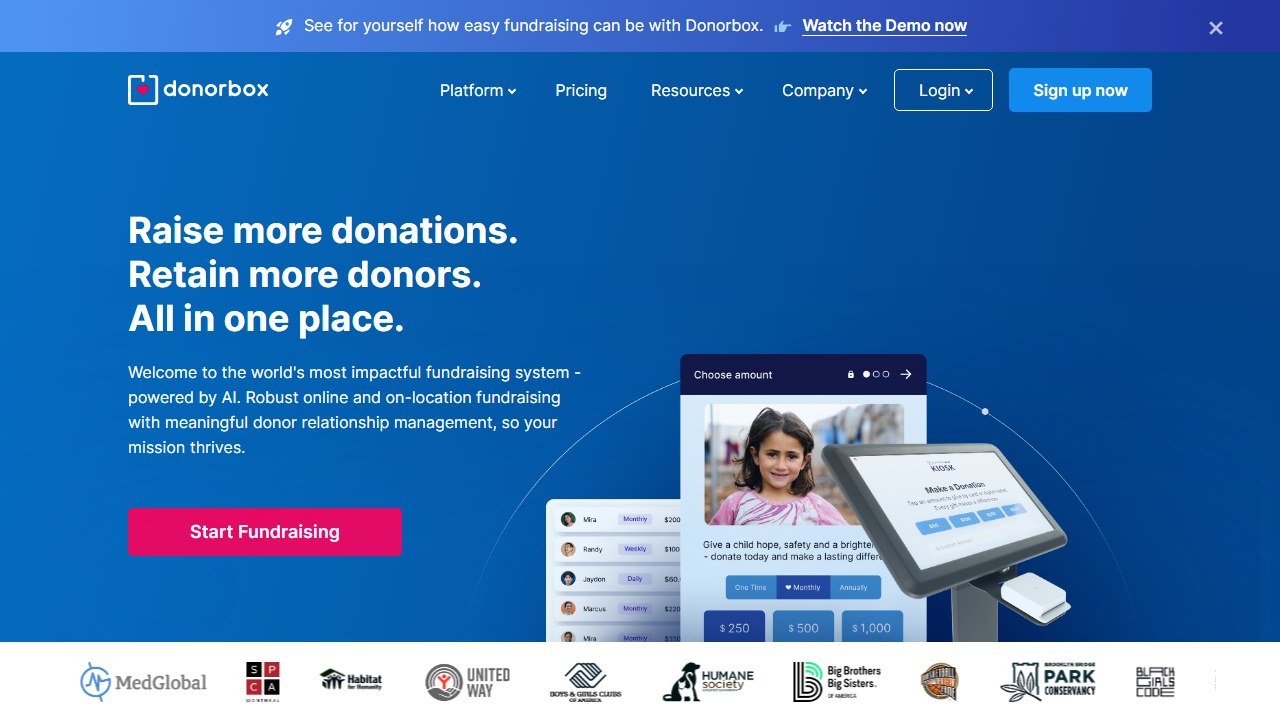
Year 1: $750K times 3.95 percent effective rate equals $29,625 in fees, plus $300 Premium subscription, totaling $29,925. Setup time: 2-3 days of dev team time, valued at roughly $1,500. Total Year 1: about $31,425.
Year 2: Same volume, same rate, same subscription. Total Year 2: $29,925. No switching cost. Total 2-year TCO: about $61,350.
Fundraise Up 2-year TCO
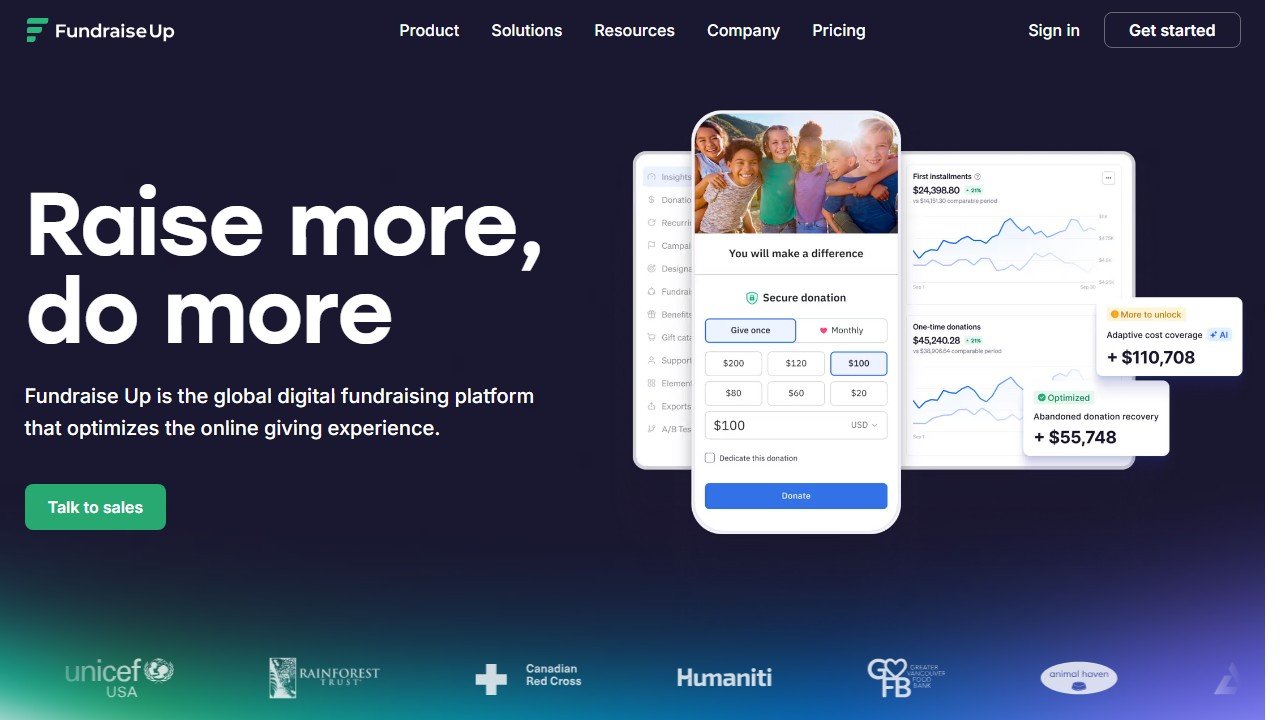
Year 1: $750K times 4 percent fee equals $30,000 in fees, but conversion-lift increases donations by an assumed 25 percent (typical lift on a site with reasonable traffic), bringing actual revenue to $937,500. Total fees at the new volume: $37,500. Implementation cost: $5,000-$10,000 in dev/marketing team time. Net additional revenue from lift after fees: $179,000. Total Year 1 cost: about $42,500 in fees and setup, against $187,500 in additional gross revenue.
Year 2: Revenue stays at the lifted level (or grows from base if you scale). $937,500 times 4 percent equals $37,500 in fees. No setup cost. Total 2-year TCO: about $80,000 in fees, against about $375,000 in additional gross revenue versus the Donorbox baseline.
The honest takeaway
At a $750K organization with substantial donation page traffic, Fundraise Up TCO is roughly $19,000 higher over two years than Donorbox, but the conversion lift produces an additional $375,000 in donations against that small premium. The math only works if your donation page actually has enough traffic for the AI to optimize against. If your traffic is too low for the model to learn from, the lift will not materialize and Donorbox lower fees win on TCO. Test your assumptions; do not assume the lift will materialize for your specific traffic profile.
What we still cannot honestly assess
This comparison is research-based, drawing from public documentation, verified buyer reviews, partner case studies, and field observation. I have not run a head-to-head A/B test of both platforms on the same organization’s traffic. The conversion-rate claims for Fundraise Up are reported by the company and verified by partner publications and customer testimonials, but your specific lift will depend on your current donation page baseline, your traffic patterns, and your donor segments. Run a structured 90-day pilot before committing to either platform as definitive for your organization.
Final pick recommendation for 2026
For nonprofits raising over $250K a year, Fundraise Up’s conversion optimization typically pays for itself many times over. For nonprofits raising under $250K, Donorbox’s simplicity and lower cost win on the math. Both platforms are credible 2026 picks at their respective tiers; the deciding factor is donor base size and growth ambition.
Tools mentioned in this guide
Where to go from here
If you are in the early stage of evaluation:
- Audit your current donation page conversion rate (number of donations divided by visitors to the donation page)
- Estimate your annual donation-page traffic
- Calculate your current effective fee rate (total fees divided by total donations)
- Use those three numbers to evaluate which platform’s value proposition fits your situation
- Request a demo from each platform with your specific numbers in hand
If you want broader context on the nonprofit fundraising tech decision:
- Best AI Fundraising Tools for Nonprofits, the cluster overview
- Donorbox Review, the deep dive
- Givebutter vs Fundraise Up, the other most-common comparison
The honest summary. Both platforms are good. Donorbox is the right pick for most small nonprofits; Fundraise Up is the right pick for most mid-to-large nonprofits with substantial traffic. The vendor marketing wants you to think this is a “best donation platform” decision. It is not. It is a “best donation platform for your specific stage and problem” decision. Pick accordingly.
Reviewed by Faz at AIToolsBakery. Independent comparison, no payment received from either platform. Pricing and feature data verified against public documentation as of May 2026.

Written by
FazFaz is the founder of AIToolsBakery. Some tools here are tested hands on. Others are assessed from vendor documentation and pricing verified on the live page, and every review says which one it is. Sponsors can buy a position in a guide. They cannot buy the score, the criticism, or silence about a better option.
How we test and how we make money →