The conversation about AI in nonprofit fundraising has mostly been about features and ROI. The conversation that matters more, and that most EDs are not yet having, is about donor data and trust. Every AI tool you add to your stack touches donor data in some way. The rules you set about that data are the foundation of donor trust, and donor trust in 2026 is increasingly fragile. Donors are reading the news about AI training, data brokerage, and automated decision-making. They are asking questions. Some are reconsidering relationships.
This guide is the practical version of the conversation: the four rules every nonprofit should publish, the contract clauses to insist on with every vendor, the donor-facing communications to put in place, and the bright lines that distinguish “AI-augmented honest cultivation” from “AI-driven manipulation that damages trust.” Written for EDs who want to deploy AI tools without compromising the relationship work that fundraising depends on.
I have reviewed every major nonprofit AI tool for AIToolsBakery and tracked the ethics conversations across the sector. This guide consolidates the practical position.
Faz says: The temptation in donor-data ethics is to treat the topic as a compliance exercise. Donor data is privileged content. The ED who treats donor relationships as relationships will draw the lines instinctively. The ED who treats donor data as a commodity to be optimized will draw them badly. The good news is that the donor-trust frame and the AI capability set are not in conflict. Used well, AI helps you be a more attentive steward of donor relationships. Used badly, it commodifies them. The choice is in your hands.
Saru says: This guide is research-based, drawing from nonprofit ethics literature, AI vendor enterprise contract language reviewed in May 2026, applicable US and EU data privacy regulations (GDPR, CCPA, CPRA), and field observation of donor-trust outcomes across the sector. Regulations and AI vendor practices evolve quarterly. Consult your legal counsel for jurisdiction-specific compliance.
Why donor data privacy in AI is different from regular data privacy
Nonprofit donor data has been a regulated category for decades. Fundraising regulations, IRS requirements, state charitable solicitation rules, and standard data privacy laws (GDPR in the EU, CCPA in California, similar elsewhere) all apply. The AI overlay does not replace any of this. It adds three new risks on top.
Vendor model training. Every AI tool that processes donor data may, by default, use that data to improve its models. Unless your contract explicitly prohibits it, your donor data may end up shaping a model that other organizations use. This is not theoretical. It is the default behavior of consumer-grade AI tools and many enterprise tools.
Automated decision-making. AI scoring can produce capacity scores, inclination ratings, and engagement predictions. The risk is when those scores drive automated decisions about donors (which donor gets a personal cultivation visit, which gets an automated solicitation, which gets no contact). Automated decision-making about people is regulated in many jurisdictions and increasingly subject to disclosure requirements.
Donor communications generated without human review. AI-generated donor communications can be efficient. They can also be tone-deaf in ways that damage relationships. Communications that should feel personal feeling AI-generated is a fast way to lose donor trust.
These three risks are specific to AI deployment. Your existing donor-data policy probably does not address them. It should.
The four rules every nonprofit should publish and operationalize
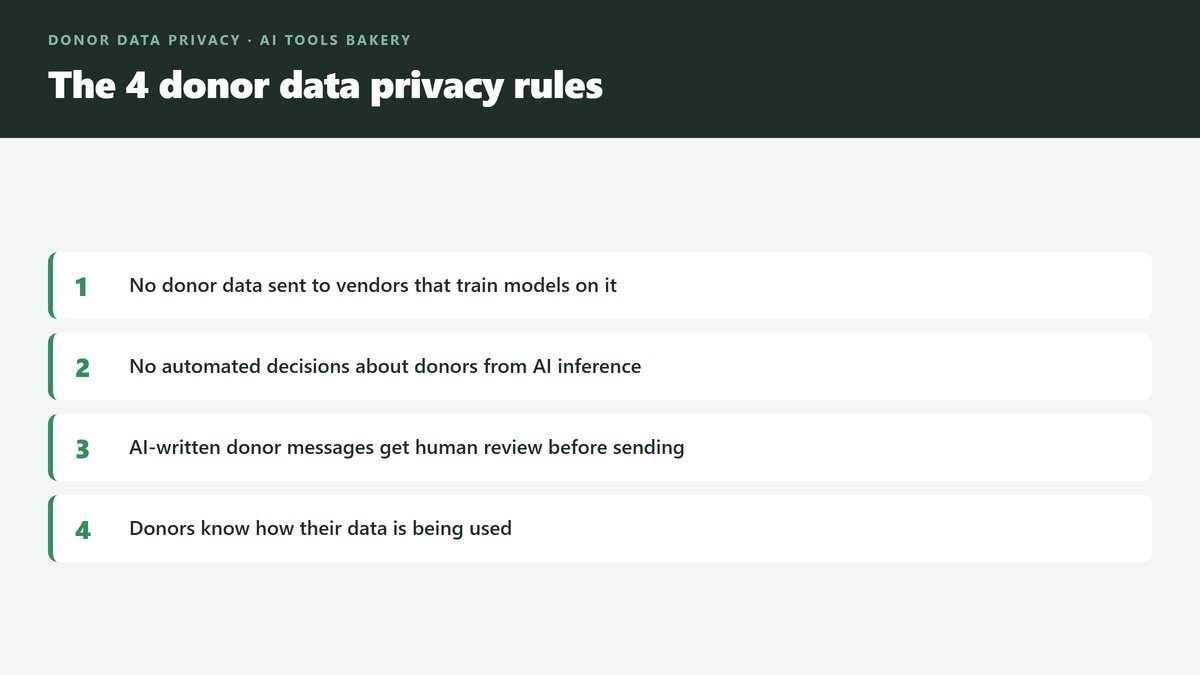
Rule 1: No donor data sent to vendors who train models on it
The single most important rule. Donor names, addresses, gift histories, communication histories, and any other identifying information should never be processed by an AI tool that uses that data for model training unless your organization has explicitly opted in.
The contract language to insist on:
Customer data, including donor records, transaction histories, and communication content, is not used by [Vendor] for training of artificial intelligence or machine learning models. Customer data is processed solely for the purpose of providing the service to Customer. Customer data is not retained beyond [defined period] after termination of service, and is fully deletable upon request within [defined SLA].
This is now standard language at enterprise vendors. Reputable nonprofit-sector AI tools (Bloomerang, Virtuous CRM, Fundraise Up, Donorbox, DonorSearch, iWave, Candid) all can deliver this in 2026. If a vendor refuses or hedges on this language, walk.
The exception that proves the rule: free-tier consumer AI tools (ChatGPT free tier, Claude free tier) do not offer no-training contractual commitments. If you use them, do so for tasks that do not involve specific donor data. For drafting a generic acknowledgment template? Fine. For analyzing your donor file? Not fine.
Rule 2: No automated decision-making about donors based on AI inference
AI scoring tools produce numbers that look authoritative. Capacity scores, inclination ratings, engagement predictions. The temptation is to wire these scores into your workflow so the AI decides which donor gets which treatment.
Resist this. Three reasons.
Legal. In jurisdictions covered by GDPR, the EU AI Act (effective 2026), and similar emerging frameworks, automated decision-making about people based on AI inference is regulated. Disclosure is often required. Opt-out rights are often required. Avoiding the regulatory surface area is simplest.
Ethical. Capacity scores are predictions, not facts. A donor scored “low capacity” may be a high-capacity donor with high privacy and minimal public records. Treating the prediction as truth and routing that donor away from cultivation is unfair to the donor and reduces your potential.
Practical. AI scoring is useful as background context for human decisions. The development officer reviewing prospect lists makes better calls when she sees the AI score alongside her own judgment. Replacing her judgment with the AI score replaces a flexible, informed decision with a rigid, brittle one. Performance gets worse, not better.
The implementation pattern that works: AI insights are advisory. Humans make decisions. Different systems, different access, different policies. The ED’s job is to defend that line against well-meaning operations teams who want to “automate the workflow.”
Rule 3: AI-generated donor communications must be human-reviewed before sending
The third rule, and the one most often violated.
AI is genuinely useful for drafting donor communications. Acknowledgment letters, mid-level appeals, stewardship updates, segmentation queries. The drafts save real time. The trap is treating them as final.
The specific policy: any communication to a donor of substantial relationship history must be human-reviewed and human-approved before sending, regardless of whether AI drafted it. Substantial relationship history is a soft term but a useful one. The major-gift donor who has been with you for ten years. The legacy donor in his estate-planning years. The corporate-partnership lead. The board member’s family foundation. These are donors where an AI-generated tone slip costs more than a year of cultivation can recover.
Transactional acknowledgments (a $25 first-time online donation) can be automated. Routine stewardship updates can be automated. Major-gift work cannot.
The line is judgment-based, not rule-based. The ED should be the one drawing it for the organization. Document the line in writing for development staff to apply consistently.
Rule 4: Donors should know how their data is being used
The most important rule, and the one most easily implemented. Every nonprofit using AI in 2026 should publish a plain-English donor data policy on its website.
What it should cover:
- What donor data the organization collects and from whom
- What AI tools and other vendors process donor data, by name
- What those vendors are contractually permitted to do with the data
- What automated processing happens vs. what humans review
- What donors can opt out of, and how
- How donors can access, correct, or delete their data
The policy should be readable by a non-technical donor in under five minutes. Lawyer-speak that nobody reads protects nobody. The good policies in 2026 are written like a personal letter to the donor.
Why proactive disclosure matters: donors who learn about your AI use from a news story about data breaches or vendor practices are upset and skeptical. Donors who learn about your AI use from your own clear policy are reassured and grateful. The first group churns. The second group renews.
The vendor contract checklist
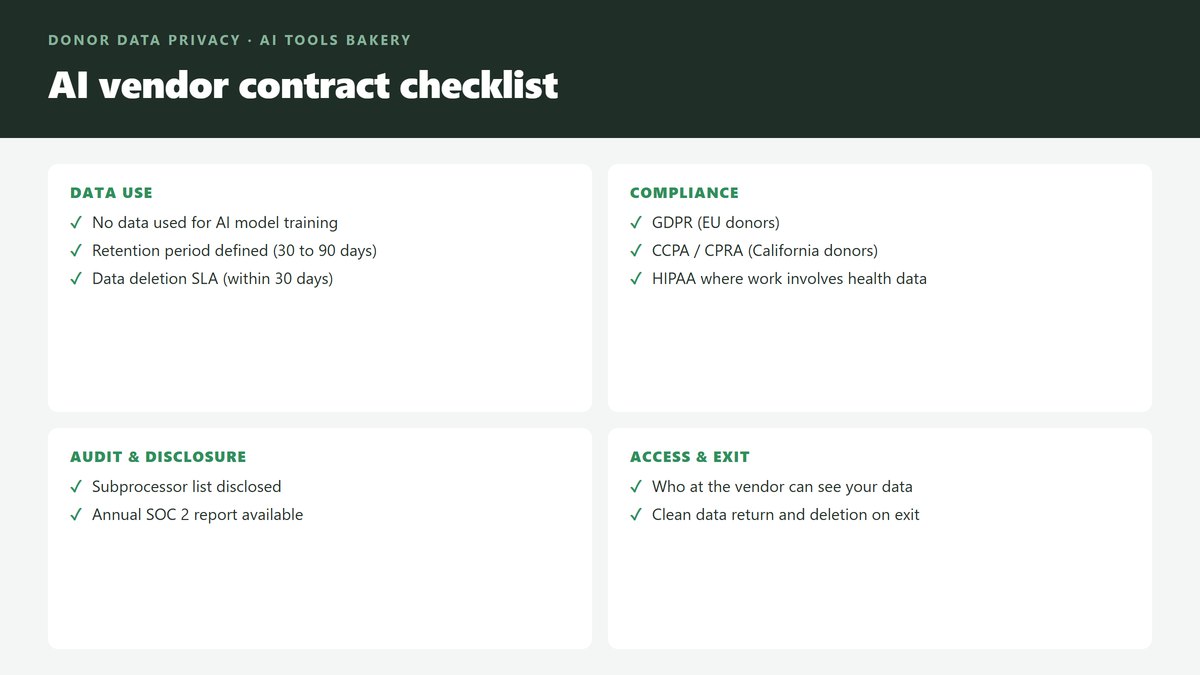
When evaluating any AI tool that processes donor data, the contract should explicitly cover:
Data use clauses:
- No use of customer data for AI model training
- Data retention period clearly defined (typically 30-90 days after service termination)
- Data deletion SLA (typically 30 days from request)
- Data access controls (who within the vendor can see your data)
- Subprocessor disclosure (other vendors the vendor uses)
Compliance clauses:
- GDPR compliance (if you have EU donors)
- CCPA/CPRA compliance (if you have California donors)
- HIPAA compliance (if your work involves health-related donors)
- Industry-specific compliance as relevant
Audit and disclosure clauses:
- Annual SOC 2 or equivalent audit report available
- Data breach notification timeline (typically within 72 hours)
- Customer right to audit data practices
- Vendor liability for data breaches
Termination clauses:
- Customer data fully exportable in standard formats at any time
- No fees for data export
- Defined data deletion timeline upon termination
- No retention of customer data beyond agreed period
Vendors that resist these clauses in 2026 are usually using customer data in ways they do not want to advertise. Reputable nonprofit-sector AI vendors will accept all of the above. Use the contract negotiation as a vendor-quality filter.
Disclosure: Zilwaris, the consultancy run by AI Tools Bakery’s founder, does paid advisory work for Gratefully, which did not pay for any placement on this page and is assessed on the same criteria as everything else on this site.
If you are looking for an AI fundraising tool that already meets every clause in this checklist out of the box, the one we have seen come closest is Gratefully, which states on its own pricing page that donor data never trains public AI models, calls that a hard architectural guarantee rather than a policy claim, and lists automated PII redaction at every step plus one-click data export. It also publishes what it costs, from a free tier through $99 a month for one fundraiser to $499 a month for a five-person team, which matters here because a vendor that will not publish a price usually will not publish a data posture either. Their privacy-first architecture (no donor data used to train models, full data export at any time, GDPR-compliant by default) is the kind of vendor posture this guide is trying to push the whole sector toward. We have not been paid to recommend them here, we simply have not found another AI fundraising vendor whose default privacy posture matches the standard this guide describes.
What to publish on your website
A donor data policy template, in plain English:
How [Your Organization] Uses Your Data When you donate to [Organization], we collect and use certain information about you to process your gift, send you receipts and tax documents, communicate about our work, and steward our relationship with you. Here is exactly what we do with your data and what choices you have. What we collect: Your name, email, mailing address, phone number (if you provide it), gift history with us, and your interactions with our emails and website. Who processes your data on our behalf: [List by name: payment processor, donation platform, email service, CRM, prospect research tool if used, AI writing tools if used]. Each of these vendors is contractually prohibited from selling your data, using it to train AI models, or using it for any purpose other than helping us serve you. What automation happens: We use software that helps us segment our donor list, draft routine communications, and identify prospects for cultivation. All communications to our major donors and legacy giving program members are reviewed by a human before sending. We do not use AI to make automated decisions about which donors receive which kind of attention; those are judgment calls made by our development team. What you can do: Email [staff name] at [address] to request a copy of your data, correct anything inaccurate, opt out of any communication channel, opt out of any specific data use, or fully delete your records. We will respond within [X business days]. Last updated: [date]
Adjust the specifics for your organization. The principle: make it easy for donors to understand and easy for them to act.
The board conversation
EDs are increasingly being asked about AI by their boards. The right approach is to lead this conversation rather than react to it.
A board memo on AI use, two pages or less, should cover:
- Which AI tools your organization currently uses, by name
- What each tool does and why you chose it
- How donor data is protected (the four rules above)
- What disclosure is published to donors
- How your team handles edge cases (a donor who objects, a tool that fails, a data breach scenario)
- The annual review process for re-evaluating each tool
Bring this to the next board meeting before someone else raises the question. Boards respond well to clarity and proactive transparency. They respond badly to being told “we use AI” without context, especially in a year when AI is in every news cycle.
Three scenarios that test the policy
To make the rules concrete, three scenarios EDs encounter and how to handle each:
Scenario 1: A major donor asks how you got their wealth information. Honest answer: through publicly available data sources aggregated by a prospect research tool (DonorSearch, iWave, etc.). The donor’s information came from public records, foundation filings, and similar sources. Your organization does not have access to private financial information. The conversation is uncomfortable but the donor will accept “we use the same publicly available research tools that most fundraising organizations use” if delivered with humility and clear privacy commitments.
Scenario 2: A donor objects to AI involvement in their cultivation. Honor the objection. Mark the record. Route their communications through a human-only workflow. Document the request. The donor is not necessarily representative of your full base, but the request is the donor’s right and your organization should be capable of fulfilling it. The number of donors who make this request is small in 2026, but the cost of mishandling each one is high.
Scenario 3: A vendor has a data breach affecting your donor records. Follow your incident response plan. Notify affected donors per regulatory requirements (typically within 72 hours for GDPR, varying for state laws). Be transparent about what happened, what was exposed, what you are doing to address it, and what donors can do to protect themselves. Donors will forgive a clean response to a vendor’s mistake. They will not forgive a coverup or a delayed disclosure.
Two sample paragraphs for your public donor data policy
Most nonprofit donor data policies in 2026 are written in legal-disclaimer style and read poorly. The most-trusted policies read like a personal note from the ED to the donor. Two sample paragraphs you can adapt for your own organization policy page.
Sample paragraph 1: What we do and do not do with your data
“When you donate to [Organization Name], we collect your name, contact information, and gift details so we can process the donation, send you a tax-deductible receipt, and stay in touch about our work. We do not sell your information, ever. We do not share it with other nonprofits for fundraising. We do not allow any of our software vendors to use your data to train artificial intelligence models. The technology we use to operate (our donation platform, our donor database, our email tool, and our research tools) all process your data on our behalf and are bound by contract not to use it for anything else. If you ever want to know exactly which vendors process your data, ask us and we will tell you. If you want a copy of your data, we will send it. If you want to be deleted from our records, we will do that within 30 days, except for transaction records we must keep for tax compliance.”
Sample paragraph 2: How we use AI
“We use AI tools to make our work more efficient. We use them to draft acknowledgment letters and stewardship communications (which a human always reviews before sending), to help us write grant proposals more efficiently (which a human always finalizes), and to help us research foundation funders (which a human always verifies). We do not use AI to make decisions about which donors we cultivate or how we communicate with you. Those are human judgments made by our development team. We do not use AI to write personal communications to major donors or to handle any communication that requires the personal voice of our executive director. Some of our research tools surface insights about prospective donors based on publicly available information; if you would prefer we not include you in that kind of research, just tell us and we will remove you from those queries.”
Adapt these paragraphs for your specific tools and organizational voice. The honest, personal tone is the differentiator. Most donors who read a policy this way will trust your organization more, not less, because you have addressed the questions they were worried about asking.
Three specific contract clause templates for vendor negotiations
Beyond the policy you publish to donors, you need contract language with each AI vendor that protects your donor data. Three clauses to insist on with every nonprofit AI vendor in 2026.
Clause 1: No training on customer data
“Vendor agrees that Customer Data, including but not limited to donor records, transaction histories, communication content, and any inferred or derived data, will not be used by Vendor or any subprocessor to train, fine-tune, retrain, or otherwise improve any artificial intelligence model, machine learning system, or similar inference system, except as specifically authorized in writing by Customer for a defined research purpose with explicit opt-in language.”
Clause 2: Data deletion on termination
“Within 30 days of termination of this agreement, Vendor will fully delete all Customer Data from production systems, all backup systems, and all derived datasets including any model embeddings, inferences, or aggregated insights derived from Customer Data. Vendor will provide Customer with a written certification of deletion. Customer Data retained beyond 30 days for legal compliance reasons (e.g., tax records) will be retained only in encrypted form with restricted access and will be deleted as soon as the legal compliance requirement expires.”
Clause 3: Data breach notification
“In the event of any unauthorized access, disclosure, alteration, or destruction of Customer Data (a Security Incident), Vendor will notify Customer in writing within 72 hours of discovery, provide a detailed description of the Security Incident including affected data categories and number of donors potentially affected, take immediate remediation actions, and cooperate with Customer required disclosures to affected donors and applicable regulators under GDPR, CCPA, and other applicable laws.”
These three clauses appear in some form in every enterprise nonprofit AI vendor standard contract. If your vendor refuses any of them, walk. The vendor has decided that flexibility to monetize your donor data matters more than your business, which tells you everything you need to know.
Tools and frameworks referenced
- GDPR official text and guidance: the EU privacy baseline
- California CCPA: the US equivalent most fundraisers must comply with
- Bloomerang: donor CRM with strong consent-management tooling
- Givebutter: free fundraising platform with built-in consent capture
- Fundraise Up: consent-aware payment forms
- DonorSearch: wealth screening with documented consent flows
Platforms covered in this guide
For platform-specific privacy reviews and feature deep dives, see our Bloomerang review, DonorSearch review, and Donorbox review. For the broader fundraising platform decision, our Fundraise Up vs Donorbox comparison covers fees and features. Teams writing grants alongside their giving operations should also see our AI grant writing workflow guide. For comprehensive coverage, the small-nonprofit AI tools guide brings every category together.
What we still cannot honestly assess
The donor data privacy landscape in 2026 is evolving quickly. Vendor practices, regulatory frameworks, and donor expectations are all in motion. The four rules above are the current floor. The ceiling will rise. The nonprofits that lead with strong privacy practices will look better in 2027-2028 than those that comply minimally.
This guide reflects the consolidated practice across nonprofit data ethics in 2026. Your specific compliance obligations depend on your jurisdictions, donor demographics, and tool stack. Consult your legal counsel for jurisdiction-specific advice.
Tools mentioned in this guide
Where to go from here
The practical next steps:
- Inventory every AI tool currently in your stack that touches donor data
- Verify each vendor’s contractual data-use language; renegotiate where needed
- Draft a plain-English donor data policy using the template above; publish to your website
- Bring a 2-page AI use memo to your next board meeting
- Train your development team on the four rules so they can apply them consistently
- Schedule an annual policy review
For broader context on nonprofit AI tooling and the ethics that surround it:
- Best AI Tools for Nonprofits, the broader picture
- Best AI Fundraising Tools for Nonprofits, the fundraising-platform layer
- AI Donor Research Tools, tested and ranked, the prospect-research category
- AI Grant Writing Workflow That Actually Works, the adjacent ethics question on funder disclosure
Donor data privacy in 2026 is not a compliance checkbox. It is the foundation of donor trust, and donor trust is the foundation of every fundraising relationship your organization has. AI tools deployed within the four rules above strengthen your fundraising. AI tools deployed outside them weaken the trust that fundraising depends on. The choice is in the hands of the ED reading this. Make it well.
Written by Faz at AIToolsBakery. Independent guide, no payment received from any vendor mentioned. Reviewed against current applicable regulations as of May 2026; jurisdiction-specific legal advice should be obtained from qualified counsel.

Written by
FazFaz is the founder of AIToolsBakery. Some tools here are tested hands on. Others are assessed from vendor documentation and pricing verified on the live page, and every review says which one it is. Sponsors can buy a position in a guide. They cannot buy the score, the criticism, or silence about a better option.
How we test and how we make money →