Quick answer: DonorSearch wins on traditional database depth, US wealth data, and bulk screening at scale. DonorAtlas wins on AI-native profile generation with cited sources and coverage of contemporary open-web signals. They solve different halves of major-gift research, and many larger nonprofits will end up wanting both: DonorSearch for bulk wealth screening, DonorAtlas for deep profile generation on the shortlist.
How we researched this comparison: we have not run hands-on trials of either platform. This assessment is based on both vendors’ websites and integration documentation, Blackbaud‘s marketplace listings, third-party coverage, and direct correspondence with DonorAtlas’s founder in July 2026, in which we verified DonorAtlas’s pricing structure, integrations, and company timeline. Facts are labeled by source and dated; pricing for both platforms is custom, so treat every figure here as directional and get current quotes.
DonorSearch wins for bulk wealth screening at scale, on 30-plus years of US wealth and property data and a broad CRM integration network. DonorAtlas wins for deep individual profiles, and for research teams who must defend an AI insight to a board, because every generated insight cites its source URL.
Scope note. Both tools on this page do the same job: finding capacity in names you do not currently hold. That is the right purchase when your list is genuinely worked out and someone is free to follow up new prospects. If the real problem is a long donor file nobody has time to work, neither one addresses it, and the category that does is donor intelligence. See best AI donor intelligence tools if that sounds closer to your situation.
DonorSearch vs DonorAtlas: how each is priced
| Dimension | DonorSearch | DonorAtlas |
|---|---|---|
| Pricing model | Custom annual license, quoted per organization | Custom annual contract, quoted per client’s needs and usage |
| Entry point | ~$5,000/year commonly reported for small nonprofit licenses (third-party reported, unverified) | Starting at $5,000/year (vendor-stated, July 2026) |
| Published price grid | No | No |
| Self-serve trial | No (demo via sales) | No (demo via sales) |
| Wealth screening (bulk) | ✅ Core use case, scales to large donor files | Not the core use case |
| AI profile generation | Limited (data points, not narrative) | ✅ Full AI-generated, source-cited profiles |
Both platforms are quote-only, so the honest budgeting guidance is the same for each: plan for an annual commitment in the thousands, and get a written quote for your actual portfolio size and seat count. An earlier version of this comparison described DonorAtlas as a roughly $200 per month per-seat subscription and ran crossover math against DonorSearch on that basis. That was wrong: DonorAtlas confirmed to us directly (July 2026) that pricing is custom per client, requires an annual contract, and starts at $5,000 per year. We have removed the per-seat math rather than replace it with new guesses.
Database depth: where DonorSearch wins
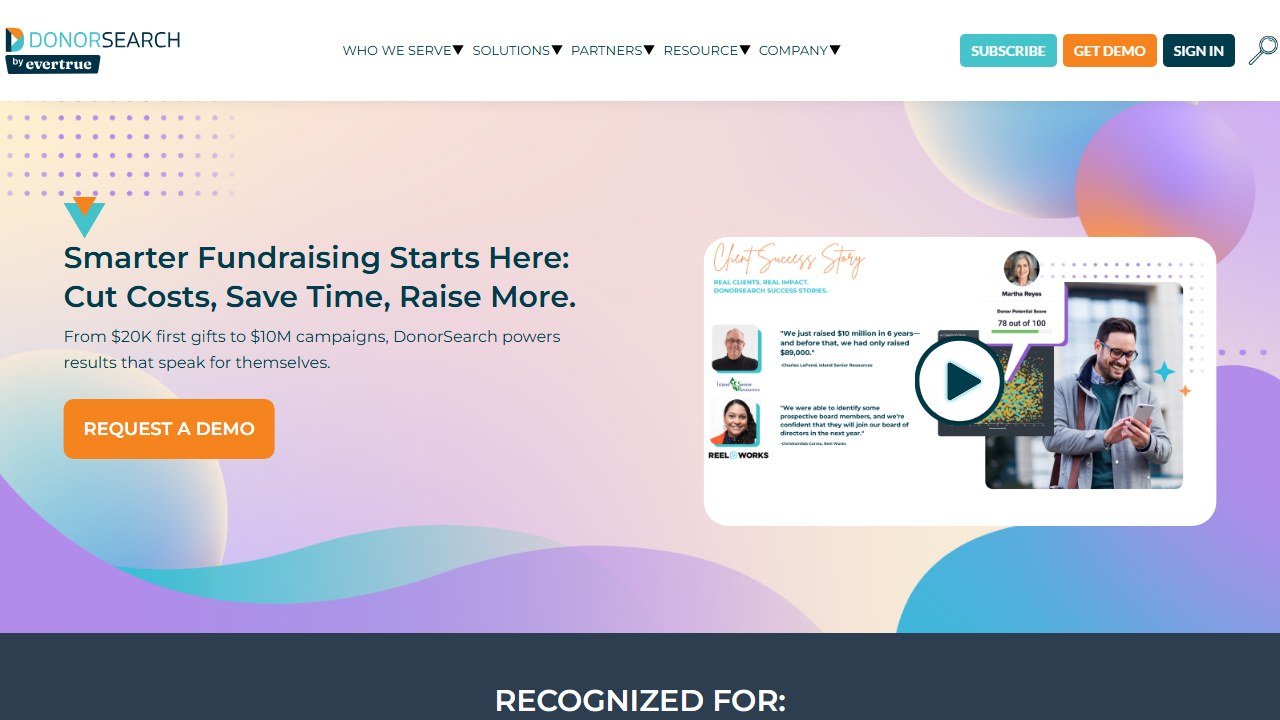
DonorSearch has 30+ years of US wealth, real estate, and charitable giving data. The depth shows up in three places:
US public-records wealth data: Property records, historical giving databases, and the long accumulation of US-specific wealth signals are the incumbent’s moat. For nonprofits whose major-gift research depends on real estate signals (typical for university capital campaigns and arts patrons), DonorSearch is the deeper source.
Bulk wealth screening: DonorSearch batch-screens large donor files in a single run, producing wealth scores, gift capacity estimates, and ranked prospect lists at scale. DonorAtlas is built for deep individual profiles, not bulk batch processing.
Breadth of CRM connectors: DonorSearch’s integration network has been accumulating across the nonprofit CRM landscape for years, a function of its age and market position.
AI features: where DonorAtlas wins
DonorAtlas was built AI-native from the ground up. The differences show up in three places:
AI profile generation: DonorAtlas generates narrative prospect profiles from open-web signals: news articles, business filings, foundation 990s, and public commitments. The vendor positions this as compressing an hour-class research task into minutes; we have not benchmarked it independently, but the workflow shift (researcher as verifier rather than gatherer) is the real story regardless of the exact multiplier.
Cited sources: Every AI-generated insight links to its source URL. When a researcher needs to defend a major-gift ask, the audit trail makes that conversation simple. DonorSearch surfaces data points without the same source-level trace on AI insights.
Contemporary signals: Recent business activity, foundation gifts, board changes, and public commitments, drawn from the open web rather than periodic public-records refreshes. This is where a scraping-first architecture naturally beats a records-first one.
CRM integrations: check the direction of the sync
An earlier version of this comparison claimed DonorAtlas offered only one-directional CRM sync. That was incorrect, and it mattered enough to correct prominently: DonorAtlas has bidirectional integrations with Blackbaud Raiser’s Edge NXT and Salesforce, per the vendor’s integration documentation and Blackbaud’s own marketplace listing (verified July 2026).
Raiser’s Edge NXT: Both platforms offer bidirectional sync. DonorSearch’s is longer-established; DonorAtlas’s is live and listed on the Blackbaud marketplace. For Raiser’s Edge shops, this is no longer a deciding gap between the two.
Salesforce Nonprofit Cloud: Both platforms have bidirectional Salesforce integrations. Either works for Salesforce shops.
Other nonprofit CRMs (Bloomerang, Virtuous, Neon One, DonorPerfect, Little Green Light): Integration depth varies by platform and changes quickly, especially on the DonorAtlas side as a young product adds connectors. Confirm your specific CRM, and the direction of the sync, in writing during evaluation rather than trusting any third-party table, including this one.
Company maturity: an honest asymmetry
DonorSearch has operated for decades and is now part of the EverTrue family. DonorAtlas was incorporated in December 2023, and its nonprofit product launched in spring 2025 (vendor-stated, July 2026). That asymmetry cuts predictably: DonorSearch offers institutional stability and a long reference-customer list; DonorAtlas offers the iteration speed of a young AI-native product. Neither is the wrong answer, but they are different risk profiles, and your organization’s tolerance for young vendors should be an explicit part of the decision.
DonorSearch vs DonorAtlas: who should pick what
Pick DonorSearch if: You are a large nonprofit with a dedicated research team and bulk screening needs. Your major-gift research relies heavily on US real estate or long-horizon giving history. You want the vendor with decades of reference customers.
Pick DonorAtlas if: Your research bottleneck is deep profile generation rather than bulk screening. You need cited sources to defend AI-driven research to your board or development directors. You are on Raiser’s Edge NXT or Salesforce and want an AI-native tool with two-way sync.
Consider both if: You run a serious major-gift operation where bulk screening builds the list and deep profiles work it. The screening-then-profiles stack is a natural pairing of the two platforms’ strengths, budget permitting; both are annual-contract products, so model the combined cost honestly before committing.
Capital campaign use case
Capital campaigns have specific research requirements: large prospect volumes, compressed timelines, and high stakes per prospect.
DonorSearch in capital campaigns: The strength is bulk wealth screening in the early “where should we even look” phase. Feed the donor file and suspect list into the screening engine, get ranked capacity estimates back at scale.
DonorAtlas in capital campaigns: The strength is rapid, source-cited profile generation on the shortlist that screening produced, on a timeline where manual research would require additional headcount.
What a $5,000 Annual Minimum Actually Commits You To
Both tools are quote-based, but the shapes of the commitments differ in a way that matters more than the headline number. DonorAtlas confirmed to us in July 2026 that its pricing is custom per client, requires an annual contract, and starts at $5,000 a year. There is no monthly plan and no self-serve trial.
Spread across twelve months that is about $417 a month, which sounds modest against a development budget. The catch is that you cannot pay it that way. You are committing the full year up front, before you have run a single real prospect list through the product, because there is no trial to run one through.
That inverts the normal evaluation order. With self-serve software you try it, then commit. Here you commit, then find out. The practical consequence is that your demo has to do the work a trial would normally do, so go into it with your own data: bring ten real prospects from your file, including two or three you already know well, and ask to see the profiles the system generates for them. If the output on donors you can personally verify is not obviously better than what your team produces today, the annual commitment is not defensible.
DonorSearch’s entry point is commonly reported at a similar level for small nonprofit licences, though we could not confirm that against a DonorSearch source and its pricing page did not resolve when we checked on 5 August 2026. Treat both as five-figure annual decisions and budget accordingly.
Which Commitment Fits Your Situation
Because both are annual, the question is not only which tool is better but which risk you can carry.
Pick DonorSearch if your need is durable. Wealth screening is a stable requirement. If you will still be screening prospects in three years, a mature vendor with a deep database is the lower-risk annual commitment, and the depth advantage is real.
Pick DonorAtlas if your need is specific and current. Its advantage is cited, auditable AI profiles, which pays off when a researcher has to defend a major-gift ask to a gift officer or a board. If that is a live problem for you this year, the commitment buys something the alternative does not.
Pick neither yet if you cannot articulate the ask. A five-figure annual contract for prospect research assumes you have the capacity to act on what it surfaces. If nobody currently owns following up on a qualified prospect, the tool will produce excellent research that nobody works, and you will have spent the year’s software budget discovering that. Fix the capacity first.
One honest asymmetry worth repeating: DonorAtlas is the younger product. That is not a reason to avoid it, but it does mean the annual commitment carries more product risk. Ask what happens to your contract and your data if the roadmap changes, and get the answer in writing before you sign.
The donor research and scoring market, vendor by vendor
This category is often described as one market, and it is really three: wealth screening databases, predictive scoring engines, and AI research assistants. They are bought for different reasons and priced on different meters. Here is where each alternative to both vendors actually sits.
Dataro, predictive scoring, and the only published price at the top of the market
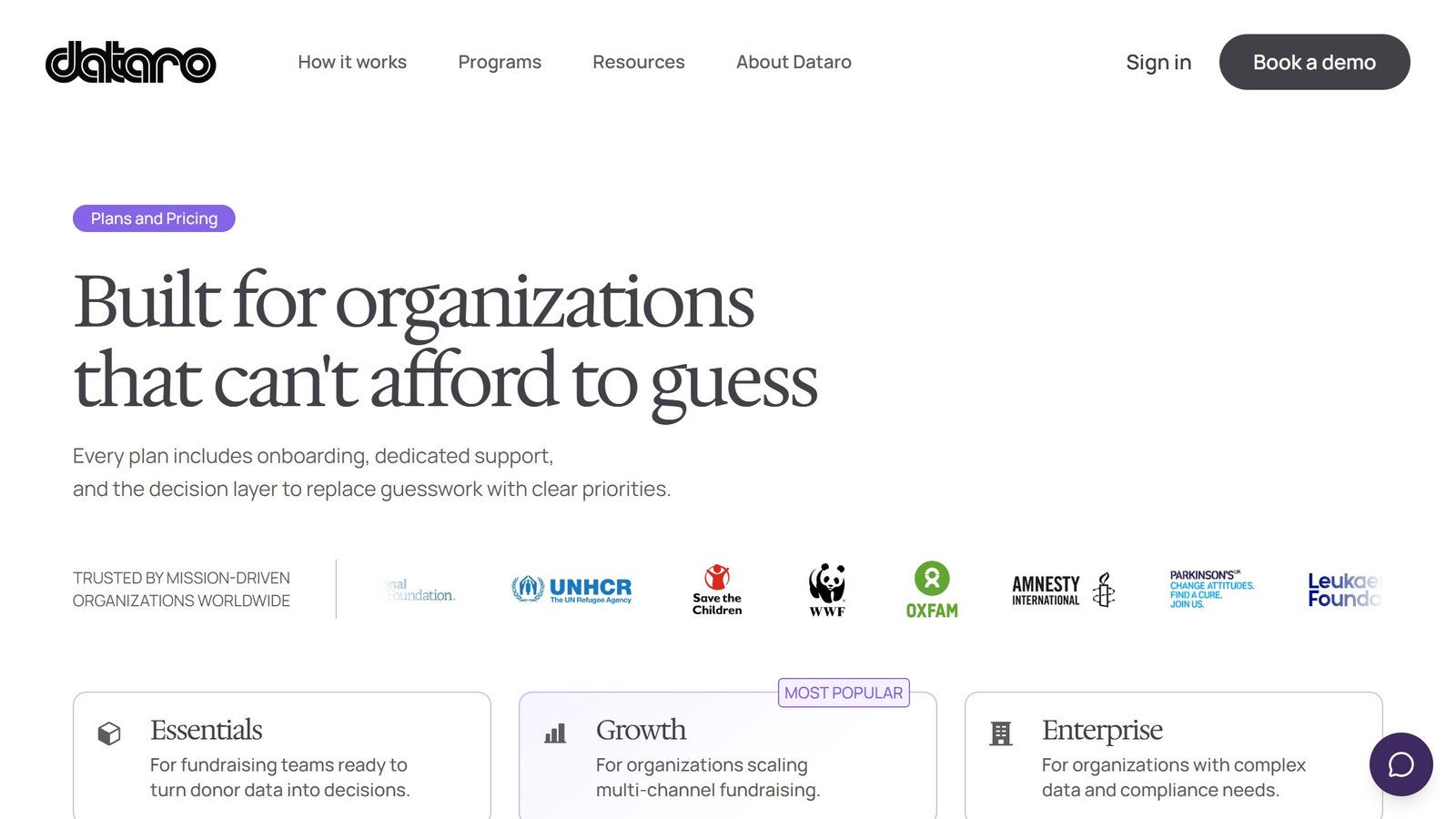
Dataro sells propensity and next best action scoring rather than research, and it publishes: Essentials from $15,000 a year plus ten cents per active donor, Growth from $25,000 plus twelve cents, Enterprise on request at fourteen cents. Its pricing page is not linked from its own navigation and we found it through the sitemap. Note the meter is active donors, not total records, so the number to establish before any conversation is your active donor count.
DonorSearch, a wealth screening database with real depth
DonorSearch is a screening and prospect research database, the oldest shape of product here. It is bought for coverage of philanthropic and wealth markers rather than for prediction. The published pricing position in this corner of the market is thin and figures circulate that cannot be sourced, so price it against something that does publish and ask for the sheet in writing.
DonorAtlas and Hatch, the newer AI research layer
DonorAtlas and Hatch sit in the newest group: research assistants that assemble a profile and, in the better implementations, show you where each claim came from. Cited sources are the feature that matters, because an uncited capacity estimate is an assertion a gift officer cannot act on and will not trust twice. Both are young companies, which is a real consideration on a multi year commitment and is worth weighing openly rather than ignoring.
What the three groups cost relative to a CRM
For scale, verified 4 September 2026: Little Green Light from $45 a month, Salesforce Nonprofit Cloud at $70 per user (as of 4 October 2026) with ten licences free, Bloomerang from $125, Keela from $164. Dataro’s floor is $15,000 a year. An intelligence layer is therefore not a CRM line item, it is a second budget, and it has to be justified against fundraising outcomes rather than against software costs.
Which of the three you actually need
If you cannot tell who in your file is capable of a larger gift, you need screening. If you know who is capable but not who is ready, you need scoring. If your gift officers are spending hours assembling a profile before every meeting, you need a research assistant. Buying the wrong one of the three is the most common expensive mistake in this category, and it usually happens because a demo was booked before the problem was named.
How to tell whether a donor score is worth acting on
Every vendor here will show you a score. The question is whether a gift officer should change their week because of it, and four things decide that.
Can it show its working
Ask the tool why a specific person scored the way they did, and look at whether the answer is a reason or a restatement. “High capacity indicators and recent engagement” is a restatement. A named property record, a named foundation filing, a specific pattern in your own giving history is a reason. Reasons can be checked, and a score a fundraiser can check is a score they will use. This is the single strongest predictor of adoption we see.
Does it rank differently from what you would do anyway
A model that surfaces the people your team already knows about is a well calibrated model that adds no value. Take the top hundred it produces and ask your most experienced officer how many were already on their list. If it is ninety, you have bought an expensive confirmation. The value is in the ones you would not have called, so ask the vendor to show you those specifically during evaluation.
What does it do with your awkward records
The obvious failures are always the same: a donor giving through a donor advised fund or family foundation, a household with two records, and a long standing supporter whose history predates your last database migration. Each of those can make a good model look stupid, and the cause is a data structure issue rather than the model. Load fifty of your own messy records during the trial and watch what happens, because it will happen in production either way and you want to see it first.
Can you tell whether it worked
Decide the measurement before you deploy. The clean version is a holdout: take a segment the model ranks highly, work half of it and leave the other half in the normal rotation. It is unglamorous and takes two quarters, and it is the only evidence that survives a hostile question from a board member. Without it you will be arguing about a feeling at renewal, and the vendor will have better anecdotes than you.
What you are actually signing, beyond the monthly figure
A published rate card tells you the list price. The contract decides what you pay, and four terms do most of the work.
Term length and the annual-billing discount
Nearly every figure quoted in this market, both vendors included, assumes annual billing. Monthly billing is routinely 20 to 30% higher, so the headline you compare against a rival may be a different commitment entirely. Check which basis each number is on before putting two of them in the same sentence, because vendors do not always label it.
Mid-term expansion, priced now or priced later
The band you cross, the seat you add, the module you switch on: agree what each costs before you sign, and specifically whether the discount you negotiated applies to anything added mid-term. It very often does not. Discovering that at the moment you need to grow is how a good first-year deal becomes an expensive second year.
The renewal cap is the term worth most and asked for least
At renewal the vendor knows your usage, your dependency and your switching cost, and in a market where most rivals publish nothing you have no rate card to anchor against. Blackbaud publishes no figures at all, and Virtuous publishes none while banding its tiers at $5 million in fundraising revenue. Against that, a capped uplift stated as a percentage is worth more than a larger first-year discount, and it is only negotiable while you still have a choice.
What happens to your data at the end
Ask what a full export contains, in what format, how long after termination you can request one, and whether live recurring gift schedules and their payment tokens transfer. Tokens are the ones that usually do not, and if they cannot move, every monthly donor has to re-enter card details and a share will not. Get the answer in writing during procurement, not during the exit.
Published does not mean fixed
Keela raised every band between late August and early September 2026, entry moving from $134 to $164, a rise of roughly 15 to 22% across the range in under two weeks. Neon retired an entire tier structure. A published price is a snapshot with a date on it, and if the figure you are comparing does not carry one, you do not know what you are looking at.
Where the figures on this page come from
Every price quoted here was read from the vendor’s own pricing page on 4 September 2026, not from an aggregator or a review site. That distinction matters more in this category than in most, because nonprofit software pricing changed materially over the past year and a great deal of what circulates online describes packaging that no longer exists.
The pages we read
Little Green Light publishes every constituent band from $45 a month. Salesforce Nonprofit Cloud publishes $70 per user per month (as of 4 October 2026) with ten licences free under Power of Us. Bloomerang publishes $125 a month for the CRM with other products priced separately. Keela publishes every contact band from $164 a month. Dataro publishes $15,000 a year plus ten cents per active donor on a page that is not linked from its own navigation. Blackbaud and Virtuous publish no figures at all.
What we do not do
We do not carry a figure we cannot source to the vendor. Where a number circulates widely and cannot be traced to a vendor page, we say so and withdraw it rather than repeating it with a hedge, and we have withdrawn our own published figures on that basis more than once. Where a vendor confirms an unpublished price directly to us, it is attributed as confirmed by the company rather than presented as a public rate.
Why every figure carries a date
Keela raised every band by roughly 15 to 22% in under two weeks in late August 2026. Neon retired an entire tier structure. A pricing claim without a verification date is not checkable, and in this market it is usually wrong within a year.
The verdict for 2026
DonorSearch and DonorAtlas are not really competing platforms in 2026. They are complementary tools serving different parts of the major-gift research workflow. DonorSearch is the deep US wealth database that handles bulk screening and historical data. DonorAtlas is the AI-native research engine that produces source-cited individual profiles. Both are custom-priced annual commitments, both are evaluated through sales demos rather than trials, and the right choice comes down to which half of the research job is your bottleneck.
For the broader category context, see our 5 best AI donor research tools guide. For dedicated reviews, see our DonorAtlas review and DonorSearch review. For other nonprofit research tools, our Hatch review covers the explainable-scoring alternative.

Written by
FazFaz is the founder of AIToolsBakery. Some tools here are tested hands on. Others are assessed from vendor documentation and pricing verified on the live page, and every review says which one it is. Sponsors can buy a position in a guide. They cannot buy the score, the criticism, or silence about a better option.
How we test and how we make money →