Quick answer: Dataro is the next-best-action AI for nonprofit fundraisers in 2026. Its models score your donor file and output ranked action lists: who to call, who to mail, who is at churn risk, who is ready for an upgrade ask. It is the right shape for fundraising teams that want daily action density rather than deep prospect research. The honest catch: published pricing starts at $15,000 per year plus a per-donor fee, which puts it firmly in mid-size and large nonprofit territory.
How we researched this review: we have not run a hands-on trial of Dataro. This assessment is based on the vendor’s website, published pricing and integrations pages (checked July 2026), Dataro’s own case studies, and third-party coverage of the AI fundraising category. Vendor claims are labeled as vendor-stated. We have not independently verified Dataro’s prediction accuracy or its case-study results.
Dataro scores 4.2/5 in our research-based assessment. Best for mid-size and large nonprofits running appeal, regular-giving and mid-level motions. Vendor-published pricing: Essentials from $15,000 a year plus $0.10 per active donor, Growth from $25,000 plus $0.12. No self-serve trial. Verified July 2026 against dataro.io.
What Dataro does well
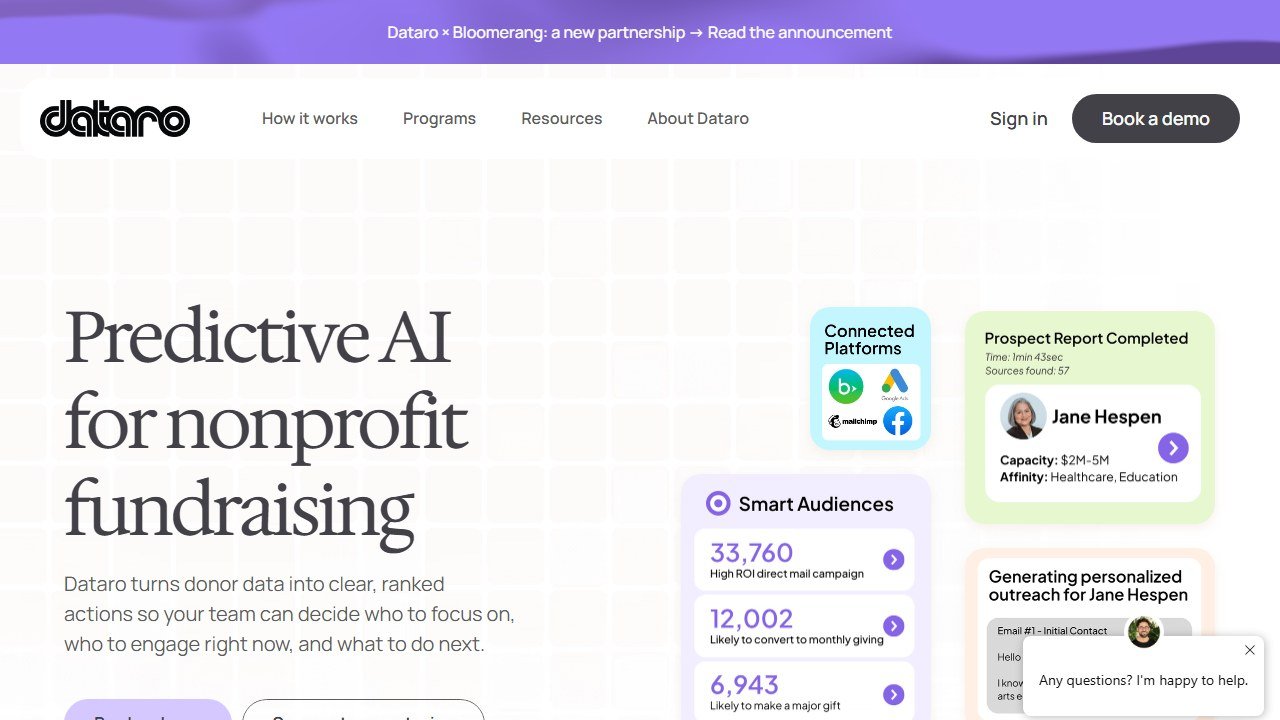
Website: Dataro
Next-best-action recommendations are the headline feature. Dataro’s models ingest your donor file, engagement history, and giving outcomes, then output propensity scores and ranked action lists: who to include in the next appeal, who is at churn risk, who is a candidate for an upgrade ask, which prospects deserve a call. The vendor describes the product as donor predictions, targeted audiences, intelligent reporting, and personalized content, with a ProspectAI module for prospect identification. The action-first framing is the differentiator versus DonorSearch (research-first) and Hatch (scoring-first).
The integration surface is broad. Per Dataro’s integrations page (July 2026), it connects with Blackbaud Raiser’s Edge NXT, Blackbaud CRM, Salesforce Nonprofit Success Pack and Nonprofit Cloud, Microsoft Dynamics, Virtuous, HubSpot, Donorfy, and ThankQ, plus marketing platforms (Mailchimp, Raisely, Facebook Ads, Google Ads) and data warehouses (Snowflake, Redshift, SQL Server). The pitch is that Dataro sits on top of the CRM you already run and pushes execution-ready audiences into the tools where campaigns actually happen. Confirm the exact sync direction and field mapping for your CRM on the demo call, since the vendor does not publish that level of detail.
The vendor’s case studies claim real revenue outcomes. Dataro’s site cites a 161% revenue increase from targeted appeals at Bristol & Weston, $489,612 raised with 8,000 fewer mailers at the Baker Institute, and 531 additional monthly donors retained through churn-risk outreach at Greenpeace (all vendor-stated, July 2026). These are marketing case studies, not independent audits, so treat them as the upper bound of what a well-run deployment can produce. The direction of the claims is credible: appeal targeting and churn prediction are exactly the problems propensity models are good at.
The workflow shape suits fundraisers, not analysts. Fundraisers consume ranked lists with a suggested action rather than learning a research platform, which keeps the learning curve light compared to research-heavy tools. The value shows up as removed decision overhead: less “who should I contact today,” more contacting.
What to weigh before buying
Profile depth is not the product. Dataro surfaces actions and scores, not deep individual prospect profiles. For researchers who need full background context on a prospect before contact, Dataro is the wrong shape. Pair it with a profile-generation tool like DonorAtlas for the full workflow.
The entry price is real money. Published pricing (July 2026) starts at $15,000 per year for Essentials plus $0.10 per active donor, with Growth from $25,000 per year plus $0.12 per active donor and Enterprise on custom quotes. Dataro’s own calculator estimates roughly $16,000 per year for an Essentials org with 10,000 active donors. Earlier third-party coverage (including a previous version of this review) described a roughly $450 per month entry point; that characterization was wrong and does not reflect how Dataro is priced today.
Explainability is thinner than Hatch’s. Dataro shows the predicted action and a propensity score, but the underlying signals driving a prediction are less transparent than Hatch’s score breakdown. For nonprofits with skeptical boards or development directors, that opacity can create AI-distrust friction.
The model loop needs outcome data. Like every propensity system, Dataro’s predictions are only as good as the outcome data flowing back from your CRM. Teams that let campaign results and gift outcomes go unlogged should expect prediction quality to drift. This is a property of the category, not a Dataro-specific defect, but it means the tool rewards operational discipline.
Dataro pricing breakdown 2026
Dataro publishes pricing on its website, which is refreshingly rare in this category. As of July 2026 (vendor-published, verify current figures on dataro.io before budgeting):
Essentials: from $15,000 per year plus $0.10 per active donor. The entry tier for organizations starting with predictions and targeted audiences.
Growth: from $25,000 per year plus $0.12 per active donor. Flagged by the vendor as the most popular tier.
Enterprise: custom pricing, talk to sales, with a $0.14 per active donor rate. For large institutions with complex data and integration needs.
The per-active-donor component means your database size drives the bill: the vendor’s own example puts an Essentials org with 10,000 active donors at roughly $16,000 per year, and notes the per-donor cost falls to as little as $0.25 per donor per year at 100,000 active donors. Contracts are annual. Get the calculator estimate in writing on the demo call, and ask exactly how “active donor” is defined for billing, since that definition is the whole bill.
Dataro vs DonorSearch vs DonorAtlas vs Hatch
DonorSearch wins on database depth and bulk wealth screening at scale. Dataro is action-first, DonorSearch is research-first. Large nonprofits often pair the two shapes: screening to build the file, action ranking to work it. See our DonorSearch review for the full breakdown.
DonorAtlas wins on AI profile depth and cited sources. Different shape from Dataro (profiles vs actions), and genuinely complementary: DonorAtlas for deep profiles, Dataro for daily action prioritization. See our DonorAtlas review and DonorSearch vs DonorAtlas comparison.
Hatch is the closest direct competitor. Both surface ranked donor lists. Hatch’s explainable scoring is more transparent about why a donor ranks where they do. Dataro’s campaign and appeal integration is deeper. Boards skeptical of AI tend to find Hatch the easier political sell. See our Hatch review.
Disclosure: Zilwaris, the consultancy run by AI Tools Bakery’s founder, does paid advisory work for Gratefully, which did not pay for any placement on this page and is assessed on the same criteria as everything else on this site.
Gratefully answers a different question again. Dataro predicts who is likely to respond to the next campaign; Gratefully reads across the CRM notes, email and documents you already hold and hands a gift officer a ranked daily list with the reason attached to each name. Campaign scoring versus portfolio triage. Teams running both direct response and a major gifts programme can reasonably use each for its own job. See our Gratefully vs Dataro comparison.
For a direct head to head, see our Gratefully vs Dataro comparison on intelligence layer versus predictive scoring.
Who should use Dataro
Mid-size and large nonprofits with active appeal, regular-giving, and mid-level fundraising motions, and a budget that can carry a $15,000-plus annual contract. Fundraising teams that work from ranked action lists rather than deep individual research. Organizations on Raiser’s Edge NXT, Salesforce, Microsoft Dynamics, Virtuous, or the other CRMs on Dataro’s integration list, where the sit-on-top-of-your-CRM design pays back. Annual fund and regular-giving teams running high-volume campaigns where targeting quality moves real dollars.
Who should NOT use Dataro
Small nonprofits for whom a five-figure annual subscription is hard to justify. Nonprofits whose primary need is deep prospect research rather than action prioritization (DonorAtlas or DonorSearch are better shapes). Boards or development directors who require explainable scoring before approving AI spend (Hatch removes that political barrier). Organizations without the operational discipline to keep campaign and gift outcomes flowing back into the CRM, since propensity models drift without outcome data.
Common setup mistakes with next-best-action tools
These apply to Dataro and to any propensity-based fundraising platform.
Not logging outcomes. Prediction quality depends on outcome feedback. Set up a regular cadence where campaign results, asks made, and gifts received flow back into the CRM that feeds the model. A propensity tool running on stale outcomes is a random-number generator with a nice dashboard.
Treating suggestions as commands. Propensity scores are probabilistic, not deterministic. Fundraisers should override suggestions when context warrants. The tool ranks likelihoods; the fundraiser knows the donor whose spouse just entered hospice.
Skipping the integration work. Some teams treat the prediction tool as a separate workflow and export CSVs by hand. The value of Dataro’s design is that audiences push directly into your CRM and marketing platforms. Set the integration up properly at the start, and get the sync direction and field mapping confirmed in writing during evaluation.
Not defining the billing unit. With per-active-donor pricing, the definition of “active donor” determines your bill. Nail it down before signing.
An alternative worth a look: for turning the donor data you already have into a daily action plan with cited reasoning (not just predictive scores), Gratefully is the donor-intelligence layer worth comparing. See our AI tools for donor retention guide.
Dataro and AI hesitancy in nonprofit boards
Nonprofit boards in 2026 are more comfortable with AI tools than they were two years ago, but they ask harder questions. Dataro’s main vulnerability in board conversations is explainability: the platform surfaces predicted actions and propensity scores, but the underlying signal weights are less transparent than Hatch’s score breakdown.
The practical way through: anchor board reporting on outcomes your own team measures (appeal response rates, retention, upgrade conversions, cost per dollar raised) rather than model methodology or vendor case studies. If your board specifically demands explainability before approving the spend, Hatch is the friendlier political sell, and it is fair to say so in the board packet.
The donor research and scoring market, vendor by vendor
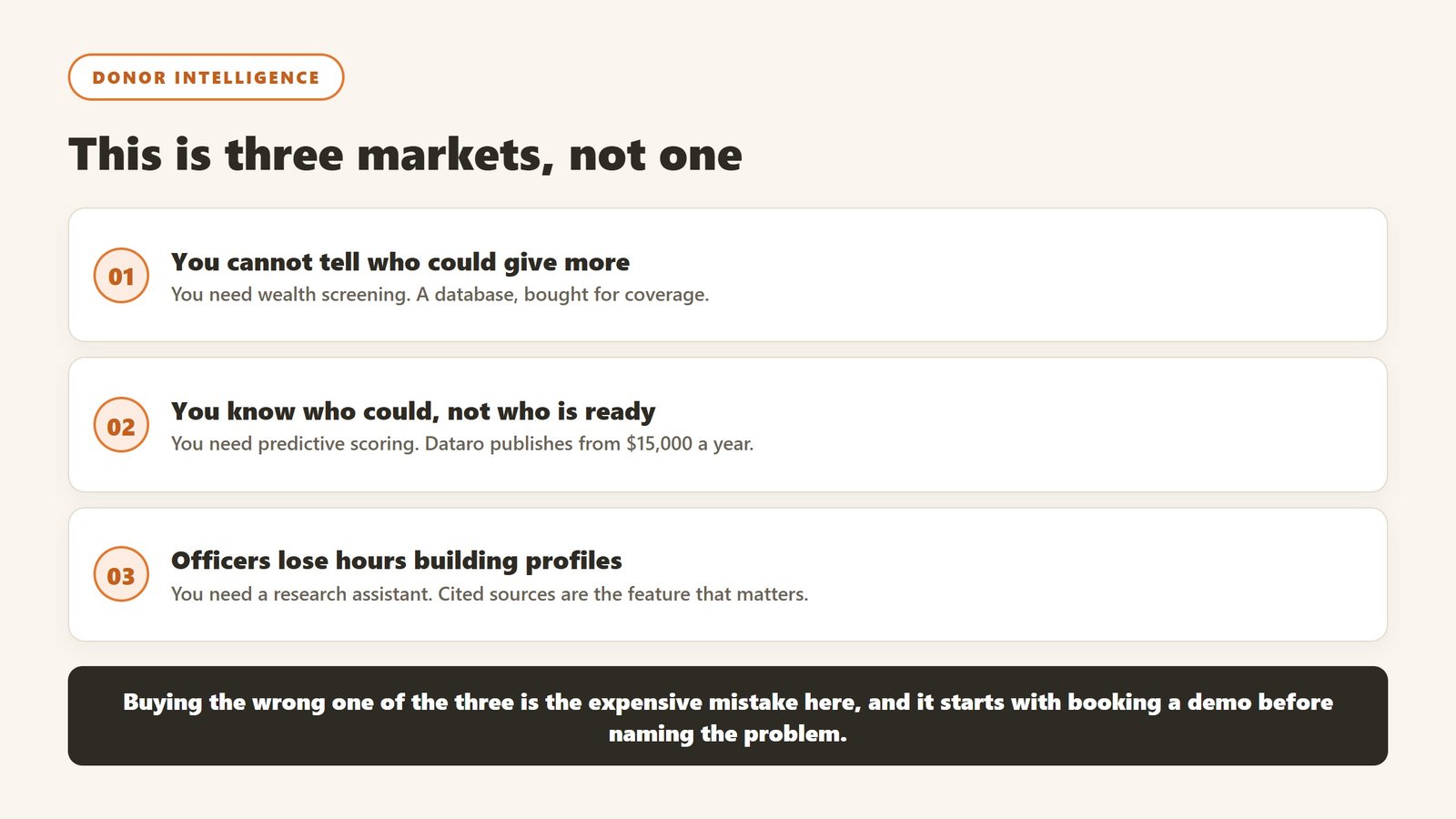
This category is often described as one market, and it is really three: wealth screening databases, predictive scoring engines, and AI research assistants. They are bought for different reasons and priced on different meters. Here is where each alternative to Dataro actually sits.
Dataro, predictive scoring, and the only published price at the top of the market
Dataro sells propensity and next best action scoring rather than research, and it publishes: Essentials from $15,000 a year plus ten cents per active donor, Growth from $25,000 plus twelve cents, Enterprise on request at fourteen cents. Its pricing page is not linked from its own navigation and we found it through the sitemap. Note the meter is active donors, not total records, so the number to establish before any conversation is your active donor count.
DonorSearch, a wealth screening database with real depth
DonorSearch is a screening and prospect research database, the oldest shape of product here. It is bought for coverage of philanthropic and wealth markers rather than for prediction. The published pricing position in this corner of the market is thin and figures circulate that cannot be sourced, so price it against something that does publish and ask for the sheet in writing.
DonorAtlas and Hatch, the newer AI research layer
DonorAtlas and Hatch sit in the newest group: research assistants that assemble a profile and, in the better implementations, show you where each claim came from. Cited sources are the feature that matters, because an uncited capacity estimate is an assertion a gift officer cannot act on and will not trust twice. Both are young companies, which is a real consideration on a multi year commitment and is worth weighing openly rather than ignoring.
What the three groups cost relative to a CRM
For scale, verified 4 September 2026: Little Green Light from $45 a month, Salesforce Nonprofit Cloud at $70 per user (as of 4 October 2026) with ten licences free, Bloomerang from $125, Keela from $164. Dataro’s floor is $15,000 a year. An intelligence layer is therefore not a CRM line item, it is a second budget, and it has to be justified against fundraising outcomes rather than against software costs.
Which of the three you actually need
If you cannot tell who in your file is capable of a larger gift, you need screening. If you know who is capable but not who is ready, you need scoring. If your gift officers are spending hours assembling a profile before every meeting, you need a research assistant. Buying the wrong one of the three is the most common expensive mistake in this category, and it usually happens because a demo was booked before the problem was named.
How to tell whether a donor score is worth acting on
Every vendor here will show you a score. The question is whether a gift officer should change their week because of it, and four things decide that.
Can it show its working
Ask the tool why a specific person scored the way they did, and look at whether the answer is a reason or a restatement. “High capacity indicators and recent engagement” is a restatement. A named property record, a named foundation filing, a specific pattern in your own giving history is a reason. Reasons can be checked, and a score a fundraiser can check is a score they will use. This is the single strongest predictor of adoption we see.
Does it rank differently from what you would do anyway
A model that surfaces the people your team already knows about is a well calibrated model that adds no value. Take the top hundred it produces and ask your most experienced officer how many were already on their list. If it is ninety, you have bought an expensive confirmation. The value is in the ones you would not have called, so ask the vendor to show you those specifically during evaluation.
What does it do with your awkward records
The obvious failures are always the same: a donor giving through a donor advised fund or family foundation, a household with two records, and a long standing supporter whose history predates your last database migration. Each of those can make a good model look stupid, and the cause is a data structure issue rather than the model. Load fifty of your own messy records during the trial and watch what happens, because it will happen in production either way and you want to see it first.
Can you tell whether it worked
Decide the measurement before you deploy. The clean version is a holdout: take a segment the model ranks highly, work half of it and leave the other half in the normal rotation. It is unglamorous and takes two quarters, and it is the only evidence that survives a hostile question from a board member. Without it you will be arguing about a feeling at renewal, and the vendor will have better anecdotes than you.
The governance questions that decide whether this is safe, not just whether it works
Donor data is among the most sensitive a small organisation holds: names, addresses, giving capacity, sometimes health or family circumstances captured in a contact report. Four areas decide your exposure, and all four are answerable in writing before anything connects.
Training, which is the question most often answered vaguely
Ask directly whether your data is used to train or improve any model, including in aggregated or anonymised form, and whether that applies to subprocessors as well as the vendor. “We do not train on customer data” and “we do not train foundation models on customer data” are different sentences and the second leaves room for a great deal. Get the answer as a contract term, not a sales assurance, because only one of those survives a change of ownership.
Subprocessors, and the ones behind the one you are buying
Most tools in this category are built on a model provider they did not write. Ask for the current subprocessor list, where each one processes data geographically, and how you are notified when it changes. A vendor that cannot produce this list in a day does not have it, which tells you what you need to know about the rest of their programme.
Retention and deletion, stated in days
Ask how long prompts, outputs and uploaded records are retained, whether retention differs for logs and support tickets, and what deletion actually means: removed from live systems, removed from backups, or flagged. Then ask for the deletion timeline in days. A vendor that will commit to a number in the contract is a different proposition from one that describes a process.
Individual rights, which are yours to honour and theirs to enable
If a donor asks what you hold on them, or asks you to delete it, you are the one who has to answer. Ask how the vendor supports a subject access request or an erasure request, how long it takes, and whether inferences the tool generated about that person are included. Inferred capacity ratings and propensity scores are data about a person even though the person never supplied them, and a tool that cannot surface or delete them puts the obligation back on you with no way to meet it.
The three answers that should end the conversation
A refusal to put the training answer in writing. An inability to name the subprocessors. And a claim that the model cannot be wrong, or that its outputs need no human review before a gift officer acts on them. The first two are governance failures you can see from outside; the third is a vendor telling you they do not understand their own product, and it is the most reliable single signal in the category.
Where the figures on this page come from
Every price quoted here was read from the vendor’s own pricing page on 4 September 2026, not from an aggregator or a review site. That distinction matters more in this category than in most, because nonprofit software pricing changed materially over the past year and a great deal of what circulates online describes packaging that no longer exists.
The pages we read
Little Green Light publishes every constituent band from $45 a month. Salesforce Nonprofit Cloud publishes $70 per user per month (as of 4 October 2026) with ten licences free under Power of Us. Bloomerang publishes $125 a month for the CRM with other products priced separately. Keela publishes every contact band from $164 a month. Dataro publishes $15,000 a year plus ten cents per active donor on a page that is not linked from its own navigation. Blackbaud and Virtuous publish no figures at all.
What we do not do
We do not carry a figure we cannot source to the vendor. Where a number circulates widely and cannot be traced to a vendor page, we say so and withdraw it rather than repeating it with a hedge, and we have withdrawn our own published figures on that basis more than once. Where a vendor confirms an unpublished price directly to us, it is attributed as confirmed by the company rather than presented as a public rate.
Why every figure carries a date
Keela raised every band by roughly 15 to 22% in under two weeks in late August 2026. Neon retired an entire tier structure. A pricing claim without a verification date is not checkable, and in this market it is usually wrong within a year.
The verdict for 2026
Dataro is the right buy for mid-size and large nonprofits with active appeal, regular-giving, and mid-level fundraising motions, especially teams that want ranked daily actions inside the CRM they already run. The published pricing (from $15,000 per year plus per-donor fees) is honest about who this is for: organizations with enough donors and enough campaign volume for better targeting to pay for itself. We have not run our own accuracy benchmark, so weigh the vendor’s case-study numbers as best cases and ask for references at your size. For deep prospect research, DonorAtlas is the complement. For explainable scoring that boards prefer, Hatch is the alternative.
For the broader category context, see our 5 best AI donor research tools guide. For nonprofit AI tools more broadly, our Best AI Tools for Nonprofits guide. For dedicated alternative reviews, see DonorAtlas review and Hatch AI review.

Written by
FazFaz is the founder of AIToolsBakery. Some tools here are tested hands on. Others are assessed from vendor documentation and pricing verified on the live page, and every review says which one it is. Sponsors can buy a position in a guide. They cannot buy the score, the criticism, or silence about a better option.
How we test and how we make money →