Quick answer: Artisan and its AI BDR Ava are the best fit for enterprise account-based outbound in 2026. We compared its documented capabilities, its published plan structure, and verified user reports. We did not run a hands-on trial. The CRM integration depth (Salesforce, HubSpot, Outreach native) is the strongest in the AI SDR category. The catch: Ava requires more configuration than AiSDR, Artisan publishes no prices at all, and the famous “stop hiring humans” marketing oversells the autonomy.
At a glance:
- Score: 4.0/5
- Best for: Enterprise sales teams running named-account ABM motions
- Starting price: Not published. Artisan quotes every plan, sized by lead volume
- Free trial: No, demo plus pilot
- Killer feature: Deepest CRM integration in the AI SDR category plus account-based workflows
- Research current to: September 2026
What Artisan does well
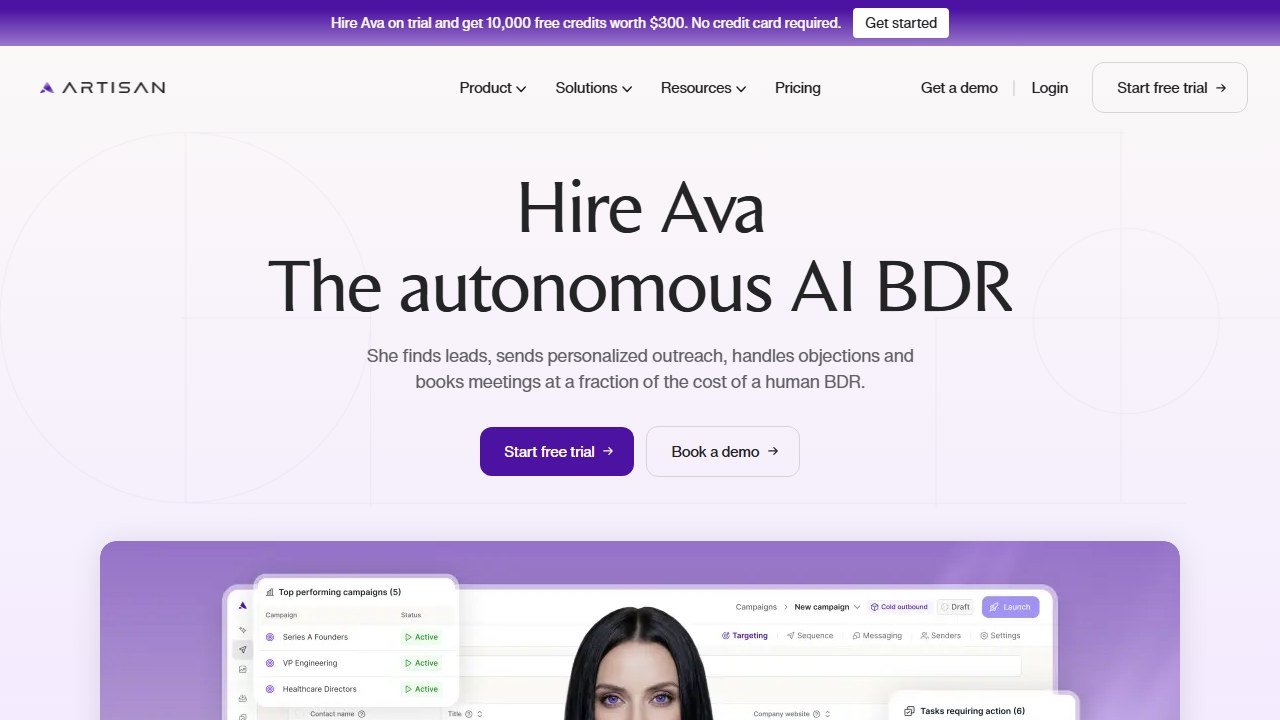
Website: Artisan
Enterprise workflows are the headline strength. Ava is built for BDRs working named-account lists with assigned territories, not broad ICP blasting. If you sell into Fortune 1000 accounts with account ownership rules, Ava’s account-based motion is purpose-built for that structure.
The CRM integration is the deepest in the AI SDR category. Native bidirectional sync with Salesforce, HubSpot, and Outreach. Ava respects opportunity stages, account ownership, and territory rules natively, which AiSDR and most autonomous agents do not handle as well.
Users single out the data quality on senior executives at large companies as the best of any AI SDR tool. Ava’s enrichment reaches harder-to-find C-suite contacts at Fortune 1000s where AiSDR and Apollo have thinner coverage.
Reported reply rates and personalization quality are solid, sitting slightly below AiSDR’s 6.1% and 4.2/5 but with the enterprise control AiSDR lacks.
What Artisan falls short on
The autonomy is more constrained than the marketing suggests. The “stop hiring humans” branding implies full autonomy, but in practice Ava requires meaningful configuration. You set up more, the AI decides less. That is good for enterprise control, less good for set-it-and-forget-it simplicity.
Price transparency. Artisan publishes no figure anywhere. Every tier on its pricing page reads “Pricing scoped on your plan” with a Talk to sales button, so you cannot size a budget without a call. There is no free trial either, and evaluation runs through a demo and a scoped plan.
The setup time is longer than AiSDR. Expect 2-3 weeks of configuration before Ava is running well, versus AiSDR’s faster (if warmup-gated) launch. The enterprise depth is the cause: more to configure means more setup overhead.
The marketing creates expectations the product does not fully meet. Teams expecting Ava to fully replace human BDRs are often disappointed. Ava augments BDRs and handles the top-of-funnel grunt work; it does not replace skilled human judgment on complex enterprise deals.
Where Artisan lands against the category
Artisan competes on a different axis than the rest of the AI SDR category. It is not trying to be the simplest tool to switch on; it is trying to be the one that survives contact with enterprise sales process.
On data, users consistently single out Ava’s coverage of senior executives at large companies as the strongest in the category, reaching C-suite contacts at Fortune 1000s where broader-but-shallower tools thin out.
On output, reported reply rates sit in the same band as the other leading AI SDR tools rather than above them. Artisan’s edge is not raw response volume, it is whether the outbound respects account ownership, territory rules, and opportunity stages.
On setup, the tradeoff bites: users describe the longest configuration runway in the category, measured in weeks rather than days. That is the price of the enterprise workflow depth, and it is why Artisan suits teams with a RevOps function and not solo operators.
Artisan pricing breakdown 2026
What Artisan actually publishes. Checked 1 September 2026, its pricing page carries no currency figure at all. Plans are scoped by outbound volume rather than by rep: Team at roughly 2,500 leads contacted a month, Scale at roughly 6,000, and Enterprise for custom volume. Every plan includes the full platform, 250M+ verified B2B contacts, Salesforce and HubSpot sync, and CSM onboarding. Scale adds a dedicated CSM and CRM setup, Enterprise adds a forward-deployed strategist. In Artisan’s own words, “plans are sized to your lead volume, mailboxes, and dialer seats”. The one per-seat item on the page is the AI dialer add-on.
Enterprise (custom): Above 20 seats, custom pricing, dedicated CSM, custom integrations, SSO, advanced governance.
No monthly option. No meaningful free trial. Evaluation is via demo plus paid pilot (typically $2,000-5,000 for a 30-day evaluation).
Artisan vs AiSDR vs Apollo
AiSDR is the closest competitor. AiSDR has better out-of-the-box personalization and a dedicated GTM engineer; Artisan has deeper CRM integration and account-based workflows. Pick AiSDR for autonomous simplicity, Artisan for enterprise control.
Apollo is 1/12th the cost but not an autonomous agent. Early and mid-market teams should start with Apollo. Artisan makes sense when account-based enterprise motion and CRM depth justify the price.
Who should use Artisan
Enterprise sales teams running named-account ABM motions. Sales orgs selling into Fortune 1000 accounts with assigned territories and account ownership rules. Salesforce, HubSpot, or Outreach-native teams that need deep CRM integration. Teams comfortable running a sales call to get a number, with the outbound volume to justify a scoped plan and the patience for a 2-3 week setup.
Who should NOT use Artisan
SMB and early-stage teams (AiSDR or Apollo are better fits). Teams that want true set-it-and-forget-it autonomy (Ava requires configuration). Teams that need a published price before they will book a demo. Teams expecting Ava to fully replace human BDRs (it augments rather than replaces). Budget-conscious teams (Apollo at $59 covers broad outbound).
Common Artisan setup mistakes
Believing the “stop hiring humans” marketing. Ava augments BDRs; it does not replace them. Teams that fire their BDRs before validating Ava regret it. Run Ava alongside humans first.
Underbudgeting setup time. Ava needs 2-3 weeks of configuration. Teams that expect day-1 results disengage during the setup phase. Plan the runway.
Skipping the CRM object mapping. Ava’s value comes from CRM depth. Incomplete Salesforce or HubSpot object mapping cripples the account-based workflows. Map objects thoroughly during onboarding.
Using it for broad ICP blasting. Ava is built for named-account ABM. Using it for broad SMB outbound wastes its account-based strengths and underperforms cheaper tools.
What an AI SDR actually is, and what it costs
This is the newest and least standardised category in sales software, and the label covers products that do very different things. Before comparing Artisan to anything, work out which of the three you are being sold.
Three products, one label
Some are copy generators bolted to a sequencer. Some are full outbound systems that source the list, write the message, send it and book the meeting. Some are essentially a managed service with software attached, where a human runs the campaign and the AI drafts. The third can be a perfectly good purchase, but it is an agency retainer wearing a software price tag and it should be compared to agencies.
What the published figures look like
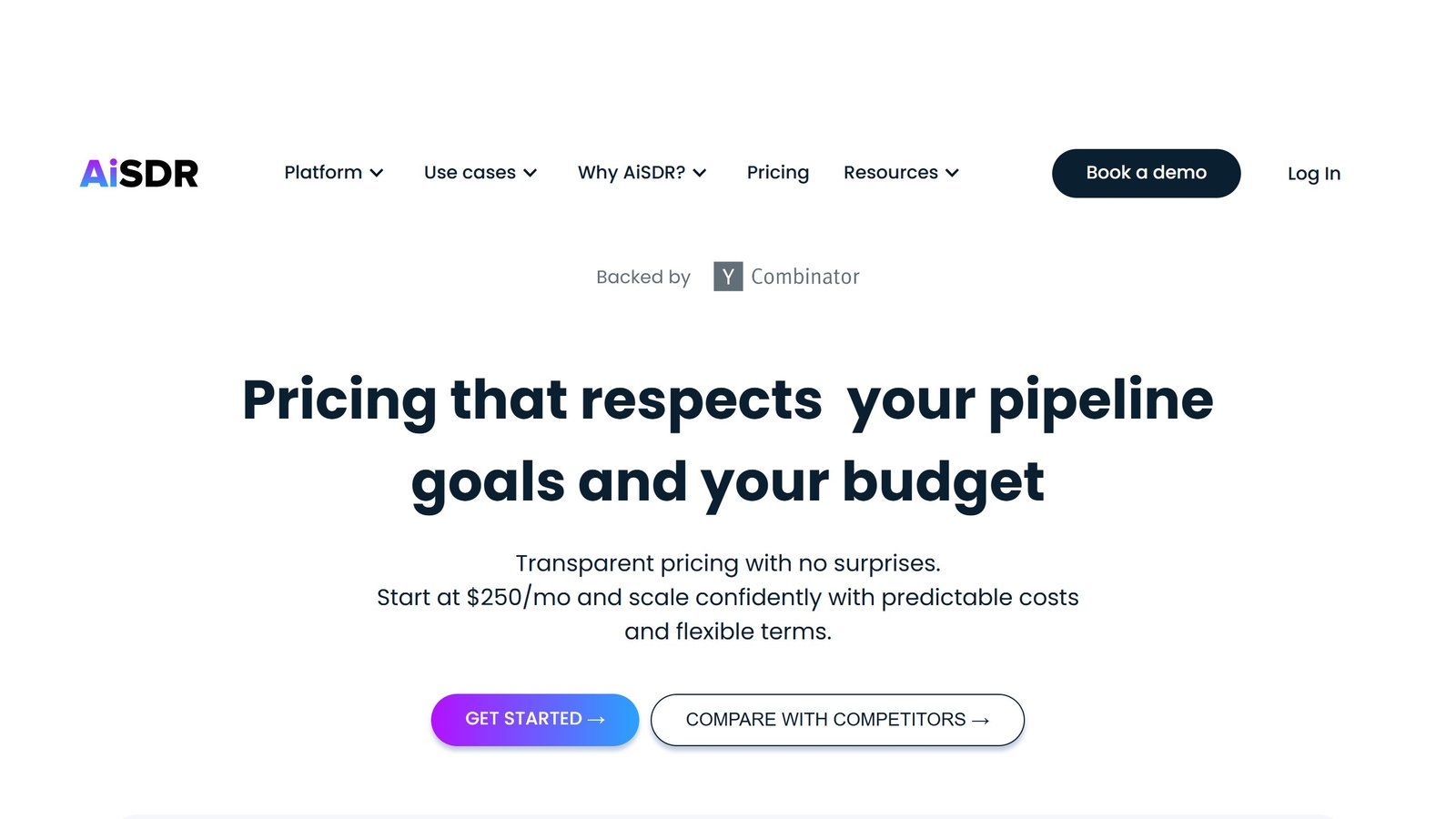
AiSDR publishes from $250 a month, then $900 and $2,500, with a managed service at an extra $149 per campaign or $2,500 a month, and a quarterly commitment on most plans. Warmly publishes $10,000, $20,000 and $30,000 a year, each starting from 10,000 credits a month, and note its pricing URL redirects. Artisan has removed its figures entirely, its cards now reading that pricing is scoped on your plan. All read 4 September 2026.
The commitment is the thing to negotiate
Quarterly and annual minimums are common here and they exist because these tools take time to produce anything measurable. That is a fair argument, and it is also a lock-in on an unproven category. If you cannot get a monthly term, get a defined exit at the first review point in writing, and agree in advance what result at that point would mean you stop.
The disclosure question your brand has to answer
Decide before launch whether a recipient can tell they are corresponding with software, and what happens when they reply and ask. This is a positioning decision rather than a legal one in most jurisdictions, and getting it wrong is a brand problem you cannot unwind. The teams that handle it well decide the policy first and configure the tool to match; the ones that do not find out when a prospect posts the exchange publicly.
Compare it to the honest alternative
The real comparison for an AI SDR is not another AI SDR, it is a junior SDR plus a stack. At $2,500 a month you are at $30,000 a year, which in many markets is a meaningful share of a real salary, and a person also handles the conversation after the reply. Price both, including the stack the human would need, and be honest about which part of the job you are actually trying to fill.
How to tell whether the tool actually worked
The failure mode in sales tooling is not a product that breaks. It is one that runs for a year while nobody can say whether it changed anything, and by renewal the argument is about anecdotes.
Take the baseline before you install
Whatever you intend to measure, you need last quarter of it from a source the project did not touch. Meetings booked per rep, reply rate by segment, average cycle length, and the hours the target task consumes. That last one is the most commonly skipped and the easiest to capture: ask two or three people to record how long it takes them this month. Time saved is measurable in advance and unprovable afterwards.
Measure the decision, not the output
A tool that generated 40,000 personalised emails has produced activity. What matters is whether the accounts your reps worked were different from the ones they would have worked anyway, and whether that difference showed up in pipeline. The clean version is a holdout: give half the team the tool and leave half on the existing process for a quarter. It is unfashionable and it is the only evidence that survives a hostile question.
Watch the metric that moves against you
Volume tools improve the numbers they are measured on and quietly degrade others. More sends usually means a worse reply rate, more meetings often means worse meeting quality, and a rising bounce rate can hide behind a healthy looking campaign until a domain is burned. Pick one counter-metric per tool and report it beside the headline, or you will optimise the wrong thing very efficiently.
Agree the stop condition in advance
Write down, before purchase, the result at the end of the first term that would mean you do not renew. Naming it converts renewal from a default into a decision, and it is the single most effective discipline against a pilot that becomes permanent. If nobody can state a result that would end it, the evaluation was never real.
What it costs to leave, which nobody quotes
Switching cost is why teams stay on tools they have outgrown. Three things determine how locked in you are, and all three are answerable during procurement.
Your data, and which parts of it come back
Contact records usually export cleanly. What often does not is the enrichment you paid for, the activity history, custom fields and the sequence performance data that tells you what actually worked. Ask specifically what a full export contains, in what format, and whether revealed contacts remain usable after the contract ends.
Sequences and templates are rebuild work
Cadences, templates, snippets and scoring rules represent months of iteration and rarely transfer between platforms. That is real staff time to rebuild, and it is the cost most often left out of a switching business case.
The integrations multiply the effort
Count every connected system before you sign, not when you leave: CRM, calendar, dialler, enrichment providers, data warehouse. Each one is work to disconnect and reconnect elsewhere, and the count is almost always higher than anyone remembers.
undefined
The verdict for 2026
Artisan (Ava) is the right AI BDR for enterprise teams running named-account ABM with deep CRM integration needs. The 5.3% reply rate and best-in-cohort senior-exec data coverage are real strengths. The price, annual lock-in, and configuration overhead are the costs. For SMB or autonomous simplicity, AiSDR. For broad budget outbound, Apollo.
See our Best AI SDR Tools 2026 guide for the full category, and Best AI Sales Tools 2026 for the broader stack.
Artisan setup checklist for enterprise teams
Ava requires more configuration than autonomous tools like AiSDR. The 2-3 week setup determines whether you get the enterprise ABM value or a frustrated team. The sequence that worked:
Week 1: CRM object mapping. Ava’s value comes from CRM depth. Map Salesforce or HubSpot opportunity, contact, account, and activity objects thoroughly. Incomplete mapping cripples the account-based workflows. This is the single most important setup step.
Week 1-2: territory and account configuration. Configure account ownership rules, territory assignments, and named-account lists. Ava respects these natively, but only if they are set up correctly. Enterprise teams with complex territories should budget extra time here.
Week 2: messaging and ICP calibration. Configure Ava’s messaging templates and ICP signals. Unlike fully autonomous tools, Ava gives you more control, which means more configuration. Run a small test batch before scaling.
Week 3: pilot launch. Launch Ava on a controlled subset of accounts. Validate personalization quality, CRM sync accuracy, and reply handling before full rollout. Run Ava alongside human BDRs during this phase, do not fire anyone yet.
Ongoing: human-AI collaboration. Ava augments BDRs rather than replacing them. The teams that succeed use Ava for top-of-funnel grunt work and human BDRs for relationship-building on qualified accounts. Set up the handoff workflow explicitly.
Artisan beyond the AI BDR
Artisan positions itself as building a broader “AI employee” platform, with Ava (the AI BDR) as the flagship. In 2026, the platform has expanded toward adjacent GTM functions, though Ava remains the core product most teams buy.
The strategic question for buyers is whether to bet on Artisan’s expanding platform vision or to buy point solutions. For enterprise teams already committed to the account-based motion Ava supports, the platform bet can make sense. For teams that want best-of-breed at each function, a stack of specialized tools (Apollo for data, Lavender for personalization, Outreach for sequencing) may outperform a single platform.
Artisan’s marketing has been polarizing. The “stop hiring humans” billboards generated attention but set expectations the product does not fully meet. Buyers who look past the marketing and evaluate Ava on its actual capability, strong enterprise ABM augmentation, get the most value. Those who expect full human replacement are disappointed.
Artisan bottom line: is it worth it in 2026?
Artisan (Ava) earns its 4.0/5 score as the strongest enterprise account-based AI BDR, held back from a higher score by the price, annual lock-in, and configuration overhead. The CRM integration depth and named-account workflows are genuinely best-in-class, and the senior-executive data coverage leads the category. But the famous marketing oversells the autonomy: Ava augments human BDRs rather than replacing them, and teams that believe the billboards end up disappointed.
The honest buyer profile: an enterprise sales org running named-account ABM into Fortune 1000 targets, with a Salesforce or HubSpot stack, enough outbound volume to justify a scoped plan, and the patience for a 2-3 week setup. For that profile, Artisan delivers real value. For everyone else, AiSDR (cheaper, more autonomous) or Apollo (far cheaper, broad outbound) are better fits. The platform-expansion vision is interesting but unproven; buy Artisan for what Ava does today, not for the roadmap.
Not sure what an AI SDR actually does? Start with our plain-English guide to what an AI SDR is.

Written by
FazFaz is the founder of AIToolsBakery. Some tools here are tested hands on. Others are assessed from vendor documentation and pricing verified on the live page, and every review says which one it is. Sponsors can buy a position in a guide. They cannot buy the score, the criticism, or silence about a better option.
How we test and how we make money →