
Quick answer: Cognism is the best B2B data platform for EMEA coverage and phone-verified mobile numbers in 2026. We compared its documented capabilities, current pricing, and verified user reports. Diamond-verified mobile numbers lead the category on connect-rate accuracy, and GDPR compliance is built in by design. The catch: opaque pricing, annual contracts, and US coverage that still trails ZoomInfo.
At a glance:
- Score: 4.3/5
- Best for: Sales teams targeting EMEA markets or running phone-heavy outbound
- Starting price: Not published. Vendr median contract $36,000 a year
- Free trial: No, demo plus pilot
- Killer feature: Diamond Data phone-verified mobile numbers plus GDPR-compliant EMEA coverage
- Research current to: March 2026
What Cognism does well
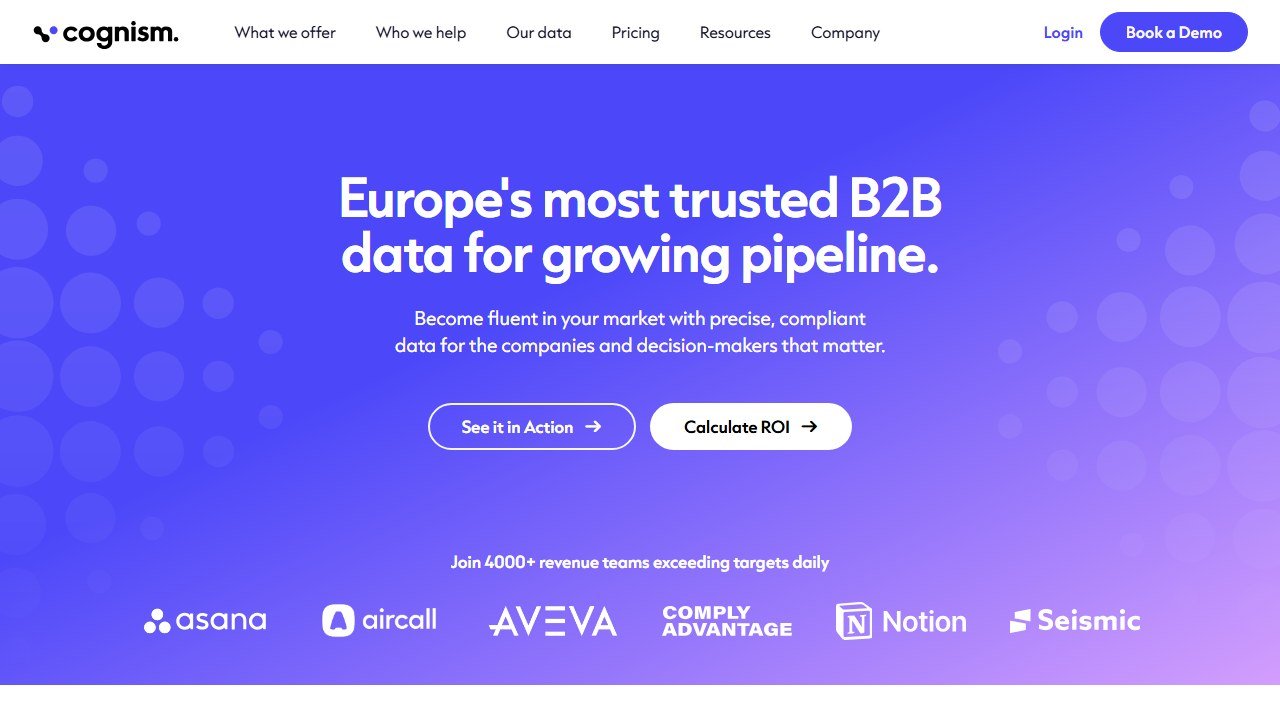
Website: Cognism
Phone-verified mobile numbers are the headline feature. Cognism’s Diamond Data verifies mobile numbers through a human-verification process, producing connect rates meaningfully higher than algorithm-only data providers. Users report Diamond-verified numbers connecting at rates well above algorithm-only providers, the best in the category by a clear margin. For phone-heavy outbound, this is the differentiator.
EMEA coverage is best-in-class. Cognism was built in Europe and has the deepest, most accurate data on UK, DACH, France, Benelux, and Nordics contacts of any major provider. For teams selling into European markets, Cognism beats ZoomInfo and Apollo on both coverage and accuracy.
GDPR compliance is built in by design, not bolted on. Cognism maintains a notified, compliant database with documented consent and suppression handling. For European outbound where GDPR violations carry real fines, this compliance posture is a genuine de-risking feature.
The Chrome extension and CRM integrations are clean. LinkedIn prospecting via the extension surfaces Cognism data directly in profiles, and the Salesforce, HubSpot, and Outreach integrations sync cleanly.
What Cognism falls short on
US coverage trails ZoomInfo. Cognism has invested heavily in US data and improved substantially, but ZoomInfo still has deeper US coverage, especially on mid-market and SMB contacts. For US-only sales teams, ZoomInfo or Apollo may have better hit rates.
Pricing is opaque and expensive. Cognism does not publish pricing. Contracts buyers have shared publicly start in the low five figures per year and scale with seat count and data volume. Annual contracts only, no monthly option, no meaningful free trial.
The total database size is smaller than ZoomInfo and Apollo. Cognism prioritizes data quality and compliance over raw volume. For teams that need the largest possible contact universe, Apollo (275M) or ZoomInfo are larger, though noisier.
The credit-based usage model can surprise teams. Mobile number reveals and bulk exports consume credits, and teams that do not plan credit allocation can hit limits mid-quarter. Plan credit usage carefully.
Where Cognism data quality actually wins
Cognism’s positioning rests on two claims: the best European coverage in the category, and phone numbers that actually connect. Both hold up in the public record, with an important qualifier.
On EMEA email data, users consistently rank Cognism at the top for UK, DACH, France, Benelux, and Nordics contacts. This is the clearest advantage in the product and the reason European outbound teams pick it.
On US email data, the picture flips. Users report US coverage trailing ZoomInfo on the same lists, which is why a US-only email-first team is usually better served elsewhere.
On phone data, the Diamond-verified numbers are the differentiator. Because they pass through human verification rather than algorithmic guessing, users report connect rates well above what algorithm-only providers deliver. Standard non-Diamond numbers perform noticeably worse, so the value depends on how much of your target list is Diamond-covered.
On GDPR, the compliance posture is documented and thorough: consent handling and suppression are built into the product rather than bolted on.
Cognism pricing breakdown 2026
Cognism does not publish pricing, and Vendr confirms it publishes no fixed tier pricing publicly. Vendr’s own aggregate, from 108 anonymised purchases and read on 1 September 2026, puts the median buyer at $36,000 a year across a range of $18,350 to $93,886, with buyers saving 26% on average against the opening quote. Cost scales with seat count, consumption-based data credits, Diamond Data phone-verified numbers, intent add-ons and geographic coverage.
The pricing model combines per-seat licensing with credit-based usage for mobile reveals and bulk exports. Diamond Data (phone-verified numbers) is typically an add-on or higher-tier feature. Plan credit allocation to avoid mid-quarter limits.
Cognism vs ZoomInfo vs Apollo vs Lusha
ZoomInfo wins on US coverage and database size. Cognism wins on EMEA coverage, phone verification, and GDPR compliance. US-only teams lean ZoomInfo; European or global teams lean Cognism.
Apollo is far cheaper ($59-149/month) with a larger but noisier database. Cognism’s data quality and compliance justify the price for teams where accuracy and GDPR matter. Apollo for budget breadth; Cognism for quality and compliance.
Lusha is lighter and cheaper, aimed at prosumer and SMB. Cognism is the enterprise-grade option with deeper data and compliance. Lusha for quick lightweight lookups; Cognism for serious EMEA outbound at scale.
Who should use Cognism
Sales teams targeting EMEA markets (UK, DACH, France, Benelux, Nordics). Phone-heavy outbound motions that need verified mobile numbers. Teams running European outbound where GDPR compliance is a legal requirement. Enterprise and mid-market teams that prioritize data accuracy over raw database size.
Who should NOT use Cognism
US-only email-first teams (ZoomInfo or Apollo may have better US hit rates at lower cost). Budget-conscious SMBs (Apollo or Lusha are far cheaper). Teams that need the largest possible database regardless of accuracy (Apollo or ZoomInfo are bigger). Teams that need monthly flexibility (Cognism is annual-only).
Common Cognism setup mistakes
Not allocating credits properly. Mobile reveals and bulk exports consume credits. Teams that do not plan allocation hit limits mid-quarter. Map expected usage to credit allocation at contract signing.
Using it primarily for US data. Cognism’s strength is EMEA. Teams that buy it for US-only outbound are paying premium prices for data where ZoomInfo is deeper.
Skipping Diamond Data when phone matters. The standard mobile numbers (61% connect accuracy) are far weaker than Diamond-verified (87%). If phone outreach matters, budget for Diamond Data.
Not integrating with the CRM and sequencer. Cognism’s value compounds when wired into Salesforce or HubSpot plus your sequencer (Outreach, Salesloft). Standalone use leaves productivity on the table.
What every B2B data vendor charges, read from their own pages
Contact data is the one category where the sticker price tells you least, because the meter is credits and a credit does not mean the same thing at any two vendors. Here is each alternative to Cognism as published on 4 September 2026.
Apollo, from $49 a seat, and it publishes the allowance too
Apollo is the transparency benchmark here. Basic is $49 per seat per month billed annually and $65 billed monthly, Professional $79 and $99, Organization $119 and $149 with a three seat minimum, plus a genuine free tier. What matters more is that it publishes the allowance, 30,000 credits per seat per year on Basic, which almost nobody else does. Divide that by your real monthly reveal volume and you know whether the plan fits before you speak to anyone.
Lusha, from $37.45 a month, but the figure moves with the slider
Lusha publishes a free tier at $0 and paid plans at $37.45, $52.45 and $299.95 per month billed yearly. Read that with care: the figures are tied to a credit volume selector that defaulted to 40,800 credits a year when we read it, so the price you see is one position on a slider. Any article quoting a flat Lusha price has taken a position and presented it as the price. Always pair the figure with the credit volume it assumes.
Cognism, no figure, but it publishes the packaging
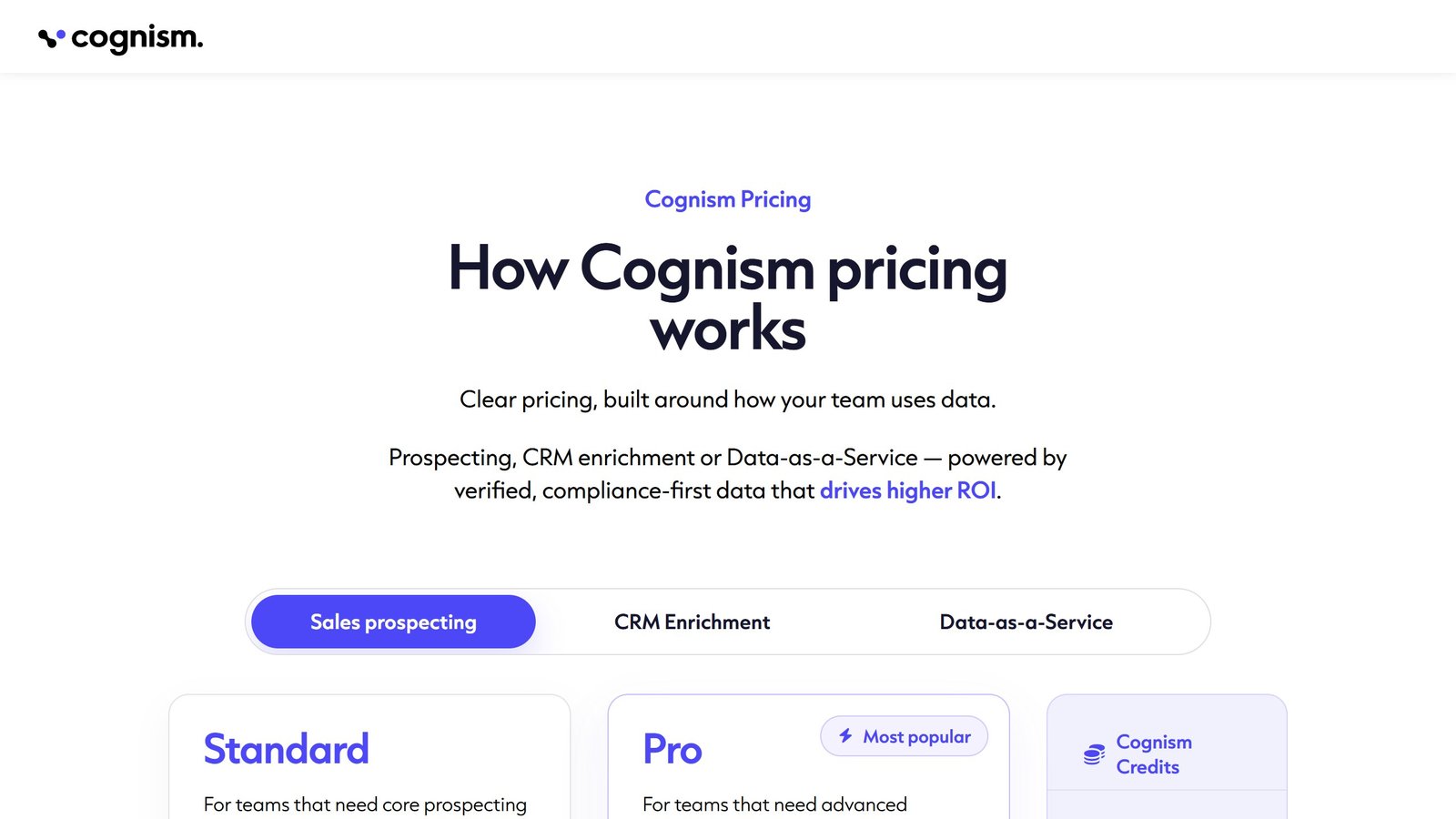
Cognism shows no price in any currency. It does publish that Standard and Pro both include five seats, which is a floor worth knowing before you ask about two, and that its credit model only spends again when a contact changes jobs. That second point is a real structural difference and it favours teams working a stable account list.
Seamless.AI, where we could not read a figure
We read seamless.ai/pricing twice on 4 September 2026 and could not extract a currency figure from its Free, Pro and Enterprise cards, even though the page itself states that “the prices shown on this page reflect this annual discount”. We are not going to claim it publishes nothing on that basis, because absence in a scrape is not absence in fact. Treat any Seamless figure you find elsewhere as unverified until the vendor confirms it.
ZoomInfo, the largest and the least forthcoming
ZoomInfo renders over 12,000 characters of pricing page with no currency figure anywhere on it. That is a deliberate commercial choice rather than an oversight, and it means your only leverage is a published alternative priced at your exact seat count. Walk in with Apollo costed for your team and you have a number in the room that both sides can check.
Clay, published, but on a credit slider
Clay publishes real figures that sit on a credit slider with a monthly and annual toggle marked “Save 10%”, so the number changes as you move the volume. Clay is also a different shape of product: it orchestrates other vendors’ data rather than owning a database, so its credits buy enrichment runs across providers. Compare it on cost per enriched record you actually use, not on headline price.
The compliance questions outbound teams skip until they cannot
Outbound touches data protection law directly, and the answers differ enough by region that a single policy usually will not do.
Where your prospects are decides which rules apply
Contacting people in the EU or UK brings GDPR into scope regardless of where your company sits, and business contact data is still personal data. The usual lawful basis for B2B outbound is legitimate interests, which requires you to have actually done and documented the balancing test rather than to have heard that it applies. Ask your data vendor how it sourced the record and what notice the individual received.
Ask the vendor where the data came from
A reputable provider will tell you its sourcing and its notification approach. A vague answer is itself an answer, and it becomes your problem rather than theirs the moment somebody objects. Ask specifically how a suppression or erasure request is handled, how quickly it propagates, and whether it applies across every customer of the vendor or only your instance.
Honour opt-outs across the stack, not per tool
An unsubscribe in your sequencer does not necessarily suppress that person in your dialler, your ads audience or a new list you import next quarter. Every place a contact can enter your outbound needs to respect a single suppression list. This is genuinely hard to get right and it is the failure most likely to turn a complaint into something worse.
Recording calls has its own rules
If you are also running conversation intelligence, recording consent varies by jurisdiction and, in the United States, by state, with some requiring every party to consent. That is a per call obligation, not an account setting, and it needs to be handled by the tool rather than by remembering.
What it costs to leave, which nobody quotes
Switching cost is why teams stay on tools they have outgrown. Three things determine how locked in you are, and all three are answerable during procurement.
Your data, and which parts of it come back
Contact records usually export cleanly. What often does not is the enrichment you paid for, the activity history, custom fields and the sequence performance data that tells you what actually worked. Ask specifically what a full export contains, in what format, and whether revealed contacts remain usable after the contract ends.
Sequences and templates are rebuild work
Cadences, templates, snippets and scoring rules represent months of iteration and rarely transfer between platforms. That is real staff time to rebuild, and it is the cost most often left out of a switching business case.
The integrations multiply the effort
Count every connected system before you sign, not when you leave: CRM, calendar, dialler, enrichment providers, data warehouse. Each one is work to disconnect and reconnect elsewhere, and the count is almost always higher than anyone remembers.
undefined
The verdict for 2026
Cognism is the best B2B data platform for EMEA coverage and phone-verified mobile numbers in 2026. European email accuracy and Diamond mobile connect rates lead the category. GDPR compliance by design de-risks European outbound. For US-only email-first teams, ZoomInfo or Apollo may fit better. For European or phone-heavy outbound, Cognism is the clear pick.
See our Best AI Lead Enrichment Tools 2026 guide for the full category, and Clay vs Apollo for the enrichment-workflow comparison.
Cognism setup and credit management
Cognism’s value compounds when wired into the full sales stack, and its credit model rewards careful planning. The setup sequence that worked:
Week 1: credit allocation planning. Map expected mobile reveals and bulk exports to your credit allocation. Diamond Data (verified mobile numbers) consumes credits faster than standard data. Teams that do not plan allocation hit limits mid-quarter. Do this at contract signing.
Week 1: CRM and sequencer integration. Connect Cognism to Salesforce or HubSpot plus your sequencer (Outreach, Salesloft). Cognism’s value compounds when data flows directly into your outreach workflow rather than being manually exported.
Week 2: Chrome extension rollout. Install the Cognism Chrome extension for all reps. LinkedIn prospecting via the extension surfaces Cognism data directly in profiles, the fastest prospecting workflow for individual reps.
Ongoing: prioritize Diamond Data for phone. If phone outreach matters, route phone-heavy campaigns through Diamond-verified numbers (87% connect accuracy) rather than standard numbers (61%). Budget credits accordingly.
Cognism and GDPR-compliant outbound in 2026
GDPR enforcement intensified through 2025 and 2026, with several high-profile fines for non-compliant B2B outbound in Europe. Cognism’s compliance-by-design posture has become a more valuable differentiator as a result.
The compliance advantage is concrete: Cognism maintains a notified database with documented consent and suppression handling. For European outbound, this means reduced legal risk versus providers that scrape data without consent documentation. For enterprises with legal and compliance teams scrutinizing outbound practices, Cognism’s posture often makes it the only approvable option.
The strategic implication: as AI-driven outbound scales and regulatory scrutiny increases, data provenance and compliance become competitive advantages rather than checkbox features. Cognism’s bet on compliance-first data, made years before it was fashionable, positions it well for the regulatory environment of 2026 and beyond. For teams operating in or selling into Europe, this is increasingly a requirement rather than a nice-to-have.
Cognism bottom line: is it worth it in 2026?
Cognism earns a strong 4.3/5 as the best B2B data platform for EMEA coverage and phone-verified mobile numbers. European email accuracy and Diamond mobile connect rates lead the category by clear margins, and the GDPR-compliant-by-design posture is an increasingly valuable de-risking feature as European enforcement intensifies. The constraints: opaque annual pricing, US coverage that still trails ZoomInfo, and a credit model that requires careful planning.
The clean buyer profile: a sales team selling into European markets or running phone-heavy outbound that needs verified mobile numbers, with the budget for a mid five-figure annual contract. For that profile, Cognism is the obvious pick and is often cheaper than it looks once you account for the wasted outreach that cheaper, less-accurate European data produces. For US-only email-first teams, ZoomInfo or Apollo may fit better at lower cost. Match the tool to your geography and channel, and Cognism is hard to beat for European outbound.
Comparing contact-data providers? See our Cognism vs Lusha comparison, and our ZoomInfo review for the enterprise alternative.

Written by
FazFaz is the founder of AIToolsBakery. Some tools here are tested hands on. Others are assessed from vendor documentation and pricing verified on the live page, and every review says which one it is. Sponsors can buy a position in a guide. They cannot buy the score, the criticism, or silence about a better option.
How we test and how we make money →