Quick answer: Clay wins on data coverage, because it queries many providers per row rather than one database, and on personalization depth. Apollo wins on price ($49 a seat billed annually against $167 a month) and ease of use. Most teams use both: Apollo for broad SDR prospecting, Clay for high-intent ABM personalization at scale.
Clay wins for high-intent personalised outreach and named-account ABM, on waterfall enrichment across 100-plus data providers with AI per row. Apollo wins for broad SDR prospecting on a budget at $59 a month, bundling a 275M-contact database, sequencing and a dialer in one tool. Early-stage teams should start with Apollo.
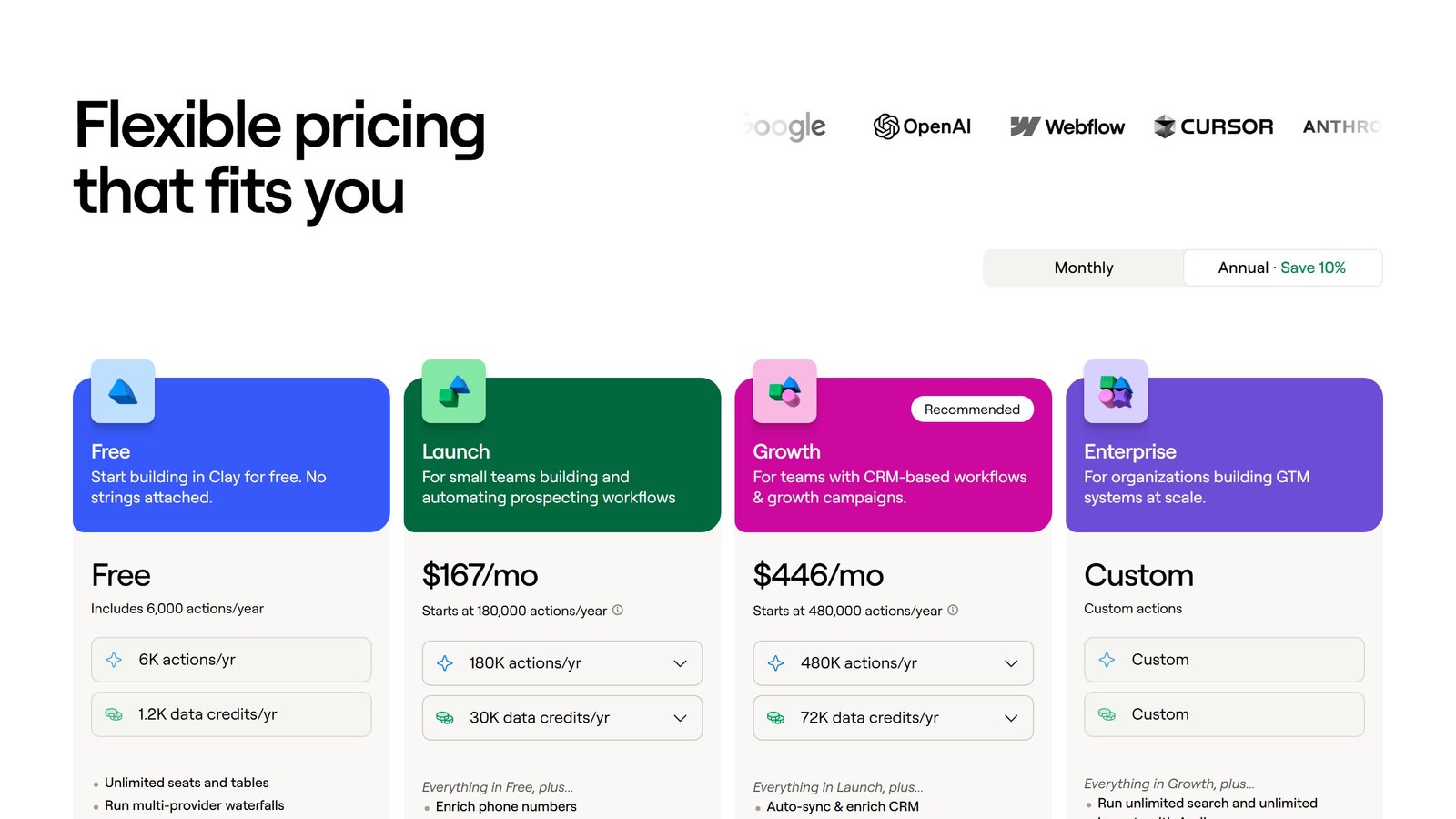
Both price lists were re-read on 26 August 2026 and both have moved. Apollo is $49, $79 and $119 a seat billed annually. Clay is $167 and $446 a month with no per-seat charge at all, which is the structural difference: five people on Apollo Professional is $395 a month, and the same five on Clay Launch is $167. Detail in Apollo.io pricing and Clay pricing.
Clay vs Apollo: pricing breakdown 2026
| Plan tier | Clay | Apollo |
|---|---|---|
| Entry | $167/mo (Launch) | Free or $49/mo (Basic, annual) |
| Mid | $446/mo (Growth) | $79/mo (Professional, annual) |
| Top | Enterprise, on quote | $119/mo (Organization, annual, min 3 seats) |
| Database | Combines 100+ providers via waterfall | 275M contacts (proprietary) |
| Sequencing | Push to external tool (Smartlead, HubSpot) | Native sequencing included |
| Dialer | No native dialer | Included from Professional tier |
The pricing comparison is apples-to-oranges. Apollo bundles database + sequencing + dialer for $59/mo. Clay is a data layer that combines providers + adds AI generation per row, then pushes the output to other tools. Most teams paying for Clay ALSO pay for sequencing (Smartlead, Instantly, or HubSpot) and possibly a dialer (Aircall, Dialpad).
Honest total cost for a typical cold email setup:
Apollo-only setup: $49 to $79 a seat per month billed annually. Covers database, sequencing, basic dialer, CRM sync. Right for solo founders and early teams.
Clay + Smartlead setup: $167 (Clay Launch) + $94 (Smartlead Pro monthly) = $261/mo. Higher hit rate, AI personalization at scale, but operational complexity is meaningfully higher.
Data hit rate: what we can and cannot tell you
Hit rate is the reason this comparison gets searched, and it is the number we cannot honestly give you. We have not run a controlled side-by-side enrichment test, so this page carries no hit-rate percentages for either tool.
What is structurally true, and matters more than a percentage from someone else’s list, is how the two find a contact. Apollo queries its own database. Clay runs a waterfall across many providers per row, Apollo often among them, and stops when one returns a result. So Clay cannot do worse than its best single provider on a given row, and it costs more per row for that.
The practical consequence: the gap between them is widest exactly where a single database is weakest, on senior people at companies outside tech. On broad, well-covered ICPs the waterfall is paying for coverage you would have had anyway. Run both trials against fifty of your own hardest accounts, because that is the only hit rate that describes your list.
Workflow depth: Clay vs Apollo
The tools work fundamentally differently. Apollo is a closed-loop database + sequencing platform. You search Apollo’s database, build a list, push it into an Apollo sequence, send emails, track replies, all inside Apollo.
Clay is a workflow primitive. You build a Clay table with columns for each enrichment source (Apollo, Hunter, RocketReach, LinkedIn Sales Nav, Phantombuster, OpenAI, Anthropic). Each row runs through waterfall logic until a column is populated with valid data. AI columns generate personalized content per row (opener sentence, value prop, custom subject line). Output pushes to Smartlead, HubSpot, or wherever your sender lives.
For teams comfortable with workflow tools (Airtable, Zapier, n8n), Clay is a productivity multiplier. For teams that want a turnkey SDR tool, Apollo is easier to operationalize.
Clay vs Apollo: who should pick what
Pick Apollo if: You are an early-stage team that needs database + sequencing + dialer in one tool. You send broad SDR campaigns to large lists. Your budget for sales tooling is under $200/seat/month. You want the lowest-friction time-to-first-meeting.
Pick Clay if: You run ABM or named-account motions on hard-to-find targets. You need personalization at scale (AI-generated openers per prospect). You already have a sender (Smartlead, Instantly, HubSpot) and want better data quality. You manage an agency or in-house ops team that builds reusable workflows.
Use both if: You run broad SDR motions (Apollo handles this) AND named-account ABM motions (Clay handles this). Many sales orgs above $5M ARR end up running both. Apollo for breadth, Clay for depth.
Clay vs Apollo: credit math and unit economics
Clay’s credit-based pricing is the most-misunderstood part of the tool. One enrichment “row” in Clay can consume 1-5 credits depending on how many waterfall steps execute. A typical SDR list of 200 accounts at full enrichment depth uses roughly 500-1,000 credits. Starter tier (2,000 credits) covers 2-4 lists per month.
Apollo’s pricing is per-seat with usage limits inside each tier. Basic ($59/mo) allows 10,000 emails per month and 50 mobile numbers per month. Most solo founders never hit these limits.
For a team of 3 SDRs running 500 enriched prospects per week:
Apollo: 3 seats at $79 billed annually = $237/mo. Database + sequencing + dialer covered.
Clay + Smartlead: Clay Growth $446 + Smartlead Pro $94 = $540/mo, and Clay does not charge for the three seats. Higher data quality, AI personalization, but no native dialer.
The Apollo math wins for teams under 5 SDRs running broad campaigns. The Clay math wins for teams running personalized ABM where reply rate is the bottleneck.
Migration patterns: Apollo to Clay and back
The most common migration is Apollo to Clay around the $3M-$5M ARR mark, when sales orgs hit two limits: Apollo’s data quality is insufficient for senior-executive ABM, and the team needs AI personalization at scale that Apollo does not natively provide.
The reverse migration (Clay to Apollo only) is rare and usually happens when a team downsizes or pivots out of personalized outbound entirely. Clay’s complexity becomes overhead without the team to operate it.
The migration timeline is 4-6 weeks for a team of 3-5 SDRs. Plan to run both tools in parallel for the first 2 weeks while building Clay workflows, then gradually shift volume.
Clay vs Apollo: workflow examples by use case
The right tool depends on the workflow you are actually running. Three concrete workflows show how the choice changes by use case.
Workflow 1: Broad SDR campaign (5,000 contacts/month, generic ICP). Apollo wins decisively. Build a list inside Apollo’s database, push into Apollo sequence, send 5,000 emails per month, track replies in Apollo. Total cost: $59-99/mo. Time to first campaign: 2-4 hours. No external tools needed.
Clay would over-engineer this workflow. The waterfall enrichment is wasted on broad ICP targets where a single database already has the coverage. The Clay setup time (4-8 hours to build the workflow table) does not pay back at this volume.
Workflow 2: Named-account ABM (200 contacts/month, hard-to-find C-suite at Fortune 1000). Clay wins decisively. A single database is weakest exactly here, on senior executives at large companies outside tech, and Clay’s waterfall across Apollo, Hunter, RocketReach, LinkedIn Sales Navigator and ZoomInfo is built for the rows a single provider returns nothing for. AI per-row generation produces personalized openers referencing each prospect’s recent activity. Total cost: $167 to $446 a month for Clay plus $94 a month for Smartlead sending, so $261 to $540 a month.
Apollo would underperform on this workflow. The hit rate gap costs 20+ valid contacts per month on a 200-contact list, and the lack of per-row AI generation forces template-flavored outreach that hurts reply rates.
Workflow 3: Mid-market sales motion (1,000 contacts/month, mixed ICP). Both tools work. Apollo handles broad mid-market prospecting cleanly. Clay adds coverage on the rows Apollo returns nothing for, plus personalization depth. The decision comes down to budget: Apollo at $79 to $119 a seat billed annually is the easier yes. Clay + Smartlead at $228+/mo is the higher-leverage yes if your reply rate is the bottleneck.
Clay vs Apollo: integration ecosystem comparison
Both tools integrate with major CRMs and sequencing tools, but the depth and direction of integrations differ.
Apollo integrations: Native bidirectional sync with HubSpot, Salesforce, Pipedrive, Close. Activity logging, contact sync, deal updates flow both ways. Apollo also has a native dialer (from Professional tier) and native sequencing, so many teams use Apollo end-to-end without external tools.
Clay integrations: One-directional push to HubSpot, Salesforce, Pipedrive, Close. Clay does not pull data back from the CRM (workflow tables are the source of truth). Clay pushes to external senders (Smartlead, Instantly, lemlist, HubSpot Marketing) for the actual sending. Native Slack notifications, Zapier webhooks, custom API endpoints round out the integration depth.
For teams that prefer a single tool covering data plus sending, Apollo is the simpler architecture. For teams comfortable with a layered stack (Clay for data + Smartlead for sending + HubSpot for CRM), Clay’s flexibility is the differentiator.
Clay vs Apollo: real cost-per-meeting math
The honest comparison is cost-per-meeting, not cost-per-tool. Here is the math using each tool’s published pricing and the reply and booking rates that are typical for cold outbound:
Apollo-only setup: at 200 cold emails per week per SDR and typical cold-outbound reply and booking rates, an SDR books a small handful of meetings per week. At $99 per seat per month, the tool cost per meeting lands in the low tens of dollars. Apollo’s advantage is that the cost base barely moves as volume rises.
Clay plus Smartlead setup: the same 200 emails per week, but better data and per-row personalization push reply and booking rates higher, so an SDR books meaningfully more meetings for the same send volume. The stack costs roughly $261 per SDR per month rather than $79, so the cost per meeting rises even where meeting volume does.
That is the trade in one line. Apollo wins on cost per meeting, Clay wins on reachable contacts per list, and we publish no meetings-per-rep figures for either because we have not run reps on them. The right choice depends on whether your bottleneck is cost discipline or list coverage.
What every B2B data vendor charges, read from their own pages
Contact data is the one category where the sticker price tells you least, because the meter is credits and a credit does not mean the same thing at any two vendors. Here is each alternative to both tools as published on 4 September 2026.
Apollo, from $49 a seat, and it publishes the allowance too
Apollo is the transparency benchmark here. Basic is $49 per seat per month billed annually and $65 billed monthly, Professional $79 and $99, Organization $119 and $149 with a three seat minimum, plus a genuine free tier. What matters more is that it publishes the allowance, 30,000 credits per seat per year on Basic, which almost nobody else does. Divide that by your real monthly reveal volume and you know whether the plan fits before you speak to anyone.
Lusha, from $37.45 a month, but the figure moves with the slider
Lusha publishes a free tier at $0 and paid plans at $37.45, $52.45 and $299.95 per month billed yearly. Read that with care: the figures are tied to a credit volume selector that defaulted to 40,800 credits a year when we read it, so the price you see is one position on a slider. Any article quoting a flat Lusha price has taken a position and presented it as the price. Always pair the figure with the credit volume it assumes.
Cognism, no figure, but it publishes the packaging
Cognism shows no price in any currency. It does publish that Standard and Pro both include five seats, which is a floor worth knowing before you ask about two, and that its credit model only spends again when a contact changes jobs. That second point is a real structural difference and it favours teams working a stable account list.
Seamless.AI, where we could not read a figure
We read seamless.ai/pricing twice on 4 September 2026 and could not extract a currency figure from its Free, Pro and Enterprise cards, even though the page itself states that “the prices shown on this page reflect this annual discount”. We are not going to claim it publishes nothing on that basis, because absence in a scrape is not absence in fact. Treat any Seamless figure you find elsewhere as unverified until the vendor confirms it.
ZoomInfo, the largest and the least forthcoming
ZoomInfo renders over 12,000 characters of pricing page with no currency figure anywhere on it. That is a deliberate commercial choice rather than an oversight, and it means your only leverage is a published alternative priced at your exact seat count. Walk in with Apollo costed for your team and you have a number in the room that both sides can check.
Clay, published, but on a credit slider
Clay publishes real figures that sit on a credit slider with a monthly and annual toggle marked “Save 10%”, so the number changes as you move the volume. Clay is also a different shape of product: it orchestrates other vendors’ data rather than owning a database, so its credits buy enrichment runs across providers. Compare it on cost per enriched record you actually use, not on headline price.
How credit pricing actually works, and the four questions that decide your bill
Credits are the reason two vendors quoting similar monthly figures can differ threefold in practice. Ask both tools and every competitor the same four questions in writing.
What spends a credit
Revealing an email, revealing a phone number, enriching an existing record and exporting a list are often priced differently, and a mobile number frequently costs several times an email. Ask for the table. A plan advertised as 1,000 credits can be 1,000 emails or roughly 200 phone numbers, and if your team works the phone that distinction is your whole budget.
Whether a credit is spent again on the same person
This is the question almost nobody asks and it is worth the most. Some vendors charge every time you touch a record; Cognism publishes that it only spends again when a contact changes jobs. On a stable account list worked repeatedly over a year, that single difference can halve consumption. Get the answer in the contract rather than from a rep.
Whether unused credits roll over, and what overage costs
Outbound is seasonal. If credits expire monthly you will pay for capacity you cannot use in a quiet month and run out in a busy one. Ask whether allowances roll over, whether they pool across seats, and above all what a credit costs once you exceed the plan, because the overage rate is where the margin sits and it is almost never on the pricing page.
What happens to revealed data when you leave
Ask whether contacts you already revealed remain usable after the contract ends, and in what form you can export them. Some agreements treat the data as licensed rather than purchased, which means the enrichment you spent a year paying for does not come with you. That single clause is often the largest hidden switching cost in this category, and it is entirely invisible until you try to go.
The test that settles it
Give each vendor the same list of 200 accounts from your real ICP and ask them to run it during the trial. Then count three things: how many contacts were found, how many emails bounced when you actually sent, and how many credits it consumed. Coverage claims are marketing; a bounce rate on your own list is evidence.
undefined
The verdict for 2026
Clay and Apollo solve different problems. Apollo is the right buy for early teams who need an all-in-one SDR tool at a price well under $200 a seat per month. Clay is the right buy for teams running personalized ABM where data quality and AI generation determine reply rates. Above $5M ARR, most sales orgs run both: Apollo for breadth, Clay for depth.
For the broader sales tool category, see our Best AI Sales Tools 2026 guide. For dedicated reviews, see our Clay review and Apollo review. For lead enrichment alternatives, our Best AI Lead Enrichment Tools covers ZoomInfo, Cognism, Lusha and RocketReach.

Written by
FazFaz is the founder of AIToolsBakery. Some tools here are tested hands on. Others are assessed from vendor documentation and pricing verified on the live page, and every review says which one it is. Sponsors can buy a position in a guide. They cannot buy the score, the criticism, or silence about a better option.
How we test and how we make money →