
Quick answer: Reply.io wins for SMB and mid-market teams that want multichannel (email plus LinkedIn plus SMS) at 1/15th the cost. Outreach wins for enterprise teams (25+ reps) needing the deepest sequence builder and conversation intelligence. The crossover is around 25 reps and Salesforce-stack complexity.
At a glance:
- Best for SMB and mid-market multichannel: Reply.io ($69-99/mo)
- Best for enterprise sequence depth: Outreach (~$2,000/seat/year)
- Best for LinkedIn-heavy motions: Reply.io (Jason AI multichannel)
- Best for Salesforce-native enterprises: Outreach (deepest CRM integration)
- Reply.io differentiator: Multichannel at SMB pricing
- Outreach differentiator: Enterprise sequence builder plus Kaia conversation intelligence
Reply.io vs Outreach: pricing breakdown
| Tier | Reply.io | Outreach |
|---|---|---|
| Entry | $69/mo (Email Only) | ~$2,000/seat/year (Engage) |
| Mid | $99/mo (Multichannel) | ~$3,000/seat/year (Engage Plus) |
| Top | $166/mo (Agency) | Custom (Enterprise) |
| Billing | Monthly available | Annual only |
| Min seats | 1 | 5 |
The price gap is roughly 15-20x per seat. Reply.io at $99/month per seat versus Outreach at $2,000-3,000/seat/year. For SMB and mid-market teams, Reply.io’s multichannel covers most needs at a fraction of the cost. The crossover happens when sequence complexity and enterprise CRM integration justify Outreach’s premium.
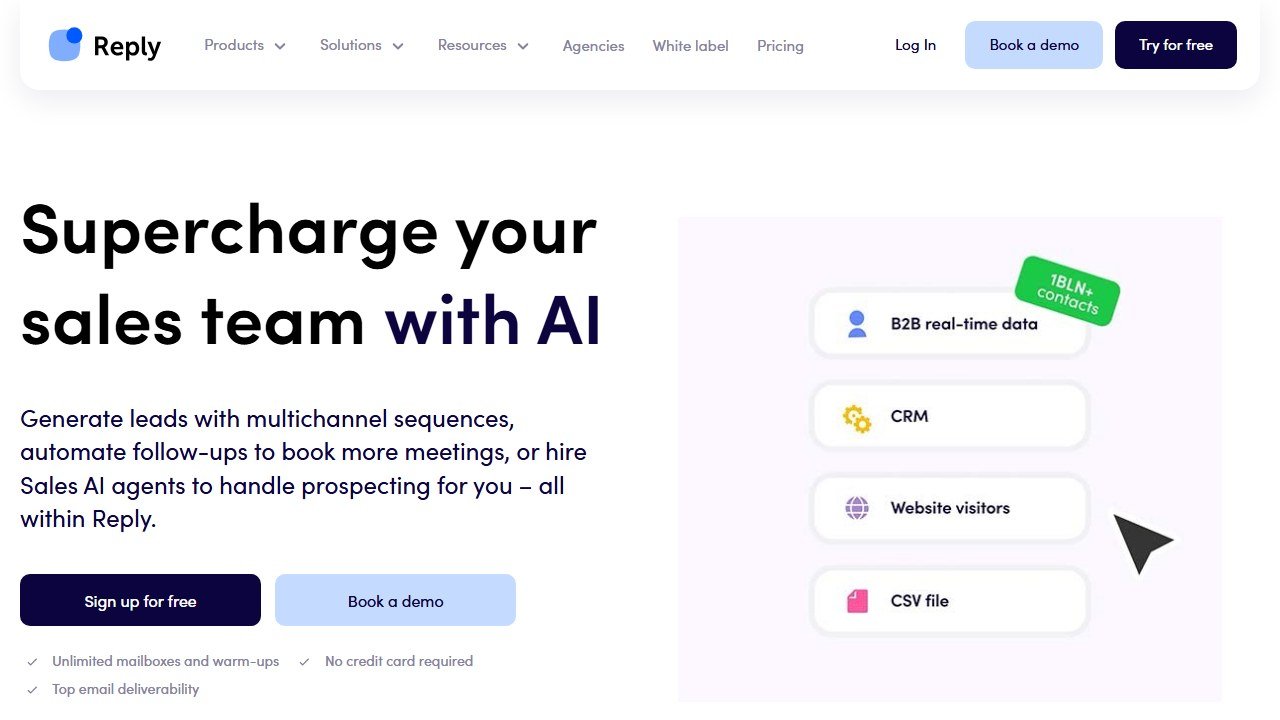
Reply.io vs Outreach: multichannel depth
Reply.io wins decisively on multichannel breadth at its price point. Jason AI handles email, LinkedIn, SMS, and calls in unified cadences. For teams whose ICP responds to LinkedIn outreach, operators consistently report Reply.io’s multichannel cadence lifting reply rates meaningfully over email-only sequences.
Outreach handles multichannel too (email, phone, LinkedIn via Sales Navigator, SMS) but the LinkedIn integration is thinner than Reply.io’s native automation. Outreach’s strength is sequence depth and conditional branching, not LinkedIn automation breadth.
For LinkedIn-heavy motions, Reply.io is the better primitive. For complex multi-stage email-and-phone sequences with branching, Outreach is deeper.
Reply.io vs Outreach: sequence builder and AI
Outreach has the deepest sequence builder in the sales engagement category. Multi-step, multi-channel cadences with rules-based branching, content variants per persona, A/B testing, and AI-suggested next-best-action. For enterprise motions with complex conditional logic, nothing matches it.
Reply.io’s sequence builder is capable but simpler. Jason AI handles personalization, cadence pacing, and reply triage well. For SMB and mid-market motions, Reply.io’s builder is sufficient. For enterprise complexity, Outreach pulls ahead.
On conversation intelligence, Outreach’s Kaia is a genuine differentiator. Call recording, transcription, AI deal risk surfacing, manager coaching dashboards. Reply.io has no equivalent conversation intelligence layer. For teams that need call coaching, Outreach is the only option of the two.
Reply.io vs Outreach: who should pick what
Pick Reply.io if: You are an SMB or mid-market team under 25 reps. Your motion is multichannel or LinkedIn-heavy. You want monthly flexibility. Your budget is under $200/seat/month. You do not need conversation intelligence.
Pick Outreach if: You are an enterprise team of 25+ reps. You run complex sequences with conditional branching. You need conversation intelligence (Kaia) for call coaching. You are Salesforce-native and need deep CRM integration. Budget allows $2,000+/seat/year.
Reply.io vs Outreach: the LinkedIn risk factor
Reply.io’s deeper LinkedIn automation carries more platform risk. A meaningful minority of accounts hit some LinkedIn friction (restrictions, flags) within the first few months of running Reply.io’s LinkedIn automation, and operator reports make clear this is a real and recurring risk rather than an edge case. Outreach’s lighter LinkedIn integration carries less risk because it does less automated LinkedIn activity.
For teams where LinkedIn outreach is mission-critical, Reply.io’s depth is worth the managed risk (use dedicated LinkedIn accounts, stay under 40 connection requests per day). For teams where LinkedIn is secondary, Outreach’s lighter touch avoids the risk entirely.
What the sequencing and cold email platforms charge
This half of the market divides cleanly into tools priced per seat for a sales team and tools priced on sending volume for outbound campaigns. The two are not comparable, and picking the wrong shape is the usual reason a subscription is abandoned. Here is each alternative to both platforms, read on 4 September 2026.
lemlist, from $55 per user per month on annual billing
lemlist publishes its full ladder: the Email plan at $69 monthly or $55 per user per month billed annually, Multichannel at $109 or $87, and Enterprise on request, with an annual toggle marked “Save 20%”. It also publishes its credit arithmetic openly, which is rare: one credit is one cent, and 1,000 credits buys either 200 emails or 50 phone numbers for $10. That lets you price a campaign before you commit to anything.
Reply.io, $29 and $69 per month per account
Reply.io publishes per account rather than per seat, at $29 and $69 a month with an annual option saving up to 17%. Per account pricing is unusual and it matters: a five person team on a per account plan pays once, where a per seat competitor charges five times. Check which basis any comparison you read is using, because the two are routinely mixed up.
Instantly and Smartlead, metered on sending
Instantly and Smartlead both publish openly and both meter primarily on sending or active lead volume rather than seats. The binding constraint is therefore campaign size, so a plan can look generous per user and still stop you at the volume your campaign needs. Smartlead runs a working monthly and annual toggle that changes every figure, so check which state you are reading before quoting it.
Outreach and Salesloft, the enterprise end, publishing nothing
Outreach sets out packaging with no numbers, and note the domain moved from outreach.io. Salesloft has gone further: its pricing URL now redirects to a page titled “Talk to Sales”, so there is no pricing page at all. Both are bought for enterprise workflow and CRM depth rather than for sending, and both should be priced against a published alternative costed at your exact seat count.
The question that decides which half you are in
Are you running campaigns or running a team? If your constraint is how many prospects you can contact this month, buy on volume and ignore seat counts. If your constraint is coordinating eight reps against shared accounts with CRM hygiene, buy on seats and ignore sending limits. Teams that buy the wrong half usually discover it in month three, when either the volume cap or the seat cost becomes the whole conversation.
Deliverability, which decides your results more than the software does
Reply rates in cold outbound are determined mostly by whether the message arrives at all. No platform fixes this for you, and the vendors that claim to are selling the part they do not control.
Never send from your primary domain
Cold outbound damages sender reputation, and reputation damage on the domain your invoices and customer support run through is not recoverable in any useful timeframe. Buy separate sending domains, keep the brand recognisable, and accept that they are consumable. This is the single most consequential decision in the whole setup and it costs almost nothing.
Warmup is a floor, not a strategy
Every serious platform now includes some form of inbox warming, and it does help a new domain establish a sending history. What it does not do is compensate for a bad list or a message nobody wants. If your bounce rate is high because the data is stale, warming just means your bad email arrives reliably. Fix the list first.
Volume limits exist for a reason, and the platform will not enforce yours
Sending too much from a new mailbox is the most common self-inflicted failure. Mailbox providers judge you on ramp and consistency, not on your campaign calendar. Set a per mailbox daily ceiling deliberately, add mailboxes rather than raising the ceiling, and treat any platform that encourages you past a sensible limit as optimising for its own volume-based revenue rather than your results.
Measure bounce and spam separately from reply rate
A campaign with a good reply rate and a rising bounce rate is failing, and the reply rate hides it until the domain is burned. Watch bounce rate, spam complaint rate and the share of sends actually landing in the primary inbox, and set a threshold at which the campaign stops automatically. Most teams learn this after losing a domain rather than before.
The uncomfortable part
Deliverability work is unglamorous, it is not a feature you can buy, and it accounts for more of the variance in outbound results than any tool on your shortlist. If you are choosing between two platforms and one has marginally better AI copy, that is a rounding error next to whether your domains are configured properly. Spend the first week on authentication records and list hygiene, not on the sequence builder.
Running the evaluation so the quote means something
Normalise every quote before you compare
Ask each vendor, both platforms included, for the same seat count, the same term, implementation quoted separately, every add-on itemised, and any usage meter stated with its included allowance and top-up rate. A blended annual figure is not comparable to anything and vendors know it.
Bring your own data to the demo
Vendor demos run on datasets chosen because the product handles them well. Ask to load your own: a messy account list, a call on a poor line, a technical conversation full of your product jargon. How a tool performs on your actual data is what decides whether reps adopt it, and it is invisible in a scripted walkthrough.
Test the thing people will do fifty times a day
Dashboards demo beautifully and get opened rarely. The feature that decides adoption is the one used constantly: finding a contact, building a list, locating a moment in a call. Time that specific task during the evaluation and count the clicks.
Agree the expansion price before you need it
Seat creep is the standard overrun in this category. Agree in writing what an additional seat costs, and whether the discount you negotiated applies to seats added mid-term. Discovering it does not is how a good first-year deal becomes an expensive second year.
Cap the renewal in the first contract
At renewal the vendor knows your usage, your dependency and your switching cost, and with no public rate card you have nothing to anchor against. A capped uplift stated as a percentage is worth more than a larger first-year discount, and it is only negotiable while you still have a choice.
undefined
The verdict for 2026
Reply.io and Outreach serve different stages and motions. Reply.io is the right multichannel sales engagement tool for SMB and mid-market teams under 25 reps, especially LinkedIn-heavy motions, at 1/15th the cost. Outreach is the enterprise standard for teams of 25+ reps needing the deepest sequence builder and conversation intelligence. The crossover is around 25-30 reps and Salesforce-stack complexity.
For dedicated reviews, see our Reply.io review and Outreach.io review. For the broader category, our Best AI Sales Tools 2026 guide and Best AI Cold Email Tools 2026.
Reply.io vs Outreach: implementation and onboarding
The onboarding gap between the two tools is significant and reflects their different target markets.
Reply.io onboarding takes hours, not weeks. Sign up, connect mailboxes and a LinkedIn account, build a sequence, and launch the same day. The self-serve model means no sales process, no implementation fees, no mandatory onboarding period. For SMB and mid-market teams that want to move fast, this is a major advantage.
Outreach onboarding takes 3-4 weeks for Engage tier and 4-6 weeks for Engage Plus. The enterprise depth requires proper Salesforce object mapping, sequence configuration, and rep training. Implementation fees start at $10,000. This is appropriate for enterprise teams with the resources to invest, but prohibitive for smaller teams that need outbound running quickly.
The onboarding difference is a clean proxy for the broader decision: Reply.io for speed and simplicity, Outreach for depth and enterprise rigor.
Reply.io vs Outreach: reporting and analytics
Outreach has meaningfully deeper analytics. Multi-quota tracking, complex territory reporting, custom forecasting models, and Salesforce object-level attribution all work without custom development. For enterprise RevOps teams that need granular performance data, Outreach is the clear winner.
Reply.io’s analytics are competent but simpler. Sequence performance, reply rates, channel breakdown, and basic team reporting cover what SMB and mid-market teams need. For complex enterprise analytics, Reply.io falls short. For straightforward performance tracking, it is sufficient.
The forecasting gap matters for larger orgs. Outreach’s forecasting (especially in Engage Plus with Kaia signals) factors conversation intelligence into pipeline predictions, lifting accuracy. Reply.io has no equivalent forecasting capability. Enterprise teams that need forecasting should weight this heavily toward Outreach.
Reply.io vs Outreach: migration considerations
Most teams that switch do so from Reply.io up to Outreach as they scale past 25-30 reps. The migration is non-trivial: sequence templates must be rebuilt, Salesforce integration reconfigured, and reps retrained on the deeper platform. Plan a 4-6 week migration with parallel running.
The reverse migration (Outreach down to Reply.io) is rare and usually follows downsizing or a deliberate simplification of the sales motion. When it happens, the main pain point is losing Outreach’s conversation intelligence and deep analytics. Teams that downgrade accept this trade-off for the cost savings.
For teams planning ahead, the key question is where you will be in 12-18 months. If you will cross 25-30 reps with complex sequences, building on Outreach now avoids a disruptive migration later. If you will stay under 25 reps or run simpler motions, Reply.io’s cost advantage compounds over time. Match the tool to your trajectory, not just your current state.
Reply.io vs Outreach: which AI is better
Reply.io’s Jason AI and Outreach’s AI features serve different philosophies. Jason AI leans toward autonomous SDR-style operation, generating personalized openers, managing cadence pacing, and triaging replies with minimal human input. Outreach’s AI leans toward augmenting human reps, suggesting next-best-actions and surfacing insights while keeping the rep in control.
For teams that want the AI to do more of the work autonomously, Jason AI is the better fit. For teams that want AI-assisted human selling with deep coaching (via Kaia), Outreach is stronger. Neither is universally better, they reflect the SMB-autonomous versus enterprise-augmented split that runs through the entire comparison.
Reply.io vs Outreach: the bottom line
The Reply.io versus Outreach decision comes down to a single question: are you an SMB or mid-market team that values speed, multichannel breadth, and cost efficiency, or an enterprise team that needs the deepest sequence builder, conversation intelligence, and CRM integration depth? Reply.io wins the former by a wide margin at 1/15th the cost. Outreach wins the latter decisively for teams with the scale and complexity to use its depth.
For the roughly 80% of sales teams under 25 reps, Reply.io is the smarter buy. The multichannel cadences (especially LinkedIn) lift reply rates meaningfully, the monthly billing avoids lock-in, and the sub-$200/seat price is a fraction of Outreach’s cost. The 20% of teams that are large enterprises with complex multi-stage motions, Salesforce-native stacks, and a need for call coaching should pay the Outreach premium, the sequence depth and Kaia conversation intelligence genuinely earn it at that scale.
The most common and costly mistake is buying Outreach too early. Teams that purchase enterprise sales engagement at 10 reps pay enterprise prices for capability they will not use for two more years, and burn weeks on implementation they did not need. Start with Reply.io, prove the motion, and graduate to Outreach when complexity actually demands it. The migration is disruptive but worth it at the right scale, and far better than over-buying upfront.

Written by
FazFaz is the founder of AIToolsBakery. Some tools here are tested hands on. Others are assessed from vendor documentation and pricing verified on the live page, and every review says which one it is. Sponsors can buy a position in a guide. They cannot buy the score, the criticism, or silence about a better option.
How we test and how we make money →