Bloomerang has quietly become the default nonprofit CRM for mid-size US organizations in 2026, and the AI features added through 2024 and 2025 have kept it competitive against Virtuous CRM and Salesforce NPSP for organizations that do not need enterprise complexity. The product is genuinely good for what it is designed to be. It is also overpriced for organizations at the small end of its target market and under-featured for organizations at the large end.
I have reviewed every major nonprofit CRM on the market for AIToolsBakery and tracked the platform’s evolution since 2022. The honest read for 2026 is this. Bloomerang is the right pick for nonprofits between $500K and $5M in annual giving who want a usable, sector-specific CRM without the consulting overhead of Salesforce or the learning curve of Virtuous. Outside that range, there are better-fit options.
This review covers what Bloomerang actually does well, where it falls short, the AI feature reality (not the marketing), the real pricing structure, and the alternatives to consider. If the price no longer fits, our guide to Bloomerang alternatives compares seven donor CRMs on published prices.
Bloomerang in one paragraph: A nonprofit-specific CRM built for mid-size organizations. Strong donor retention focus, clean UI, AI features (segmentation, engagement scoring, draft generation) added through 2024-2025. Pricing starts at $125 a month for the CRM, billed annually, with Fundraising and Volunteer priced separately. Best for $500K to $5M nonprofits who want a usable sector-specific CRM. Under $500K, Bloomerang is overkill. Over $5M, Virtuous CRM or Salesforce NPSP usually serves better. If you are working out which numbers to hold it to, our donor analytics guide covers retention rate, second-gift conversion and recurring share, and how to calculate each.
Faz says: The pitch every nonprofit CRM makes is “we get nonprofits.” Most of them mean “we put the word donor on a generic CRM screen.” Bloomerang actually meant it. The retention scoring, the engagement timeline, the gift entry workflow are all designed by people who have watched a development director do this work and asked what frustrates her. That matters more than the AI feature list.
Saru says: Review is research-based, sourced from Bloomerang’s public pricing pages, the 2025 product roadmap announcements, verified buyer reviews on G2 and Capterra current to May 2026, and field observation from development directors using the platform at $1M to $10M nonprofits. Pricing changes annually. Verify the live pricing page before committing. Weighing it against a cheaper database? Our Bloomerang vs Little Green Light comparison sets out price, fees and contract terms.
The Bloomerang honest scorecard
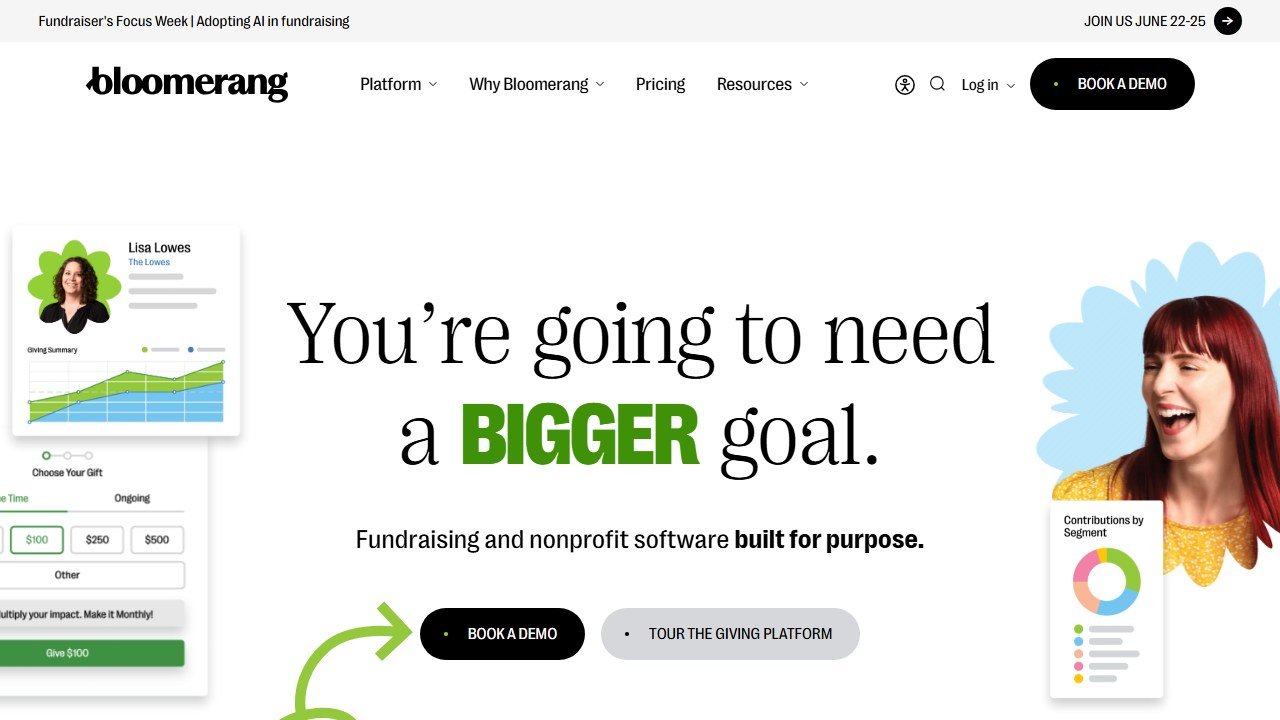
Website: Bloomerang
Usability: 9/10. The UI is the most approachable in the nonprofit CRM category. New users productive within a week.
Donor retention features: 9/10. The retention-scoring layer and engagement-timeline view are category-leading.
AI feature reality: 6/10. Useful, not differentiating. Segmentation and draft generation work; engagement scoring is solid. AI is a feature here, not a strategy.
Integrations: 8/10. Strong with donation platforms (Donorbox, Givebutter, Fundraise Up), email tools, and event platforms. Integration with QuickBooks is the cleanest in the sector.
Pricing transparency: 7/10. Tiered pricing is published but the actual price you pay depends on donor record count, add-ons, and negotiation. Get a quote.
Customer support: 9/10. Among the best in the nonprofit software sector. Phone and email both responsive. Dedicated CSM at higher tiers.
Overall (research-based): 4.1 / 5
What Bloomerang actually does well
The category Bloomerang dominates is donor retention as a strategic operating focus. Three specific strengths.
The retention-scoring system is the differentiator. Bloomerang surfaces every donor with a clear engagement score based on recency of giving, frequency, communication interactions, and event participation. Development directors get a daily dashboard view of who is slipping and who is heating up. The retention frame is built into the workflow rather than bolted on as a report.
The gift entry workflow is the cleanest in the category. Entering a gift, attributing it to a campaign, and triggering an acknowledgment letter is a three-screen flow that takes under two minutes for an experienced user. The same workflow in Salesforce NPSP takes 5 to 10 minutes for the equivalent action. Time savings compound across thousands of gifts per year.
The user experience genuinely respects nonprofit staff. New development hires can be productive within a week of training. Compare that to Salesforce NPSP, where most nonprofits budget 6 to 12 weeks of staff training. The reduced training overhead is not a small benefit. It is often the difference between a CRM that gets used and one that becomes shelfware.
Where Bloomerang falls short
The platform is opinionated about how a nonprofit should operate. The retention-focused worldview is correct for most organizations but constraining for nonprofits with non-traditional models (advocacy organizations, fiscally-sponsored projects, mutual aid networks). If your model does not fit the donor-retention frame, Bloomerang fights you.
The AI features added through 2024 and 2025 are useful but not category-leading. Segmentation works, draft generation produces usable first drafts for acknowledgments and mid-level appeals, and engagement scoring is solid. None of these features are reasons to choose Bloomerang over Virtuous (where AI-driven responsive cultivation is the central operating model). Take Bloomerang’s AI as a useful add-on, not as the reason to buy.
Customization is limited compared to Salesforce. If your organization has unique program-tracking needs, complex grant compliance workflows, or substantial custom-object requirements, Bloomerang’s customization will frustrate you. Salesforce NPSP exists because some nonprofits need that flexibility. Bloomerang exists because most do not.
Pricing scales with donor record count, which becomes painful as your database grows. A 25K-record database is significantly more expensive than a 5K-record database, even if your active engagement is concentrated in a smaller subset. The pricing model rewards aggressive list hygiene, which is fine in principle but can punish organizations that maintain historical records for legitimate reasons.
The AI feature reality in 2026
Bloomerang’s AI additions through 2024 and 2025 fall into three categories:
Donor engagement scoring (genuinely useful): AI-driven scoring that surfaces donors heating up and slipping based on multi-signal analysis. Replaces what was previously a manual quarterly review by development directors. Real time saver.
Draft generation for communications (useful, requires editing): Acknowledgment letters, mid-level appeals, and stewardship updates can be drafted from donor-specific data. Drafts are usable but require human polishing before sending. Treat as a first-draft tool, not an automation.
Segmentation assistance (useful, basic): Natural-language segmentation queries (“show me lapsed donors who gave more than $500 in any of the last three years”). Works but does not differentiate against competitors who have similar features.
What is missing: any kind of predictive major-gift identification, automated campaign optimization, or AI-driven workflow recommendation. For those, you would look at Virtuous CRM’s responsive fundraising features, which are more ambitious AI implementations.
Bloomerang pricing in 2026
Bloomerang publishes tiered pricing on its website, but the actual price you pay depends on donor record count and add-on features. Approximate ranges current to mid-2026:
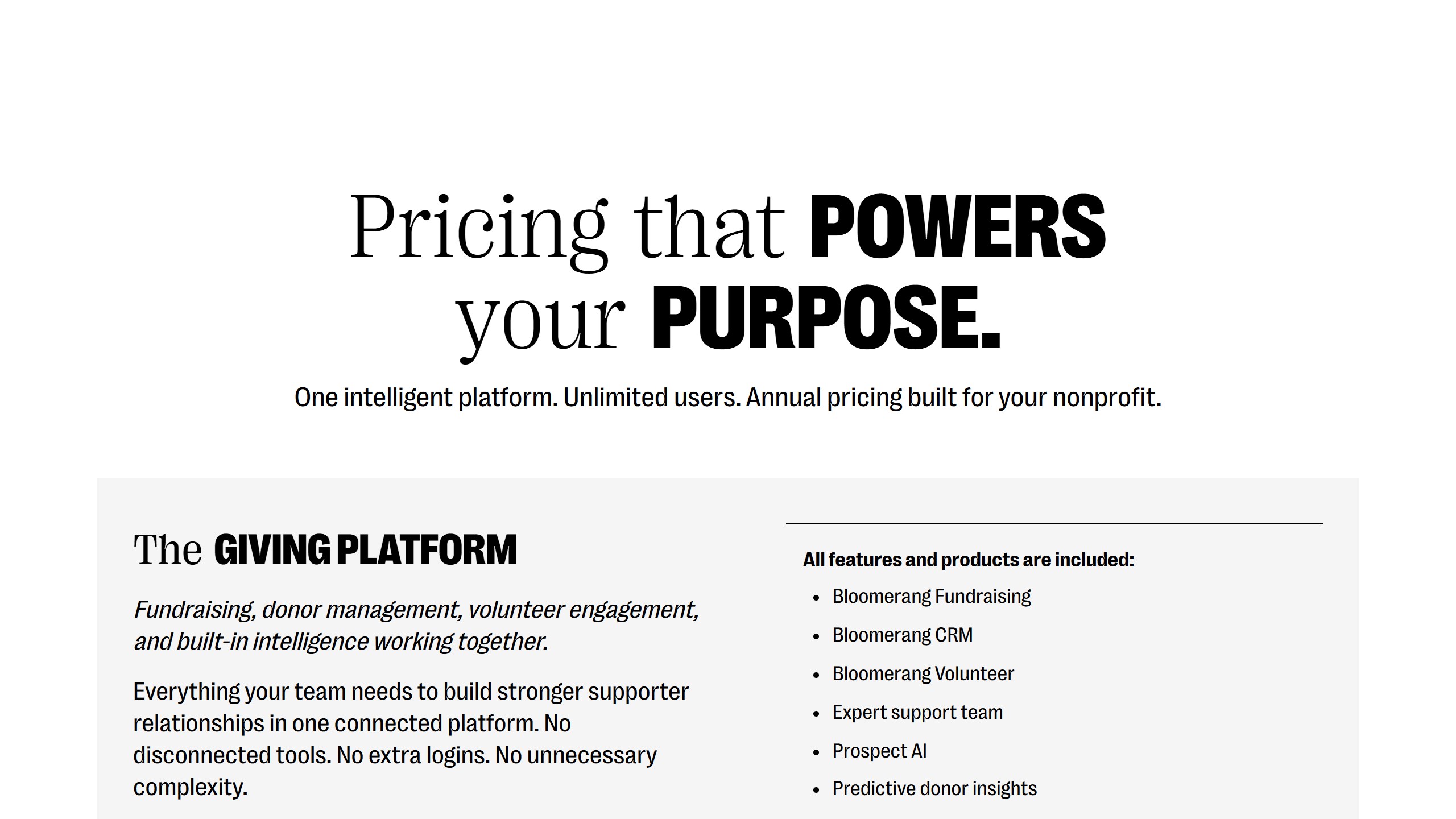
Bloomerang now prices by product, not by record count. Read from bloomerang.com/pricing on 4 September 2026, twice, with identical results:
Bloomerang Fundraising: from $40 a month, billed annually. Donation forms, event management, text fundraising, mobile apps, with auctions and peer-to-peer available on top.
Bloomerang CRM: from $125 a month, billed annually. Donor management, predictive giving insights, marketing and engagement, reporting, data management.
Bloomerang Volunteer: from $119 a month, billed annually. Volunteer onboarding, AI-powered scheduling, communication, screening.
Each of those is a starting price. What it scales on above that is not published, and there are no Essential, Standard, Professional or Enterprise tiers on the page any more. An earlier version of this review set out those four tiers at roughly $99, $199 and $349 a month plus a custom top band, priced by donor record count. That structure no longer exists on Bloomerang’s site, so we have withdrawn it rather than carry it forward.
The practical consequence for buyers: you can find out where Bloomerang starts, but not what it costs at your size. That is competitive with Virtuous CRM at the same scale and significantly less than the all-in cost of Salesforce NPSP (which is “free” but typically requires $10K to $30K in consulting overhead to deploy).
Bloomerang vs the alternatives
The platforms most often compared against Bloomerang in 2026, plus the AI layer we would add on top:
Disclosure: Zilwaris, the consultancy run by AI Tools Bakery’s founder, does paid advisory work for Gratefully, which did not pay for any placement on this page and is assessed on the same criteria as everything else on this site.
Bloomerang vs Gratefully: Not really a head-to-head. Gratefully is an AI donor-intelligence layer that sits on top of Bloomerang (it syncs natively), turning your Bloomerang data into a ranked daily action list with the cited reason behind each, and generating handover dossiers when staff leave. If you want retention scoring inside the CRM, Bloomerang. If you want an AI layer that works your whole portfolio overnight on top of it, add Gratefully. See our AI tools for donor retention guide.
Bloomerang vs Virtuous CRM: Virtuous is more ambitious on AI-driven responsive cultivation, more sophisticated on segmentation, and substantially more expensive. The right fit if responsive fundraising as a strategy is your operating model. Bloomerang is the right fit if you want a usable, sector-specific CRM without the steeper price tag or the operating-model commitment. We cover this in our Virtuous CRM review in detail.
Bloomerang vs Salesforce NPSP: Salesforce NPSP is technically free for nonprofits, but the all-in cost (consulting, training, customization, ongoing maintenance) typically exceeds Bloomerang for organizations under $10M. The customization ceiling is higher with Salesforce, which matters for some organizations. For most $1M to $5M nonprofits, Bloomerang is the better cost-and-usability trade-off.
Bloomerang vs DonorPerfect: DonorPerfect is the legacy nonprofit CRM with deeper customization and older UI. Bloomerang is the modern, more usable alternative. If your organization is renewing DonorPerfect and considering alternatives, Bloomerang is the natural step.
For how a cross source intelligence layer compares, see our Gratefully vs Bloomerang comparison.
Who should buy Bloomerang in 2026
Buy if: You are a $500K to $5M nonprofit. You want a sector-specific CRM with strong retention features. Your team has 2 to 8 development staff who will use the tool daily. You value usability and short training time over deep customization. You want phone-based support that actually answers.
Consider alternatives if: You are under $500K (Bloomerang is overkill, use Donorbox standalone for now). You are over $10M with complex requirements (look at Virtuous or NPSP). Your model is non-traditional and the retention-focused frame does not fit. You need extensive customization for program tracking.
And if the problem is not the CRM at all. Bloomerang is a system of record: it stores what happened and reports on it. That is a different job from deciding who to call on Monday morning. A donor intelligence layer sits on top of whatever CRM you already run and turns the same records into a ranked action list with the reason attached, which is why teams buy one without replacing anything. If your gift data is fine but nobody is working it, that is the purchase to look at first, and it is cheaper than a migration. Gratefully is the tool we rank first for that job and publishes its price openly: free for one person, $99 a month for a single fundraiser, and $499 a month for a five-person team, against Bloomerang from $125 a month for the CRM itself. At the team tier Gratefully is the more expensive of the two and does a different job, which is why we treat it as a layer rather than an alternative. We compare the two directly in Gratefully vs Bloomerang.
Bloomerang from the development officer’s daily workflow
To understand whether Bloomerang fits your organization, picture how a development officer actually uses a nonprofit CRM. The first 30 minutes of her day is checking the donor dashboard for activity since yesterday: who gave, who responded to an email, who is having a portfolio meeting today. The dashboard surfaces this naturally because the retention-scoring engine flags donors heating up or slipping. The same view in Salesforce NPSP requires building 3-4 custom reports.
Mid-morning: gift entry from yesterday’s mail batch. A typical batch is 15-30 checks. In Bloomerang, the data-entry flow is a single screen per gift with the campaign, fund, and acknowledgment template selected in 3 clicks. Time per gift: about 90 seconds. Same flow in DonorPerfect: 3-4 minutes per gift due to UI friction. Across a year, the time savings on gift entry alone justify the price difference for most mid-size orgs.
Afternoon: drafting a mid-level appeal segment. Bloomerang natural-language segmentation (“show me donors who gave between $250 and $2,000 in the last 24 months and have not received a personal solicitation in 6 months”) returns the list in seconds with options to push directly into a Mailchimp segment via the integration. The equivalent query in Salesforce NPSP requires Lightning App Builder or a SOQL query.
End of day: a portfolio review meeting with the ED. The engagement scoring surfaces three donors heating up that the development officer had not yet noticed. One of them gets a cultivation call scheduled for tomorrow. This kind of pattern surfacing is the central value Bloomerang delivers and the reason most mid-size nonprofits picking it stay with it.
What Bloomerang actually costs at your size
We cannot tell you, and neither can Bloomerang’s website. This section previously modelled three organisations at 2,500, 8,000 and 25,000 donor records against named tiers. Those tiers are gone, and nothing published has replaced them, so the model would be invention rather than analysis.
What you can hold a quote against, as at 4 September 2026:
The floor. $125 a month billed annually for the CRM, which is $1,500 a year before anything scales and before you add Fundraising at $40 a month or Volunteer at $119 a month. Running all three at their published entry prices is $284 a month, or $3,408 a year.
The unknown. Every one of those is a “starting at” figure. Ask what drives it up: records, contacts, seats, or emails sent. Ask for the number at your actual record count in writing, and ask what happens to it when you cross the next threshold.
The comparison. Little Green Light publishes its whole ladder, $45 a month at 0 to 2,500 constituents rising in $15 steps, so you can price yourself without a call. Virtuous publishes nothing at all. Bloomerang sits between the two: an honest entry price, an undisclosed slope.
Bloomerang AI features in practice
The 2025-2026 AI features are practical rather than ambitious. Honest read on each.
Engagement scoring is the differentiating feature and the one that drives the most daily value. The score weights gift recency, frequency, communication interactions, event attendance, and email engagement. It surfaces both heating-up donors (lift candidates) and slipping donors (retention risks). In my observation across multiple mid-size orgs using it, the score correlates with actual giving behavior at a useful but not perfect level. Treat it as a starting point for human judgment, not as an automated routing decision.
Draft generation produces acknowledgment letters, mid-level appeals, and stewardship updates with donor-specific personalization. Quality varies: routine acknowledgments are generally good, mid-level appeals require human editing for tone, major-gift personal communications should not use AI drafting at all. Use as a first-draft tool, never as final.
Natural-language segmentation is the most practically useful for development teams who do not have an analyst on staff. The chat-style query builder produces SOQL-equivalent segments without requiring SQL knowledge. Saves real time on routine list pulls.
For how Bloomerang AI stacks up against Virtuous, Neon, Keela, and the rest of the field, see our full comparison of nonprofit CRMs with AI features.
Migration paths: from DonorPerfect, Little Green Light, or Salesforce NPSP
Three common migration patterns into Bloomerang in 2026. Each has a different timeline and complexity.
From DonorPerfect: Most common migration. The Bloomerang data import team handles donor records and gift history with high fidelity. Typical timeline 4-6 weeks contract to live. Plan for 30-40 hours of internal team time on data cleanup before import (deduplication, address standardization). The UX improvement is the biggest win; users productive within a week of go-live versus 3-4 weeks on DonorPerfect.
From Little Green Light: Smaller orgs upgrading. Migration is straightforward, 3-4 weeks. The biggest adjustment is workflow change: LGL is volunteer-friendly with simpler workflows; Bloomerang has more structured workflows that take a week to acclimate to. Worth the change at $300K+ annual giving where LGL starts to feel constraining.
From Salesforce NPSP: Most complex migration. NPSP customers picking Bloomerang are usually doing so to reduce complexity, not to gain features. Plan 6-8 weeks because data structures map imperfectly (custom objects in NPSP need re-modeling in Bloomerang). The decision is right when your team uses 30 percent of NPSP capabilities and pays for 100 percent of its consulting overhead.
What we still cannot honestly assess
I have not run Bloomerang as a development director through a full fiscal year. This review reflects research-based observation across multiple mid-size nonprofits using the platform. Your specific results depend on your team’s adoption discipline and your organization’s fit with the retention-focused operating model. The strongest predictor of CRM success is staff training time invested in the first 90 days, not the CRM’s feature list.
Bloomerang’s competitive position will be tested by Virtuous CRM’s expansion and by integrated platforms (Bonterra, Salesforce NPSP) building deeper AI features. Track the category through 2026-2027 and revisit your CRM choice at major contract renewal points (typically every 3-5 years for mid-size nonprofits).
One more thing: the category’s competitive dynamics
Bloomerang’s market position in 2026 is strong but the broader nonprofit CRM category continues to evolve. Virtuous CRM’s responsive-fundraising approach is gaining traction at the upper end of Bloomerang’s target market. Bonterra (formerly Social Solutions) is integrating multiple acquired tools into a unified mid-market platform. Salesforce NPSP continues to dominate the enterprise tier. Bloomerang’s challenge is maintaining its mid-market sweet spot as competitors push from both ends. Reevaluate at contract renewal points to ensure the tool still fits your organization’s growth stage.
The strategic case for Bloomerang in 2026
Bloomerang’s strategic positioning in the 2026 nonprofit CRM market is as the usability-first mid-market alternative to enterprise platforms. Its differentiator is not feature breadth (Salesforce NPSP has more features) or AI sophistication (Virtuous CRM has more sophisticated AI). The differentiator is that nonprofit development staff actually use it daily, which is the more important property for delivering real fundraising outcomes than feature lists.
Where to learn more about Bloomerang
For pricing, demo requests, and the latest feature releases, visit the official Bloomerang website. Their pricing page has up to date tier details. For their philosophy on donor retention and the data behind their methodology, see the Bloomerang about page.
Alternatives worth comparing: Donorbox for simpler small-org needs, Givebutter for free-first orgs, and Salsa for advocacy-heavy nonprofits.
What we still cannot honestly assess
I have not run Bloomerang as a development director through a full fiscal year. This review is research-based: sourced from Bloomerang’s public documentation, verified buyer reviews on G2 and Capterra, partner case studies, and field observation from development directors at $1M to $10M nonprofits. The verdict reflects how Bloomerang performs in those settings. Your specific results depend on your team’s adoption discipline and your organization’s fit with the retention-focused operating model. Run a structured pilot before treating any review (including this one) as definitive for your organization.
The Bloomerang verdict for 2026 nonprofits
Bloomerang remains the strongest pure-CRM pick for mid-sized nonprofits in 2026, with retention-focused features and clean reporting that outperform competitors at similar price points. The case against Bloomerang: it lacks the all-in-one breadth of Salesforce Nonprofit Cloud or the integrated payment processing of Fundraise Up. For organizations that want a focused, well-built donor management tool, Bloomerang is the right pick. For organizations that want one platform that does everything, consider larger suites.
More AI tool guides worth reading: Gratefully vs Gravyty, Gratefully vs DonorSearch and Bloomerang vs DonorPerfect 2026.
Tools mentioned in this guide
The exit costs nobody quotes you
Switching cost is the reason organisations stay on platforms they have outgrown, and it is almost never discussed during procurement. Three things determine how trapped you are.
Recurring gifts and payment tokens
Donor records and giving history export cleanly from almost any platform. Live recurring schedules and the payment tokens behind them frequently do not. If tokens cannot transfer, every monthly donor has to re-enter card details and a meaningful share will not, so the real cost of leaving is a slice of your most reliable income. Ask about token portability during procurement, in writing, when you still have leverage.
Custom fields and history
Ask what a full export actually contains. Standard fields usually come out fine; custom fields, soft credits, relationship links between households and the audit trail of who changed what often do not. Losing the relationship structure means rebuilding institutional knowledge that took years to accumulate.
Integrations you will have to rebuild
Every connected system, email platform, giving forms, accounting, event tools, is work to reconnect elsewhere. Count them before signing rather than after, because the number is usually higher than anyone remembers and it is the part that turns a two-week migration into a six-month one.
How to tell whether any of this actually worked
The failure mode in this category is not a tool that breaks. It is a tool that runs for a year while nobody can say whether it changed anything. Decide the measurement before you deploy, because after deployment every number is contested.
Pick a baseline you already have, not one you will start collecting
Whatever you measure, you need last year of it, and you need it from a source that was not touched by the project. Gift counts by segment, retention rate by cohort, average gift by channel, and the number of qualified visits per officer are all usually recoverable from the CRM for prior years. A metric that only starts on go-live day cannot show improvement, only activity, and activity is what makes a board sceptical.
Measure the decision, not the output
A propensity model that produces ten thousand scores has produced nothing. What matters is whether the list an officer worked was different from the list they would have worked anyway, and whether that difference showed up in outcomes. The cleanest version is a holdout: take a segment the model ranks highly, work half of it, and leave the other half in the normal rotation. It is unglamorous, it takes two quarters, and it is the only evidence that survives a hostile question.
Retention is the metric that moves last and matters most
Acquisition responds to activity within weeks. Retention responds over a giving cycle, which for most organisations means twelve to eighteen months before a change is legible. Report it, but say plainly at the outset when it will become meaningful, so that a flat number at six months is understood as expected rather than as failure.
Count the hours the thing was supposed to save
Most of the honest value in this category is time rather than income: research that took ninety minutes taking fifteen, a report that took a day taking an hour. Time is measurable if you measure it before, and unprovable if you do not. Ask the two or three people whose work will change to record how long the task takes them this month, before anything is installed. It is the cheapest evaluation you will ever run and almost nobody does it.
Agree in advance what would make you stop
Write down, before purchase, the result at twelve months that would mean you do not renew. Naming it converts a renewal from a default into a decision, and it is the single most effective discipline against the pilot that quietly becomes permanent. If nobody can name a result that would end it, the evaluation was never real.
How this goes wrong in practice, and the warning signs
Four failure patterns account for most of what we hear from organisations a year after purchase. All four are visible early if you know the shape.
The pilot that never ends and never scales
One enthusiastic person runs a tool brilliantly for eighteen months. They leave, and it stops the same week. The warning sign is that nobody else has ever produced the output, and the fix is procedural rather than technical: a second person runs it once a quarter, in the same way, from written steps. If the process only exists in one head, you did not buy a system, you rented a habit.
Output nobody acts on
Scores are generated, reports are produced, and the work continues exactly as before. This is usually a sequencing failure: the tool was chosen before anyone agreed what decision it would change. The test is simple and worth applying before purchase. Name the meeting where the output gets used and the person who will be holding it. If you cannot, the output has no destination.
Trust lost to one visible error
A tool rates a long-standing donor as low potential, a gift officer sees it, and the credibility of every other score goes with it. Almost always the cause is a data structure issue rather than the model: a soft credit missing, a household split, a migration boundary hiding the giving history. Expect this in the first month, plan for who investigates it, and make sure the first person to see an odd score has somewhere to take it other than the corridor.
The cost that arrives in year two
Year one is discounted, implementation is one-off, and the renewal is negotiated by somebody who was not in the original procurement. Uncapped renewals, mid-term expansion at list price, and processing fees growing with your success are the three lines that move. All three are fixable in the first contract and effectively unfixable later, which is why the terms matter more than the discount.
The common thread
None of these is a software failure. Every one is a decision that was not made, or was made by default, before anything was installed. The organisations that get value from this category are not the ones that picked the best product; they are the ones that named an owner, agreed what would change, and wrote down what failure would look like.
Where to go from here
If Bloomerang is on your shortlist:
- Request a personalized demo against your specific use case (the canned demo will not match your reality)
- Get the price quote in writing including all add-ons and record-count tiers
- Verify migration timing and data-import costs from your current system
- Confirm the integrations you need (donation platform, email tool, accounting software) are supported
- Run a 60-day pilot with a subset of your donor base before full migration
For broader context, see our Best AI Tools for Nonprofits overview and the Virtuous CRM review for the most-common competitor comparison.
Bloomerang in 2026 is what mid-size nonprofits actually need from a CRM. A usable, sector-specific tool that respects how development teams work, with AI features that help rather than dominate. It is not the most ambitious CRM in the category. It is the one most likely to actually get used by your team, which is the more important property.
Reviewed by Faz at AIToolsBakery. Independent review, no payment received from Bloomerang or any competitor. Pricing and feature data verified against Bloomerang’s public documentation as of May 2026.

Written by
FazFaz is the founder of AIToolsBakery. Some tools here are tested hands on. Others are assessed from vendor documentation and pricing verified on the live page, and every review says which one it is. Sponsors can buy a position in a guide. They cannot buy the score, the criticism, or silence about a better option.
How we test and how we make money →