Most restaurant marketing fails for one boring reason: nobody has time to do it consistently. The food is great, the regulars are loyal, and the Instagram has not been touched in three weeks. AI does not make your restaurant cool. What it does is remove the friction that keeps a busy operator from showing up, so the marketing actually happens.
We are AIToolsBakery, we are independent, and we sell none of these tools. This guide covers seven AI tools that genuinely help a restaurant market itself, organized by job, with prices read on the vendor’s own pages and a clear note on where each one stops being worth it.
Quick answer: ChatGPT or Claude plus Canva covers most restaurant marketing, from captions and emails to menu copy and review replies, for about $32 a month on US pricing. Add ClipTalk or Nueve for short videos from your own photos, and Owner.com or Popmenu when you want automated guest marketing and your own online ordering.
Faz says: Do not buy a marketing platform to fix a consistency problem you can fix for $20. Most restaurants do not have a tools problem; they have a “we got slammed and forgot to post” problem. A general AI model that writes a month of content in one sitting solves more than any expensive platform you will stop logging into by week three.
The 7 tools at a glance
| Tool | Marketing job | Best for | Price |
|---|---|---|---|
| ChatGPT | Captions, emails, menu copy, review replies | The bulk of the writing | Free; Plus $20/mo |
| Claude | The same writing jobs | Long drafts in a consistent voice | Free; Pro $20/mo, or $17/mo billed yearly |
| Canva | Graphics, menus, signage, simple video | All visual content | Free; Pro US$144/yr |
| Owner.com | Website, ordering, app, automated marketing | Independents moving orders off the apps | $249/mo plus 5% per order, or $499/mo flat |
| Popmenu | Website, interactive menu, guest marketing | Marketing that runs itself, plus reviews | From $159/mo, prepaid annually |
| ClipTalk | Short videos from your website or photos | Reels and TikTok without filming | 50 free credits; from $39/mo |
| Nueve | Dish videos, posts, scheduling, publishing | Restaurants happy with its fixed halal content rules | 1 free video; Go $39/mo, $19 on offer |
Social media and content
This is where most restaurants want help, and where a cheap general AI model earns its keep fastest. The realistic win is consistency: AI removes the “I do not know what to post” friction so you actually show up every week. Your real food photos and your actual voice remain the entire differentiator in a feed full of restaurants, so use AI for the first draft and the grind, never as the final voice.
ChatGPT and Claude: the writing workhorses
ChatGPT and Claude will write a month of captions, turn a new dish into five posts, draft your story polls, and brainstorm a campaign around a slow Tuesday, all in the time it takes to prep mise en place. They do the same for email newsletters, event announcements, menu descriptions and review replies, which is why one of them sits at the center of almost every lean restaurant stack.
The trick is to feed them your restaurant, not a blank prompt. Paste in your menu, a few past posts that did well and two or three lines about your tone, then ask for a four-week posting calendar with captions. The output gets noticeably less generic once the model has your dishes, your prices and your way of talking to work from.
Both have free tiers that are enough to start. ChatGPT Plus is $20 a month according to OpenAI’s help center, and Claude Pro is $20 a month, or $17 a month billed yearly, on Anthropic’s pricing page. The honest limit: raw output reads like every other restaurant, so always edit before you post, and never paste guest names or contact details into a chatbot.
Canva: graphics, menus and simple video
Canva pitches itself on its own homepage as the place to make AI-powered social posts, videos and presentations. For a restaurant that means specials boards, printable and PDF menus, event posters, Reels covers and story templates built from your phone photos, with your colors and fonts saved so every post looks like you.
The free plan covers a lot. On Canva’s US pricing page, Pro is US$144 a year for one person, and Canva shows different prices in different countries, so check what it charges where you are. The limit: Canva’s templates are used by thousands of other restaurants, so change the layout and use your own photos rather than the stock food shots.
Email, text and automated guest marketing
Your guest list is the most valuable marketing asset you own, because reaching it costs nothing and it is full of people who already like you. This is where the restaurant-specific platforms earn their price: campaigns that run without you remembering to send them, aimed at turning first-timers into regulars and pulling orders off the delivery apps.
Owner.com: website, ordering and marketing for independents
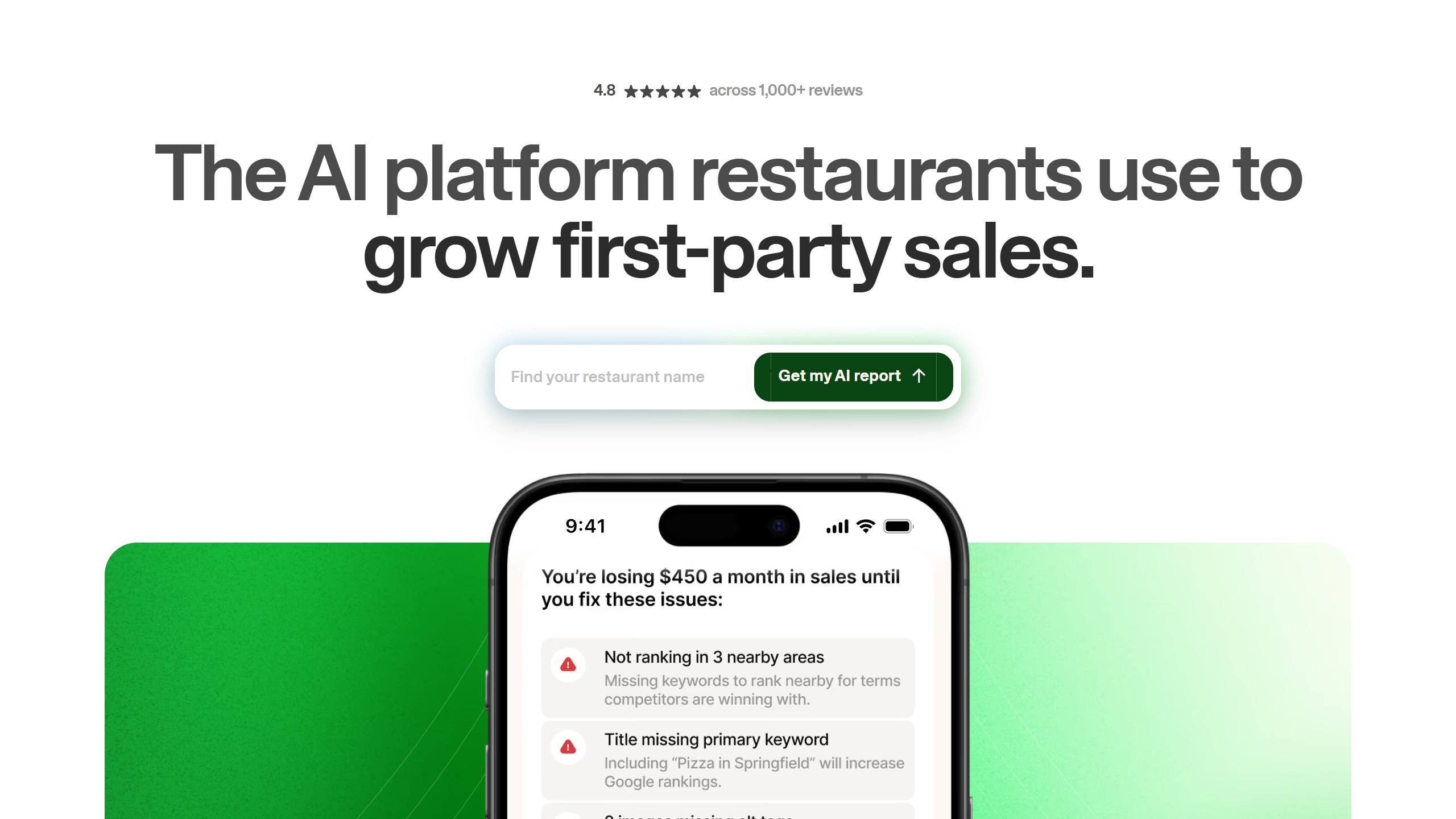
Owner.com is built for independent restaurants. Its pricing page lists the same platform on every plan: an AI-optimized website, online ordering, a branded mobile app, automated SEO pages, loyalty and rewards, direct catering orders, and AI-powered email and text campaigns that run on their own, with setup and migration handled for you and month-to-month billing with no long-term contract.
There are two prices. Flexible is $249 a month plus a 5% restaurant fee on each order, and Flat Rate is $499 a month with no per-order fees, which Owner.com recommends for restaurants doing $5,000 or more a month in online sales. That threshold is simple arithmetic: 5% of $5,000 is $250, exactly the gap between the two plans, so above it the flat plan is cheaper.
The limit: Owner.com wants to run your whole digital front door, website and ordering included, so it suits restaurants ready to move off a cheap site builder, not ones that only want better Instagram. For the ordering side specifically, see our restaurant online ordering systems comparison.
Popmenu: interactive menus and marketing that runs itself
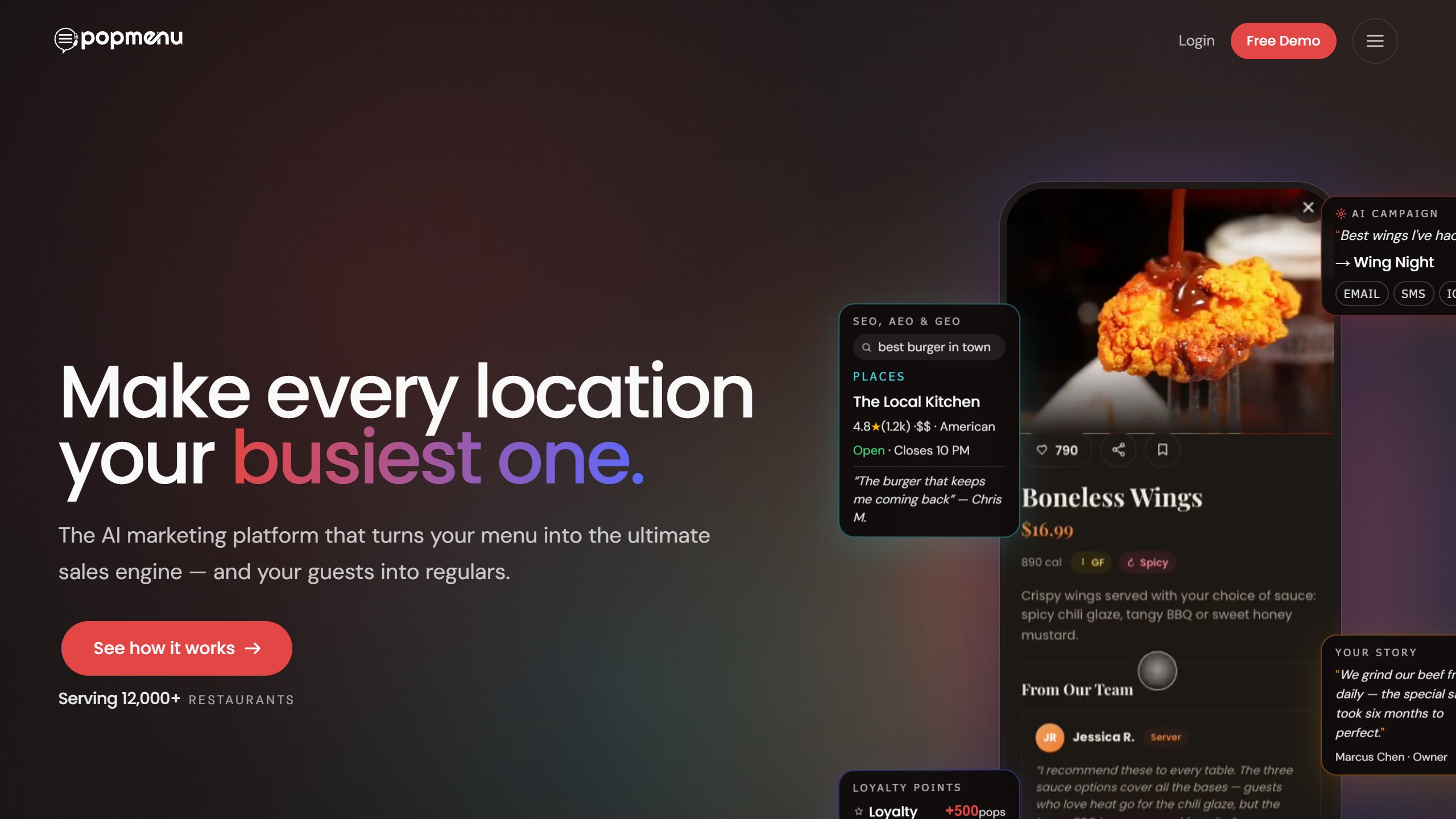
Popmenu calls itself an AI marketing platform and says it serves more than 12,000 restaurants. Its three plans are priced per month, prepaid annually. Starter, at $159, covers an SEO-driven website, an interactive menu, Google Business Profile sync, guest contact collection, automated email marketing, dish reviews and responses, and an OpenTable integration. Essentials, at $269, adds mass email campaigns, social posting, 500 text messages and AI-crafted emails and social posts. Premier, at $449, adds 5,000 text messages, audience segmentation, a digital waitlist and reservations, guest feedback, reputation management and AI-crafted review replies.
Read the add-on line carefully: online ordering and catering, and AI phone answering, are add-ons on every plan rather than included. If phones are your bottleneck, compare it with the dedicated tools in our AI phone answering for restaurants guide.
The limit for both platforms: automation amplifies whatever you feed it. A platform sending generic blasts will train your guests to ignore you. The restaurants that win send genuinely useful, well-timed messages, a real offer, a new menu, an event, not noise.
Short-form video
Reels and TikTok reward restaurants that post video, and filming and editing is exactly the job a busy kitchen never gets to. This is where a newer kind of AI tool fits: one that turns material you already have into a finished short video. Both tools below start from your photos, but they make very different videos.
ClipTalk: short videos from your website or food photos
ClipTalk turns a link or your own photos into a captioned, narrated vertical video through an AI agent. We tested it with credits ClipTalk provided. On 23 October 2026 we pointed it at the website of Katz’s Delicatessen, the New York deli. It read the page, saved 8 of the deli’s photos, got the selling points right (open since 1888, hand-carved pastrami, nationwide shipping), asked who the video was for and how long it should be, then wrote a six-scene, 30-second script in the deli’s voice.
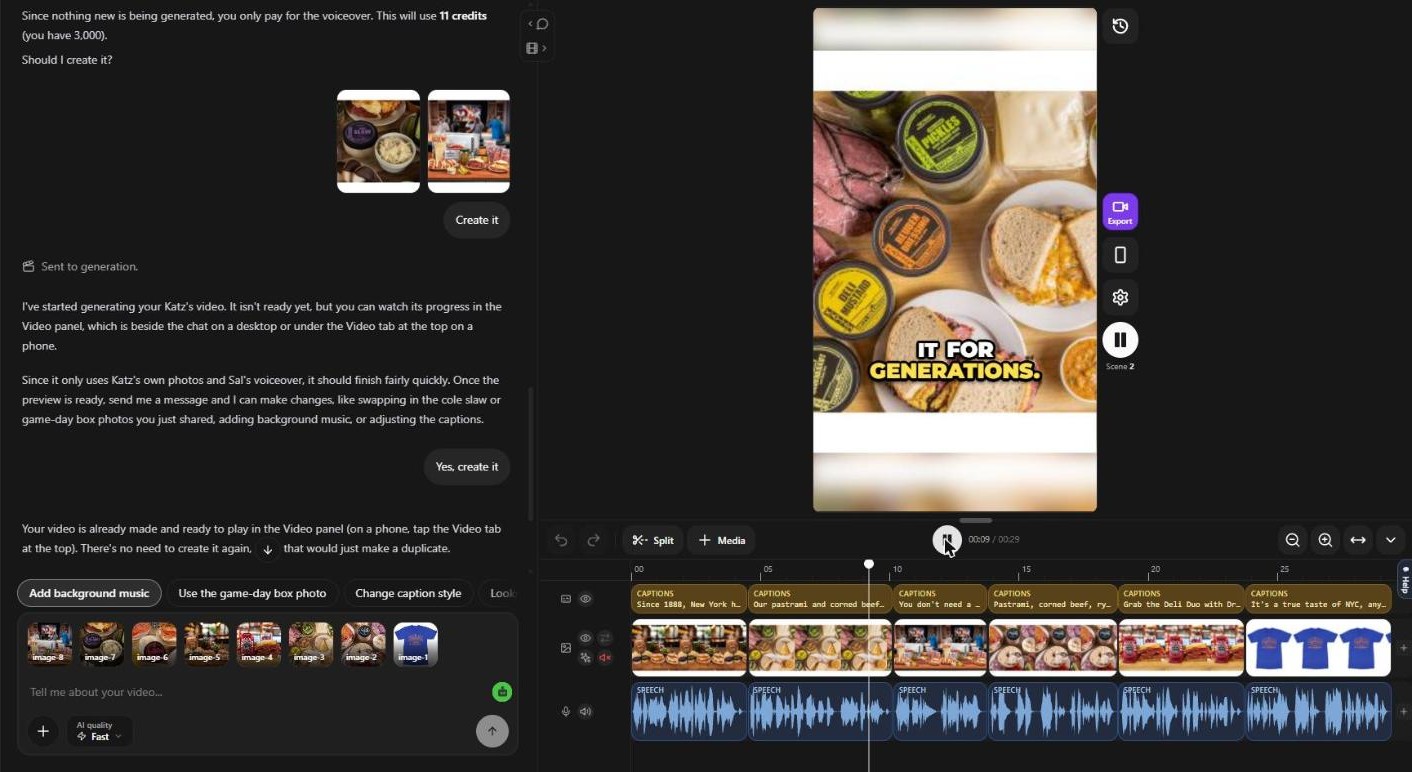
Its visual options were AI clips, AI images or motion graphics, so we had to type in that we wanted the restaurant’s own photos. It then built a 29-second video from them with bold captions and a narrator, quoting 11 credits for the voiceover. Two things to fix in its editor: the landscape photos sit inside the vertical frame with bands above and below, and it put a T-shirt photo behind the final “order now” line. We did not export the file, so we cannot comment on the watermark or the final render.
New accounts get 50 free credits, with a watermark on free videos; Starter and Pro are both $39 a month (Pro cut from $99) for 8,000 and 14,000 credits, and Ultra is $199 a month. A 30-second video used about 11 credits from existing photos in our test, and AI visuals cost far more. ClipTalk could not name a restaurant customer when we asked, as most of its users are small brands and creators.
Nueve: dish videos with fixed content rules
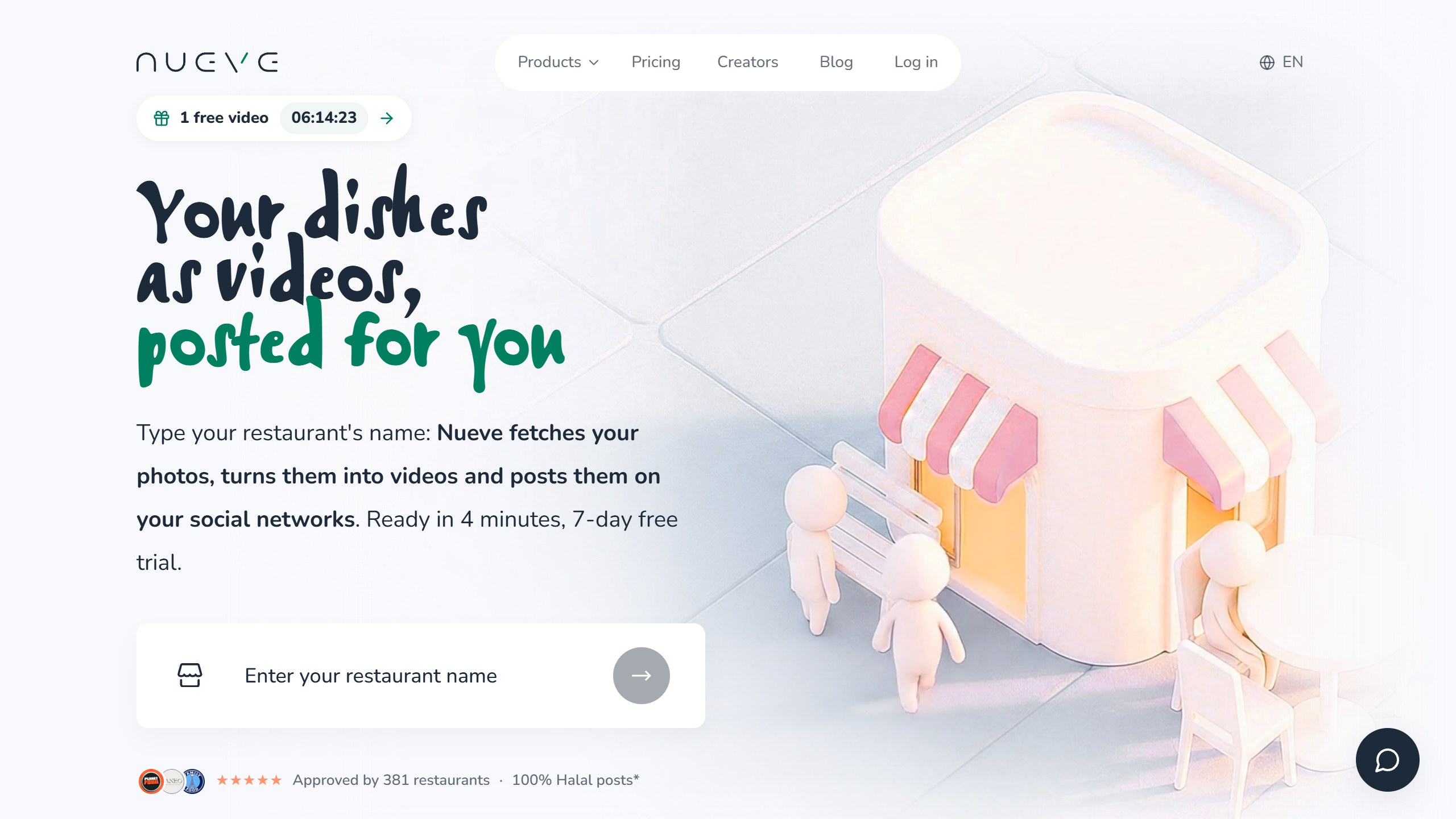
Nueve is built only for restaurants. It turns your photos into videos, carousels and images, then schedules and publishes them, and its plans add a website, Google review replies, flyers and food-cost tools. Its pricing page lists Go at $39 a month, Plus at $99 and Pro at $199, with a countdown offer of 50% off that brought them to $19, $49 and $99 when we read it. Go covers 6 videos, 10 carousels and 10 images a month, and Pro covers 30 of each. Its FAQ says the 7-day trial needs a card, though our account made one free video without a card or a plan.
What we found. We set up a clearly made-up restaurant with free-licensed photos, generated one video, and did not publish it or connect a social account. The result was an 11-second vertical clip of miniature workers using a toy crane to lower the dish into its bowl, with no voice-over, a text hook and a closing card crediting Nueve. It is eye-catching, and the dish, bowl and room stayed recognisable from our photos. It took about 17 minutes against the 13 the app estimated.
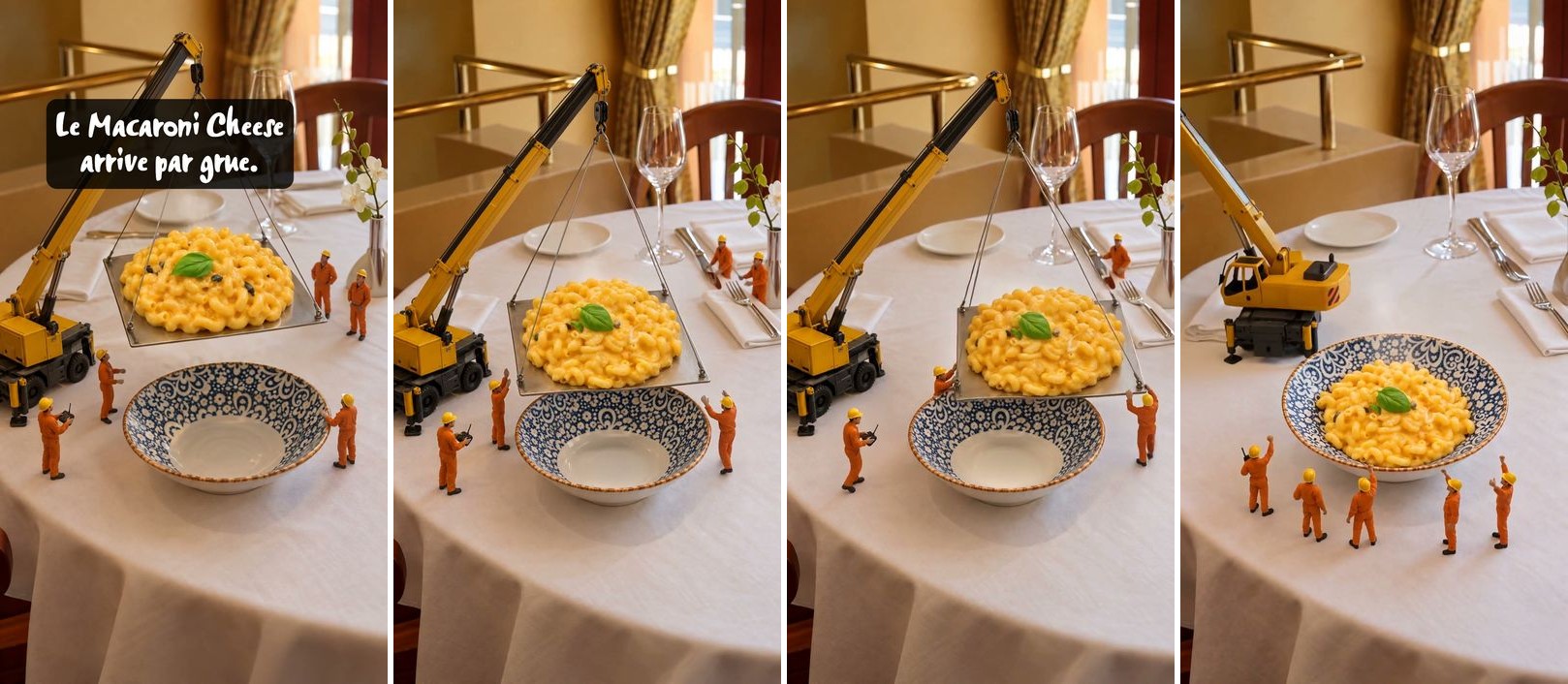
The AI needs checking on food. It labelled a pasta with potato and provola as “Macaroni Cheese” and described it as fresh macaroni in a creamy cheese sauce, details it had no way of knowing. The caption came out in French, because generated content follows the country of the restaurant and our made-up address had none, so set this correctly on a real account. It also picked up our test town as a hashtag.
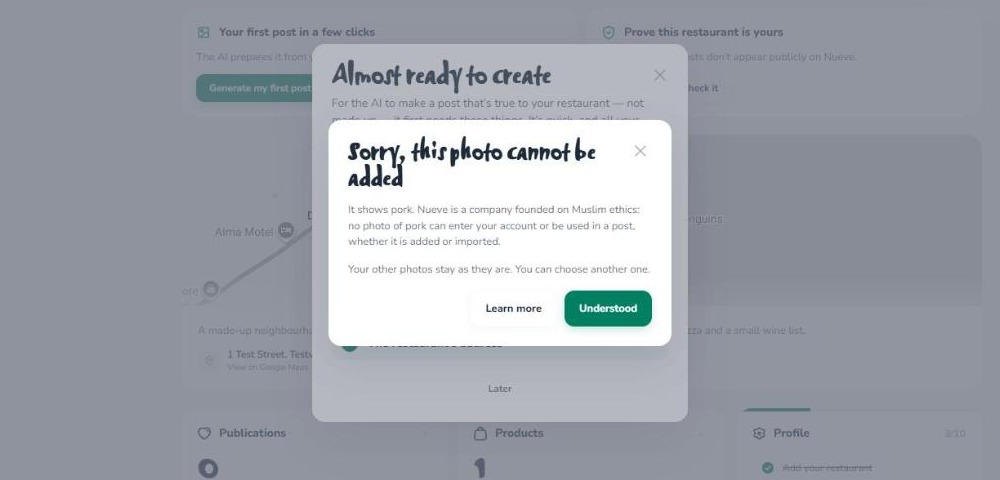
Read this before you buy. Nueve’s terms say everything it creates follows fixed rules that cannot be turned off: no pork, no alcohol, modest clothing, no gambling or nightlife, and no musical instruments, with percussion and voices only. It also refuses any photo showing pork. Our first test photo, a tagliatelle it labelled Bolognese, was blocked this way. That suits many restaurants well and rules out others, such as a wine bar or a place known for its pork dishes. Its terms also say “100% Halal posts” describes the content rules and is not a certification of your restaurant.
Two more limits. The site lists six networks and sells Go on one-click publishing to TikTok and Instagram, but in our account Instagram and Facebook were marked “Back soon”, leaving TikTok, YouTube, Google and LinkedIn, with the last three locked until you take a plan. And we would not rely on its “Approved by 381 restaurants” line, since we could not verify it. One free video also cannot show how varied its posts are over a month.
Reviews and reputation
Reviews are marketing whether you manage them or not, and AI makes managing them realistic. A general AI model drafts calm, on-brand replies at scale: a warm thank-you to the five-star regular, a measured, non-defensive response to the one-star that does not make you look worse. Paste the review in, ask for a reply in your voice, edit, post. What used to be a dreaded hour becomes ten minutes. If you would rather not paste reviews in by hand, Popmenu’s Premier plan lists reputation management and AI-crafted review replies.
The discipline that matters: never paste a guest’s personal details into a tool you have not vetted, and always read every AI-drafted reply before it goes live. A reply that sounds robotic or misses the actual complaint does more damage than no reply. AI gets you to a calm first draft; your judgment makes it right.
Website, online ordering and SEO
Your website is your highest-intent marketing channel: the person searching your name is ready to order or book. Owner.com includes online ordering on both plans, while Popmenu sells it as an add-on. Either way, orders through your own site avoid the delivery apps’ commission, though Owner.com’s Flexible plan charges its own 5% per order. A general AI model helps with the words: menu descriptions that sell, an “about” page with actual personality, and local SEO copy that helps you show up for “best tacos near me”.
For getting found in AI search and chatbots, an increasingly real source of “where should I eat” questions, the same fundamentals apply: clear, accurate, well-structured information about your hours, location, menu and what makes you worth the trip. We cover that channel in our generative engine optimization guide.
A one-hour weekly AI marketing routine
Tools only help if they fit into a week that is already full. This is a simple routine a busy owner or manager can run in about an hour, using only the lean stack above.
Monday: plan the week in ten minutes
Open ChatGPT or Claude and give it the week’s facts: specials, events, anything new on the menu, the weather forecast and which nights are usually slow. Ask for a seven-day plan with one post a day, one email to your list and one idea to fill the slowest night. Keep the plan, cut what does not fit, and you know exactly what to shoot.
During service: shoot the photos
The single biggest quality lever is real photos. Ask whoever is on the pass to take three or four phone shots of each dish in the plan in good light. Ten minutes of photos during a quiet moment beats an hour of stock images later, and it is what stops AI-assisted marketing from looking like everyone else’s.
One sitting: batch the content
Back at the model, paste the plan and ask for the captions in your voice, then drop the photos into a Canva template you have already saved with your colors and fonts. If you want one video for the week, give ClipTalk your best photos and the week’s hook. Schedule everything at once, so nothing depends on remembering to post on a busy Friday.
Friday: reviews and a quick check
Paste the week’s new reviews into the model and ask for short replies in your voice, then edit and post them yourself. Look at which post got the most saves, shares or orders and tell the model next Monday, so the plan slowly learns what your guests actually respond to.
How to choose
Start lean and add tools only when a real problem appears:
- Every restaurant: ChatGPT or Claude for all the writing, plus Canva for every graphic. On US pricing that is about $32 a month with ChatGPT Plus and Canva Pro, and both have free tiers to start.
- You want more video: add ClipTalk and build videos from your own photos, which keeps the credit cost low. Nueve suits restaurants that want posts made and scheduled for them, and that are happy with its fixed content rules.
- Delivery apps take a big share of your orders: look at Owner.com, and do the 5% arithmetic on your own online sales before picking a plan.
- You want marketing that runs itself, plus reviews and reservations: look at Popmenu, and price in the ordering add-on if you need it.
Add a platform when growth, not guilt, is driving the decision. If you are building the wider operator stack, from POS to scheduling, start with our best AI tools for restaurants guide.
How we researched this guide
This is a research-based guide, with two exceptions. We read every price on the vendor’s own pages: Owner.com, Popmenu, Claude and ClipTalk from their pricing pages and ChatGPT Plus from OpenAI’s help center, rechecked on 3 November 2026, Canva from its US pricing view on 23 October, because it showed us regional prices on the recheck, and Nueve on 3 November. The ClipTalk section comes from a video we made on 23 October with credits it provided, and the Nueve section from one free video we made on 3 November with a made-up restaurant. We have not run restaurant campaigns through Owner.com or Popmenu ourselves, so their sections describe what their pages list. No vendor paid to appear in this guide.
Our verdict
Restaurant marketing does not fail for lack of tools. It fails for lack of time and consistency, and that is exactly what AI fixes. Start with ChatGPT or Claude and Canva to show up every week without the friction, add ClipTalk or Nueve if you want video without filming, and bring in Owner.com or Popmenu when you are ready to automate guest marketing and take your online ordering back from the apps. Keep your real voice and real food at the center, and let AI handle the grind around them.
Sources
- OpenAI help center: What is ChatGPT Plus
- Claude pricing
- Canva pricing (US view)
- ClipTalk pricing
- Owner.com pricing
- Popmenu pricing
- Nueve pricing and terms, section 18

Written by
FazFaz is the founder of AIToolsBakery. Some tools here are tested hands on. Others are assessed from vendor documentation and pricing verified on the live page, and every review says which one it is. Sponsors can buy a position in a guide. They cannot buy the score, the criticism, or silence about a better option.
How we test and how we make money →