A few years ago, the goal of every content team was simple to state. Rank on page one of Google, earn the click, win the customer. That sentence still matters, but it now describes only part of the job. A growing share of the questions people used to type into a search box are answered inside ChatGPT, Perplexity, Google AI Overviews, Gemini, and Microsoft Copilot, and those tools often answer in full without sending anyone to a website at all. When the answer is the destination, the new question becomes obvious. How do you get your brand, your page, and your facts into that answer?
That is the problem generative engine optimization tries to solve. GEO is the practice of shaping your content, your structure, and your reputation across the web so that generative AI systems understand you, trust you, and quote you when they synthesize a response. It overlaps with classic SEO in places, breaks from it sharply in others, and it is moving fast enough that most of what was written about it eighteen months ago is already stale. This guide is our attempt to give you the durable version: what GEO actually is, how it differs from SEO and from answer engine optimization, how the major engines really pick the sources they cite, the practical playbook we use, how to measure any of it, and where the honest limits are.
We have skin in this game, which is the whole point of writing it ourselves rather than summarizing someone else’s slide deck.
A note on our independence. We are AIToolsBakery, an independent AI-tools review site. Our own niche is AI search, so we do not just write about GEO, we practice it on this site. We ship an auto-refreshed llms.txt at our root, we write self-contained answer capsules at the top of our posts, we mark up our content with schema, and we test the AI-visibility monitoring tools we recommend with real budget rather than vendor demos. Everything below is filtered through what we have actually seen move, and what we have seen do nothing. When a post on this site is sponsored, it is labelled sponsored at the top, and a sponsorship never changes a verdict. This guide is not sponsored. We take no vendor money to move a recommendation, and the only agenda here is helping you make good calls about where your effort goes.
The short version: GEO is optimizing your content and reputation so generative AI engines cite you in their answers, not just so search engines rank you. It shares SEO foundations but optimizes at the fact level, rewards clear self-contained answers, schema, freshness, and mentions across trusted sites like Reddit, Wikipedia and G2. It does not replace SEO. It extends it.
What generative engine optimization is
Generative engine optimization is the discipline of making your content the kind of thing a large language model will pull into its answer. The term was coined in academic work, not in a marketing blog. The first peer-reviewed paper on the subject, titled “GEO: Generative Engine Optimization,” came out of a collaboration between researchers at Princeton University, Georgia Tech, the Allen Institute for AI, and IIT Delhi, and it was presented at KDD 2024, the ACM SIGKDD conference. The authors built a benchmark of roughly 10,000 queries and tested nine optimization techniques to see which ones actually increased a page’s presence inside AI-generated responses. That paper is the reason anyone uses the phrase at all, and it is still the most credible starting point for the field.
The mental model that helps most is this. A search engine returns a ranked list of pages and asks you to click. A generative engine reads across many pages, decides which facts and phrasings to trust, writes a single synthesized answer, and may or may not show its sources. SEO optimizes for the first behaviour, getting your page into the ranked list. GEO optimizes for the second, getting your facts into the synthesized answer and your name onto the citation chip. Those are related problems, but they are not the same problem, and treating them as identical is the most common mistake we see.
There is a second reason GEO is its own discipline. In classic search, visibility and traffic move together. If you rank, you get clicks. In generative search, the link between visibility and traffic is weaker, because the engine often satisfies the user inside the answer. You can be the most-cited source on a topic and still see modest referral traffic from it. That changes what you are optimizing for. The win is being present, trusted, and named in the answer, which builds awareness and authority even when the click does not arrive. If you measure GEO purely by referral sessions, you will conclude it does nothing, and you will be measuring the wrong thing.
GEO vs SEO: a clear comparison
SEO and GEO are siblings, not rivals. They share a spine. Both reward genuine authority, clear writing, fast clean pages, and content that actually answers the question. The differences show up in the unit of optimization, the signals that matter most, and the way you measure a win. The table below lays out how we think about them side by side.
| Dimension | SEO (classic search) | GEO (generative engines) |
|---|---|---|
| Primary goal | Rank a page in the results list | Get cited and named inside the AI answer |
| Unit of optimization | The page | The fact, claim, passage, or capsule |
| What wins the click or citation | Title, headings, topical depth, links | Clear extractable answers, sources, quotes, stats |
| Role of keywords | Central, you target query strings | Looser, engines work at the level of meaning and entities |
| Role of structured data | Helpful for rich results | Helpful for machine comprehension and extraction |
| Freshness | Matters for some queries | Matters more, several engines weight recency heavily |
| Off-site signal | Backlinks | Mentions and citations across sites the AI trusts |
| Main success metric | Rankings, organic clicks, impressions | Share of voice in answers, citation count, mentions |
| Traffic relationship | Visibility drives clicks | Visibility may not drive a click at all |
| Determinism | Fairly stable rankings | Non-deterministic, answers vary by phrasing and run |
Read the table top to bottom and a pattern emerges. SEO is a page-level, query-level, link-driven, click-measured discipline. GEO is a fact-level, entity-level, mention-driven, presence-measured discipline. The reason the two keep getting bundled together in the same articles, and the same buyer conversations, is that the foundational work overlaps so heavily. A page that is well-structured, deeply researched, properly marked up, fast, and widely cited tends to do well in both worlds. You do not throw away your SEO program to do GEO. You extend it.
The most important row in that table is the last two. Because generative engines are non-deterministic and because they often answer without a click, the feedback loop you are used to from SEO breaks. You cannot refresh a rank tracker and watch a number climb the same way. This is not a reason to ignore GEO. It is a reason to measure it differently, which we get to further down.
For the engine-specific versions of this, we keep two companion guides current: how to rank in ChatGPT and how to show up in Google AI Overviews. This cornerstone is the map. Those are the turn-by-turn directions for the two engines that matter most to the largest number of readers.
GEO vs AEO: the brief version
You will see a third acronym thrown around constantly, AEO, for answer engine optimization. It is worth understanding the distinction, but it is worth understanding it briefly, because the gap between GEO and AEO is smaller than the gap between either of them and classic SEO.
Answer engine optimization is the practice of structuring content so it gets extracted as a direct answer. Think featured snippets, the People Also Ask box, voice assistant replies, and the short direct answers at the top of an AI result. AEO is about being the clean, liftable answer to a specific question. Generative engine optimization is broader. It is about being the source the engine chooses to synthesize from and credit when it writes a longer, multi-source response, the kind you get from ChatGPT or Perplexity rather than a one-line snippet.
In practice the two share most of their tactics. Both want clear questions answered concisely near the top of the content, both want structured data, both want unambiguous facts. The useful way to hold the difference: AEO makes your content easy to extract, GEO makes the engine prefer you over a competitor when it weighs which sources to trust and name. Some teams have collapsed the two into one label because the daily work looks so similar. We are comfortable treating GEO as the umbrella and AEO as the part of GEO that targets short, extractable, direct-answer formats. Do not spend a meeting arguing about the taxonomy. Spend it on the work, which is mostly the same either way.
How AI engines actually pick the sources they cite
This is the section everyone wants and the section most articles get wrong, because they describe one engine and pretend it describes all of them. The single most important thing to understand in 2026 is that the engines do not agree with each other. A 2026 analysis found that only about 11 percent of domains cited by ChatGPT were also cited by Perplexity, which tells you these systems run on genuinely different citation logic. Brand citation rates between platforms have been measured as differing by an order of magnitude in studies of the same queries. There is no single algorithm to game. There are several, and they behave differently.
That said, a handful of signals recur across all of them, and a handful of per-engine quirks are stable enough to plan around.
The signals that recur everywhere
Across every major engine, the same broad qualities keep correlating with getting cited. Clarity and structure, so the model can find and lift a clean answer. Specific, verifiable, sourced claims rather than vague assertions, because models are biased toward content that looks checkable. Original data, statistics, and direct quotations, which the Princeton work singled out as among the highest-impact techniques it tested, with citation-source, quotation, and statistics additions delivering the largest visibility gains in their benchmark. Genuine topical authority and experience signals, the same E-E-A-T qualities Google has pushed for years. And freshness, because most engines now visibly favour recently published or recently updated material.
The other recurring truth is off-site. Brands that win in AI answers are usually not winning because of anything on their own domain. They are winning because they are mentioned and cited consistently across the third-party sites the models lean on. Reddit, Wikipedia, YouTube, G2, Capterra, industry media, and major publishers show up again and again as the substrate AI engines draw from. If those sites talk about you accurately and often, the engines learn the association. If they are silent on you, your beautifully optimized page is fighting uphill.
How the major engines differ
The table below summarizes how the five engines most of our readers care about retrieve and choose sources, based on what each company has disclosed and what independent citation studies have measured in 2026. Treat the percentages in the surrounding research as directional, not gospel, because they shift fast.
| Engine | How it retrieves | What it appears to favour |
|---|---|---|
| ChatGPT | Training data plus live web search via its search partner, leaning on web search more for commercial-intent queries | Third-party presence on sites like G2 and Capterra, structured formatting, FAQ markup, answers placed early in the page |
| Perplexity | Real-time web search on essentially every query, no fixed knowledge cutoff | Recency, heavy use of Reddit and community sources, question-structured content with visible methodology, many citations per answer |
| Google AI Overviews and AI Mode | Draws on Google’s index, then fans a question out into many sub-queries and pulls passages, not whole pages | Passage-level clarity, semantic completeness, structured data, multimodal content, strong YouTube presence |
| Gemini | Google grounding via search, shares plumbing with AI Overviews | Similar to AI Overviews, with consistent surfacing of large authority publishers |
| Microsoft Copilot | Bing-grounded retrieval | Bing-indexed authority, clear structured pages, freshness |
Two engine behaviours deserve a closer look because they change how you write.
Google’s AI Overviews and AI Mode use a technique usually called query fan-out. When someone asks a complex question, the system silently breaks it into many smaller sub-questions, runs them in parallel, and synthesizes the results. Crucially it pulls passages rather than pages. A tight forty to sixty word passage that directly answers one sub-question is far more likely to be cited than a three thousand word article with no clear answer boundaries. That is a structural instruction, not a vague suggestion. Write self-contained answer blocks that each resolve one specific question, and you give the fan-out something to grab. One more wrinkle worth knowing: studies through early 2026 found that AI Overviews and AI Mode, both Gemini-powered, frequently reach the same conclusion while citing different URLs, so ranking in one does not guarantee the other.
Perplexity sits at the opposite end on freshness. It searches the live web for nearly every query and visibly prefers recent material, with studies finding a large share of its citations come from content published very recently. It also leans unusually hard on community sources. If your category is discussed on Reddit, your presence in those threads matters more for Perplexity than for any other engine.
The honest summary is that you cannot optimize for one engine and assume the rest follow. You optimize for the recurring signals, which cover most of the ground, then you make targeted moves for the specific engines where your audience actually is. Our how to rank in ChatGPT and how to show up in Google AI Overviews guides go deep on the two biggest.
The practical GEO playbook
Here is the work, in the order we would do it. This is the same checklist we run on our own posts. Nothing here is theoretical. Everything here is something we have shipped on this site.
1. Entity clarity and consistent positioning
An engine has to know who you are before it can recommend you. That sounds obvious and it is the step most brands skip. You want one consistent answer, repeated across every surface, to the question “what is this and what is it for.” Your site, your About page, your social profiles, your Wikipedia entry if you have one, your listings on directories, and the way third parties describe you should all say roughly the same thing in roughly the same words. Inconsistency confuses the entity. If half the web calls you an AI writing tool and the other half calls you a content marketing platform, the model has a fuzzier idea of when to surface you.
Practically, this means writing a crisp, repeatable one-line definition of what you are, and using it everywhere. It means making sure your name, category, and key facts are stated plainly in text the crawlers can read, not buried in an image or a video. And it means keeping the story consistent over time, because the model’s idea of you is an average of everything it has seen.
2. Write citable, self-contained answers
This is the highest-leverage on-page move, and it is the one we feel most confident about because we watch it work. The pattern is simple. Identify the specific questions in your topic, then answer each one in a short, standalone block that makes sense even when lifted out of the page with no surrounding context. That is exactly what an answer capsule is, the short bolded summary near the top of this very post.
A good answer capsule is sixty words or fewer, states the answer first, and does not depend on the sentence before it. The same pattern applies to every sub-section. When a generative engine fans a query out and goes looking for passages, you want each of your sections to be a clean, quotable, self-sufficient answer. Write the way you would want to be quoted. Lead with the conclusion, support it with a specific fact, and avoid the throat-clearing intro that pushes the actual answer to paragraph four. The Princeton research found that adding sources, quotations, and statistics were among the strongest techniques for lifting AI visibility, so weave real numbers and named sources into those answers rather than leaving them as bare assertions.
3. Structured data and schema
Schema markup is how you hand the machine a clean, labelled version of your content. Article, FAQPage, HowTo, Product, Organization, and Breadcrumb schema all help engines parse what your page is and what it asserts. We mark up every post, and we treat FAQ schema in particular as load-bearing, because question-and-answer pairs map almost perfectly onto how people prompt AI assistants. Schema will not save weak content, but it removes ambiguity from good content, and removing ambiguity is most of the GEO battle. Make sure your structured data validates and matches what is actually on the page, because mismatches get ignored at best and penalized at worst.
4. llms.txt, with realistic expectations
We ship an auto-refreshed llms.txt at our root, regenerated at the end of every publish run, and we recommend most content sites do too. But we want to be straight with you about what it does and does not do, because there is a lot of hype here. An llms.txt file is a plain-text map of your most important pages, grouped by topic, that you place at your domain root for AI systems to read. The honest 2026 picture: adoption sits in the low double digits across the web, no major AI lab has publicly committed to using it as a ranking input, and large-scale crawl studies have found very few bots actually requesting the file. If someone tells you llms.txt is the secret to AI visibility, they are overselling it.
So why do we still ship one? Two reasons. First, it is nearly free to maintain once automated, and a clean machine-readable index of your best content is good hygiene regardless of who reads it. Second, the clearest real value is in the agentic layer, where coding assistants and AI agents pointed at a site genuinely look for llms.txt to fetch relevant context. We treat it as cheap infrastructure with optional upside, not as a growth lever. If you want the implementation details, we wrote them up in how to write an llms.txt. Do it, automate it, and then forget about it. The wins in GEO are elsewhere.
5. Earn mentions and citations across the sites AI trusts
This is the off-site half of GEO, and for most brands it is where the real movement comes from. The engines learn who matters by reading the web, and they lean disproportionately on a small set of trusted sources. Getting your brand discussed accurately on those sources is the closest thing GEO has to link building, except the currency is mentions, not just hyperlinks.
Where to focus depends on your category, but the recurring high-value surfaces are consistent. Reddit, because community discussion shows up heavily in ChatGPT and dominates Perplexity in many categories. Wikipedia, because it is a foundational entity source for nearly every model, although you earn a page through genuine notability, you do not write your own. G2, Capterra, and Gartner for software, because the assistants pull product comparisons straight from them. YouTube, because its transcripts and titles correlate strongly with AI Overview selection. And credible industry media and original research, because journalism carries outsized weight on time-sensitive and factual queries. The play is not to spam these places. It is to be genuinely present and accurately described on the handful that matter for your topic, through real reviews, real participation, real coverage, and real data others want to cite.
6. Technical crawlability
None of the above matters if the engines cannot read your page. The AI crawlers from the major labs, GPTBot, ClaudeBot, PerplexityBot, Google-Extended, and the rest, need to be allowed in your robots.txt, or at least the ones you want citing you do. Your content must be present in the served HTML rather than locked behind client-side rendering that a crawler may not execute. Pages must be fast, accessible, and stable. This is unglamorous and it is the floor. We audit it on every site we run, because a single overzealous robots.txt rule can quietly remove you from the entire conversation.
The table below is the playbook condensed into a one-screen reference.
| Move | What it is | Why it matters for GEO | Effort |
|---|---|---|---|
| Entity clarity | One consistent definition of you, everywhere | Engines must know who you are to recommend you | Low, ongoing |
| Answer capsules | Short self-contained answers per question | Gives fan-out and extraction something clean to lift | Low per post |
| Schema markup | Article, FAQ, HowTo, Product, Org | Removes ambiguity, maps to how people prompt | Low, automatable |
| llms.txt | Machine-readable index at site root | Cheap hygiene plus agentic-layer upside | Very low, automate it |
| Off-site mentions | Presence on Reddit, Wikipedia, G2, media | The biggest real driver of AI citations | High, slow, durable |
| Crawlability | Allow AI bots, serve content in HTML, be fast | The floor, nothing works without it | Medium, one-time plus audits |
How to measure GEO
Measurement is where most GEO efforts fall apart, because the instinct from SEO does not transfer. You cannot just watch rankings climb. Generative answers are non-deterministic, so the same prompt can return different sources on two runs, and there is no public, complete equivalent of Search Console for AI answers. So you measure differently, with a mix of tooling and discipline.
The category that has grown up around this is AI-visibility monitoring, sometimes called AI search monitoring or prompt tracking. The way these tools work is consistent. You define a set of prompts that represent how real buyers would ask about your category, the tool runs those prompts across the major engines on a schedule, and it records whether you were mentioned, where you ranked in the answer, which pages got cited, the sentiment of the mention, and your share of voice against named competitors. That gives you something you can actually trend over time, which raw curiosity-clicking in ChatGPT never will.
The three things worth tracking, in priority order, are: share of voice, meaning how often you appear in answers for your priority prompts versus competitors; citations, meaning which of your specific URLs are being credited and on which engines; and mentions, meaning how often your brand name surfaces even without a link. Sentiment and the list of which third-party sources the engines are citing for your category round it out, the latter being a direct map of where your off-site effort should go.
we have reviewed the main platforms in this space with real budget rather than demos, and we keep three living guides current so you do not have to take a single vendor’s word for it. Our roundup of the best AI search monitoring tools for 2026 and our ranking of the best AI visibility tools for 2026 cover the field from cheap self-serve options to enterprise platforms, and why use AI search monitoring tools makes the case for buying one at all rather than checking by hand. The short version of our experience: a cheap tool that you actually check weekly beats an expensive one you log into once a quarter, and the value is in the trend, not in any single day’s snapshot.
One discipline that costs nothing and is easy to skip: keep a manual prompt log. Pick ten to twenty prompts that matter for your business, run them by hand across the engines once a month, and screenshot the results. Tools are great for scale, but nothing builds intuition like reading the actual answers and watching, in your own words, who the engine chose and why.
Why monitor AI search, and how to start
Measuring GEO is one thing. Deciding it is worth the budget, and knowing what to watch once you commit, is another. This section was consolidated here on 17 August 2026 from our separate AI search monitoring guide.
The Business Case: What You’re Missing Without Monitoring
It helps to be concrete about what the absence of AI search monitoring costs you in practice.
You cannot improve what you cannot measure
GEO (generative engine optimization) is the practice of improving your brand’s visibility in AI-generated answers. It involves things like creating authoritative content that AI platforms trust as a source, earning citations from publications that AI platforms pull from, and structuring your content so it is easy for language models to extract and paraphrase accurately.
None of that optimization is possible without a feedback loop. If you change your content strategy and do not track AI citations, you have no way of knowing whether the change improved your AI visibility, hurt it, or had no effect at all. Monitoring tools are the measurement layer that makes GEO a real discipline rather than guesswork.
Your competitors are likely already tracking this
The market for AI visibility tools grew sharply through 2025. Tools like Peec AI and Profound saw significant adoption among enterprise marketing teams. If a competitor is running monthly AI citation audits and adjusting their content strategy accordingly while you are not, they are compounding an advantage in a channel that is growing at 357% year over year.

Traffic patterns no longer tell the full story
Consider the zero-click problem. When AI Mode answers a question with a product recommendation and the user acts on it without clicking through to any site, that conversion-driving moment is completely invisible in Google Analytics. Your brand either shaped that moment or it did not. GA4 will not tell you which.
AI monitoring tools surface this hidden influence layer. They show you the prompts where your brand is being mentioned even when no referral click follows, giving you a more accurate picture of your actual presence in the buyer’s research journey.
Reputation risks appear faster in AI than in SERP
AI platforms synthesize information from across the web, including outdated articles, negative reviews, and competitor comparisons. If an AI engine is consistently describing your product with an outdated limitation or a negative framing pulled from a two-year-old review, that is damaging brand perception at scale across millions of queries, and it will not show up in your rank tracker or your social listening tool.
| What Traditional SEO Tools Track | What AI Search Monitoring Tools Track |
|---|---|
| Keyword rankings (positions 1-100) | Brand mentions in AI-generated answers |
| Backlink profiles | Citation frequency in AI responses |
| Organic click-through rates | Share of AI voice vs. competitors |
| Page-level traffic from search | Sentiment around brand mentions in AI |
| SERP feature appearances | Which sources AI platforms trust for your category |
What AI Search Monitoring Tools Actually Track
The category is newer than most SEO tools, so the feature sets still vary quite a bit. At the core, these platforms do a few things traditional tools cannot.
Brand mention frequency
The tool submits a set of prompts, questions, or queries to AI platforms (ChatGPT, Perplexity, Google AI Overviews, Claude, Gemini, Microsoft Copilot) and records whether your brand appears in the generated answer. This runs repeatedly over time so you can see trends, not just snapshots.
Citation tracking
When an AI cites a source URL, that is a citation. Monitoring tools log which URLs get cited and how often. This matters because brands cited in AI Overviews earn 35% more organic clicks according to research from Seer Interactive, and the overlap between traditional top-10 rankings and AI citations has collapsed from 75% to somewhere between 17% and 38% in early 2026. Ranking well no longer guarantees you get cited.
Share of AI voice
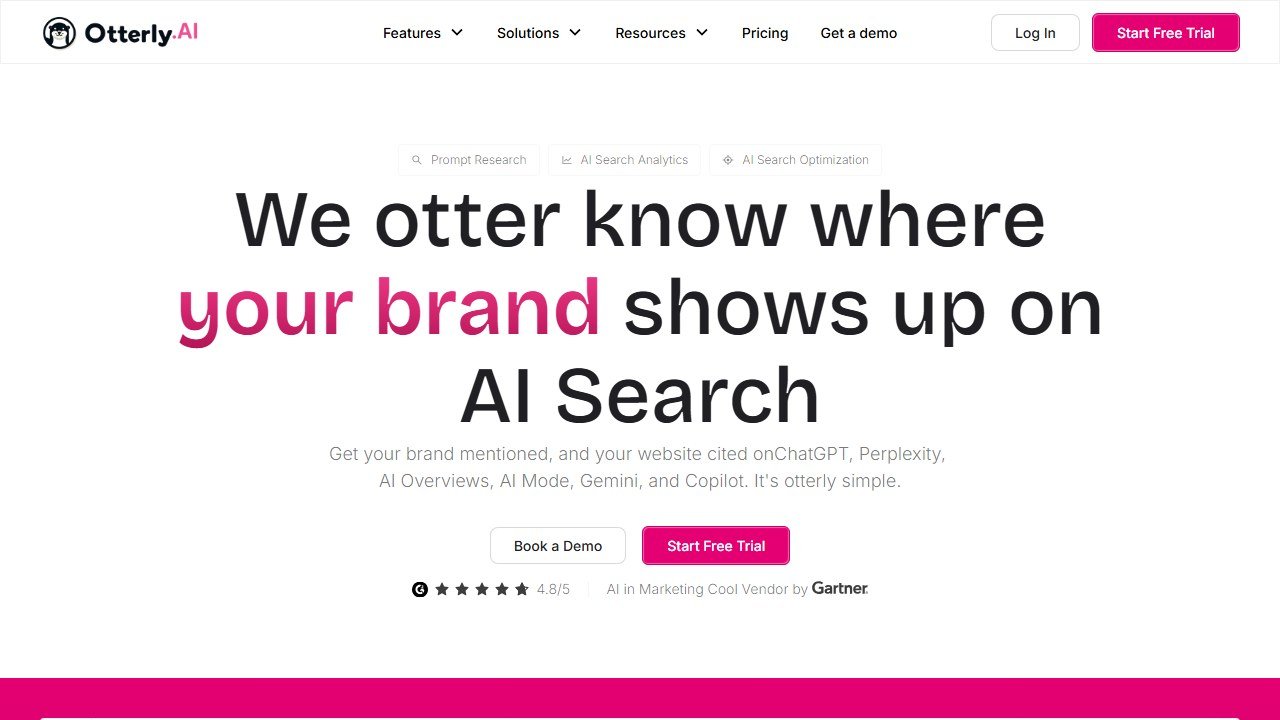
This is the metric that translates brand monitoring into competitive intelligence. Tools like Otterly.ai calculate what percentage of relevant AI responses mention your brand versus your competitors. It is the AI-era equivalent of share of voice in paid media, applied to organic AI presence.
Sentiment analysis
Being mentioned is not the same as being recommended positively. Some platforms, including Nightwatch and Rankscale, analyze the sentiment around your brand’s mentions so you can tell whether AI engines describe you favorably, neutrally, or with caveats.
Competitive benchmarking
Most platforms let you monitor competitors alongside your own brand. You input a list of competitors, and the tool tracks their citation rates, mention frequency, and share of voice in parallel with yours. This gives you a clear picture of where you’re gaining or losing ground relative to specific rivals.
How to Get Started With AI Search Monitoring
Getting started does not require an enterprise budget or a full tool migration. Here is a practical approach to standing up AI search monitoring for your brand.
Step 1: Define your prompt set
The foundation of any AI monitoring setup is the list of prompts you will track. These should mirror how your target audience actually asks questions in AI search. Think buying-intent queries (“what is the best [category] tool for [use case]”), comparison queries (“[your brand] vs [competitor]”), and problem-statement queries (“how do I [solve the problem your product solves]”). Start with 20-50 prompts and refine from there.
Step 2: Choose a monitoring platform that fits your scale
The tool landscape breaks down roughly by budget and use case.
Otterly.ai is a well-regarded entry point for teams that want solid coverage across ChatGPT, Perplexity, Google AI Overviews, Gemini, and Microsoft Copilot. Its Share of AI Voice metric is one of the cleaner ways to benchmark competitive position, and pricing sits in an accessible mid-tier range.
Peec AI is built for marketing teams that need to analyze brand visibility, identify which third-party sources AI platforms trust in their category, and benchmark against competitors. It sits in the mid-tier price range and is reported (based on publicly available reviews) to have a clean UI suited to non-technical marketers.
Profound is positioned at larger organizations and covers ChatGPT, Claude, Gemini, and Google AI Overviews with an emphasis on LLM tracking depth. It runs at a higher price point with a sales process for enterprise tiers, making it more suitable for companies that need custom reporting or team-level workflows.
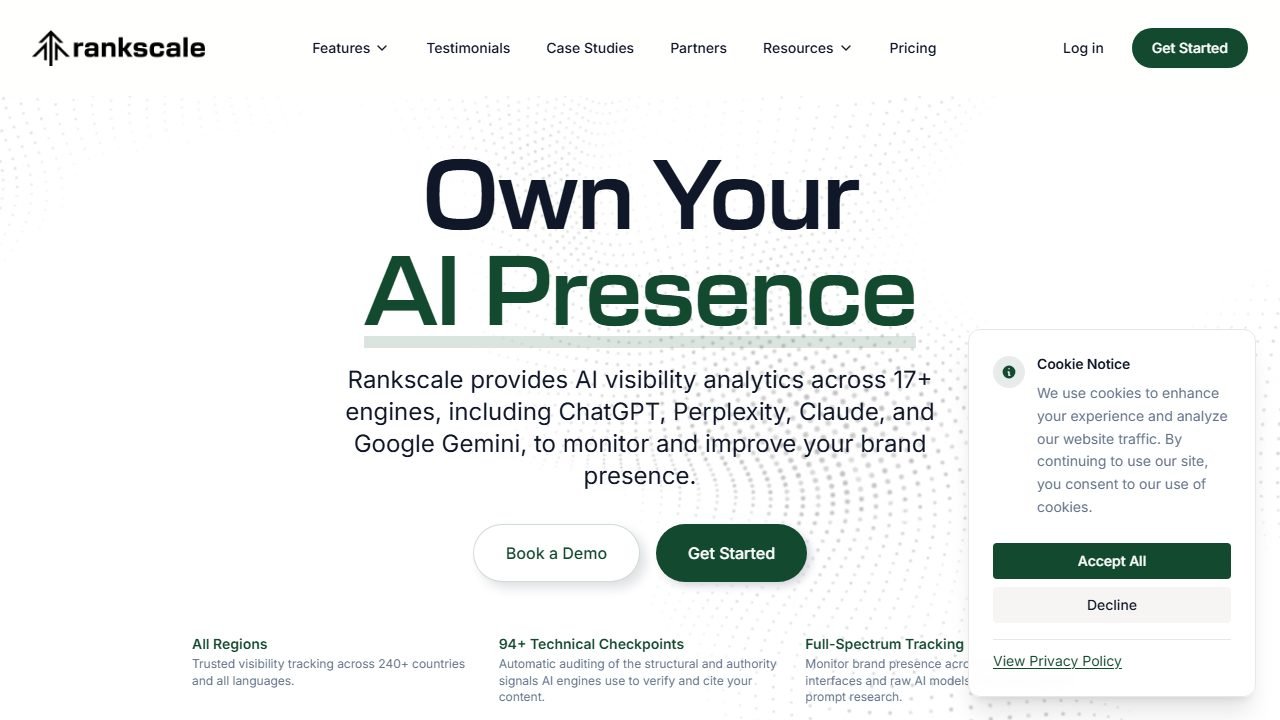
Rankscale sits at the intersection of traditional SEO auditing and AI visibility, running AI-focused site audits alongside citation tracking, sentiment analysis, and competitive benchmarking. Useful for teams that want to understand both the content gaps and the visibility gaps in a single workflow.
Nightwatch offers a broad monitoring solution that tracks LLM responses, the web searches those LLMs run for fresh data, individual prompt performance, and citation-level sentiment. It is also notable for offering a full alternative comparison to several of the other tools in this list, which signals strong competitive awareness of the space.
Step 3: Run a baseline audit before making any changes
Before you touch your content strategy, run your prompt set through your chosen tool and record the baseline numbers: your citation rate per platform, your share of AI voice for key topic clusters, and which competitors are outperforming you and where. This baseline is what every future measurement is compared against. Without it, you cannot demonstrate improvement.
Step 4: Connect findings to your content calendar
AI monitoring tools generate signals, not solutions. The value comes from translating a signal (“Perplexity cites a competitor three times more often than us for pricing-related queries”) into a content action (“we need a stronger, more citable pricing and ROI page that AI platforms can confidently pull from”). Build a monthly review into your content planning cycle where monitoring data feeds directly into topic and format decisions.
For a closer look, see our best AI Mode SEO checking tools.
The honest limits
We would be doing the opposite of independent if we sold you GEO as a solved, measurable, deterministic discipline. It is none of those things yet, and pretending otherwise is how the hype merchants operate.
The engines are non-deterministic. The same prompt can yield different sources on different runs, on different days, from different locations, and after silent model updates you will never be told about. Citation share has been observed swinging wildly within weeks rather than years, sometimes after a single configuration change at one company. That means any single measurement is noise. Only sustained trends across many prompts and many runs carry signal, and even those can be reset overnight by a model upgrade. We saw this directly when major engines swapped underlying models in early 2026 and citation behaviour shifted noticeably.
Attribution is hard, and getting harder. Because the engines often answer without a click, your analytics will under-count GEO’s impact, possibly severely. You cannot draw a clean line from “cited in ChatGPT” to “closed a deal” the way you can from an organic landing page to a conversion. This is real, and it means GEO has to be justified partly on awareness and brand terms that are inherently fuzzier than last-click revenue.
And be deeply skeptical of “visibility scores.” Many tools, ours-recommended ones included, will hand you a single number that claims to summarize your AI visibility. These are useful as a relative trend for one brand over time. They are close to meaningless as an absolute, and they are not comparable across tools, because every vendor measures a different prompt set against a different engine mix with a different scoring formula. Use the score to ask “is my own number going up,” never to declare “we are at 73 out of 100, therefore we are winning.” The map is not the territory, and the score is not the citation.
The last limit is the most uncomfortable. A lot of GEO advice, including some you will read elsewhere, is extrapolated from a handful of correlation studies on shifting systems. The Princeton paper is real and peer-reviewed, but most of the precise-sounding percentages floating around the web come from vendor studies with undisclosed methods and obvious incentives. Treat specific numbers as directional. Trust the durable principles, clarity, authority, structure, freshness, and earned mentions, because those have held up across every engine and every study we have read, and they are unlikely to stop mattering.
What we actually did on our own site
The most useful thing we can offer is not theory, it is the record of what we changed on AIToolsBakery and what we observed afterward. Our niche is AI search, so we are both the practitioner and the test subject, which is a privileged position for writing a guide like this. Here is the honest account, including the parts that did not move.
We started with answer capsules, because they were cheap and the Princeton work pointed straight at them. Every post on the site now opens with a sixty-word-or-fewer bolded capsule that answers the title question first, with no preamble. The one at the top of this post is a live example. This is the single change we feel most confident about. When we read the actual answers our priority prompts return across the engines, the capsule language is the language that gets lifted and paraphrased most often. It is also good for human readers, who get their answer immediately, so there is no tradeoff to manage. If you do one thing from this guide, do this one.
Next we made our entity unambiguous. We tightened the one-line description of what AIToolsBakery is and used the exact same framing on the site, on our profiles, and in the way we ask to be described elsewhere. We are an independent AI-tools review site, we say it the same way every time, and we repeat it inside posts like this one. The point is to give the models a single, stable, repeated association rather than a scatter of slightly different descriptions to average together. This is slow, undramatic work with no clean before-and-after number, but it is foundational, and it is the kind of thing that compounds quietly.
We marked everything up. Article schema, FAQPage schema on posts with a question block, Breadcrumb, and Organization. We treat structured data as non-negotiable hygiene, and we validate it on every publish, because schema that does not match the page is worse than no schema. We cannot isolate schema’s contribution to citations from everything else we changed, and we are suspicious of anyone who claims they can, but it is cheap, it is correct, and it removes ambiguity, so we keep doing it.
We ship an auto-refreshed llms.txt. It regenerates at the end of every publish run, grouped by content cluster, and our robots.txt AI policy points at it. We want to be candid: we have not been able to attribute any citation lift to the file, which matches the broader 2026 evidence that almost no AI bots request it. We keep it because it is automated and free to maintain, because a clean machine-readable index of our best content is good practice on its own terms, and because the agentic layer genuinely uses it. We do not count it as a growth lever, and you should not either.
We test the monitoring tools we recommend with real money. We run our own prompt sets through them, we compare what each tool reports against what we see by hand in the engines, and that direct testing is what our monitoring-tool guides are built on. The most useful thing this taught us is how noisy the data is. Two runs of the same prompt can name different sources, and a model update can move everything at once. That experience is exactly why the limits section above is as blunt as it is. We learned those limits by being burned by them, not by reading about them.
The off-site work is the hardest and the slowest, and it is where we still have the most room to grow. We earn mentions the legitimate way, by being a source worth citing, publishing original testing, and being accurately described where our category is discussed. There is no shortcut here that we would be willing to recommend, and the shortcuts that exist are the kind that get a brand burned when the engines tighten up. It is the part of GEO that looks most like old-fashioned reputation building, because that is essentially what it is.
Common GEO mistakes to avoid
Watching this field for a living, we see the same avoidable errors repeated constantly. Steering around them is most of the battle, because the upside of GEO is real but the noise around it is louder than almost any marketing topic we cover.
The first mistake is treating GEO as a single algorithm to game. There is no one engine and no one trick. The engines disagree with each other so sharply that a tactic which lifts you in Perplexity may do nothing in ChatGPT, and a hack that works this month can reverse next month after a quiet model swap. Anyone selling you “the” GEO trick is selling you a snapshot of a moving target.
The second mistake is measuring GEO with SEO instruments. If you judge a GEO program purely by referral traffic in your analytics, you will conclude it failed, because the engines often answer without sending a click. You will have optimized for the wrong number and missed the awareness and authority you actually earned. Measure presence and citations, not just sessions.
The third mistake is over-investing in llms.txt while under-investing in mentions. We see brands spend a week perfecting a text file that almost no bot reads, then never do the slow off-site work that actually drives citations. The effort is backwards. Automate the file in an afternoon and spend the saved weeks earning a genuine reputation on the sites the models trust.
The fourth mistake is chasing visibility scores as if they were truth. A single number from a single tool is a relative trend for one brand over time and nothing more. It is not comparable across tools, it is not an absolute grade, and treating it as a scoreboard leads to optimizing the metric instead of the outcome.
The fifth mistake is thin, unsourced content dressed up with structure. Schema and answer capsules amplify good content, they do not rescue weak content. The engines are biased toward specific, verifiable, sourced claims, so a beautifully formatted page of vague assertions is still a page of vague assertions. The structure helps only when there is something worth extracting underneath it.
The last mistake is abandoning SEO to chase GEO. The foundation is shared. Authority, clarity, crawlability, and depth serve both, and a brand that guts its SEO program to free up budget for GEO usually weakens the very signals GEO depends on. Extend, do not replace.
Where this goes next
The direction of travel is clear even if the details are not. More queries will be answered inside AI surfaces, the line between “search” and “assistant” will keep blurring, and the click will keep losing ground as the unit of success. Google’s own products are converging on this, with AI Mode and AI Overviews steadily eating the traditional results page, and the standalone assistants are pulling habitual users away from search entirely for whole categories of question. The agentic layer is the next frontier, where AI agents act on your behalf, fetch context, and complete tasks, and being machine-readable and well-described will matter for being chosen by an agent the same way it now matters for being cited in an answer.
Our advice has not changed since we started practicing this on our own site, and the volatility of the past year has only reinforced it. Build the durable foundation. Make your entity unmistakable, write answers worth quoting, mark them up cleanly, ship the cheap infrastructure like llms.txt, earn genuine mentions on the sites the models trust, and keep your pages crawlable and fast. Then measure the trend, not the snapshot, with a monitoring tool you actually check, and hold every “score” at arm’s length. The brands that win in generative search are not the ones who found a clever hack. They are the ones who became genuinely, verifiably, consistently the best answer, and then made sure the machines could read it. That was true for SEO, it is true for GEO, and it is the one thing we are confident will still be true when the next acronym arrives.
For a closer look, see our best AI Mode SEO checking tools.
More AI tool guides worth reading: Prerender.io Alternatives, Scrunch AI Review and Otterly.ai Review.

Written by
FazFaz is the founder of AIToolsBakery. Some tools here are tested hands on. Others are assessed from vendor documentation and pricing verified on the live page, and every review says which one it is. Sponsors can buy a position in a guide. They cannot buy the score, the criticism, or silence about a better option.
How we test and how we make money →Frequently Asked Questions