Buyers no longer start on Google. They ask ChatGPT, Perplexity, Gemini, and Google AI Overviews, and they trust the answer those tools hand back. That shift created a new problem for brands: you can rank on page one of Google and still be invisible in the AI answer that now sits above it. A whole category of tools has grown up to fix that, and at the enterprise end of it sits Scrunch AI (you will also see it as scrunch.com, which redirects to the same place).
Scrunch is not trying to be the cheapest AI visibility tracker, and it does not pretend to be. It pitches itself at brands big enough to have a security review, a compliance checklist, and real money riding on how they show up in AI answers. It also does something most rivals do not: it tries to optimize the actual machine-readability of your site for AI crawlers and agents, not just measure your visibility and hand you a chart. That is the difference between diagnosis and treatment, and it is the heart of this review.
We spent time with the platform, read through current customer feedback, and dug into the one development every prospective buyer needs to know about: in June 2026, Sitecore acquired Scrunch for a reported 225 million dollars. We get into exactly what that means for you below, because it changes the calculus in ways the marketing pages will not tell you.
A note on independence: we are AIToolsBakery, an independent review site. We do not sell Scrunch AI, we are not a Scrunch or Sitecore partner, and we earn nothing if you buy it. When a post on this site is sponsored, it is labelled as sponsored, and a sponsorship never changes a verdict or a score. This review is not sponsored. Most of the Scrunch reviews you will find online are written by competing vendors comparing their own tool favorably against it. This one is not.
The verdict in 30 seconds: Scrunch AI is the enterprise pick in AI visibility, with the best satisfaction scores in the category (about 4.6 out of 5 on G2) and two things rivals lack: a proprietary Influence Score and an Agent Experience Platform that optimizes your site for AI crawlers, not just reports on it. Pricey, light for small teams, and freshly acquired. Score: 4.5 out of 5.
What Scrunch AI is
Website: Scrunch AI
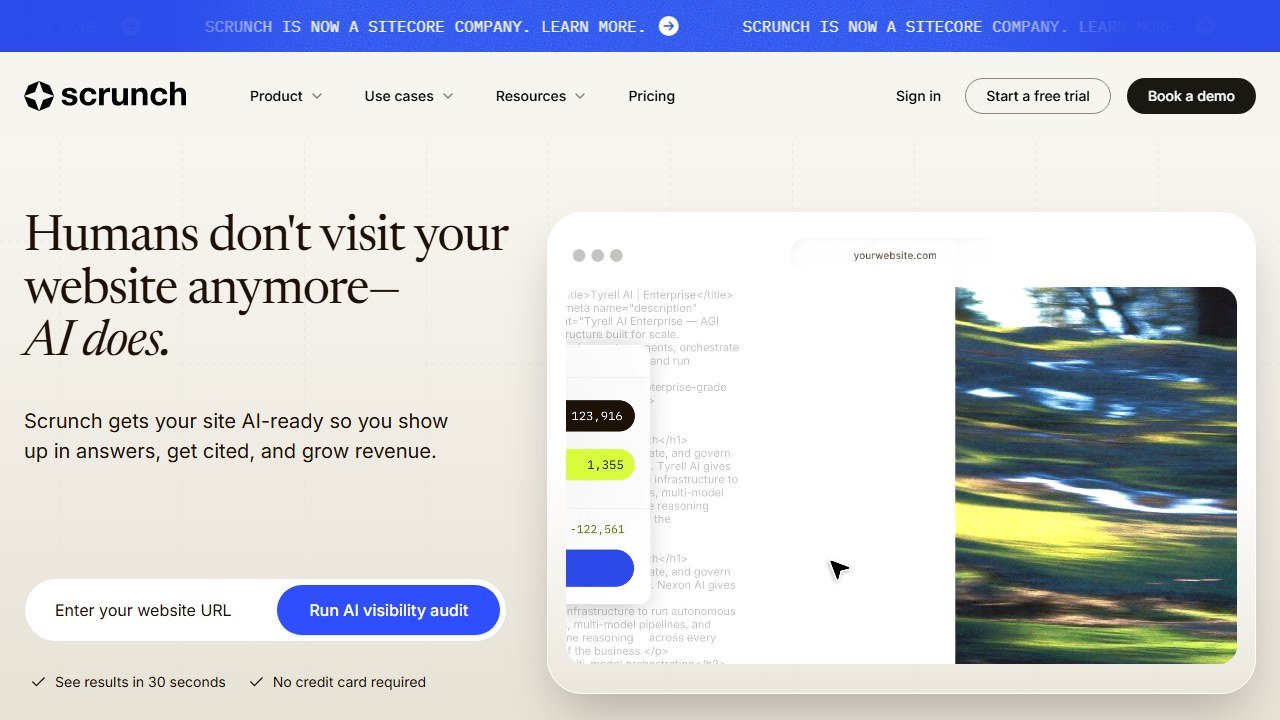
Scrunch AI is an enterprise AI search visibility platform. Its job is to tell you how your brand shows up when people ask AI assistants questions in your category, then help you do something about it. It monitors your presence across the major AI engines (ChatGPT, Perplexity, Gemini, Claude, Google AI Overviews, Google AI Mode, Meta AI, and Copilot, depending on tier), tracks which prompts mention you, which competitors win the answers you lose, and which sources the models cite when they build those answers.
That much is table stakes for the category. Where Scrunch separates itself is on the optimization side. Most tools in this space are monitoring tools: they describe the problem in great detail and leave the fixing to you. Scrunch goes further with two proprietary pieces, the Influence Score and the Agent Experience Platform, that together aim to move you from measuring AI visibility to actually changing it. That combination is why Scrunch sits at the enterprise end of the market and why its customer list reads the way it does: Lenovo, Skims, Penn State, Crunchbase, Akamai, and a few hundred others.
The platform is built for teams, not solo operators. Multi-site and multi-region support, role-based access control, a data API, and SOC 2 Type II compliance all point at the same buyer: a marketing or SEO team inside a company large enough that procurement and security have a say in the purchase.
The Agent Experience Platform and Influence Score (what is unique)
These two features are the reason to consider Scrunch over a cheaper rival, so they deserve a precise explanation rather than the marketing gloss.
The Agent Experience Platform (AXP) is the headline. The premise is that AI crawlers and agents read your website differently from a human, and most sites are built entirely for the human. Heavy JavaScript, bloated markup, and design-first layouts can leave a crawler unable to cleanly extract what your page actually says. AXP serves a lightweight, machine-readable version of your content to AI agents at the network edge, without changing what human visitors see. In plain terms: humans get your normal site, AI crawlers get a clean, structured version designed to be easy to parse and cite. The goal is higher crawl success, more citations, and better odds of being included in AI answers. This is the feature almost no competitor has, because most of them are measurement tools that never touch your delivery layer. Scrunch is trying to fix the pipe, not just photograph the leak.
The Influence Score is the second piece. AI models do not invent their answers from nothing. They lean on a set of trusted third-party sources, the sites that consistently get cited when models talk about your category. The Influence Score ranks those domains by how much sway they hold over the answers in your space, so your team can prioritize outreach, partnerships, and placements on the sources that actually move the needle, rather than guessing. It turns “we should get mentioned in more places” into a ranked, actionable target list. For a brand running a real digital PR or partnerships motion, that is genuinely useful prioritization that most rivals do not offer.
Put together, AXP and the Influence Score are why Scrunch can credibly call itself an optimization platform and not just a dashboard. That is the single biggest reason to pay enterprise prices for it.
What it tracks and optimizes
On the tracking side, Scrunch covers the work you would expect from a serious platform. Prompt and topic tracking shows you which questions in your category surface your brand and which surface a competitor instead. Citation analysis surfaces the specific sources models pull from when they answer, which feeds straight into the Influence Score. Competitive benchmarking lets you compare your share of AI answers against named rivals, sliced by persona, topic, and geography. Sentiment tracking flags whether the way models describe you is positive, neutral, or a problem.
There is also an agent traffic layer. Scrunch can monitor AI bot and crawler activity hitting your site in near real time, through integrations with analytics and CDN data, so you can see which AI engines are actually crawling you and how often. That closes a loop most tools leave open: you can see not just whether you show up in answers, but whether the crawlers feeding those answers are even reaching your pages.
Site and page audits round it out, flagging crawlability issues that keep AI engines from reading your content properly. Those audits are the on-ramp to AXP: the audit finds the problems, AXP is the mechanism that serves a fixed version to the crawlers. The number of audits you get per month scales with your tier, which is worth checking against your site size before you sign.
Enterprise and security (SOC 2, RBAC)
This is where Scrunch quietly wins the deals its rivals cannot. SOC 2 Type II compliance is the headline credential, and it matters more than it sounds. For a regulated company or a large brand, a vendor without SOC 2 Type II often cannot clear security review at all, which ends the conversation before pricing ever comes up. Several of Scrunch’s competitors do not hold it, or gate it behind enterprise tiers they rarely sell. Scrunch leading with it is a real, concrete advantage for a certain kind of buyer.
Role-based access control (RBAC) is the other enterprise essential, letting you give a large team scoped permissions rather than handing everyone the keys. Add multi-site and multi-region support and a data API for piping results into your own systems, and you have a platform that fits the way a large organization actually operates. None of this is glamorous. All of it is the reason a 2,000-person company picks Scrunch over a cheaper, scrappier tool that would get bounced by infosec on day one.
The Sitecore acquisition (what changed in June 2026)
You cannot honestly review Scrunch in mid-2026 without addressing this. On June 3, 2026, Sitecore (the enterprise digital experience platform) acquired Scrunch for a reported 225 million dollars. Scrunch is now “a Sitecore company,” and the stated plan is to integrate its capabilities into Sitecore’s broader platform.
What that means for a buyer is a genuine mixed bag, and you should weigh it honestly. On the positive side, an acquisition by a large, established enterprise vendor reduces the startup-failure risk that hangs over every young tool in this category, and it gives Scrunch deeper resources. On the cautious side, acquired products change. Standalone availability, pricing, roadmap, and support can all shift once integration begins, and a tool that was independent is now a feature inside someone else’s suite. As of this writing, both the standalone product and existing customer relationships appear to continue near-term, but “near-term” is the operative phrase.
Our practical advice: if you are evaluating Scrunch now, ask Sitecore two direct questions before you sign. First, will the standalone product be supported beyond the next 12 months, and on what terms. Second, what is the integration timeline with Sitecore’s platform, and does it change anything about your contract. Get the answers in writing. This is not a reason to rule Scrunch out, but it is a reason to do more diligence than you would for an independent vendor.
Pricing
Scrunch is priced as an enterprise tool, and you should walk in expecting that. The published entry point sits in the area of a few hundred dollars a month for the core brand plan, billed annually, with a step up to a higher mid tier for larger needs, and fully custom enterprise pricing above that, which commonly lands in the four-figures-per-month range once you add the advanced engines, security features, and seat counts a large team needs. We are deliberately not quoting hard dollar figures as fact, because pricing in this category moves quickly and because the acquisition adds extra reason for it to change. Check the current numbers on the Scrunch pricing page directly, and treat any specific figure you read in a third-party review, including any you might infer from ours, as a starting estimate to confirm.
Two things are worth flagging on value. First, several of the features that define Scrunch, including the broadest model coverage, SOC 2 Type II, and API access, are gated to higher tiers. Map the features you actually need against the tier that includes them before you anchor on the entry price. Second, the recurring complaint in customer reviews is prompt limits: the number of tracked prompts on lower tiers can feel tight for a brand with a wide topic footprint, and pushing past them means moving up a tier. Size your prompt needs honestly before you buy, because that is the line item most likely to force an upgrade you did not plan for.
Scrunch vs the alternatives (Profound, Peec, Otterly)
The right tool depends almost entirely on your size and what you need it to do. Here is how Scrunch sits against the three names it comes up against most often.
| Tool | Best for | Optimization vs monitoring | Security and team features | Entry price (verify) | Standout |
|---|---|---|---|---|---|
| Scrunch AI | Enterprise brands and large teams | Both: monitors and optimizes (AXP) | SOC 2 Type II, RBAC, multi-site, API | Several hundred per month, custom enterprise above | Influence Score and Agent Experience Platform; best G2 satisfaction |
| Profound | Enterprise, category leader by brand | Mostly monitoring and diagnosis | Enterprise-grade, sales-led | Higher, often four figures per month | Most established brand and the lone G2 Leader in the AEO grid |
| Peec AI | Mid-market and value buyers | Monitoring, strong description | Lighter, team-friendly | Low, starts around mid-double-digits per month | Best price-to-capability for growing teams |
| Otterly.ai | Freelancers and small teams | Monitoring only | Basic, self-serve | Entry tiers from tens of dollars per month | Most affordable on-ramp, free trial |
The honest read: Profound is the brand-name leader and the one analyst grids currently crown, but it leans toward diagnosis, and it is at least as expensive as Scrunch. Scrunch matches it on enterprise credibility, beats it on customer satisfaction, and pulls ahead on actual optimization through AXP and the Influence Score. Peec AI is the value pick for a mid-market team that mainly needs to see the picture clearly without enterprise overhead. Otterly is the entry-level on-ramp for a freelancer or small team testing the waters. If you are a large brand that wants to measure and move your AI visibility under a real security posture, Scrunch and Profound are the two-horse race, and Scrunch’s optimization layer is its sharpest edge.
For the full landscape, see our roundup of the best AI search monitoring tools for 2026, our guide to AI search visibility gap analysis tools, and our independent Profound review if Profound is the other tool on your shortlist.
Pros and cons
What we liked:
- The Agent Experience Platform genuinely optimizes machine-readability for AI crawlers, a capability almost no competitor offers.
- The Influence Score turns vague “get mentioned more” goals into a ranked, actionable target list of high-sway domains.
- The best customer satisfaction in the category, around 4.6 out of 5 on G2 across a healthy review count.
- Enterprise-grade security and governance: SOC 2 Type II, RBAC, multi-site and multi-region support, and a data API.
- Broad model coverage spanning the major AI engines, plus near real-time AI bot and crawler traffic monitoring.
What gave us pause:
- Enterprise pricing puts it out of reach for solo operators and many small teams, and key features are gated to higher tiers.
- Prompt limits on lower tiers are the most common customer complaint and can force an upgrade.
- Self-serve onboarding and hands-on optimization guidance are thinner than the price suggests; this is a tool that rewards a team that will act on it.
- Younger brand recognition than Profound, and the June 2026 Sitecore acquisition adds roadmap and continuity questions you should resolve before signing.
Who it’s for
Scrunch AI is for the enterprise or upper-mid-market brand that has decided AI visibility is a real channel and is ready to staff and fund it like one. If you have a marketing or SEO team, a security review that vendors must pass, multiple sites or regions, and budget measured in the high hundreds to low thousands per month, Scrunch is one of the two or three tools genuinely built for you, and its optimization layer gives it an edge the others lack.
It is not for a freelancer, a solopreneur, or a small business dipping a toe in. The price is wrong for you, the prompt limits will bite, and the AXP and Influence Score machinery is more than you can act on. If that is you, start with Otterly.ai or Peec AI, learn the category, and revisit Scrunch when you have a team and a budget to match it. If you are mid-market and value-focused, Peec is the smarter first buy. If you are enterprise and weighing Scrunch against Profound, the deciding questions are how much you value actual optimization over pure measurement, and how comfortable you are with a freshly acquired vendor.
Our verdict
Scrunch AI earns its place as the enterprise pick in AI visibility, and the best-satisfaction crown in the category is deserved. The Agent Experience Platform and the Influence Score are not marketing dressing: they are real capabilities that move Scrunch from measuring your AI visibility to actually changing it, and that is something most of the field cannot claim. Pair that with SOC 2 Type II, RBAC, and the governance features large teams need, and you have a platform that fits enterprise buyers the way few rivals do.
The marks against it are the price, the thin fit for small teams, the prompt limits, and the fresh uncertainty the Sitecore acquisition introduces. None of those undercut the core product, but together they mean this is a tool you buy with your eyes open, after a real diligence conversation, not on the strength of a demo. For the enterprise buyer it is built for, Scrunch is one of the strongest options on the market today. We score it 4.5 out of 5.
For a closer look, see our best AI Mode SEO checking tools.

Written by
FazFaz is the founder of AIToolsBakery. Some tools here are tested hands on. Others are assessed from vendor documentation and pricing verified on the live page, and every review says which one it is. Sponsors can buy a position in a guide. They cannot buy the score, the criticism, or silence about a better option.
How we test and how we make money →Frequently Asked Questions