Sales training used to mean a binder, a quarterly offsite, and a manager who listened to maybe three calls a month if you were lucky. That model never scaled, and it never produced consistent reps. In 2026 the category looks completely different, because AI now sits inside almost every layer of how sales teams learn. The same platforms that once just stored PDFs now run interactive buyer roleplays, transcribe and score every live call, surface the exact moment a deal went sideways, and tell a manager which rep needs help before the quarter is lost. “Sales training software” today is really four overlapping disciplines wearing one label: practice and roleplay, conversation intelligence and call coaching, readiness and enablement (think LMS plus certification plus content), and pure communication coaching. The best tool for you depends entirely on which of those problems is actually bleeding. If you want conversation review rather than rehearsal, that is a different purchase and our best AI sales coaching software guide is the right list.
That breadth is exactly why a simple “top 10 roleplay bots” list does most buyers a disservice. A 12-person startup that wants reps to rehearse cold calls before they dial has almost nothing in common with a 2,000-seat enterprise that needs to certify a new product launch, correlate practice scores with closed revenue, and stay compliant across regulated markets. Both are buying “AI sales training software,” and both will land on completely different shortlists. We researched and scored the leading platforms across all four categories, working from vendor documentation, verified pricing pages, and aggregated buyer reviews, so you can match the tool to the job instead of buying the loudest brand. Each tool below gets a 0 to 5 score, a one-line “best for,” an honest read on its AI strengths and weaknesses, and a plain description of how its pricing works.
A quick note on how we operate. AIToolsBakery is an independent AI-tools review site. We are not owned by any vendor on this list, we are not resold by them, and we earn nothing if you buy any of these products. When a post is sponsored we label it clearly at the top, and a sponsorship never changes a score or a ranking: the verdict is the verdict regardless of who paid for placement. This post is not sponsored. Every tool here was evaluated against the same yardstick (does the AI genuinely make reps better, how honest is the feedback, and is the pricing fair for the size of team it targets), and the scores reflect that and nothing else.
Quick answer: Gong is the best for conversation intelligence and call coaching, Mindtickle for sales readiness and certification, and Second Nature for realistic AI buyer roleplay. Match the tool to the gap: a coaching problem, a readiness problem, or a practice problem.
How the tools compare
| Tool | Score (X/5) | Category | Best for | Pricing model |
|---|---|---|---|---|
| Gong | 4.7/5 | Conversation intelligence | Call coaching at scale | Platform fee plus per seat, annual, quote only |
| Mindtickle | 4.6/5 | Readiness / enablement | Certifying and ramping reps | Custom enterprise, modular add-ons |
| Second Nature | 4.5/5 | Roleplay / practice | Realistic AI buyer practice | Per seat, annual, quote only |
| Exec | 4.5/5 | Roleplay / practice | Voice roleplay scored on your own rubric | $120/mo for 5 full seats, published |
| Highspot | 4.4/5 | Enablement | Content plus coaching in one place | Custom enterprise plus implementation |
| Salesloft | 4.3/5 | Conversation intelligence | Coaching inside the workflow | Per seat tiers, annual, quote only |
| Hyperbound | 4.3/5 | Roleplay / practice | Cold and discovery call reps | Free tier plus custom enterprise |
| Allego | 4.1/5 | Readiness / enablement | Mobile and just in time learning | Per seat subscription, custom |
| Yoodli | 4.0/5 | Communication coaching | Delivery, pacing, and filler words | Free plus low cost individual plus custom teams |
| Quantified.ai | 3.9/5 | Roleplay (regulated) | Pharma, medtech, finance reps | Custom enterprise, per seat |
| Chorus (ZoomInfo) | 3.8/5 | Conversation intelligence | ZoomInfo data customers | Bundled into ZoomInfo, per seat |
| Bigtincan Readiness | 3.6/5 | Readiness / enablement | Coaching plus content authoring | Custom enterprise subscription |
1. Gong: best for conversation intelligence and call coaching
Score: 4.7/5
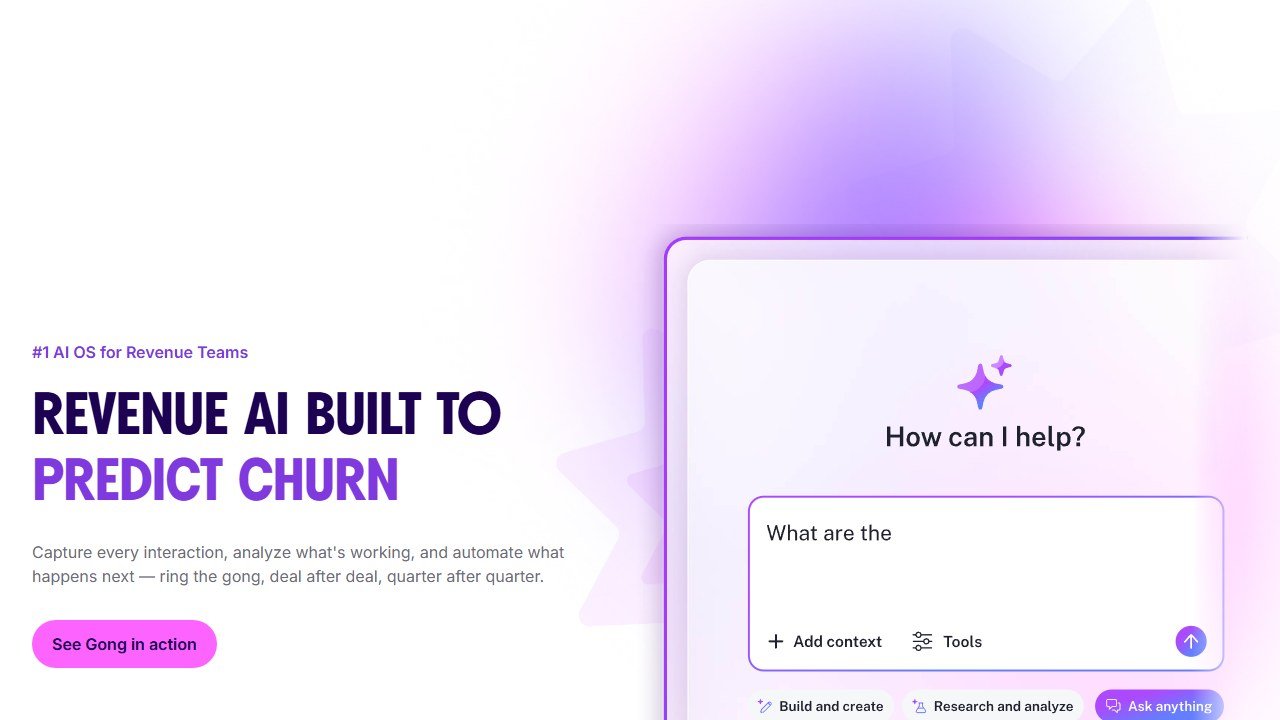
Gong is the platform most sales leaders picture when they hear “AI for sales,” and it earns the top spot because it does the single highest leverage thing in sales training better than anyone: it turns every real customer conversation into a coaching opportunity. Gong records, transcribes, and analyzes calls, meetings, and emails across the whole revenue team, then surfaces deal risk, competitor mentions, buying signals, talk ratios, and coaching moments automatically. The training value is that managers stop guessing. Instead of coaching off vibes, they coach off the actual transcript where a rep talked for nine straight minutes or fumbled a pricing objection.
In 2026 Gong pushed harder into training specifically with its Mission Andromeda release, which added Gong Enable (a dedicated coaching and enablement product with its own seat tier), the Gong Assistant chatbot that lets reps and managers query past calls in plain language, and account level views that fold risk signals into one place. It also opened up interoperability with rival AI systems through the Model Context Protocol, which is a notable shift for a company that historically kept everything inside its own walls.
Strengths. The transcription and speaker separation are best in class, the analytics are genuinely actionable rather than vanity metrics, and the new Assistant makes the giant pile of recorded calls searchable in seconds. For coaching at scale across a real revenue org, nothing else surfaces patterns this cleanly.
Weaknesses. Gong coaches off conversations that already happened, so it is not a practice or roleplay tool: a brand new rep still needs somewhere to rehearse before their first live call. Pricing is steep and notoriously layered, and several buyers report being surprised by platform fees and bundling at renewal. It is overkill for very small teams.
Pricing. Quote only. Expect a three part bill: an annual platform fee, a per user license that scales down with seat count, and a one time onboarding fee, usually on a multi year contract. The new Gong Enable coaching tier is priced separately per seat. Plan for a real enterprise commitment, not a credit card signup. See Gong.
2. Mindtickle: best for sales readiness and certification
Score: 4.6/5
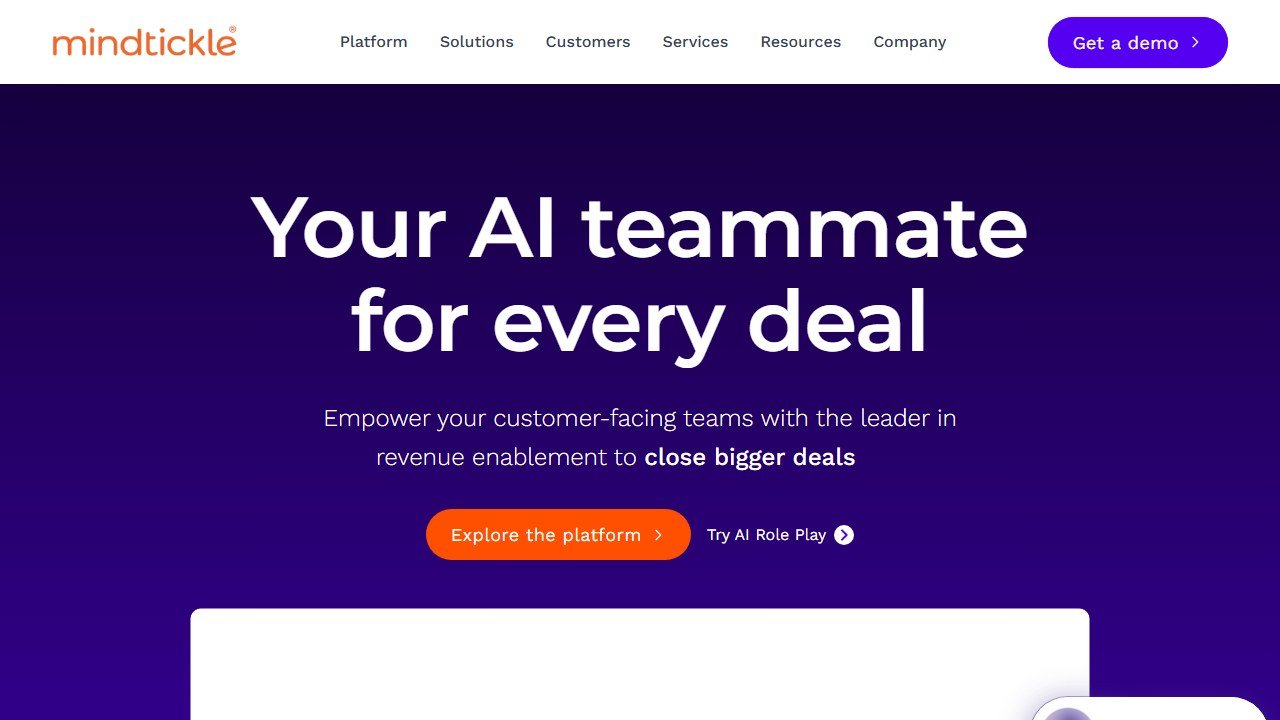
If your problem is “we cannot ramp and certify reps fast enough,” Mindtickle is the strongest answer on this list. It is a full revenue enablement and readiness platform, which means it combines structured learning paths, content, certification, and AI roleplay into one system that ties practice back to actual business outcomes. That last part is what separates it from a standalone roleplay bot. Mindtickle’s Readiness Index dashboards correlate roleplay and learning performance against real metrics like quota attainment, deal size, and ramp time, so leaders can prove that training is moving the number instead of just hoping it is.
The AI does heavy lifting here. Mindtickle’s AI Copilot can review thousands of roleplay submissions in minutes, assign an initial score, and write detailed feedback, which is the kind of thing that used to eat weeks of manager time (Cisco reportedly saved up to 38 weeks of review time). Reps practice cold calls, discovery, objection handling, negotiations, renewals, and launches using prebuilt templates or natural language prompts, and Mindtickle says its roleplays run at the lowest latency in the industry, which matters a lot for conversations feeling natural.
Strengths. Genuine end to end coverage from onboarding through ongoing certification, strong CRM integration so practice maps to revenue, and serious data governance (it does not train models on customer data and meets standards like ISO 42001 and the EU AI Act). For enterprises running formal launches and certifications, it is hard to beat.
Weaknesses. It is enterprise software with enterprise complexity, so a small team will feel the weight. Pricing is fully custom and modular, and a key gotcha is that two way interactive roleplay is a separate add on rather than part of the base readiness package, so the sticker you first hear may not include the feature you wanted.
Pricing. Custom enterprise pricing on typical 12 to 36 month contracts, structured by modules. Confirm whether interactive (two way) roleplay is in your quote before signing. We have a deeper breakdown in our Mindtickle review. See Mindtickle.
3. Second Nature: best for realistic AI buyer roleplay
Score: 4.5/5
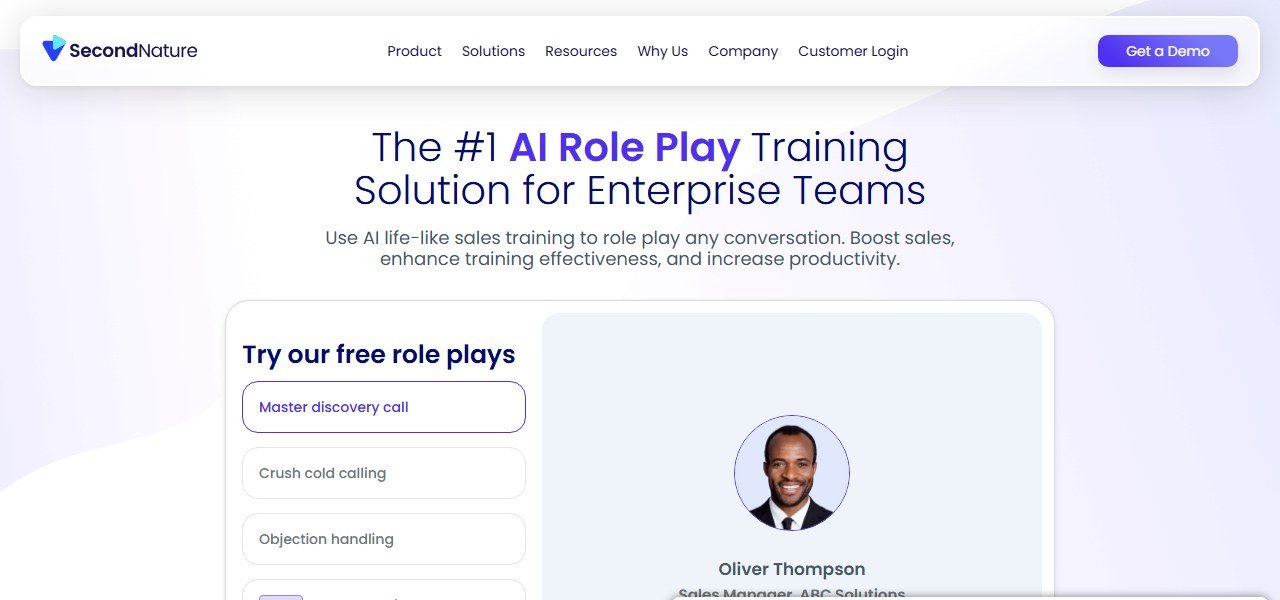
Second Nature is the dedicated roleplay specialist that most enterprises benchmark everyone else against, and it scores highest of the pure practice tools because the conversations feel real. Reps talk (out loud, in natural conversation) to AI personas that behave like actual buyers, across one to one calls, group scenarios, and chat. The platform leans into a face to face feel with animated avatars rather than audio only, and it evaluates performance the instant a session ends, handing back specific, actionable feedback rather than a generic score.
What lifts it above a novelty is how fast you can stand up a useful scenario. Second Nature can build a full roleplay in minutes from freeform text or uploaded content, generating the persona and the evaluation criteria for you, and it runs simulations in a long list of languages, which matters for global teams. The customer roster (Zoom, Oracle, Adobe, and others) and reported outcomes like double digit sales lifts after surprisingly little practice time back up the substance.
Strengths. The most lifelike buyer simulation in this group, very fast scenario authoring, broad language support, and instant structured feedback that reps actually act on. If practice is your single problem, this is the front runner.
Weaknesses. It is focused on practice, so it does not analyze your live calls or function as a full LMS the way Mindtickle or Highspot do. Pricing is opaque and quote only, which makes quick budgeting hard, and the animated avatar style is not to everyone’s taste.
Pricing. Per seat, billed annually, quote only (no public pricing). You will need to talk to sales for a number tied to your seat count and scenario needs. Our full writeup is the Second Nature review. See Second Nature.
4. Exec: best for voice roleplay scored against your own rubric
Score: 4.5/5
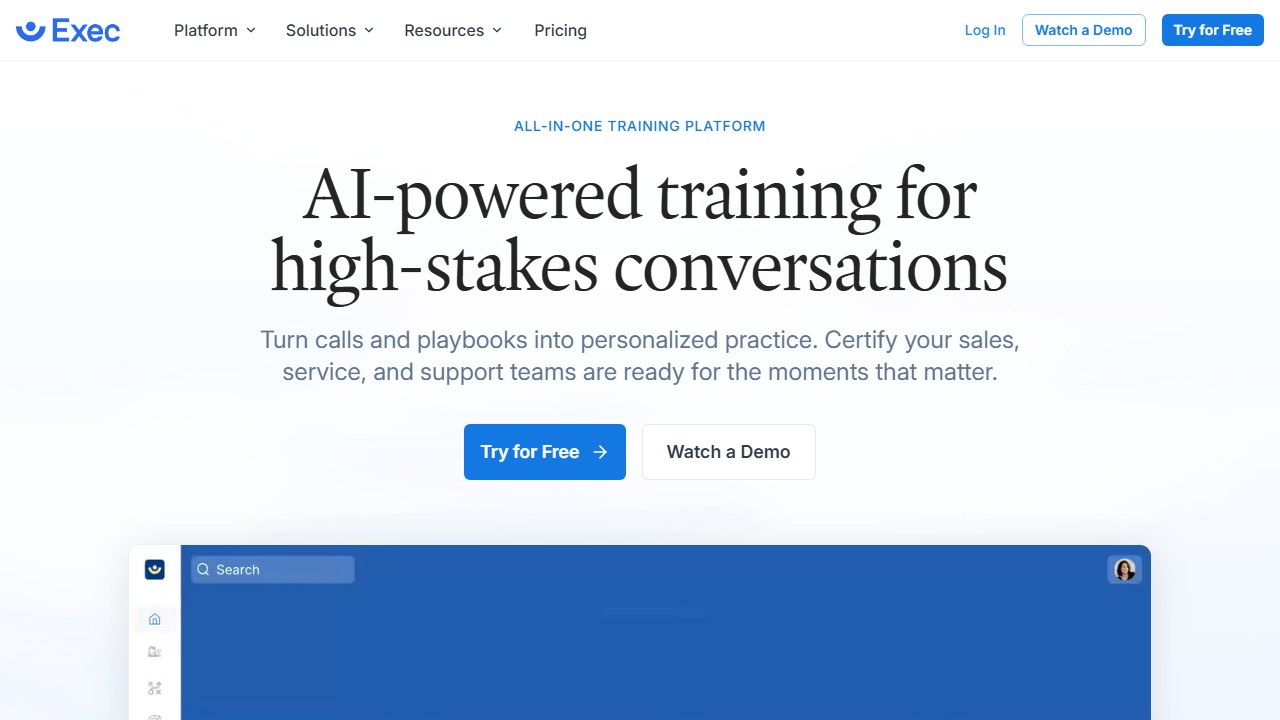
Exec is a practice platform rather than a content library or a call recorder. A rep opens a scenario and has a real spoken conversation with an AI character playing a prospect, a customer or a direct report, and the conversation is then scored against a rubric that was published before they started. We spent a full working day inside it, built a scenario from a one-paragraph brief, ran it cold by voice and got marked, which is written up in our full Exec review.
What separates it from the rest of this list is that the character is not a hidden prompt. Open the Character Details tab and you get editable fields, a four-paragraph backstory and an explicit trigger table where each rule carries its own response budget. Ask the AI to make a character easier and it rewrites those rules and hands you a changelog. The same instinct runs through the feedback: a marked timeline sits above the recording so you can play the eleven seconds that cost you a point, and a live AI voice coach will talk through the session with you afterwards.
Strengths. The most convincing voice roleplay we have used, with no walkie-talkie lag and characters that stay in role under pressure. Feedback quotes your actual transcript rather than templated advice. Analytics lead on average lift, the gap between a learner’s first attempt and their best, which is the number that answers whether training worked. Pricing is published: $120 a month for five full seats.
Weaknesses. No CRM and no Slack integration today, though Exec says CRM is roughly two months out. Call scoring has no numeric or date field type, so deal sizes arrive as unsortable free text. Courses and Knowledge Hub are both labelled beta, and Knowledge Hub retrieval was unreliable when we tested it.
5. Highspot: best for content plus coaching in one platform
Score: 4.4/5
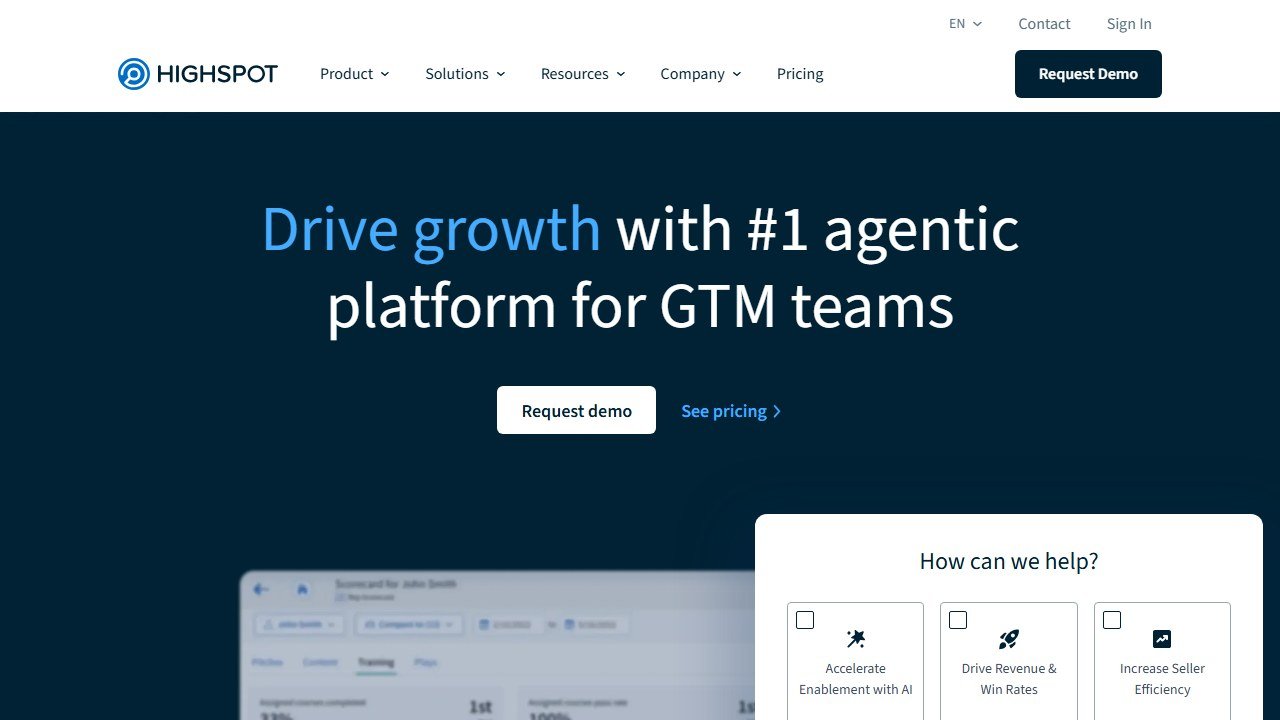
Highspot started as the gold standard for sales content management (the system that makes sure reps actually find and use the right deck), and in 2026 it has grown into a genuine enablement plus coaching platform. The pitch is unification: content, training, deal guidance, and coaching all live in the flow of work, so reps are not bouncing between a content tool, an LMS, and a separate practice app. For organizations that already live in Highspot for content, layering coaching on top is a natural and low friction move.
The AI layer is meaningful. Highspot Copilot automatically reviews meetings and practice pitches and surfaces coaching insights so managers spend their time giving feedback rather than hunting for moments. AI Role Play lets sellers rehearse high stakes conversations by persona, product, or deal before they happen, and Deal Agent grounds next step recommendations in real deal context, flagging risk and nudging the right follow up content. The whole thing is built around content adoption, which is a problem most enablement teams quietly struggle with.
Strengths. Best in class content management with coaching and roleplay built on top, strong adoption analytics, and the convenience of one platform instead of a stitched together stack. The Copilot review automation is a real time saver for managers.
Weaknesses. Roleplay and coaching are newer additions and not quite as deep as the dedicated practice specialists. It is priced and scoped for mid market and enterprise, with meaningful implementation cost, so it is not a quick lightweight buy.
Pricing. Custom, sold through sales and tailored by team size, roles, and feature set, typically with a separate implementation and content migration fee. Third party procurement data puts median annual contracts in the mid five figures, with a wide range by seat count and services. See Highspot.
6. Salesloft: best for coaching inside the seller workflow
Score: 4.3/5
Salesloft is a revenue orchestration platform first, which means coaching here happens right where reps already do their daily work (cadences, dialing, deal management) rather than in a separate training tool. Its conversation intelligence product, Salesloft Conversations, records and analyzes calls so managers can spot coaching opportunities and scale best practices, and its Rhythm engine turns buyer signals into a prioritized action list for each rep. The training angle is that good habits get reinforced in the flow, not in a quarterly review.
The 2026 AI agent lineup is where it gets interesting for coaching. The AI Scorecard agent pre fills manager scorecards by analyzing call transcripts, which removes a huge amount of manual review. The Conversation Summary agent writes recaps and follow up emails, and the Key Moment agent surfaces competitor mentions, objections, and decision makers across calls so teams act on what affects deal health. For a team that wants coaching woven into execution, that is a strong combination.
Strengths. Coaching and conversation intelligence embedded in the same platform reps use to sell, the AI Scorecard genuinely cuts manager review time, and Rhythm keeps reps focused on the right next action. Good fit for outbound heavy teams.
Weaknesses. It is a broad orchestration suite, so you are buying a lot more than training, and conversation intelligence sits in the higher tiers. The dialer is a separate paid add on, and several buyers note that the real cost climbs once you add the pieces you actually need.
Pricing. Quote only across three tiers (Essentials, Advanced, Premier), with conversation intelligence and coaching landing in Advanced and up. Third party estimates put list pricing in the low hundreds per user per month, with the dialer billed separately. See Salesloft.
7. Hyperbound: best for cold and discovery call reps
Score: 4.3/5
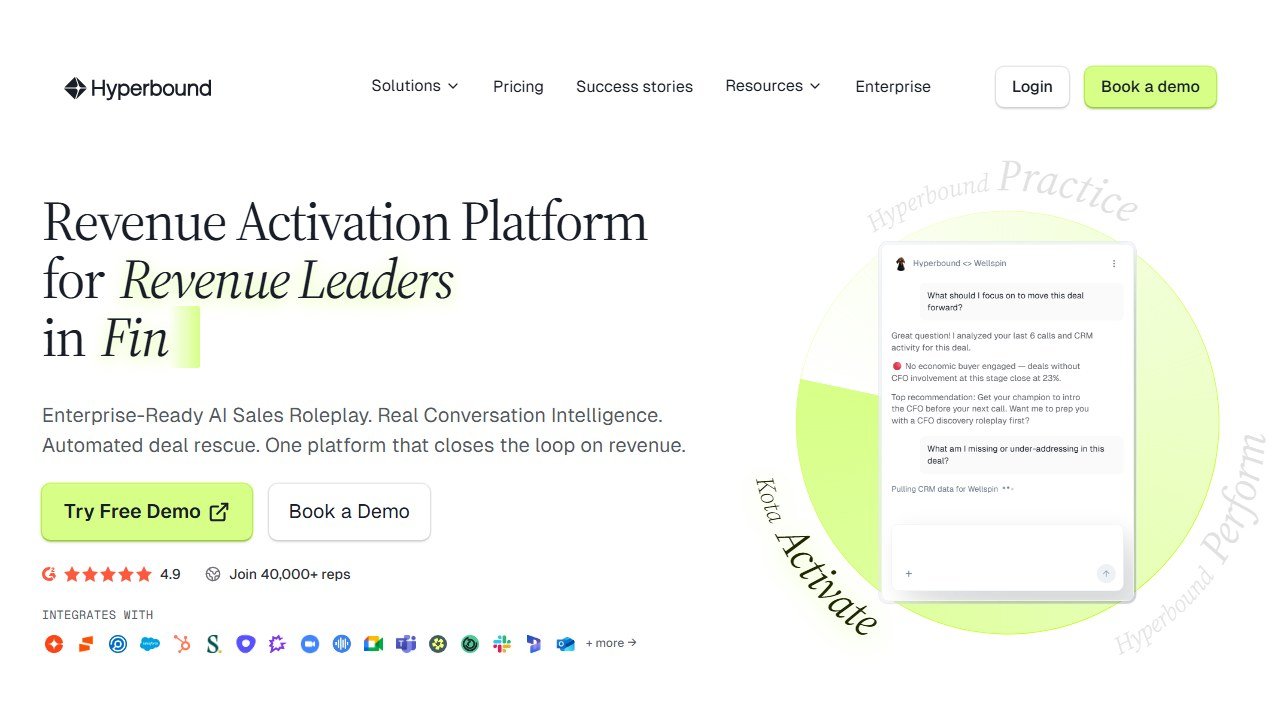
Hyperbound is the fast rising roleplay specialist that has earned a real following with outbound and discovery teams, and it ties Salesloft for sixth because it nails a specific, high value use case: getting reps reps before they ever risk a real prospect. You describe your ideal customer profile and Hyperbound turns it into an interactive AI buyer in under two minutes, then reps practice cold calls, gatekeeper calls, voicemails, warm and discovery calls, demos, and even post sale upsell and renewal conversations. It gives instant, objective feedback on talk ratios, objections handled, and key selling moments, so a rep improves without waiting on a manager.
Its credibility comes from data and focus. Hyperbound says it is built on more than two million hours of real B2B call data, its discovery specific scorecards track question depth and methodology adherence, and it can build personas from a LinkedIn profile. It is backed by Y Combinator and used by teams at Databricks, Snowflake, and Cognism, and it claims to cut ramp time by up to half. It has also broadened into scoring real calls, not just practice ones.
Strengths. Extremely fast bot creation, sharp discovery and cold call scenarios, a genuinely useful free tier for evaluation, and feedback that targets the moments that win or lose calls. Great value for outbound teams.
Weaknesses. The free tier is limited to prebuilt bots, and everything that makes it powerful (custom bots, custom scorecards, real call scoring, integrations, multilingual) sits behind the enterprise plan with no self serve pricing. It is a practice specialist, not a full enablement or content platform.
Pricing. A real free tier with prebuilt bots and unlimited practice time, then a custom enterprise plan for the serious features (reported to start in the mid five figures per year for a team). Book a demo for a quote. See Hyperbound.
8. Allego: best for mobile and just in time learning
Score: 4.1/5
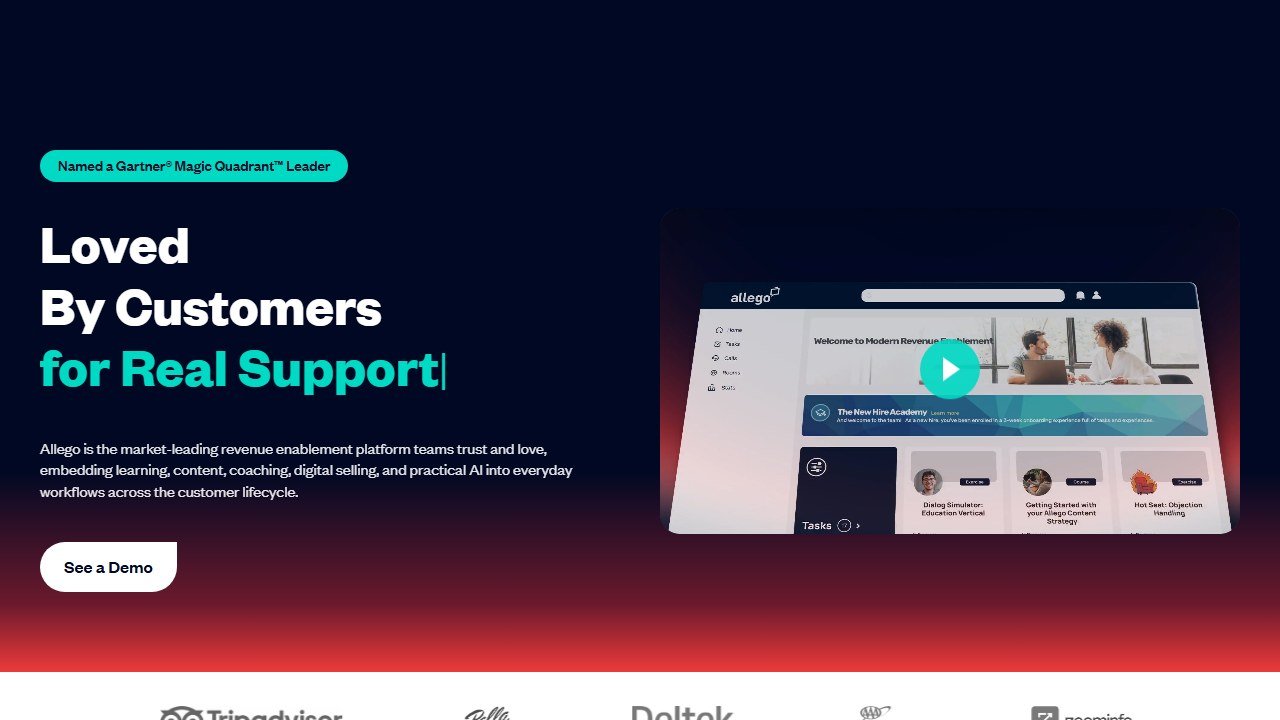
Allego is a readiness and enablement platform with a distinct personality: it was built around video and mobile first learning, which makes it a strong fit for distributed and field sales teams who learn in short bursts between meetings rather than in long desk based courses. Reps can search, watch, and share learning content and approved messaging on the go, including by voice, and managers can run video based practice and coaching where reps record themselves and get feedback. For teams whose sellers are rarely at a desk, that mobility is a genuine differentiator.
Allego’s AI shows up as a set of capabilities it calls Sparks, plus embedded agents. Generative AI search delivers instant answers pulled from content, experts, and learning materials. AI recommendations surface the right content and learning for a specific deal stage, vertical, or product. Embedded agents automate the busywork: summarizing calls, recommending content, generating roleplay scenarios, and proposing next best actions inside the CRM and collaboration tools. It is all grounded in approved content and wrapped in enterprise governance.
Strengths. Excellent mobile and video learning experience, strong content discovery, and AI that meets reps inside the tools they already use. A natural pick for field and distributed teams who will not sit through traditional courses.
Weaknesses. It is broad rather than deep on pure AI roleplay compared with the practice specialists, and the experience can feel sprawling. Pricing is fully custom with nothing public, so budgeting requires a sales conversation.
Pricing. Subscription based, custom, structured by user count and the feature set you need. No public pricing or free trial. See Allego.
9. Yoodli: best for delivery, pacing, and communication coaching
Score: 4.0/5
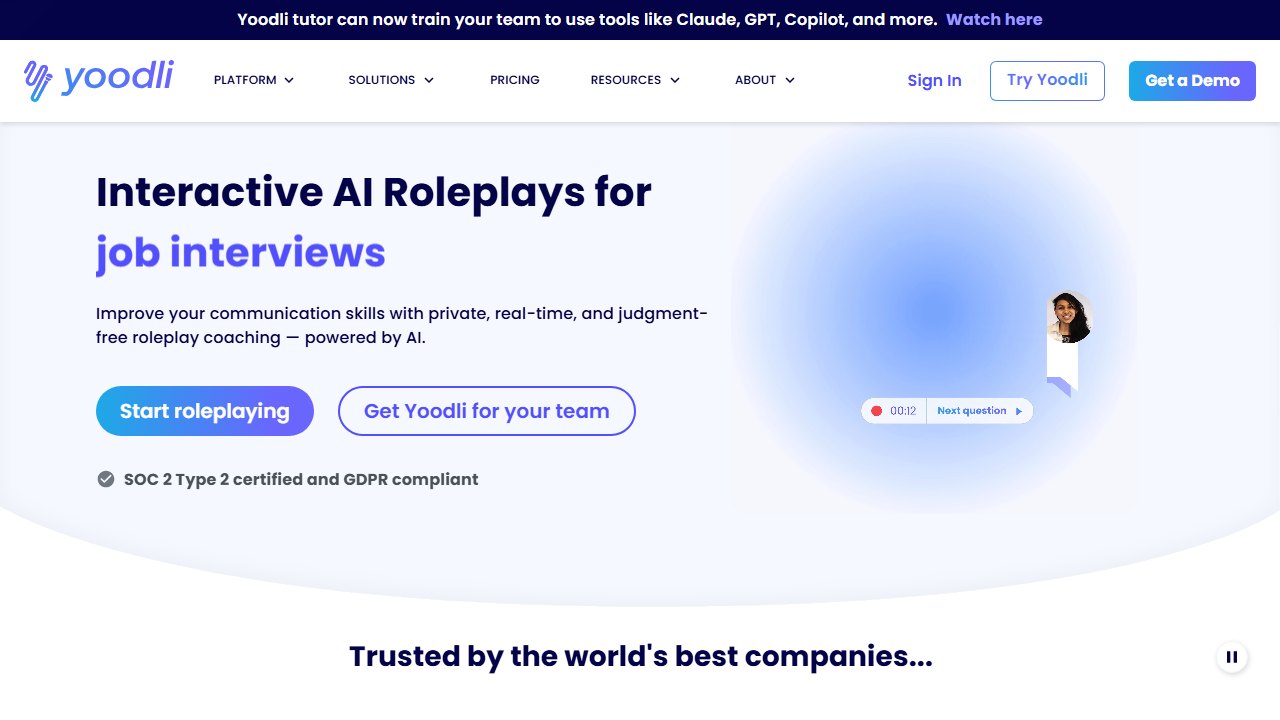
Yoodli sits in a category of its own on this list: it is a communication coaching tool, and it is the best one here for the specific job of making reps sound better. It gives private, judgment free, real time feedback on how someone speaks, analyzing pacing, vocal tone, and clarity, and flagging filler words like “um,” “like,” and “you know.” Keep your webcam on and it also reads eye contact and body language. That focus on delivery (not just what you say but how you say it) is something the bigger platforms touch but rarely do this well.
For business use, Yoodli has built out real sales enablement features. Its AI roleplays simulate customer interactions, competitive objections, and product demos, and enablement leaders can customize personas, scenarios, messaging, and scoring rubrics to match their own sales methodology. Team and manager dashboards track skill progression, certification status, and performance trends. It is trusted by names like Google, Sandler, and Korn Ferry, which lends credibility on the coaching side specifically. We go deeper in our Yoodli review.
Strengths. The strongest delivery and presentation coaching on the list, an unusually generous free tier and genuinely cheap individual paid plans, and customizable roleplay rubrics for teams. The lowest friction way to start improving how reps actually come across.
Weaknesses. Its core strength is communication mechanics, so it is lighter on deep deal context and revenue analytics than the enterprise platforms. Some advanced controls and integrations (SSO, SCIM, LMS and HRIS connections) are gated to custom team and enterprise plans.
Pricing. A free Starter tier, low cost individual Pro and Advanced plans billed annually, and custom Team and Enterprise pricing that adds admin controls, integrations, and rubric based scoring. By far the easiest entry point to trial. See Yoodli.
10. Quantified.ai: best for regulated industry sales reps
Score: 3.9/5
Quantified.ai is a roleplay and coaching platform with a sharp vertical focus: pharma, medtech, finance, and insurance. That specialization is the whole point. Selling in regulated industries means reps cannot say the wrong thing, and Quantified builds compliance into the practice loop. Its AI avatars can actually see and respond to visual aids (a screen share or a leave behind), so a medical or financial rep can rehearse presenting with the exact materials they will use in the field, and its Compliance Agent enforces regulatory and brand standards with an audit trail.
The platform spans more than roleplay. It includes an AI Readiness Coach for launch and onboarding, an AI Field Coach for pre call prep and live call analysis, and instant feedback dashboards that show readiness and progress so managers can coach off data. Quantified reports strong outcomes for its target customers, including a 40 percent reduction in time to readiness and a sizable jump in practice volume. For a regulated sales org, the compliance guardrails alone can justify the buy.
Strengths. Purpose built for regulated selling, with visual aid aware avatars and built in compliance enforcement that general purpose tools lack. SOC 2 Type 2 architecture and private models suit security conscious buyers, and the readiness analytics are solid.
Weaknesses. The vertical focus that makes it great for pharma and finance makes it overkill for a general B2B SaaS team. It is enterprise only with custom pricing that runs high, putting it out of reach for smaller teams.
Pricing. Custom enterprise, per seat, oriented toward five and six figure annual contracts. Expect a sales led process and a price that reflects the compliance tooling. See Quantified.ai.
11. Chorus (ZoomInfo): best for existing ZoomInfo customers
Score: 3.8/5
Chorus is a capable conversation intelligence and call coaching platform, and the reason to choose it over Gong usually comes down to one word: ZoomInfo. Acquired by ZoomInfo in 2021, Chorus captures and analyzes calls, meetings, and emails, with speaker separation and topic identification backed by a long patent history, and it shines at coaching off real examples. Managers can build call libraries of best practice conversations for onboarding, and reps learn from the calls of top performers on their own team, which is one of the more effective ways to transfer skill.
The real strategic value is the data tie in. Chorus sits inside ZoomInfo’s broader go to market platform, so conversation insights connect to ZoomInfo’s very large contact and company database. If your team already runs on ZoomInfo for prospecting and data, adding Chorus keeps everything in one ecosystem and one bill, which is a meaningful convenience and often a pricing advantage.
Strengths. Strong, mature conversation intelligence with genuinely useful coaching features and best practice call libraries, plus deep integration with ZoomInfo’s data platform. The most natural call coaching pick for committed ZoomInfo customers.
Weaknesses. As a standalone conversation intelligence tool it trails Gong on polish, analytics depth, and the newest AI assistant features. Its value is strongest when bundled with ZoomInfo, which means it is less compelling if you are not already in that ecosystem, and like all call analysis tools it does not let reps practice before live calls.
Pricing. Sold per seat, typically as part of a larger ZoomInfo package rather than standalone, in the higher per user range. Pricing favors customers already paying for ZoomInfo. See Chorus by ZoomInfo.
12. Bigtincan Readiness (Brainshark): best for coaching plus content authoring
Score: 3.6/5
Bigtincan Readiness, the platform formerly known as Brainshark, rounds out the list as a readiness tool with a long enablement heritage and a notably deep content authoring story. It combines on demand training that speeds onboarding, coaching and practice that validate readiness, and tools to create and update rich learning content quickly. The coaching side carries over Brainshark’s well regarded VoiceVibes technology, which measures vocal clarity, pace, and filler words and scores reps across a range of positive and negative “vibes” like confidence, authenticity, and even arrogance, which is a more nuanced read on delivery than most platforms attempt.
Bigtincan has layered a full suite of AI on top: RolePlayAI for practice with objective feedback, AuthoringAI and AI voiceover, voice cloning, and translation for fast content creation, CoachingAI, MeetingsAI, and the Genie assistant for search and answers. For teams that produce a lot of their own training content and want authoring, coaching, and roleplay under one roof, it is a sensible and capable choice.
Strengths. Strong content authoring with AI voiceover and translation, the distinctive VoiceVibes delivery scoring, and a complete readiness suite. Good for teams that build and refresh a lot of their own learning material.
Weaknesses. The brand has been through acquisition and rebranding, and the product can feel less cohesive and less cutting edge than newer rivals. No public pricing and no free trial, and the AI roleplay is not as lifelike as the dedicated practice specialists.
Pricing. Custom enterprise subscription based on needs, with no public plans or trial. Expect a sales led quote. See Bigtincan.
What sales training and roleplay platforms actually charge
This is one of the least transparent categories we cover. Most vendors quote rather than publish, which changes how the evaluation has to be run. Here is each alternative to best ai, read at source on 4 September 2026.
Yoodli, the only one here with a published individual rate
Yoodli publishes $8 a month billed annually for its Pro individual plan, which includes up to ten roleplays a week and live AI coaching, and $20 a month billed annually above that. It also runs a free tier. That makes it the only platform in this comparison a single person can price without speaking to anyone, which matters if you want to test the category before committing a team budget.
The five that publish no figure at all
We could not read a price from Second Nature, Hyperbound, Mindtickle, Highspot or Visier on 4 September 2026. Hyperbound and Highspot both render a pricing page carrying no currency figure. That is a commercial choice rather than an oversight, and it is the norm at the enterprise end of sales enablement.
Allego publishes a pricing page with no price on it
Allego is worth calling out separately. It has a real pricing page, headed “Simple Sales Enablement Pricing. Clear Results.”, and there is not a single currency figure anywhere on it. It does publish something useful though: a contract buyout programme for customers switching from a competitor mid-term. If you are locked into a rival, that is worth asking about specifically, because it is the kind of term that rarely appears in a comparison table.
What to do when almost nobody publishes
Price a published alternative precisely at your seat count and make it the number every quote has to justify itself against. Yoodli at $20 a month billed annually across 40 reps is $9,600 a year. That is not a like-for-like substitute for an enterprise enablement platform, and it is a real figure in the room that both sides can verify, which is more than you will otherwise have.
Ask what the platform fee is separate from the seats
Several vendors in this category price as per-user licences plus a platform fee that scales with the number of users supported. That means the cost does not fall as neatly with a smaller pilot as you might expect, and a 10-seat pilot can carry most of the platform cost of a 50-seat deployment. Ask for both components separately before modelling a phased rollout.
How to choose the right tool
The fastest way to a good decision is to stop asking “what is the best AI sales training software” and start asking “which part of training is actually broken for us.” The four categories on this list solve genuinely different problems, and the right pick falls out of that almost immediately.
If the gap is practice (reps need reps before they go live). You want a roleplay and practice specialist. Second Nature is the most realistic buyer simulation for general B2B teams, Hyperbound is the sharpest and best value for outbound and discovery heavy teams, and Quantified.ai is the one to beat if you sell in pharma, medtech, finance, or insurance and need compliance baked in. Yoodli belongs here too if your specific problem is how reps come across (pacing, filler words, presence) rather than the content of what they say. These tools shine for onboarding and ramp, because they let a rep fail safely a hundred times before they ever risk a real prospect. If pure roleplay practice is genuinely all you need and you do not want a broader platform, read our dedicated roundup of the best AI roleplay tools for corporate training, which goes deeper on practice only options.
If the gap is call coaching (reps are live but inconsistent). You want conversation intelligence. Gong is the clear leader for analyzing real calls, surfacing coaching moments, and scaling what your best reps already do, and its 2026 Enable and Assistant additions push it further into training specifically. Salesloft is the better fit if you want that coaching embedded inside the daily selling workflow rather than as a separate system, and Chorus is the obvious choice if you already run on ZoomInfo and want everything in one ecosystem. The thing to remember is that these tools coach off conversations that already happened, so they make existing reps better but do not replace practice for new ones.
If the gap is the whole system (onboarding, certification, content, and proof it works). You want a readiness and enablement platform. Mindtickle is our top pick when you need to certify reps, run product launches, and prove training moved revenue, because it ties practice scores to real outcomes. Highspot is the strongest choice if content adoption is your pain and you want coaching layered on top of a best in class content system. Allego wins for field and mobile heavy teams who learn in short bursts, and Bigtincan Readiness is worth a look if you author a lot of your own training content. These platforms are enterprise commitments, so they make sense when training is a program, not a project.
A practical sequencing tip for teams that can only buy one thing first: if you are early and small, start with practice (it is the cheapest to trial and the fastest to show value). As you scale and live call volume grows, add conversation intelligence. Only commit to a full readiness platform once training is formal enough to need certification, content governance, and revenue correlation. Buying the big platform too early usually means paying enterprise prices for features you will not use for two years.
Our verdict
There is no single best AI sales training software, and any list that claims otherwise is selling you a category, not a solution. After scoring across all four disciplines, our picks break down cleanly by job. For conversation intelligence and coaching your team off real calls, Gong (4.7) is the best on the market, with Salesloft (4.3) the better pick when you want coaching woven into the selling workflow and Chorus (3.8) the natural choice for ZoomInfo shops. For full sales readiness, certification, and proving training moved revenue, Mindtickle (4.6) leads, followed by Highspot (4.4) for content driven teams and Allego (4.1) for mobile field forces. For dedicated practice and roleplay, Second Nature (4.5) is the most realistic, Hyperbound (4.3) the best value for outbound teams, Quantified.ai (3.9) the specialist for regulated industries, and Yoodli (4.0) the standout for delivery and communication coaching.
If you can only take one thing away, it is this: match the tool to the gap. A team that buys Gong to fix a ramp problem will be disappointed, and a team that buys a roleplay bot to coach a 200 person revenue org will outgrow it in a quarter. Identify whether your reps need to practice before the call, get coached after it, or run inside a full enablement program, and the shortlist writes itself. And if it turns out roleplay practice is the only piece you need right now, skip the platform overhead entirely and start with our focused guide to the best AI roleplay tools for corporate training. For the wider view of how AI is reshaping learning beyond sales, our roundup of the best AI corporate training tools covers the broader landscape. Buy for the problem in front of you, trial before you commit, and let your reps tell you which category actually moves their number.

Written by
FazFaz is the founder of AIToolsBakery. Some tools here are tested hands on. Others are assessed from vendor documentation and pricing verified on the live page, and every review says which one it is. Sponsors can buy a position in a guide. They cannot buy the score, the criticism, or silence about a better option.
How we test and how we make money →Frequently Asked Questions