Mindtickle is a full sales readiness platform: onboarding, content, call analysis, AI roleplay, and a readiness index, priced for enterprise. Yoodli is an affordable AI speaking coach with a free tier and live call nudges. Pick Mindtickle to run enablement at scale. Pick Yoodli for fast, low-cost coaching on delivery.
One is a category-defining sales readiness suite used by Cisco, Johnson & Johnson, and Thomson Reuters. The other is a fast-growing AI speaking coach with a genuinely free tier that a single rep can start using in five minutes. Both claim to make your sellers better, but they operate at completely different altitudes.
The confusion is understandable. Search “AI sales coaching” and both names come up. Yet buying one instead of the other is not really a like-for-like decision. It is a decision about whether you need a coaching feature or an enablement system. This guide compares Mindtickle and Yoodli honestly on pricing, roleplay depth, analytics, integrations, and fit, so you can tell which problem you are actually solving.
**Faz says:** I have sat on both sides of this. As a rep I wanted something I could open today and use before a call. As an enablement lead I wanted a system that proved training moved the number. Yoodli nails the first. Mindtickle is built for the second. Most teams pick the wrong one because they shop on the word “coaching” instead of the job to be done.
Quick comparison table
| Feature | Mindtickle | Yoodli |
|---|---|---|
| Website | mindtickle.com{rel=”nofollow”} | yoodli.ai{rel=”nofollow”} |
| Category | Sales readiness and revenue enablement suite | AI communication and speaking coach |
| Pricing | Enterprise, quote-based (est. $30 to $50/user/mo) | Free / ~$11/mo Pro / ~$28/mo Advanced / Enterprise |
| Free tier | No | Yes (limited lifetime sessions) |
| AI roleplay | Yes, Copilot-generated scenarios and scoring | Yes, AI-generated scenarios |
| Live call coaching | No (records and analyzes calls after) | Yes (real-time nudges on Zoom, Teams, Meet) |
| Conversation intelligence | Yes (full call recording and analysis) | Delivery metrics only |
| Onboarding and content | Yes (paths, certifications, content hub) | No |
| Readiness scoring | Yes (Readiness Index tied to revenue) | Delivery scores (filler words, pacing, clarity) |
| Implementation | 6 to 8 weeks typical, implementation fee | Self-serve, minutes |
| Best for | Mid-market and enterprise enablement | Individuals, SMBs, fast rep practice |
Pricing
This is the starkest difference, so it goes first.
Yoodli publishes its pricing. A free Starter plan gives you a small number of lifetime roleplay sessions plus speech analytics, no credit card required. Pro sits around $11 per month and unlocks a larger weekly roleplay allowance. Advanced sits around $28 per month for effectively unlimited practice and richer analytics. Team and Enterprise plans are quote-based and add admin controls, but the entry cost is close to zero and there is no implementation fee. A ten-person team on Advanced runs roughly $3,400 per year.
Mindtickle does not publish pricing and sells through a sales-led enterprise motion. Independent industry estimates put it in the range of $30 to $50 per user per month on annual contracts, typically 12 to 36 months, plus an implementation fee often cited in the $3,000 to $5,000 range. You are buying a platform and a rollout, not a per-seat app.
**Saru says:** Do not compare the sticker prices in isolation. Mindtickle costs more because it replaces several tools: your LMS, your content hub, your call-recording software, and your roleplay app. If you would otherwise buy those separately, the consolidated price can pencil out. If all you need is delivery coaching, you would be paying enterprise money for a fraction of the platform. That is the real trap.
The honest read: Yoodli wins outright on cost and time to value. Mindtickle can win on total cost of ownership only if you genuinely use the broader suite.
Roleplay depth
Both tools do AI roleplay, but they aim at different outcomes.
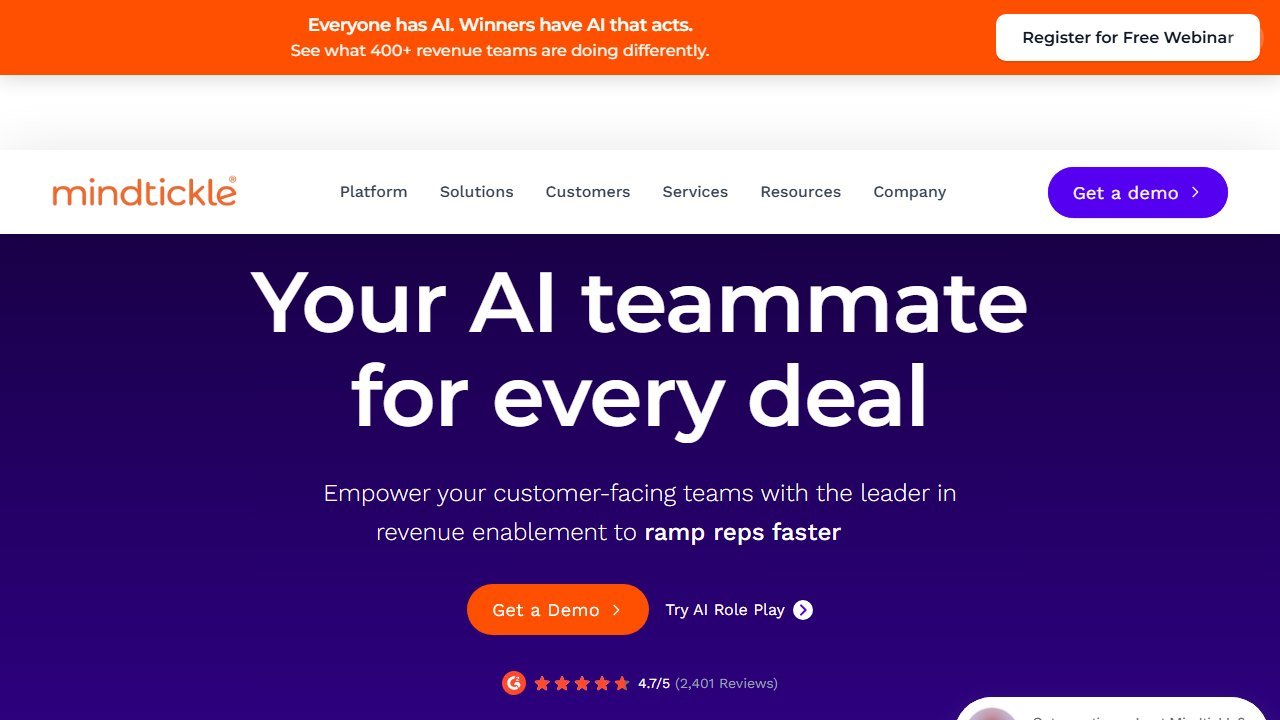
Mindtickle roleplay runs through its AI Copilot. Managers spin up practice scenarios for cold calls, discovery, objection handling, negotiations, renewals, and product launches from pre-built templates or natural-language prompts. Copilot generates the scenario, scores the submission, and gives feedback at scale. The scale point is the story: in one widely cited Cisco example, Copilot handled the initial review of 7,200 submissions, saving managers thousands of hours and pushing reps to practice four to six times before their final attempt. Because roleplay lives inside the readiness platform, scores roll up into certifications and the Readiness Index rather than sitting in a silo.
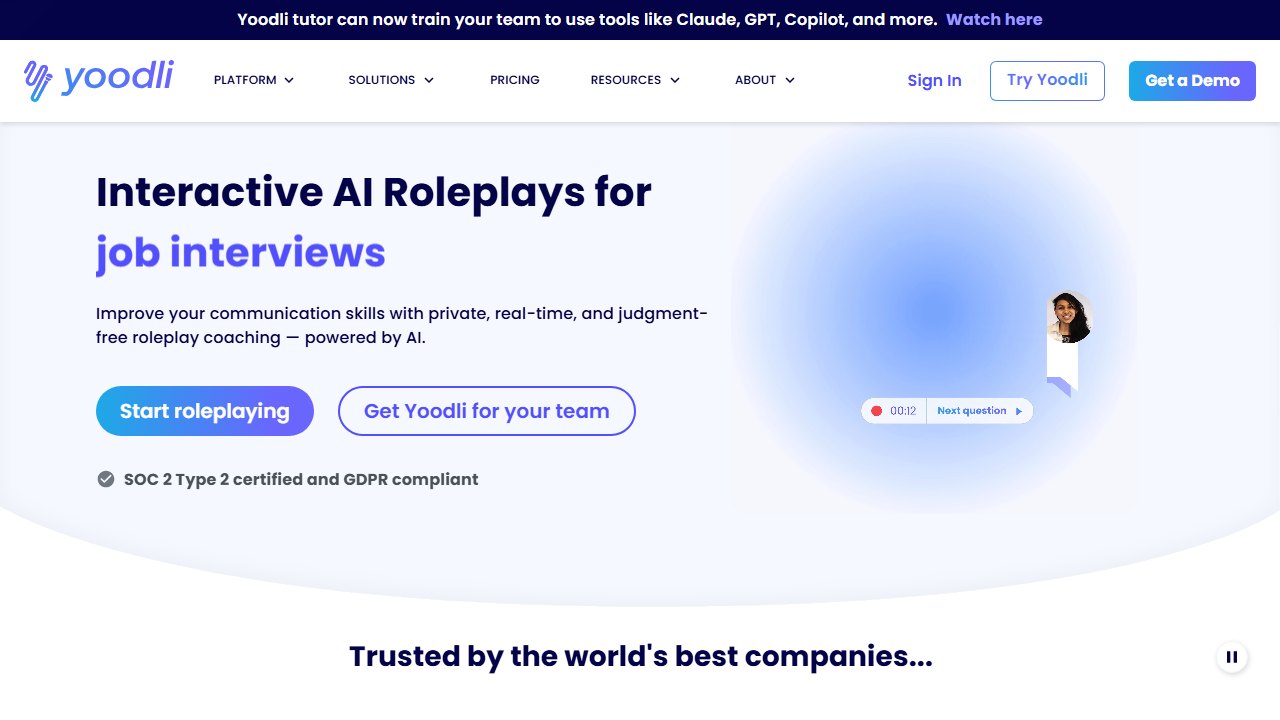
Yoodli roleplay is built for the individual rep. You pick or describe a scenario, and the AI plays a prospect you can talk to by voice. It scores your delivery: filler words, pacing, talk-to-listen ratio, clarity, and confidence. It is fast, private, and genuinely useful for rehearsing a pitch before a real call. What it does not do is judge whether you advanced the deal, qualified correctly, or earned a next step. It evaluates how you said it, not whether you sold.
Verdict on roleplay: Mindtickle for structured, scored, manager-reviewed practice that feeds a broader competency model. Yoodli for frictionless solo rehearsal on communication mechanics. If you want to know more about the roleplay landscape beyond these two, our best AI roleplay tools for corporate training roundup covers the full field.
Analytics and call intelligence
Mindtickle records and analyzes real sales calls as conversation intelligence, then ties that behavior to competency scoring and revenue. Managers see who is ready, where the skill gaps are, and how training correlates with pipeline. This closed loop from training to call behavior to outcome is the core reason enterprises buy it.
Yoodli analyzes your speaking, both in practice and live. During a real Zoom, Teams, or Google Meet call, Yoodli sits in the meeting and nudges you in real time: slow down, cut the filler, adjust pacing. No enterprise suite here coaches you mid-call. After the fact you get delivery analytics, but not deal-progression scoring or CRM-linked pipeline analytics.
The distinction is clean. Mindtickle answers “is this rep ready and did training move revenue.” Yoodli answers “how well did I communicate, live and in practice.” Live in-call coaching is Yoodli’s signature advantage and Mindtickle does not offer it. Deep readiness analytics is Mindtickle’s territory and Yoodli does not attempt it.
Onboarding, content, and the wider platform
This is where the comparison stops being close.
Mindtickle is a full enablement suite. Beyond roleplay it includes structured onboarding paths, certifications, a sales content hub, digital sales rooms, and manager coaching workflows, all stitched together by the Readiness Index and Copilot. For a company ramping dozens or hundreds of reps a year, that consolidation is the point. It is one system for hire-to-productive.
Yoodli is intentionally not that. It has no content management, no certification engine, no onboarding paths, and no digital sales rooms. It is a focused coaching tool. That focus is a feature, not a bug, if coaching is all you need. But if you are trying to run onboarding, it is only one piece and you would still need an LMS and a content system around it. For structured onboarding specifically, compare against our best AI tools for sales onboarding picks.
Integrations
Mindtickle integrates deeply with the enterprise sales stack: CRM (Salesforce and others), conferencing and call sources for conversation intelligence, SSO, and typical enterprise identity and data tooling. It is designed to sit at the center of a RevOps and enablement environment.
Yoodli integrates where a coaching tool needs to: it joins live meetings on Zoom, Teams, and Google Meet, and supports LMS standards such as SCORM and LTI so practice can slot into an existing learning platform. It does not push readiness data into your CRM the way Mindtickle does, because that is not its job.
If a single dashboard tying training to pipeline matters to you, Mindtickle wins integrations. If you just need coaching to show up in your meetings and your LMS, Yoodli is enough.
Honest limitations
No tool is all upside. Here is where each one frustrates buyers.
Mindtickle limitations. The cost and commitment are real. Twelve to thirty-six month contracts plus an implementation fee mean this is a budgeted, procurement-led purchase, not an experiment. Rollouts commonly take six to eight weeks and need an owner. The platform is broad, which means admin overhead: someone has to build the paths, manage content, and keep certifications current, or the suite underdelivers. Reviewers on Gartner Peer Insights and G2 sometimes flag a learning curve for admins and a heavier lift than expected to configure everything well. If you only ever use the roleplay module, you overpaid.
Yoodli limitations. The focus that makes Yoodli fast also caps it. It scores delivery, not deal progression, so it cannot tell you whether a rep actually qualified an opportunity or earned a next step. It has no content management, certifications, or onboarding paths, so it cannot be your enablement system of record. Its roleplay is voice and text rather than animated buyer avatars, and it does not push data into your CRM. For a solo rep that is fine. For a VP of enablement trying to prove revenue impact across a hundred reps, it is not enough on its own.
Read those two lists back to back and the buying decision almost makes itself. You are choosing between “too much platform for a coaching need” and “not enough platform for an enablement mandate.”
Best for X
Best for enterprise enablement at scale: Mindtickle. Long ramp cycles, hundreds of reps, and a mandate to prove training ROI are exactly what it is built for.
Best for individuals and small teams: Yoodli. Free to start, cheap to scale to a handful of seats, and productive on day one.
Best for live-call coaching: Yoodli. Real-time nudges during actual customer calls are unique to it here.
Best for onboarding and certification: Mindtickle. It is a system of record for rep readiness, not just a practice app.
Best for delivery and communication polish: Yoodli. Filler words, pacing, and confidence are its home turf, and it works for interviews and presentations too, not only sales.
Best for tight budgets and fast pilots: Yoodli. No implementation project, no long contract, no procurement marathon.
Where the figures on this page come from
Every price here was read from the vendor’s own pricing page on 4 September 2026 and carries that date. Where a page served us regional pricing we say so rather than converting it, because regional rates are set deliberately and are not a currency conversion.
The pages we read
Yoodli publishes $8 and $20 a month billed annually plus a free tier. Colossyan publishes a free plan and Professional at $59 a month annually with $30 per additional member. HeyGen publishes $0, $29, $49 and $149 a month with team seats at $20. iSpring publishes $970, $1,290 and $720 USD per author per year. Deputy publishes $5, $6.50 and $9 per user per month excluding tax. Synthesia served us rupee pricing, reported as such above.
The ones that publish no figure
Second Nature, Hyperbound, Mindtickle, Highspot and Visier all declined to show us a price, and Allego publishes a pricing page with no currency figure on it at all. Articulate publishes only a limited-time offer, currently $1,198 per user per year against a struck-through $1,749. Treat any other figure for those seven as unverified.
What we do not do
We do not convert currencies, and we do not carry a figure we cannot source to the vendor. Where a number circulates and cannot be traced, we say so and withdraw it rather than repeating it with a hedge.
What sales training and roleplay platforms actually charge
This is one of the least transparent categories we cover. Most vendors quote rather than publish, which changes how the evaluation has to be run. Here is each alternative to mindtickle vs, read at source on 4 September 2026.
Yoodli, the only one here with a published individual rate
Yoodli publishes $8 a month billed annually for its Pro individual plan, which includes up to ten roleplays a week and live AI coaching, and $20 a month billed annually above that. It also runs a free tier. That makes it the only platform in this comparison a single person can price without speaking to anyone, which matters if you want to test the category before committing a team budget.
The five that publish no figure at all
We could not read a price from Second Nature, Hyperbound, Mindtickle, Highspot or Visier on 4 September 2026. Hyperbound and Highspot both render a pricing page carrying no currency figure. That is a commercial choice rather than an oversight, and it is the norm at the enterprise end of sales enablement.
Allego publishes a pricing page with no price on it
Allego is worth calling out separately. It has a real pricing page, headed “Simple Sales Enablement Pricing. Clear Results.”, and there is not a single currency figure anywhere on it. It does publish something useful though: a contract buyout programme for customers switching from a competitor mid-term. If you are locked into a rival, that is worth asking about specifically, because it is the kind of term that rarely appears in a comparison table.
What to do when almost nobody publishes
Price a published alternative precisely at your seat count and make it the number every quote has to justify itself against. Yoodli at $20 a month billed annually across 40 reps is $9,600 a year. That is not a like-for-like substitute for an enterprise enablement platform, and it is a real figure in the room that both sides can verify, which is more than you will otherwise have.
Ask what the platform fee is separate from the seats
Several vendors in this category price as per-user licences plus a platform fee that scales with the number of users supported. That means the cost does not fall as neatly with a smaller pilot as you might expect, and a 10-seat pilot can carry most of the platform cost of a 50-seat deployment. Ask for both components separately before modelling a phased rollout.
The verdict: final pick by buyer type
Mindtickle and Yoodli are not really rivals. They are answers to different questions.
Choose Mindtickle if you are a mid-market or enterprise sales org that needs to onboard reps, manage content, analyze real calls, run scored roleplay, and prove that all of it moves revenue, in one platform. You have an enablement team, budget for an annual contract and implementation, and consolidation is a goal rather than a nice-to-have. For a deeper look at what you are buying, read our full Mindtickle review, and if you want to weigh other suites, see our Mindtickle alternatives guide.
Choose Yoodli if you want affordable, fast coaching on how reps communicate, including live nudges during real calls, without a platform rollout. You are an individual, an SMB, or a larger team that only needs the coaching layer. Our full Yoodli review covers its features, pricing tiers, and limits in detail.
The clean way to decide: if the word that describes your need is “enablement,” buy Mindtickle. If the word is “coaching,” buy Yoodli. A few well-funded teams even run both, using Mindtickle for structured readiness and Yoodli for live in-call nudges. For the full category context, start with our best AI corporate training tools pillar or, if your focus is purely the sales floor, our best AI sales training software guide.

Written by
FazFaz is the founder of AIToolsBakery. Some tools here are tested hands on. Others are assessed from vendor documentation and pricing verified on the live page, and every review says which one it is. Sponsors can buy a position in a guide. They cannot buy the score, the criticism, or silence about a better option.
How we test and how we make money →