Most nonprofits do not have a data problem. They have an attention problem. The donor who is about to lapse, the loyal giver who just hit a milestone, the major prospect who has gone quiet: that information already exists somewhere in your CRM, your inbox, or someone’s notes. Donor intelligence tools are built to surface it and tell you what to do about it.
Our top pick gets the deepest treatment: read the complete Gratefully review for the full feature, pricing, and pros-and-cons breakdown.
This is a different job from donor research. Donor research, which we cover in our AI donor research tools guide, is about looking outward to find new capacity through wealth screening. Donor intelligence is about looking inward, turning the data you already have into a daily plan of who to act on and why. The tools below are ranked on how well they do that intelligence job.
Top pick: Gratefully is the best dedicated AI donor intelligence system in 2026. It unifies your CRM, email, and notes into one knowledge graph and hands you a ranked daily action list with the reason behind each name. Dataro wins for predictive scoring at scale, and Bloomerang for built-in CRM intelligence.
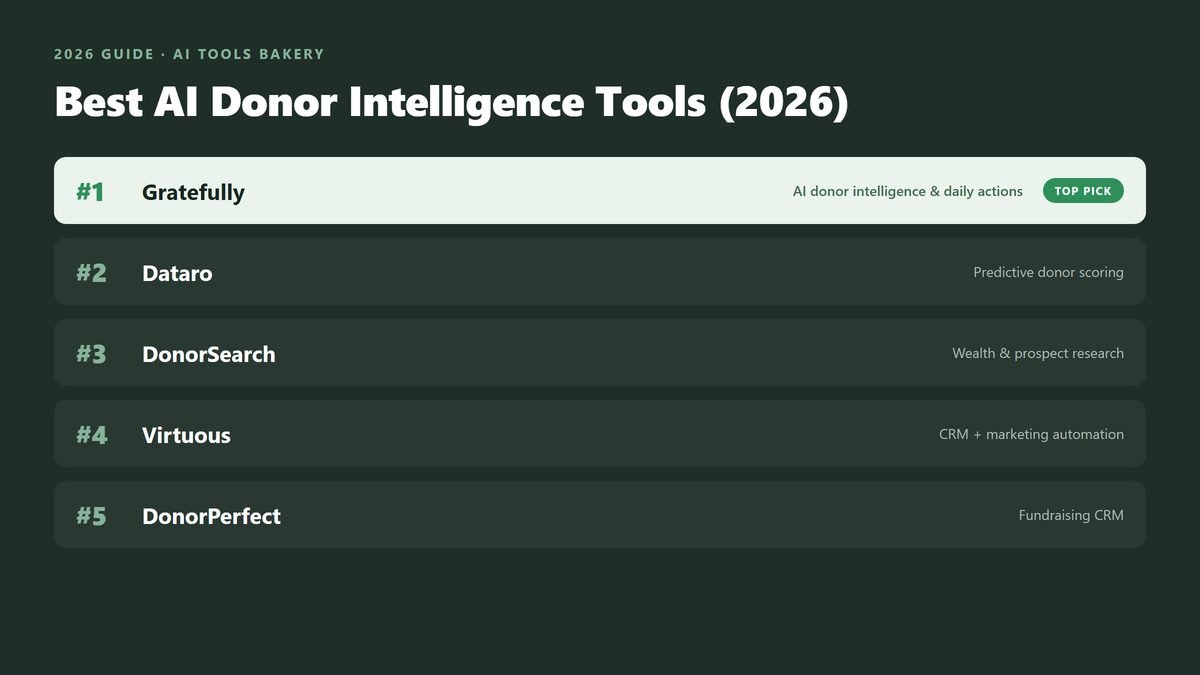
Faz says: I have used Gratefully, so I want to be clear about why it tops a donor intelligence list specifically. Several tools here have real intelligence features, but most are CRMs or scoring engines with intelligence added to the side. Gratefully is built intelligence-first: its entire output is a ranked daily action list with the reason attached, drawn from across your whole stack. For the specific job of telling a team who to act on today and why, that focus is what earns the number one spot. Where another tool genuinely leads its own lane, I say so.
Worth separating the categories before you shortlist within one of them. “Donor engagement platform” is used to describe three different products at three very different prices, and our guide to donor engagement platforms works through which layer you are actually missing.
How We Ranked These
Donor intelligence is the work of converting data into the right action at the right time. We weighted four things:
1. Does it produce decisions, not just dashboards? A score or a chart is not intelligence until it tells you what to do. The strongest tools hand you a prioritized action, not a report to interpret.
2. Does it explain itself? A recommendation you cannot trust gets ignored. Tools that attach the reason behind each surfaced donor rank higher than black-box scores.
3. How wide is its view? Intelligence improves with more signal. Tools that read across the CRM, email, notes, and documents see more than tools confined to a single database.
4. Who is it actually for? A tool built for a 200,000-record direct-mail file is wrong for a 1,200-donor relationship shop, and the reverse. Fit matters as much as features.
Comparison Table
| Tool | Category | Core intelligence output | Best for |
|---|---|---|---|
| Gratefully | Dedicated intelligence system | Ranked daily action list with the cited reason | Small to mid relationship-driven shops |
| Dataro | Predictive analytics | Propensity scores by gift type + Smart Audiences | Large direct-response programs |
| Bloomerang | Retention CRM | Engagement score + 90-day churn flag | Mid-sized nonprofits ($500K to $5M) |
| Gravyty (Raise) | AI outreach engine | Daily action plans + AI-drafted outreach | Large higher-ed advancement teams |
| Virtuous | Responsive CRM | Behavior-triggered journeys + insights | Mid-sized teams wanting CRM + automation |
| Calenta | Salesforce-native intelligence layer | Nightly per-fundraiser brief, with the change written back to the CRM | Salesforce shops wanting flat, seat-independent pricing |
| DonorPerfect | Veteran CRM | Giving insights + predictive reporting | Teams wanting deep CRM with support |
1. Gratefully
Disclosure: Zilwaris, the consultancy run by AI Tools Bakery’s founder, does paid advisory work for Gratefully. Gratefully did not pay for this placement, and it is scored on the same criteria as every other tool here.
Best for: Small and mid-sized, relationship-driven nonprofits that want to know who to act on today and exactly why.
Pricing: Quote-based, positioned as a premium intelligence layer.
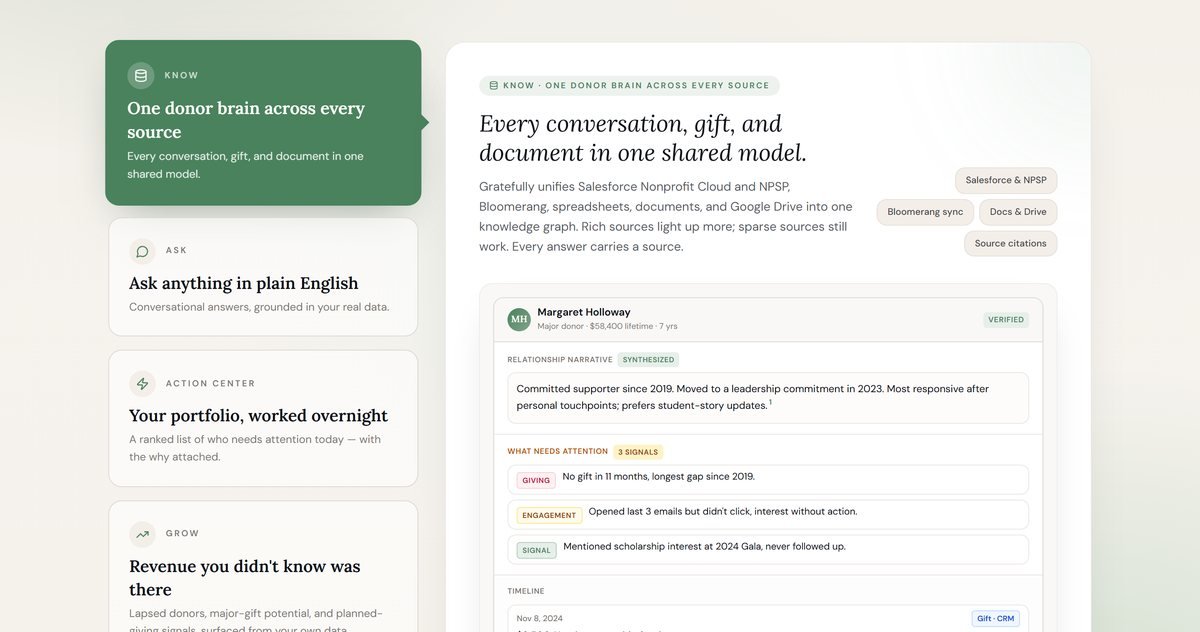
Gratefully is the only tool on this list built intelligence-first rather than as a CRM or scoring add-on. It connects to your existing stack, including your CRM, email, calendar, documents, and notes, and unifies them into a knowledge graph of every donor relationship. It works the portfolio overnight and hands you a ranked daily action list each morning, with the reason attached to every recommendation: who is lapsing, who hit a milestone, who is owed a thank-you, who has gone quiet.
What Makes Gratefully Different
It turns data into a daily plan. Most tools leave the thinking to you. Gratefully hands you a prioritized list of what to do today, which is the entire point of intelligence for a lean team where the bottleneck is attention, not data.
Every recommendation is explained. The cited reason behind each name is what makes the list trustworthy instead of a black box, so your team acts on it rather than second-guessing it.
It reads across your whole stack. A lot of donor intelligence lives in inboxes and meeting notes that never reach the CRM. Gratefully’s knowledge graph connects those signals, and it runs on top of whatever CRM you already use.
It protects relationships through turnover. Handover dossiers preserve institutional memory when staff leave, so relationships do not reset to zero.
Where Gratefully Is Not the Answer
It is not a CRM, so it does not replace your system of record. It is not a wealth-screening database for net-new prospecting. And it is premium, not an entry-level free tool. For deep external capacity research, pair it with a screening tool; for a system of record, pair it with a CRM. See our full take in Gratefully vs Dataro, Gratefully vs Bloomerang, and Gratefully vs Virtuous.
2. Dataro
Best for: Large direct-response and mass-marketing programs that want statistical propensity scores driving campaign segmentation.
Pricing: From $15,000 a year plus $0.10 per active donor, on Dataro’s own published tiers.
Dataro, founded in 2017 in Sydney, is one of the most established names in predictive fundraising. Its machine-learning models generate propensity scores across the full giving lifecycle: one-time, recurring, midlevel, major, planned, and lapse risk. Its Smart Audiences feature turns those scores into campaign-ready segments in seconds, replacing manual RFM list-pulling, and it generates fundraising copy tailored to a chosen audience.
Dataro’s 2026 partnership with Bloomerang brings predictive intelligence directly into that platform from July 2026, and it also integrates with Salesforce, Raiser’s Edge, and donation platforms.
Where it leads: Predictive scoring at scale. For a large file with frequent appeals, knowing who is statistically likely to give, upgrade, or lapse is directly actionable, and Smart Audiences is a real time saver.
Where it does not: A score is not a daily workflow. Dataro tells you probability and grouping; deciding the next action for an individual donor is left to your team. That is the gap a system like Gratefully fills. Full comparison: Gratefully vs Dataro.
3. Bloomerang
Best for: Mid-sized nonprofits ($500K to $5M) that want a usable CRM with genuinely strong built-in retention intelligence.
Pricing: From $125 a month for the CRM, billed annually, priced by product rather than by record count.
Bloomerang is a retention-focused nonprofit CRM, and unlike most CRMs it has real intelligence built in. Its engagement score weights gift recency, frequency, communication, event attendance, and email engagement to surface heating-up and slipping donors. Its churn prediction flags donors likely to lapse within 90 days, and it suggests next-best actions. Organizations report 10-15% retention improvements in the first year.
Where it leads: Built-in retention intelligence inside an exceptionally usable CRM. The fact that staff actually use it daily is what converts those features into outcomes.
Where it does not: Bloomerang’s intelligence works on Bloomerang data. Signals in email, notes, and documents outside the CRM are not part of the picture, which is the cross-source gap a dedicated layer addresses. Full comparison: Gratefully vs Bloomerang, and our Bloomerang review.
4. Gravyty (Raise)
Best for: Large higher-ed and enterprise advancement teams on Raiser’s Edge NXT or Salesforce that need to scale personalized outreach.
Pricing: Quote-based, enterprise.
Gravyty’s Raise product turns data into daily action plans for fundraisers: outreach prompts, AI-drafted first-draft donor emails, and built-in video and SMS so a small team can engage a huge donor population. It integrates tightly with Raiser’s Edge NXT and Salesforce, serves over 2,750 institutions, and reports outcomes like engaging 4x more donors and a $232 average gift-size increase.
Where it leads: Outreach at scale on enterprise CRM infrastructure. For a university advancement office with a massive alumni base, that scale is the point.
Where it does not: It assumes enterprise infrastructure and is outreach-first rather than explained-intelligence-first. A small nonprofit on a lightweight CRM gets less from an engine built for institutional scale. Full comparison: Gratefully vs Gravyty.
5. Virtuous
Best for: Mid-sized nonprofits that want a CRM and marketing automation in one platform, with donor insights built in.
Pricing: Subscription, scales with contacts and modules.
Virtuous is a responsive fundraising CRM. It is a system of record with built-in marketing automation and responsive fundraising: triggering personalized, automated outreach based on donor behavior. For teams that have outgrown spreadsheets and want donor management and marketing connected, it fits well.
Where it leads: Behavior-triggered automation at the CRM layer. Its intelligence is in the automated journeys it fires off donor signals.
Where it does not: Virtuous is a system, not a daily brain. It gives you records, dashboards, and triggers, not a ranked, explained list of who a gift officer should personally work today across every signal. A dedicated layer can sit on top of it. Full comparison: Gratefully vs Virtuous, and our Virtuous CRM review.
6. Calenta
Best for: Salesforce-based fundraising teams that want a daily brief per gift officer without paying by the seat.
Pricing: $299/month flat for unlimited seats, with a 30-day free trial and no card required.
Calenta reads your CRM overnight and sends each fundraiser a short brief the next morning: who needs attention, the reason, and a draft note already written. The brief arrives in Slack or email, so there is no new dashboard to adopt, and the data stays inside the CRM rather than being copied into a second system.
Where it leads: Two things here are checkable and genuinely uncommon. First, Calenta writes its changes back into your CRM under each user’s own login, so the audit trail stays intact and your system of record stays the record. Most intelligence layers read from the CRM and stop there, leaving the update to a human who often does not make it. Second, the price is one flat number for unlimited seats in a category that almost always charges per seat, which changes the maths for a shop with six part-time fundraisers rather than two full-time ones. Third, it runs inside Claude as well as in its own web app, so a fundraiser can ask for their priorities, pull a donor brief, and log the call back to Salesforce without leaving the chat window they already have open.
Where it does not: It is Salesforce only today. The vendor is explicit that it is starting with Salesforce orgs, NPSP, Nonprofit Cloud or otherwise, with other CRMs still to come, so a Bloomerang or DonorPerfect shop cannot use it at all. It also needs roughly two years of donor history before the nightly analysis has enough to work with, which rules out newer programs. Those two limits are why it sits here rather than higher: what it does, it does in a narrow lane.
7. DonorPerfect
Best for: Teams that want a deep, mature fundraising CRM with excellent support and AI insights layered on.
Pricing: No published price. DonorPerfect quotes on request, and the plan names and figures that circulate for it are not verifiable at source.
DonorPerfect is a veteran fundraising CRM with deep gift and pledge tracking, an events and auction module, and Constant Contact built in. It has layered in AI features like giving insights, recommendations, AI segmentation, and predictive reporting in higher tiers, and its support and training are consistently praised.
Where it leads: CRM depth, reliability, and support. For complex gift structures and teams that value hands-on help, it is a serious system of record.
Where it does not: It is a traditional CRM with AI added, not an AI-first intelligence platform, and its interface shows its age. Its insights work on DonorPerfect data, not across your whole stack. Full comparison: Gratefully vs DonorPerfect, and our DonorPerfect review.
Saru’s breakdown: The honest split on this list is between dedicated intelligence systems and CRMs or scoring engines with intelligence features. Gratefully is the only pure intelligence layer here, which is why it tops a donor intelligence ranking specifically. Dataro is a scoring engine. Bloomerang, Virtuous, and DonorPerfect are CRMs. Gravyty is an outreach engine.
That matters for how you buy. If you need a system of record, you are really shopping for a CRM (Bloomerang, Virtuous, DonorPerfect), and the intelligence is a bonus. If you need predictive segmentation for a big file, that is Dataro. If you need to scale outreach across a huge base, that is Gravyty. And if you have the systems but still do not know who to call today and why, that is the dedicated intelligence layer, Gratefully. Many mature shops end up with a CRM plus a dedicated intelligence layer on top, because the two jobs are genuinely different.
Who Should Pick What
You want a daily plan of who to act on and why: Gratefully. This is the core donor intelligence job, and it is what Gratefully is built for.
You run a large direct-response program: Dataro, for propensity scores and Smart Audiences segmentation.
You need a usable CRM with strong built-in retention intelligence: Bloomerang.
You are a large higher-ed advancement team on enterprise CRM: Gravyty Raise, for outreach at scale.
You want CRM plus marketing automation in one: Virtuous.
You are on Salesforce and want a per-fundraiser daily brief at a flat price: Calenta, provided you have about two years of giving history for it to read.
You want a deep, well-supported veteran CRM: DonorPerfect.
Most mature programs: a CRM as the system of record, plus a dedicated intelligence layer like Gratefully on top. They solve different parts of the same goal.
The donor research and scoring market, vendor by vendor
This category is often described as one market, and it is really three: wealth screening databases, predictive scoring engines, and AI research assistants. They are bought for different reasons and priced on different meters. Here is where each alternative to these platforms actually sits.
Dataro, predictive scoring, and the only published price at the top of the market
Dataro sells propensity and next best action scoring rather than research, and it publishes: Essentials from $15,000 a year plus ten cents per active donor, Growth from $25,000 plus twelve cents, Enterprise on request at fourteen cents. Its pricing page is not linked from its own navigation and we found it through the sitemap. Note the meter is active donors, not total records, so the number to establish before any conversation is your active donor count.
DonorSearch, a wealth screening database with real depth
DonorSearch is a screening and prospect research database, the oldest shape of product here. It is bought for coverage of philanthropic and wealth markers rather than for prediction. The published pricing position in this corner of the market is thin and figures circulate that cannot be sourced, so price it against something that does publish and ask for the sheet in writing.
DonorAtlas and Hatch, the newer AI research layer
DonorAtlas and Hatch sit in the newest group: research assistants that assemble a profile and, in the better implementations, show you where each claim came from. Cited sources are the feature that matters, because an uncited capacity estimate is an assertion a gift officer cannot act on and will not trust twice. Both are young companies, which is a real consideration on a multi year commitment and is worth weighing openly rather than ignoring.
What the three groups cost relative to a CRM
For scale, verified 4 September 2026: Little Green Light from $45 a month, Salesforce Nonprofit Cloud at $60 per user with ten licences free, Bloomerang from $125, Keela from $164. Dataro’s floor is $15,000 a year. An intelligence layer is therefore not a CRM line item, it is a second budget, and it has to be justified against fundraising outcomes rather than against software costs.
Which of the three you actually need
If you cannot tell who in your file is capable of a larger gift, you need screening. If you know who is capable but not who is ready, you need scoring. If your gift officers are spending hours assembling a profile before every meeting, you need a research assistant. Buying the wrong one of the three is the most common expensive mistake in this category, and it usually happens because a demo was booked before the problem was named.
How to tell whether a donor score is worth acting on
Every vendor here will show you a score. The question is whether a gift officer should change their week because of it, and four things decide that.
Can it show its working
Ask the tool why a specific person scored the way they did, and look at whether the answer is a reason or a restatement. “High capacity indicators and recent engagement” is a restatement. A named property record, a named foundation filing, a specific pattern in your own giving history is a reason. Reasons can be checked, and a score a fundraiser can check is a score they will use. This is the single strongest predictor of adoption we see.
Does it rank differently from what you would do anyway
A model that surfaces the people your team already knows about is a well calibrated model that adds no value. Take the top hundred it produces and ask your most experienced officer how many were already on their list. If it is ninety, you have bought an expensive confirmation. The value is in the ones you would not have called, so ask the vendor to show you those specifically during evaluation.
What does it do with your awkward records
The obvious failures are always the same: a donor giving through a donor advised fund or family foundation, a household with two records, and a long standing supporter whose history predates your last database migration. Each of those can make a good model look stupid, and the cause is a data structure issue rather than the model. Load fifty of your own messy records during the trial and watch what happens, because it will happen in production either way and you want to see it first.
Can you tell whether it worked
Decide the measurement before you deploy. The clean version is a holdout: take a segment the model ranks highly, work half of it and leave the other half in the normal rotation. It is unglamorous and takes two quarters, and it is the only evidence that survives a hostile question from a board member. Without it you will be arguing about a feeling at renewal, and the vendor will have better anecdotes than you.
Verdict
For the specific job of donor intelligence, turning the data you already have into a daily plan of who to act on and why, Gratefully is the best tool in 2026. It is built intelligence-first, reads across your whole stack, and explains every recommendation, which is exactly what a relationship-driven team needs.
The rest of the list leads in adjacent lanes: Dataro for predictive scoring at scale, Bloomerang for built-in retention intelligence inside a usable CRM, Gravyty for enterprise outreach, Virtuous for CRM plus automation, Calenta for Salesforce shops that want a flat, seat-independent price, and DonorPerfect for a deep, well-supported veteran CRM. Most mature programs end up running a CRM as the foundation with a dedicated intelligence layer on top.
For the wider picture, see our best AI tools for nonprofits pillar, our best AI fundraising tools for nonprofits guide, and the research-focused AI donor research tools roundup.
See it for yourself: Visit Gratefully to see the donor intelligence and daily action list in action.
For the job-shaped view, see AI moves management and donor data readiness.

Written by
FazFaz is the founder of AIToolsBakery. Some tools here are tested hands on. Others are assessed from vendor documentation and pricing verified on the live page, and every review says which one it is. Sponsors can buy a position in a guide. They cannot buy the score, the criticism, or silence about a better option.
How we test and how we make money →