Lofty vs Ylopo looks like a straightforward head-to-head, and that is exactly why most of the comparisons you will find get it wrong. These two are not rivals fighting over the same job. Lofty is an all-in-one platform: CRM, IDX websites, lead generation, and a stable of AI agents in one subscription. Ylopo is deliberately not a CRM. It is a lead generation and AI nurture layer built to sit on top of whatever CRM you already run. Ylopo even built a native integration into Lofty, and its own comparison page suggests running both together.
So the real question is not “which one wins.” It is: do you consolidate everything into one platform, stack a specialist layer on the CRM you already love, or run both side by side? That is the decision we will walk through here.
Two quick housekeeping notes before the matrix. First, Lofty is the company formerly known as Chime: the rebrand happened in November 2023, so any “Chime vs Ylopo” thread you find is about the same product. Second, lofty.com is not lofty.ai: the latter is an unrelated fractional real estate investing app, so make sure you are googling the right one.
The decision matrix
| Decision factor | Consolidate: Lofty | Stack: Ylopo + your CRM | Run both |
|---|---|---|---|
| What you are buying | One platform: CRM, IDX site, lead gen, AI agents | Lead gen + AI nurture layered on an external CRM | Lofty as the CRM, Ylopo as the lead-gen and nurture engine |
| CRM included | Yes, built in | No. Ylopo requires an external CRM; AI Voice requires Follow Up Boss specifically | Yes, Lofty is the CRM of record |
| AI capabilities | AI Copilot, Sales Agent (24/7 virtual ISA), Social Agent, Homeowner Agent, dynamic lead scoring | Ylopo AI Text and AI Voice: 24/7 qualifying, live transfer, long-cycle follow-up | Both AI stacks; Ylopo behavioral data syncs to Lofty as Ylopo Stars |
| Lead generation | 33+ lead-gen methods plus managed ads, all in-platform | Ylopo’s specialty: dynamic FB/IG/Google ads and branded search sites | Ylopo drives the leads, Lofty works them |
| Vendor lock-in | Higher: leaving means replacing CRM, site, and lead gen at once | Lower: swap the lead-gen layer, keep your CRM and database | Highest total spend, but each layer is separately replaceable |
| Reported monthly cost (no figure is official) | ~$449 to $1,500 platform, plus setup (reported 2026) | ~$300 to $1,500 platform, plus ad spend and CRM fees (reported 2026) | Both subscriptions plus ad spend; free-Lofty brokerage deals change this math |
| Best fit | Solo agents and new teams wanting one bill and one login | Teams with an established CRM and a database worth nurturing | High-volume teams at eXp or LPT, or teams that want best-of-breed at both layers |
Both vendors gate their pricing behind demo calls, so every dollar figure in that table is a third-party reported estimate, not a rate card. We break the full fee math down separately in our Lofty pricing guide and Ylopo pricing guide, including setup fees, ad-spend tiers, and the add-ons that move the total.
Why this is not a head-to-head
Here is the fact that reframes the whole comparison: Chime (now Lofty) and Ylopo announced a formal partnership back in October 2020, and the integration they built is still live and documented in Ylopo’s support center. Ylopo-generated leads flow straight into Lofty, and Ylopo’s behavioral tracking, the signals about which listings a lead is watching, syncs into Lofty as “Ylopo Stars.”
Even more telling: Ylopo publishes its own Lofty comparison page, and instead of trashing the competitor, it tells readers that plenty of teams run Lofty and Ylopo together. Vendors do not build native integrations with products they consider direct substitutes.
The architecture explains it. Lofty’s pitch is “search to settlement”: one system that captures the lead, houses the database, runs the website, and closes the transaction. Ylopo’s tagline is the literal opposite: “Keep Your CRM. Replace the Rest With AI Agents.” Ylopo made a strategic bet that agents hate migrating CRMs, so it sells everything around the CRM instead of the CRM itself.
That means your decision is really about architecture, not features. Do you want one throat to choke, or do you want to assemble a stack?
The two platforms in brief
Lofty: the consolidate option
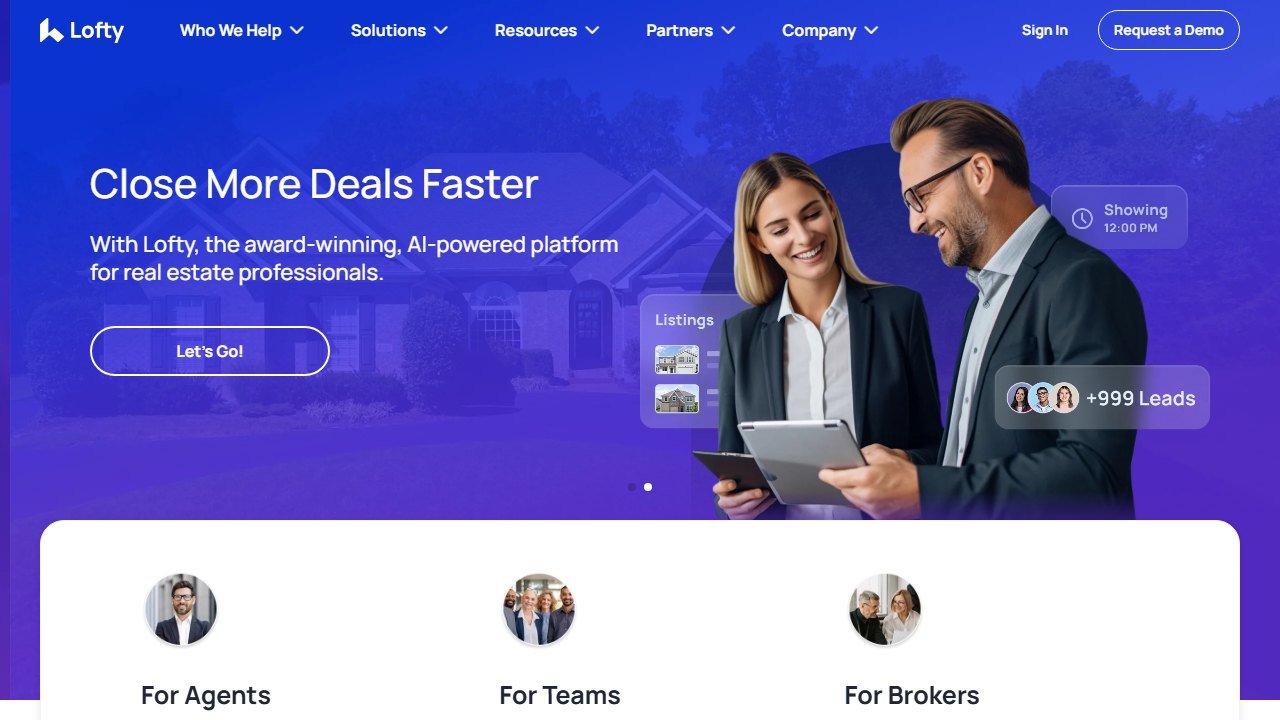
Lofty is a full real estate operating system: CRM, IDX websites, transaction tracking, and more than 33 lead generation methods under one roof, with 70+ integrations for the edges. Its AI suite ships on all tiers and is genuinely broad: AI Copilot for daily workflow, a 24/7 Sales Agent that works leads like a virtual ISA, a Social Agent for content, and the Homeowner Agent, launched in April 2026, which watches seller-intent signals like equity, appreciation, and years owned.
In our time watching Lofty deployments across team setups, the consolidation is the point. Lead comes in from a Lofty ad, gets scored by the AI, gets worked by the Sales Agent, and lives in the same database the agent closes from. No sync jobs, no duplicate records, no finger-pointing between vendors.
Pricing is fully gated: all four tiers on Lofty’s packages page say “Request Pricing.” Third-party reporting from 2026 puts the entry tier around $449 per month with higher tiers reported at roughly $649 to $1,500 depending on seat count, plus a setup fee. Every one of those numbers is reported, not official; the full worked math is here.
Who it is for: agents and teams who want one bill, one login, and one support line, and who are not attached to an existing CRM.
The honest limitation: all-in-one means all-or-nothing. If Lofty’s CRM workflow does not fit how your team operates, you cannot swap just that piece. Leaving Lofty means replacing your CRM, your website, and your lead gen simultaneously, which is why consolidate buyers should be more careful up front, not less.
Ylopo: the stack option
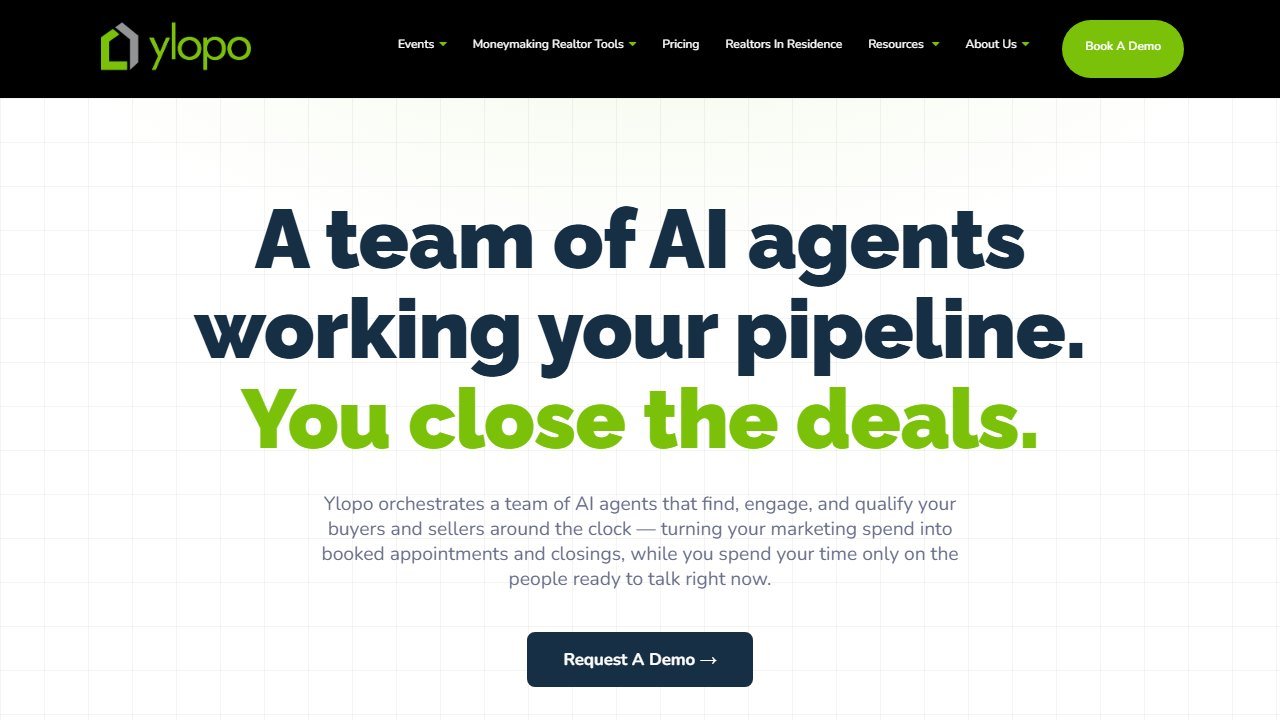
Ylopo is a specialist. It generates leads through dynamic Facebook, Instagram, and Google advertising plus branded home-search sites, then nurtures those leads with Ylopo AI, its text and voice assistant layer. (If you have seen the old “rAIya” branding, note that it is retired; the current name is simply Ylopo AI.) The AI Text side claims a 48% reply rate, and AI Voice calls leads around the clock with live transfer to your team. Both figures are vendor claims; third-party reporting from May 2026 describes roughly a 30% connect rate, an average of seven call attempts to reach a lead, and 90-day calling cycles.
The critical architectural fact: Ylopo is not a CRM and does not pretend to be. You bring your own, and if you want AI Voice specifically, that CRM must officially be Follow Up Boss. Ylopo’s own comparison page recommends the Follow Up Boss pairing, which means the stack path usually carries a second subscription; we run those seat costs in our Follow Up Boss pricing breakdown.
Pricing is also gated. Reported estimates put the platform somewhere between $300 and $1,500 per month depending on configuration, before ad spend (reported at $250 to $500 per month minimum, commonly much more) and before the CRM underneath. Again: reported figures, dated 2026, not a rate card. The full stack-tax math is here.
Who it is for: teams with an established CRM, a real database, and a follow-up problem. Ylopo’s whole design assumes you have somewhere for the leads to live.
The honest limitation: your lead flow is rented. Competitor-published reviews, which we weight cautiously because they come from rivals, raise complaints about lead quality and website ownership, but the structural point stands regardless of source: when Ylopo ad spend stops, the leads stop. There is no organic flywheel, so budget continuity matters.
Path 1: Consolidate with Lofty
Choose this path when you are starting fresh or your current stack is duct tape. The consolidate case is strongest for:
- Solo agents and new teams. You have no database migration to fear and no sunk workflow costs. One platform means one learning curve.
- Teams tired of sync failures. If your current setup involves three tools and a Zapier bill, Lofty collapses the whole chain.
- Buyers who want AI everywhere, not bolted on. Lofty’s four AI agents share one database, so the Sales Agent knows what the Homeowner Agent flagged.
The tradeoff you accept: lock-in. You are betting the whole operation on one vendor’s roadmap. Given that Lofty already carries a rebrand in its history (Chime to Lofty) and sits under a publicly traded parent, that bet has so far been stable, but it is still a single point of failure.
Path 2: Stack Ylopo on your CRM
Choose this path when your CRM is non-negotiable. The stack case is strongest for:
- Follow Up Boss shops. This is the canonical Ylopo pairing, and the only officially supported one for AI Voice. If your team already lives in FUB, Ylopo adds lead gen and AI nurture without touching the database.
- Teams with big, aging databases. Ylopo’s long-cycle AI follow-up, the 90-day calling cadence and behavioral retargeting, is built for reviving a database, not just working fresh leads.
- Buyers who want replaceable parts. If Ylopo underdelivers, you cancel the layer and keep your CRM, your data, and your workflows intact. That optionality is worth real money.
The tradeoff you accept: total cost sprawl. Platform fee plus ad spend plus CRM seats adds up fast, and you own the integration seams. When a lead falls through a sync gap, there is no single vendor to blame. Before committing, run the combined numbers across our Ylopo and Follow Up Boss pricing pages, because the stack tax is real and mostly invisible on the demo call.
If what you actually want from Ylopo is only the AI nurture piece, not the ad engine, it is worth comparing against nurture-only specialists first; our Structurely vs Ylopo comparison covers that axis, and our roundup of AI ISA tools ranks the whole category.
Path 3: Run both
This is the path nobody writes about, even though the vendors themselves built it. The native integration means Ylopo leads land in Lofty automatically and Ylopo Stars behavioral data enriches the Lofty record, so your agents see which listings a lead has been circling without leaving their CRM.
Who actually does this?
- Agents at eXp and LPT. Ylopo’s own comparison page concedes that these brokerages offer Lofty to their agents free. If your CRM layer costs you nothing, adding Ylopo on top is no longer double-paying; it is buying a specialist lead engine for a platform you already have. This single fact flips the math for a large population of agents.
- High-volume teams that want best-of-breed at both layers. Lofty’s transaction and database tooling plus Ylopo’s ad engine and AI nurture is a legitimately strong combination if the budget supports two subscriptions plus ad spend.
- Teams migrating gradually. Running both is also a transition state: some teams adopt Ylopo first, prove the lead flow, then decide whether Lofty’s built-in tools make the Ylopo layer redundant, or vice versa.
The tradeoff: this is the most expensive path, full stop. Two platform fees plus managed ad spend puts you well into four figures monthly on reported estimates. It only makes sense when one layer is free (the brokerage deals) or when lead volume justifies specialist tooling at every layer.
Ylopo’s other common rival is a different animal entirely: our Ylopo vs CINC comparison covers the managed-ad-machine option and the exit terms that separate the two.
How to decide in five minutes
Work down this list and stop at the first line that describes you:
- Your brokerage gives you Lofty free (eXp, LPT): run both, or start with free Lofty alone and add Ylopo when ad budget allows.
- You run Follow Up Boss and your team would revolt if you switched: stack Ylopo on top. This is the pairing both vendors design for.
- You are solo or newly teamed with no real database yet: consolidate on Lofty. One bill, one login, AI included at every tier.
- You have a large stale database and your problem is follow-up, not lead volume: look hard at whether you need Ylopo’s full ad engine or just an AI nurture layer; compare against the nurture-only options in our AI ISA roundup before paying for lead gen you may not want.
- You want maximum lead volume and have the budget: run both with the native integration and let Ylopo Stars data flow into Lofty.
And whichever path you pick, do the fee math before the demo call, not after. Both vendors will quote you numbers on the call that you cannot compare-shop in the moment; walking in with the reported ranges from our Lofty and Ylopo breakdowns puts you in a much stronger seat.
Our verdict
Lofty vs Ylopo is an architecture decision wearing a product comparison costume. Lofty wins for buyers who want to consolidate: one platform, one database, four AI agents, no seams. Ylopo wins for buyers who want to stack: keep the CRM you trust, rent a specialist lead engine and AI nurture layer on top, and preserve the option to swap it later. And the run-both path, which the vendors built a native integration for, is the quiet best answer for agents whose brokerage already covers Lofty.
What we would not do is pick either one based on a feature checklist. Both gate pricing, both lean on vendor-claimed performance stats, and both work best when they match your team’s architecture. Decide consolidate vs stack first. The product choice falls out of that almost automatically. For the wider field beyond these two, our guide to the best AI tools for real estate agents covers the full landscape, and if Follow Up Boss itself is on your shortlist as the platform layer, our Lofty vs Follow Up Boss comparison takes that decision head-on.
Buying leads honestly: what the conversion numbers actually mean
Every platform in this category quotes conversion figures. Almost none of them mean what a reader assumes, and the differences are large enough to reverse a purchase decision.
Ask what the denominator is
A conversion rate can be measured against leads delivered, leads contacted, leads that answered, or appointments set. Those four produce wildly different percentages from the same underlying performance. When a vendor quotes a rate, ask which one it is, and ask for the number of days over which it was measured. A rate with no denominator and no window is a marketing figure rather than a metric.
Speed to lead is the variable that actually moves conversion
The single largest controllable factor in internet lead conversion is how fast the first contact happens, and it is measured in minutes rather than hours. That is a staffing and process question, not a software one. A platform that routes leads instantly to an agent who checks their phone twice a day will underperform a spreadsheet worked by someone answering in five minutes. Fix the response process before buying anything that increases lead volume.
More leads at the same conversion is not obviously good
Doubling lead volume doubles the work and, unless response times hold, usually reduces conversion. Teams that buy volume without adding capacity get a lower conversion rate on a bigger number and conclude the leads were bad. Before increasing volume, work out how many new leads your current team can genuinely contact within the window that matters.
The contract term is where the risk sits
Lead platforms frequently ask for six or twelve month commitments, sometimes with a territory or exclusivity element. That is defensible, because a pipeline takes time to season. It is also a lock-in on performance you have not seen. Ask for a defined review point in writing, agree in advance what result would end the arrangement, and be sceptical of any exclusivity you are paying a premium for without a written definition of the area it covers.

Written by
FazFaz is the founder of AIToolsBakery. Some tools here are tested hands on. Others are assessed from vendor documentation and pricing verified on the live page, and every review says which one it is. Sponsors can buy a position in a guide. They cannot buy the score, the criticism, or silence about a better option.
How we test and how we make money →