Ylopo is one of the most talked-about lead generation platforms in real estate, it just won an Inman 2025 Best of PropTech award (reported), and it will not tell you what it costs. There is no rate card on ylopo.com, and the company’s own pricing FAQ says a real number requires a demo. Meanwhile, third-party estimates diverge wildly: we found entry figures quoted at $295, $345, and $545 per month, and all-in annual claims ranging from around $2,000 to $50,000 depending on who was counting.
We went through every current source, dated each figure, and stacked the full cost model: platform fee, setup fee, ad spend, the AI2 add-on, and the external CRM Ylopo requires you to run underneath it. That last line item is the one nobody totals up, and we call it the stack tax.
Ylopo pricing at a glance: every figure, labeled
Here is every current cost component, with its source status. “Official” means it appears on the vendor’s own site as of July 16, 2026. “Reported” means a third party published it and Ylopo has not confirmed it publicly.
| Cost component | Figure | Official or reported | Source and date |
|---|---|---|---|
| Published rate card | None exists | Official | ylopo.com/pricing, July 2026 |
| Ylopo Suite (core plan) | ~$295 to $500/mo | Reported estimate | Luxury Presence, May 2026 |
| Suite + Managed Marketing | ~$795+/mo | Reported estimate | Luxury Presence, May 2026 |
| AI Assistant add-on (AI2) | ~$100+ per level | Reported estimate | Luxury Presence, May 2026 |
| One-time setup fee | $1,000 to $2,000 | Reported | Luxury Presence, May 2026 |
| Setup fee (older figure) | $1,500 | Reported, stale | The Close, Oct 2023 |
| Monthly ad spend | $250 to $500 starting, $1,000 to $2,500+ common | Reported | Luxury Presence, May 2026 |
| Ad management surcharge | 10% of ad spend | Reported, 2023 era | The Close, Oct 2023 |
| External CRM (Follow Up Boss) | $69/user/mo to $1,000/mo | Official | followupboss.com/pricing, July 2026 |
| User seats | Unlimited on all plans | Official | ylopo.com/pricing, July 2026 |
| Contract | “No Long Term Contracts” | Official | ylopo.com/pricing, July 2026 |
Two things jump out. First, the only officially confirmed facts are structural: no rate card, unlimited seats, no long term contracts. Every dollar figure is reported. Second, the platform fee is not the real number. Once you add ad spend, the AI add-on, and the CRM, the reported all-in cost is two to four times the headline estimate.
Why Ylopo will not publish a price
How Ylopo’s quote model works
Ylopo’s pricing page lists three offerings: Ylopo Suite (the core websites plus dynamic ad platform, pitched at individual agents and small teams), Ylopo Suite + Managed Marketing (the “most popular” tier where Ylopo’s team runs your ad campaigns), and the AI Assistant as an optional add-on. All three carry a book-a-demo button instead of a price (official, July 2026).
Per Ylopo’s own pricing FAQ, the quote depends on three variables: the lead types you buy (social leads cost less than PPC leads, which cost less than live transfers), how many agents are on your team, and your market geography. A cheap Midwest farm area and a competitive Southern California zip code produce very different ad costs, and Ylopo prices accordingly.
That is a defensible reason to customize quotes. It is a bad reason to publish nothing at all, and it is why the reported estimates below are the only budgeting reference you have before a sales call.
Current reported platform fees (2026)
The freshest third-party estimate we found is Luxury Presence’s May 2026 breakdown, which puts Ylopo Suite at roughly $295 to $500 per month and Suite + Managed Marketing at $795 or more per month, with AI add-ons at $100 or more per level. Luxury Presence is a competitor, so treat these as informed estimates rather than gospel, but they are the most recent dated figures in circulation.
For context, The Close reported in October 2023 that Ylopo’s plans were Tech Plus at $345 per month and Starter at $545 per month including a $300 ad credit, with text AI at $100 per month per level. Those figures predate the Ylopo 2.0 platform overhaul and the January 2025 AI2 pricing update, so treat them strictly as historical. If a sales rep quotes you something in that range today, you at least know the anchors have not moved much in three years.
The setup fee: $1,000 to $2,000, reported
Ylopo does not publish a setup or onboarding fee. Luxury Presence’s May 2026 coverage reports a one-time setup fee of $1,000 to $2,000 depending on plan and configuration. The Close’s October 2023 report cited $1,500, which sits comfortably inside that range but is nearly three years old, so we treat it as an older corroborating data point rather than a current figure.
Budget planning note: on a reported $345 to $545 platform fee, a $1,500 setup fee is roughly three months of platform cost paid up front. Setup fees are also the most negotiable line item in this category. Ask directly whether it can be waived on an annual commitment or split across your first few invoices.
Ad spend: the biggest and most variable line
Ylopo is an ad-driven lead generation system. Without ad budget, the websites and AI have nothing to work with, so ad spend is not optional in practice.
Reported figures (Luxury Presence, May 2026): starting budgets of $250 to $500 per month, with agents in competitive markets commonly spending $1,000 to $2,500 or more. The Close’s 2023 report also described a 10 percent surcharge on ad spend for campaign management. We could not confirm whether that surcharge survives in the current Managed Marketing packaging, so raise it on your demo call: “Is there a percentage fee on top of my ad budget, and what is it?”
The good news, officially confirmed: Ylopo’s pricing page lists monthly marketing budget adjustments and unlimited marketing budgets as standard, so you can scale spend up and down without changing plans.
AI2: what the AI Assistant add-on actually costs
Ylopo’s AI Assistant, sold as AI2, bundles AI Text and AI Voice into one package: text drives engagement, and engaged leads trigger voice calls (official, ylopo.com/ai2, July 2026). Ylopo updated AI2 pricing in January 2025, but no figure appears anywhere on the official site. The only current estimate is the reported $100 or more per level from May 2026.
Two structural facts matter more than the sticker:
- AI Voice requires Follow Up Boss. Per Ylopo’s support documentation, the AI Voice product works only when Follow Up Boss is your CRM. If you run anything else, you can buy AI Text but not the full AI2 stack.
- The AI works long cycles. Per Ylopo’s documentation, AI Voice keeps calling leads for around 90 days, averaging about 7 call attempts to connect, and Ylopo’s new-lead text follow-up runs an immediate 30-day sequence (official pages plus support docs, July 2026).
One naming note: you will still find third-party articles pricing “rAIya,” Ylopo’s old AI branding. That name is retired, the old rAIya page on Ylopo’s site now 404s, and the current product name is simply Ylopo AI. Any price attached to rAIya is by definition stale.
If you are weighing Ylopo’s AI against standalone conversational ISA tools, that comparison lives in our Structurely vs Ylopo breakdown and the full best AI ISA tools roundup. This page stays on the fee math.
The stack tax: Ylopo is not a CRM
Here is the line item that most Ylopo cost articles skip entirely. Ylopo positions itself as a lead generation and AI nurture layer that sits on top of your CRM, not a replacement for it. Its own tagline is keep your CRM. So the true Ylopo budget always includes a second subscription.
In practice that CRM is usually Follow Up Boss, because AI Voice requires it. FUB pricing is fully public (official, July 2026): Grow at $69 per user per month ($58 on annual), Pro at $499 per month flat for 10 users ($416 annual), and Platform at $1,000 per month for 30 users ($833 annual). A solo agent adds $69, a 10-person team adds $499 or more, and a brokerage adds $1,000 or more, every month, before Ylopo bills a cent. We run the full seat math, including the calling add-on gotcha on the Grow plan, in our Follow Up Boss pricing breakdown.
Reported all-in totals: solo, team, and brokerage
Stacking platform fee, ad spend, AI add-ons, and CRM, Luxury Presence’s May 2026 analysis lands on these monthly all-in ranges. These are reported estimates, not official figures, but they match the component math above, which is why we consider them the most useful budgeting anchor in this article.
| Buyer profile | Reported all-in monthly total | What is inside the number |
|---|---|---|
| Solo agent | $1,364 to $2,100/mo | Suite platform fee + starter ad spend + AI add-on + FUB Grow (1 seat) |
| Small team (roughly 3 to 8 agents) | $2,100 to $3,600/mo | Suite or Suite+ + mid ad spend + AI2 + FUB Grow seats |
| Brokerage / large team | $3,800 to $5,500+/mo | Suite + Managed Marketing + competitive ad spend + AI2 + FUB Pro or Platform |
All figures reported (Luxury Presence, May 2026), except the FUB component, which is official. Add the one-time reported setup fee of $1,000 to $2,000 to year-one budgets. On the solo profile, that means a realistic first-year commitment of roughly $17,000 to $27,000 (derived from the reported ranges), which is a very different number from the $295 headline estimate.
If that total is what is pushing you to shop around, we mapped the escape routes by switch reason in our Ylopo alternatives guide, and the consolidate-versus-stack decision gets its own treatment in Lofty vs Ylopo.
Contracts and cancellation: the sources disagree
Officially, Ylopo’s pricing page says “No Long Term Contracts” (July 2026). Beyond that, the record conflicts:
- Luxury Presence (May 2026) describes cancellation with roughly 30 days notice.
- The Close (October 2023) reported a 90-day cancellation window.
Those cannot both be current, and the honest answer is that the notice period appears to have changed since 2023 and Ylopo has not published the current terms. Before signing, get the exact notice period, any early termination conditions, and what happens to your ad accounts and lead data at cancellation, in writing. Lead-gen platforms differ meaningfully on whether leads generated during your term stay yours, so ask that question specifically.
If the alternative on your shortlist is CINC, the decision is structural, not just financial: our Ylopo vs CINC comparison covers who keeps your website, your domain, and your database when you leave.
What to negotiate on the demo call
For pricing posts we always end the research with a checklist you can read off a sticky note. Here is Ylopo’s:
- Anchor to the reported ranges. Ask which plan corresponds to the $295 to $500 estimate and what pushes a quote toward the top of it.
- Setup fee waiver or split. The reported $1,000 to $2,000 fee is the most commonly discounted item in this category.
- The ad surcharge question. Confirm whether a percentage management fee applies on top of your ad budget under current Managed Marketing packaging.
- AI2 pricing in writing. Pricing was updated in January 2025 and nothing is published, so get the current per-level cost and what a level covers.
- Cancellation terms. Pin down 30 versus 90 days and data ownership at exit.
- Total with CRM. Ask the rep to quote your all-in including Follow Up Boss seats, and check it against the persona table above.
What it costs to leave, which no pricing page mentions
Switching cost is why landlords and managers stay on systems they have outgrown. In this category it is unusually concrete, which means you can ask about it precisely.
Recurring payment authorisations rarely transfer
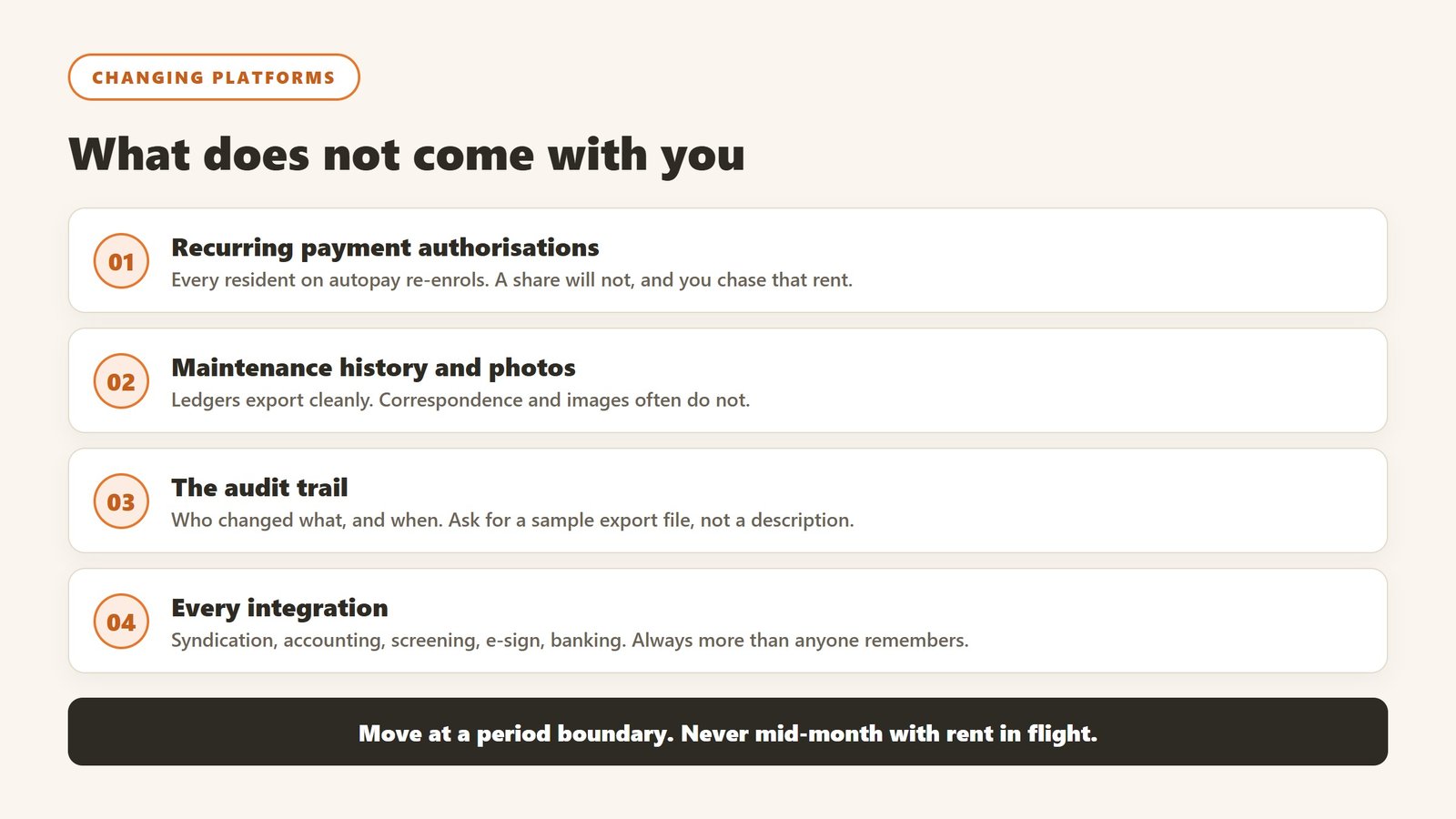
This is the big one. Tenant records, leases and ledgers export from almost any platform. Live recurring payment authorisations and the stored bank or card details behind them generally do not, which means every resident on autopay has to re-enrol. A share will not, and you will chase rent you were previously collecting automatically. Ask about this in writing during procurement, when you still have leverage.
Ask exactly what a full export contains
Standard fields usually come out cleanly. What often does not is the maintenance history with its photographs and correspondence, the document store of signed leases and addenda, the accounting history in a form your accountant can actually use, and the audit trail of who changed what. Ask for a sample export file during the trial rather than a description of one.
The accounting cutover has a right time and many wrong ones
Move at a period boundary, ideally the start of a financial year, and never mid-month with rent in flight. Plan to run a parallel reconciliation for one full cycle, and budget the hours for it. Migrations that go badly almost always went live at a convenient calendar date rather than a sensible accounting one.
Count the integrations before you sign, not when you leave
Listing syndication, accounting, screening providers, e-signature, banking, insurance and any owner portal are each work to disconnect and reconnect elsewhere. The count is always higher than anyone remembers, and it is the part that turns a two week migration into a six month one.
Where the figures on this page come from
Every price here was read from the vendor’s own pricing page on 4 September 2026, not from an aggregator or a review site. Each figure carries that date, because pricing in this market moves and a claim without a date is not checkable.
The pages we read
Buildium publishes $62, $192 and $400 a month plus a detailed fee schedule. DoorLoop publishes $69, $149 and $209 a month billed yearly with per unit equivalents. TurboTenant publishes a free tier plus $12.42 and $16.48. TenantCloud publishes $15 to $50 a month on annual billing. RentRedi publishes $12 a month on the annual plan. Hemlane, Rentec Direct and Landlord Studio all publish in full, as do Follow Up Boss at $69 per user, Wise Agent at $49, and Placester from $59.
The ones we could not read
AppFolio, Innago, Top Producer and Hostaway did not yield a figure to the same method that read every vendor above, and Lofty’s pricing page carried no plan rates. We are not presenting that as proof they publish nothing, because a failed read is not evidence of absence. Treat any figure for those five from elsewhere as unverified.
What we do not do
We do not carry a figure we cannot source to the vendor. Where a number circulates and cannot be traced, we say so and withdraw it rather than repeating it with a hedge, and we have withdrawn our own published figures on that basis more than once.
Verdict: budget the stack, not the sticker
Ylopo’s refusal to publish pricing is annoying but survivable, because the reported record is consistent enough to budget from: roughly $295 to $500 per month for the core Suite, $795 or more with managed marketing, $1,000 to $2,000 setup, $250 to $2,500+ in monthly ad spend, an AI add-on around $100 or more per level (all reported, May 2026), plus an officially priced Follow Up Boss subscription underneath. For a solo agent that stacks to a reported $1,364 to $2,100 per month all-in, and teams should plan on $2,100 to $5,500 or more.
If unlimited seats and a heavyweight AI follow-up engine fit how you run your business, that math can pencil. If the stack tax does not, start with our Ylopo alternatives guide or zoom out to the full best AI tools for real estate agents roundup before you book the demo. Either way, walk into the sales call with this page open. The numbers are reported, but they are dated, sourced, and reconciled, which is more than the sales deck will tell you.

Written by
FazFaz is the founder of AIToolsBakery. Some tools here are tested hands on. Others are assessed from vendor documentation and pricing verified on the live page, and every review says which one it is. Sponsors can buy a position in a guide. They cannot buy the score, the criticism, or silence about a better option.
How we test and how we make money →