
The short answer
Bonterra does not publish a price for Guided Fundraising, or for any of its nonprofit products.
We loaded the fundraising pricing page in a browser on 1 September 2026. Its own headline promise is “Customized pricing for tools that help you raise more”, and the call to action is Talk to an expert. There is no currency figure and no percentage anywhere on the page.
What makes Bonterra worth a dedicated page is the unusual thing it does instead, which is genuinely more useful than most quote-only vendors offer, provided you know how to read it.
Start on the right page
Bonterra sells several distinct product lines and each has its own pricing page. This trips people up constantly.
| If you go to | You land on | Which covers |
|---|---|---|
| bonterratech.com/pricing | Corporate Social Responsibility | Deed Engage, Deed Grants, Deed 360, CyberGrants |
| /pricing/fundraising-and-engagement | Fundraising and Engagement | Network for Good, EveryAction, DonorDrive, Mobilize |
| /pricing/case-management | Case Management | Human services case management |
If you are a nonprofit looking at Guided Fundraising, the middle row is the page you want. The default lands you on enterprise employee-giving software, which is a different product for a different buyer, and reading the wrong one wastes a call.
One naming point worth having straight before you dial: Bonterra Guided Fundraising is the product formerly known as Network for Good, and on the pricing page it still appears under the Network for Good name.
What Bonterra publishes instead of prices
This is the part worth your time. Bonterra publishes a complete feature matrix in which every line item is marked either Included or Additional cost.
So you cannot learn what anything costs. But you can learn, precisely and in advance, which capabilities will appear as separate line items on your quote. That is considerably more than most vendors in this category disclose, and it is the single best preparation available to you.
Work through the matrix and write down every item marked Additional cost that you actually need. That list is your negotiation agenda. A quote that bundles those items without itemising them is a quote you cannot compare against anything else, and it is the easiest thing in the world to accept by accident.
Why we are not quoting a figure
Bonterra’s own phrase is “customized pricing”, and the product has historically been positioned as a premium option for small organisations rather than a budget one.
We are not going to attach a number to that. Bonterra prices per organisation, the four fundraising products have different shapes, and the acquisition history means figures circulating from the Network for Good era may describe a product and a support model that no longer exist in the same form. A stale figure here would be worse than no figure, because it would anchor a small nonprofit’s annual budget on something we cannot stand behind.
If you receive a quote and are willing to share its shape, we will publish it, attributed and dated.
What actually drives the number
From the structure Bonterra publishes, four variables move a Guided Fundraising quote.
Which of the four products you need. Network for Good, EveryAction, DonorDrive and Mobilize solve different problems. Buying one is a different conversation from buying the suite.
Contact or record volume. Standard across nonprofit CRM pricing, and the usual cause of a mid-contract surprise after a large list import. Every lapsed donor and every event attendee is a record.
Everything the matrix marks Additional cost. Which is exactly why you read it first.
Payment processing. Ask whether processing rates sit outside the subscription and what they are. On donation platforms this is frequently the larger number across a year, and it is the one most often left out of a headline comparison.
The questions to ask on the call
Which product am I actually being quoted for? Get the product name in writing, given the Network for Good and Guided Fundraising overlap.
Itemise every line the matrix marks Additional cost. You already know what they are. Make them price each one separately.
What are the payment processing rates, and are they negotiable at my volume?
What is the record or contact ceiling on this quote, and what happens when I cross it?
What does year two look like? Post-acquisition renewal terms are the most common complaint we see about Bonterra, so settle it before signing rather than discovering it later.
What its competitors do publish
Transparency in nonprofit fundraising software is genuinely mixed, and Bonterra sits at the opaque end of it.
| Platform | Publishes a price |
|---|---|
| Givebutter | Yes, free platform with stated fees |
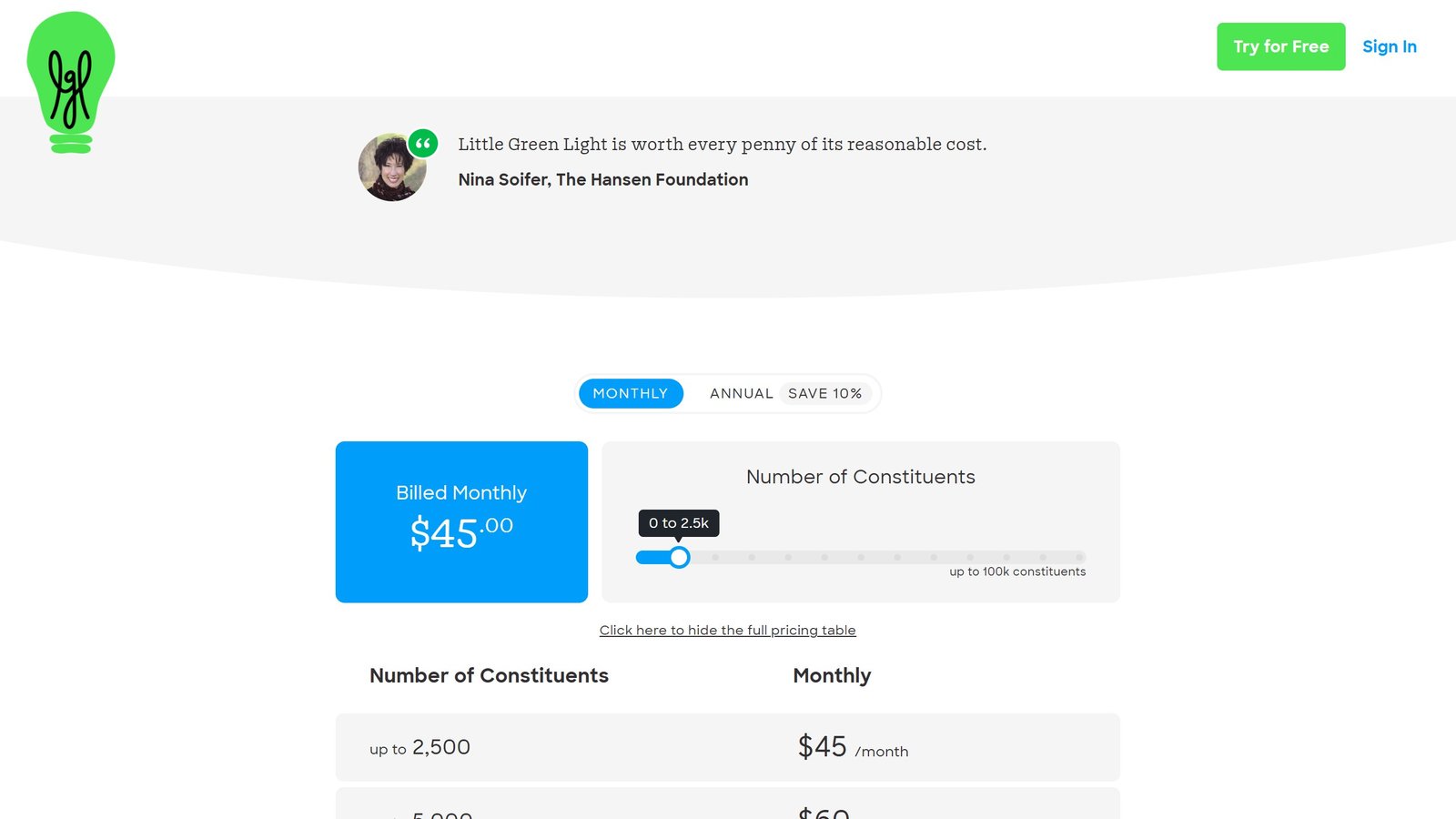
| Little Green Light | Yes, tiered from $45 a month by record count |
| Donorbox | Yes, pay-as-you-go fees |
| Bonterra Guided Fundraising | No, customized pricing only |
None of that makes Bonterra the wrong choice. Its depth and its guidance model are real, and a small nonprofit that wants coaching alongside software has fewer alternatives than the table suggests.
It does mean that if published pricing is itself a decision criterion for your board or your finance committee, three credible alternatives clear that bar and Bonterra does not. That is a legitimate thing to weigh, and it is better weighed now than after a procurement process.
For what the product does, where the post-acquisition friction shows and who it genuinely suits, see our Bonterra Guided Fundraising review.
Where Bonterra sits in the published market
| Vendor | Publishes a price? | Entry figure, verified 4 Sep 2026 | Meter |
|---|---|---|---|
| Little Green Light | Yes | $45/mo | Constituents |
| Salesforce Nonprofit Cloud | Yes | $70/user/mo (4 Oct 2026), 10 free | Seats |
| Neon CRM | Yes | $99/mo | Annual revenue |
| Bloomerang | Yes | $125/mo | Product |
| Keela | Yes | $164/mo | Contacts |
| Dataro | Yes | $15,000/yr + $0.10/donor | Platform + donors |
| Blackbaud | No | Quote form only | Quote |
| Virtuous | No | Quote, banded at $5M revenue | Quote |
| GoFundMe Pro (Classy) | No | Quote | Subscription + % of gifts |
Bonterra is at the quote-only end. That is a legitimate enterprise choice, but it is worth knowing that most of this market does publish, so opacity here is a decision rather than a category constraint.
The meter matters more than the price
The most common budgeting mistake in this category is comparing monthly figures across vendors that charge on completely different bases. Six vendors in the table above meter on six different things.
Contacts and constituents punish list growth
Keela bands by contacts and Little Green Light by constituents. Under those models, adding lapsed donors or event attendees to your database raises the bill even though those records generate nothing. Teams on contact-metered platforms end up deleting history to control cost, which is precisely the wrong incentive for a fundraising organisation.
Seats punish hiring, not data
Salesforce meters on users. A database of two million costs the same as one of two thousand, and the eleventh person in the CRM is what costs money. That inverts the usual advice: on a seat-metered platform you can keep every record you have ever touched.
Revenue metering punishes success
Neon prices on annual fundraising revenue. A good year raises your software bill, which is defensible in that the platform grows with you, and uncomfortable in that the cost arrives at the same time as the growth rather than after it.
Work out which of your numbers is growing fastest
That is the whole decision. For most nonprofits the list grows faster than the team, which argues for seat-based pricing. If you are hiring quickly against a stable donor base, the reverse is true. Our nonprofit CRM pricing comparison works through the arithmetic at real team and list sizes.
What every comparable vendor actually charges
A comparison table tells you the number. It does not tell you what the number is measured against, which is the part that decides your bill. Here is each of the main alternatives to Bonterra, read from their own pricing pages on 4 September 2026, with the meter that matters.
Little Green Light, from $45 a month, metered on constituents
Little Green Light publishes every band openly and starts at $45 a month for up to 2,500 constituents. It takes nothing from your donations, which makes it one of the few platforms where online giving revenue is genuinely yours. The catch is structural: because the meter is constituent count, growing your list raises the bill even when the added records are lapsed donors or one-off event attendees who will never give again. Organisations on constituent-metered platforms end up pruning their database to control cost, which is a bad incentive for a fundraising team that should be keeping history.
Salesforce Nonprofit Cloud, $70 per user (as of 4 October 2026), with ten licences free
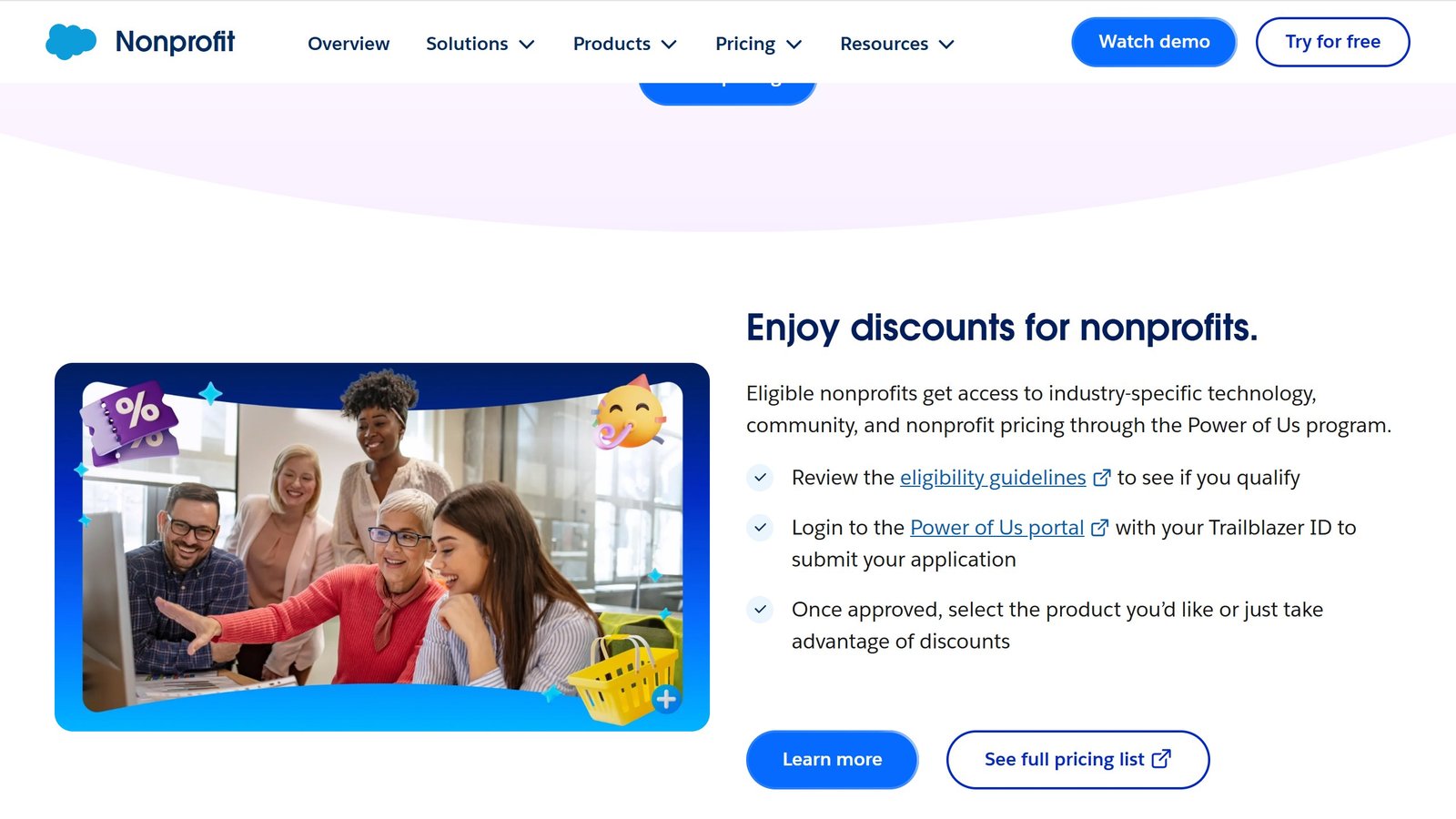
Salesforce is the odd one out and it is worth understanding why. Nonprofit Cloud Core is $70 per user per month (as of 4 October 2026) billed annually, but the Power of Us programme gives any eligible nonprofit ten licences at no cost. An organisation with ten or fewer people in the CRM pays nothing for the CRM itself, at any list size. The eleventh person costs $840 a year at the October 2026 rate. That inverts the usual advice: on Salesforce a database of two million costs the same as one of two thousand, and hiring is what raises the bill. The real cost is not the licence, it is that somebody has to own the configuration.
Neon CRM, from $99 a month, metered on your fundraising revenue
Neon starts at $99 a month with unlimited users and unlimited records, priced on annual fundraising revenue rather than seats or contacts. Modules are added as a percentage of the subscription: memberships at 10%, events at 20%, volunteers at 10%. Worth knowing that Neon retired its old Essentials, Impact and Empower tier structure entirely, so any article still quoting $209 or $409 tiers is describing packaging that no longer exists.
Bloomerang, from $125 a month, metered by product
Bloomerang publishes $125 a month for the CRM, with Fundraising from $40 and Volunteer from $119 as separate products. It moved away from record-tier pricing, so comparisons written against its old banding are stale. The practical effect of product-based pricing is that a quote assembled from three Bloomerang products is not comparable to a single all-in figure from a competitor without itemising first.
Keela, from $164 a month, metered on contacts
Keela bands by contact count starting at $164 a month for up to 1,000 contacts. It raised every band between late August and early September 2026, entry moving from $134 to $164, a rise of roughly 15 to 22% across the range in under two weeks. That is a useful reminder that a published price is a snapshot: check the date on any figure you are comparing, including ours.
Dataro, from $15,000 a year plus $0.10 per active donor
Dataro is a different category, predictive donor intelligence rather than a CRM, and its pricing shows it: Essentials from $15,000 a year plus ten cents per active donor, Growth from $25,000 plus twelve cents. Its pricing page is not linked from its own navigation and is only discoverable through the sitemap. Included here because it is the honest top of the nonprofit software market and a useful upper bound when someone tells you a quote is expensive.
The ones that publish nothing
Blackbaud runs a quote request form headed “Let us find a price that fits your organization” with no figures at all. Virtuous publishes no price and bands its tiers at $5 million in annual fundraising revenue, so it segments you by what you raise before quoting. GoFundMe Pro, formerly Classy, publishes only that its model is an annual subscription plus a transaction fee per donation.
How to run the procurement so a quote means something
Get every quote onto the same basis before comparing
Ask each vendor, including Bonterra, for the same seat count, the same contract length, implementation quoted separately from subscription, every add-on itemised, and payment processing stated as inside or outside the platform fee. A single blended annual number cannot be compared against anything, and vendors know it.
Establish the total first-year cost, not the subscription
Onboarding, data migration, integration work and training are frequently larger than the first year of licence fees in this category and are rarely in the headline figure. Ask for the all-in number, then ask which parts of it are one-off and which recur.
Negotiate the renewal before you sign the first contract
This is the single most valuable term and the one most often left out. A capped renewal uplift, stated as a percentage, is worth more than a bigger first-year discount, because at renewal the vendor knows your usage, your dependency and your switching cost while you have no public rate card to argue against.
Insist on a trial with your own data
A demo runs on a dataset chosen because the product handles it well. Ask to load a sample of your own records, including the messy ones: duplicate households, lapsed donors with old addresses, a recurring gift that failed. How a platform handles your actual data quality is the thing that decides whether staff use it, and it is invisible in a scripted walkthrough.
Name the person who will own it
Every platform in this category rewards an owner and punishes shared responsibility. Before signing, name the person whose job description includes this system and check they have the hours. Software does not create that role, and its absence is the most common reason a nonprofit CRM purchase disappoints.
The exit costs nobody quotes you
Switching cost is the reason organisations stay on platforms they have outgrown, and it is almost never discussed during procurement. Three things determine how trapped you are.
Recurring gifts and payment tokens
Donor records and giving history export cleanly from almost any platform. Live recurring schedules and the payment tokens behind them frequently do not. If tokens cannot transfer, every monthly donor has to re-enter card details and a meaningful share will not, so the real cost of leaving is a slice of your most reliable income. Ask about token portability during procurement, in writing, when you still have leverage.
Custom fields and history
Ask what a full export actually contains. Standard fields usually come out fine; custom fields, soft credits, relationship links between households and the audit trail of who changed what often do not. Losing the relationship structure means rebuilding institutional knowledge that took years to accumulate.
Integrations you will have to rebuild
Every connected system, email platform, giving forms, accounting, event tools, is work to reconnect elsewhere. Count them before signing rather than after, because the number is usually higher than anyone remembers and it is the part that turns a two-week migration into a six-month one.
How we checked this
We loaded bonterratech.com/pricing in a real browser on 1 September 2026, recorded the default redirect to the corporate social responsibility page, followed the navigation to the Fundraising and Engagement page, and read the fully rendered content there. We recorded no currency figure and no percentage on that page, and confirmed the Included versus Additional cost matrix along with the four product names. We hold no private quote data and quote none. This is a pricing page rather than a review of the product, and we did not run a hands-on trial for it.
Related: our full Bonterra review, our OneCause review, now part of Bonterra and nonprofit CRM pricing compared.

Written by
FazFaz is the founder of AIToolsBakery. Some tools here are tested hands on. Others are assessed from vendor documentation and pricing verified on the live page, and every review says which one it is. Sponsors can buy a position in a guide. They cannot buy the score, the criticism, or silence about a better option.
How we test and how we make money →