If you Google “Placester review” today, the top results have two problems. The #1 organic review is written by Luxury Presence, a direct competitor selling $180+ per month websites against Placester’s $59 entry point. And the big independent write-ups, including TheClose’s May 2024 review and TrustRadius’s “$80 to $200” range, still quote a pricing structure that no longer exists. The old DIY $79 / Do It For Me $119 / DIFM plus Content $239 grid, with its $500 setup fee, is dead.
We spent time in the live product and on the live pricing page (verified July 19, 2026) to write the review we could not find: current numbers, the real IDX math, and a close look at the thing nobody above us covers at all. Placester, the budget builder, quietly ships GEO plumbing that premium rivals skip: an AI website builder with chat-based editing and an auto-generated llms.txt file for every site it hosts.
Placester pricing and verdict at a glance
All prices below come from placester.com/pricing, checked July 19, 2026. Everything is official unless labeled otherwise.
| Plan | Monthly | Annual | Included seats | Our take |
|---|---|---|---|---|
| Agent Essential | $59/mo | $566/yr | 1 site | Cheapest real entry, but add $25/mo for IDX ($84/mo true cost) |
| Agent Plus | $79/mo | $758/yr | 1 site | The sweet spot for most solo agents |
| Agent Premier | $129/mo | $1,238/yr | 1 site | “Recommended” tier; live chat included at this level |
| Team | $199/mo | ask sales | 10 seats | Bills only “active agents” who launch a site |
| Broker Standard | $399/mo | ask sales | 25 seats | Same active-agent billing model |
| Broker Plus | $599/mo | ask sales | 100 seats | Cheapest per-seat ceiling in its class if agents actually activate |
| IDX add-on | +$25/mo per MLS | – | – | Not included on any plan; the number everyone misses |
| Verdict | 4.0/5. Best-value AI website platform for budget-conscious agents; weak as a standalone CRM | |||
The old numbers you will still see elsewhere: DIY $79, Do It For Me $119, DIFM plus Content $239, and a $500 setup fee. That structure is gone. Do It For Me survives only as a monthly add-on ($50 on Essential, $75 on Plus and Premier), and there is no setup fee anywhere on the current pricing page. If a review quotes you $500 to get started, it was researched before the repricing.
What Placester actually is
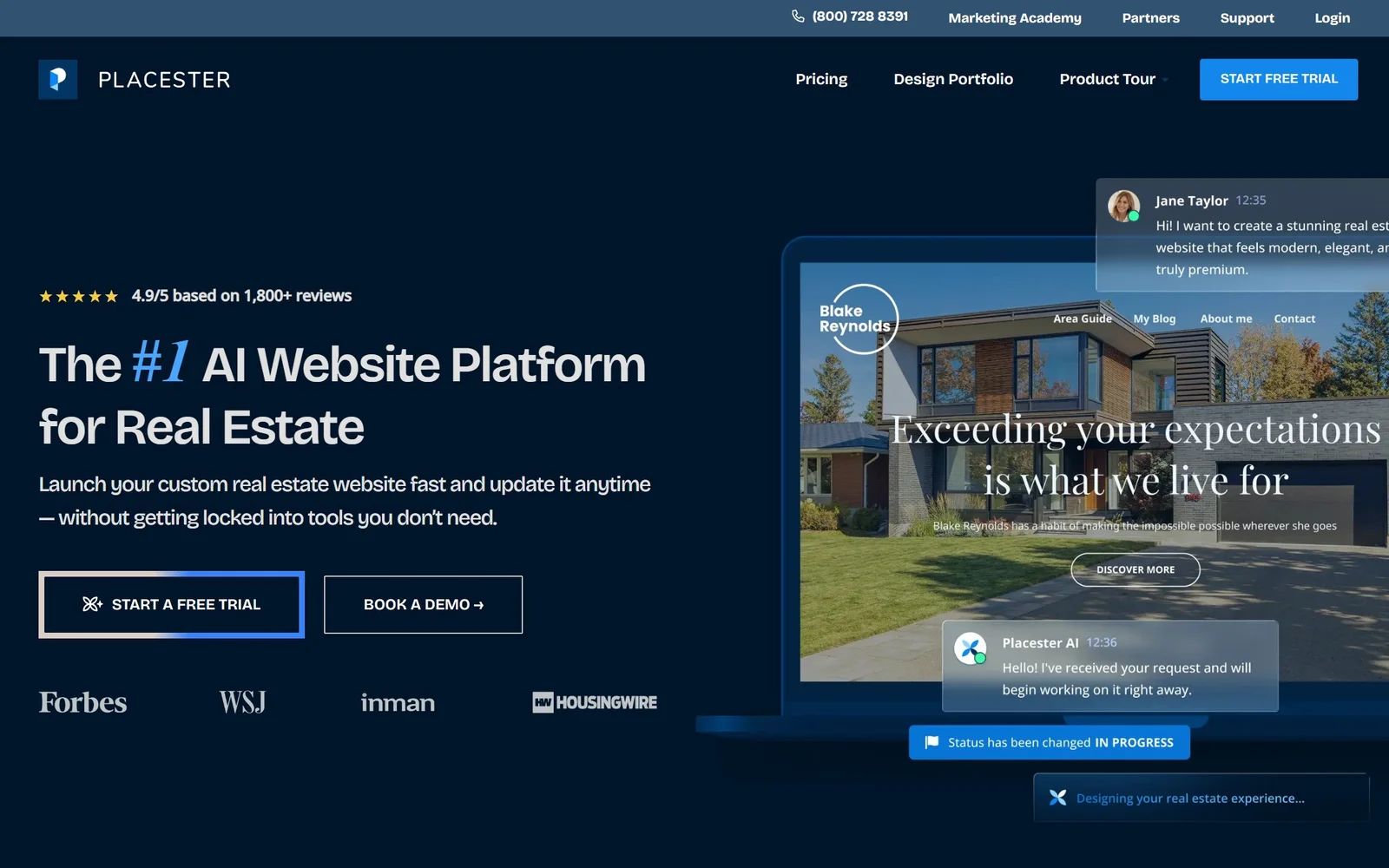
Placester is a real estate website platform: IDX-capable agent and broker sites, a landing page system, a light CRM, and a services marketplace, sold at roughly a third of the price of premium website vendors. It has been around since 2011, which in proptech terms makes it a grandparent.
The company history matters for a buying decision, so here it is honestly. Placester raised roughly $100 million by 2017, hit a wall, and cut more than half its staff in 2018. Today it runs lean at around 25 people, and third-party revenue tracking (Latka, reported) shows the business growing again: about $3.6 million in 2023 to $5.4 million in 2024. That is the profile of a fallen unicorn that found a sustainable lane, not a dying platform. The practical read: do not expect an army of account managers, do expect a focused product that keeps shipping. The AI builder that launched around November 2025 is evidence the roadmap is alive.
One trust note on ratings, because Placester’s marketing leads with “4.9/5 from 1,800+ Google reviews.” That figure is self-reported and collected on Google, where vendors prompt happy customers post-support-ticket. G2, where reviews skew toward unprompted users, has Placester at 3.5/5 across roughly 84 reviews. The truth lives between those numbers, and the gap tells you what to expect: people love the price and the setup help, and the complaints cluster around support responsiveness on the cheap tiers and the ceiling on the CRM.
Hands-on with the AI website builder
The headline 2025 addition is the AI Website Builder and Editor, and in practice it is more substantive than the usual “AI” sticker on a template picker. You describe your business in a chat interface, and it generates a full agent site: pages, copy blocks, area pages, the lot. The editing model is the interesting part. Instead of dragging blocks, you tell the editor what to change (“make the hero about Scottsdale luxury condos, add a valuation CTA”) and it applies the edit. For an agent who has never touched a page builder, this removes the single biggest reason budget websites stay ugly: nobody ever edits them.
Two honest observations from testing. First, the generated copy is serviceable but generic until you feed it specifics; spend ten minutes telling it your farm area, niches, and proof points and the output improves a lot. Second, know what “free” means here. Placester promotes the AI builder as free, and the build step genuinely is: you can generate and preview a site without a card. Hosting and publishing that site requires a paid plan. It is a well-designed trial, not a free website.
The AI Content Assistant rounds it out, drafting listing descriptions, area guides, and blog posts inside the platform. It is a competent GPT-class writing layer. If you want hands-off publishing instead, the Content Automation add-on delivers done-for-you posts at $15, $25, or $50 per month depending on cadence, which is cheaper than any human content service we track.
The GEO angle: a $59 builder doing llms.txt plumbing premium rivals skip
This is the section that earned Placester real respect from us, and it is invisible in every other review.
AI assistants are now a primary discovery channel. On our own portfolio we watch Bing Copilot alone cite our pages tens of thousands of times per week, and GA4 shows AI assistant referrals as a top traffic source. Where a site shows up in ChatGPT, Copilot, Perplexity, and Google’s AI results is starting to matter as much as where it ranks in blue links. The emerging plumbing for that is generative engine optimization: clean crawlable structure, question-shaped content, and an llms.txt file that hands AI crawlers a curated map of the site.
Placester auto-generates an llms.txt for every site it hosts. No toggle, no add-on, no agency retainer. Combined with what it calls an AI-Ready SEO Foundation (structured data and crawlable IDX-adjacent pages), a $59 per month Placester site ships GEO infrastructure that agents on premium platforms are paying consultants to retrofit. We maintain llms.txt files across our own sites and can confirm this is real, unglamorous, useful work, exactly the kind of thing a solo agent would never do manually.
Is llms.txt a guaranteed ranking lever inside AI assistants? No, adoption by the engines is still uneven, and anyone promising otherwise is selling something. But it costs nothing, it cannot hurt, and it signals a vendor that is actually thinking about where real estate search is going rather than bolting a chatbot onto a 2019 product. For a budget platform to be ahead of the premium field on this is genuinely unusual.
The IDX math nobody puts up front
Here is the number that changes the comparison shopping: IDX is not included on any Placester plan. Every MLS feed is a $25 per month add-on. So the real entry price for a working IDX agent site is $84 per month ($59 Essential plus $25 IDX), and a Plus setup with one MLS runs $104.
That is still cheap. Real Geeks starts at $399 per month plus a $500 setup fee, Sierra Interactive starts at $299.95 per month on annual billing, and premium website vendors commonly land between $180 and $500 per month. Even with IDX bolted on, Placester undercuts the field by a wide margin. But if you saw “$59” in an ad and budgeted that, the add-on sheet will find you:
- IDX: $25/mo per MLS (per feed, so multi-MLS agents pay twice)
- Do It For Me service: +$50/mo on Essential, +$75/mo on Plus and Premier
- Additional website: $25/mo each
- Live chat: +$25/mo (included on Premier)
- Content Automation: $15, $25, or $50/mo by posting cadence
A realistic “hands-off solo agent” build (Plus, one MLS, Do It For Me, monthly content) lands around $194 per month. That is the honest comparison point against done-for-you rivals, and it still wins on price. Just do the math before the sales call, not after.
For teams and brokers, the seat model is a legitimate differentiator: Placester bills only “active agents,” meaning agents who actually launch a site, and the Team, Broker Standard, and Broker Plus subscriptions include 10, 25, and 100 seats respectively. A brokerage where half the roster never activates effectively pays half price. We have not seen another website vendor structure it that way.
How Placester compares to the platforms above it
The useful way to place Placester is by what you give up moving down from a $300 to $500 all-in-one, and what you give up moving up from a DIY Wix or WordPress build.
Against the full-stack platforms (Real Geeks, Sierra Interactive, Lofty and friends), Placester loses on CRM depth, dialers, texting, and bundled lead generation, and wins on price by 3x to 5x and, surprisingly, on AI editing and GEO plumbing. None of the mid-market platforms we track auto-generates llms.txt today, and most of their site editors still assume you will hire someone. If your lead flow comes from sphere, referrals, and organic rather than paid portals, the expensive stack is mostly paying for machinery you will not run.
Against DIY builders, Placester wins on the only axis that matters for an agent: IDX. Getting compliant, well-rendered MLS listings onto a Wix or WordPress site means third-party IDX plugins that typically run $30 to $100 per month on their own, plus setup labor. By the time a DIY build has working IDX, decent search pages, and hosting, you have rebuilt Placester Essential for more money and none of the support.
The honest positioning: Placester is the floor of the “real platform” market, not the ceiling of the DIY market. That is a compliment. The floor is where most solo agents should be buying, because the money saved funds the thing that actually converts: a proper CRM and follow-up discipline.
Where Placester falls short
We score tools on what they claim to be, and Placester claims to be a website platform with a CRM attached. The website side earns its keep. The CRM side is the weak leg, and you should plan around it.
The CRM covers contact storage, basic pipelines, and lead routing, and that is about it. There is no dialer, no built-in texting, and no behavioral automation of the kind lead-nurture platforms sell. The lead capture default is the bigger operational issue: forms require only an email address, with no phone number required. Website leads without phone numbers convert measurably worse for follow-up-driven agents, and there is no setting that fully fixes it. Most serious users run Placester purely as the website layer and sync leads into a dedicated CRM. A budget pairing we like: Placester for the site plus Wise Agent at $49 per month for the CRM, which we cover in our full Wise Agent review. That stack runs about $133 per month with IDX and beats most $300 all-in-ones for a solo agent.
Support is the other recurring complaint, and the G2 reviews back it up: response times on the lower tiers can stretch, and with roughly 25 employees there is no pretending otherwise. Premier customers report better experiences. If white-glove support is a dealbreaker, this is not your platform.
And then there is add-on creep. None of the individual add-ons is unreasonable, but the gap between the advertised $59 and a fully assembled $150 to $200 stack is wide enough that some buyers feel misled. We would rather Placester print an “with IDX” price on the pricing page. It does not, so we just did.
Who should buy Placester
Placester is the right call for a specific buyer, and the wrong call for another. Based on our assessment:
Buy it if you are a solo agent or small team that needs a professional IDX website under $110 per month, wants AI-assisted editing so the site actually gets updated, and either does not need heavy CRM automation or already runs a separate CRM. It is also a sleeper pick for GEO-minded agents who want AI-discoverability plumbing without an agency retainer, and for brokerages with uneven agent activation, where the active-agent seat billing can cut effective per-head cost dramatically.
Skip it if your business runs on aggressive lead nurture (look at the full-stack platforms in our best AI tools for real estate agents guide), if you need bundled paid lead generation, or if you want one login for website, CRM, dialer, and marketing. Placester competes on the website layer only, and buyers leaving pricier all-in-ones over cost frequently land here: it shows up in our Sierra Interactive alternatives, Lofty alternatives, and Real Geeks alternatives roundups for exactly that reason.
Our verdict: 4.0/5
Placester earns its 4.0 on value density. For $84 per month with IDX, you get a professional site, a genuinely useful AI builder and editor, an AI content layer, and GEO plumbing (auto llms.txt, AI-ready structure) that vendors charging four times as much have not shipped. The company is smaller than its funding history suggests, but it is growing again and the late-2025 AI release cadence says the product is alive.
The deductions are real: a CRM you will outgrow in a quarter, email-only lead capture defaults, support that thins out on cheap tiers, and an add-on sheet that quietly triples the sticker price for a hands-off setup. None of those is disqualifying at this price. All of them are things the reviews ranking above this one, quoting a pricing grid from 2024 or written by a competitor, will not tell you.
If you want the cheapest credible way to own a modern, AI-editable, AI-discoverable real estate website in 2026, this is it. Just walk in knowing the real numbers: $59 is the ad, $84 is the entry, and the CRM is a placeholder for the one you actually run your business on.
How to tell whether the tool paid for itself
Real estate software is unusually easy to evaluate honestly, because the outcomes are countable. Most teams still do not do it, and the renewal conversation becomes an argument about impressions.
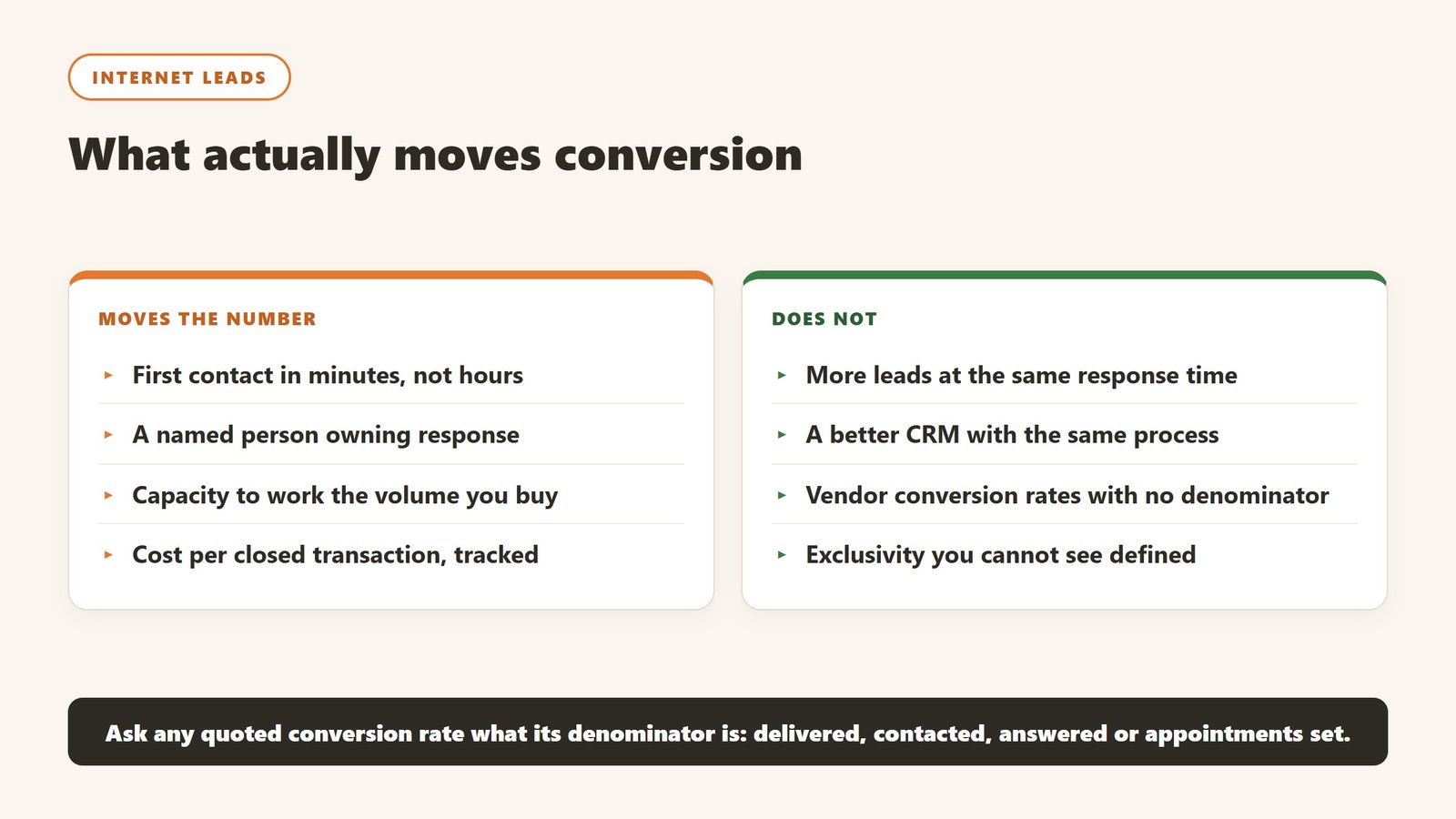
Pick the metric the tool is supposed to move
For a lead platform it is cost per closed transaction. For property management software it is hours of admin per unit per month, and days to fill a vacancy. For staging it is days on market and list-to-sale ratio. For screening it is time to approve and the rate of problem tenancies. Each of those is available from records you already keep, and each needs a figure from before you started.
Take the baseline before you switch anything on
You need last year of the metric from a source the project did not touch. This is the step that gets skipped and it is the reason most of these purchases can never be evaluated. It costs an hour. Ask the two or three people whose work will change to record how long the target task takes them this month, because time saved is measurable in advance and unprovable afterwards.
Give it a full cycle before judging
Leasing and transactions are seasonal, so a six week read tells you very little. Judge lead tooling over at least two quarters, and property management tooling over a full turnover cycle, because the value shows up at move-out and move-in rather than in the quiet middle. Say that at the outset so an unremarkable month one is understood as expected.
Write the stop condition down first
Before purchase, name the result at twelve months that would mean you do not renew. It converts renewal from a default into a decision and it is the most effective discipline against a subscription that quietly becomes permanent. If nobody can name a result that would end it, the evaluation was never real.

Written by
FazFaz is the founder of AIToolsBakery. Some tools here are tested hands on. Others are assessed from vendor documentation and pricing verified on the live page, and every review says which one it is. Sponsors can buy a position in a guide. They cannot buy the score, the criticism, or silence about a better option.
How we test and how we make money →