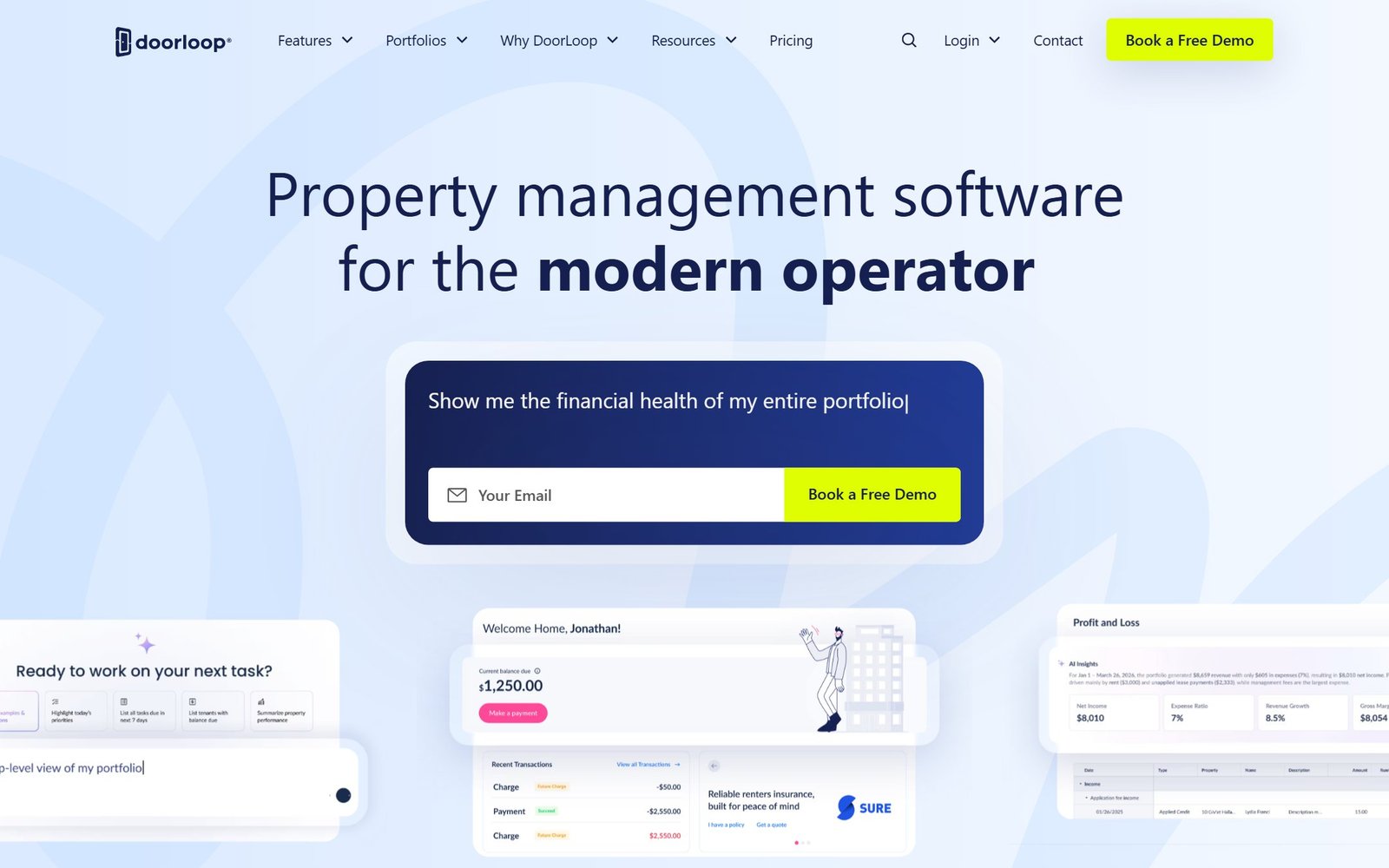
DoorLoop’s pricing page is one of the most polished in property management software, and that polish is exactly why it deserves a calculator instead of a skim. The banner promises 30% off. The strike-through prices next to each plan tell three different stories, none of which is 30% on two of the three plans. The countdown names a deadline that, by our reading of the calendar, expired months ago. And buried in the support docs is the only AI add-on in this entire vertical priced as a percentage of your subscription, structured so the cheaper plan pays the higher rate.
None of this means DoorLoop is a bad buy. It is a genuinely capable platform, and our DoorLoop review covers what it is like to actually run, including the promo-versus-real pricing pattern we first flagged there; this post stays in its lane, which is the money. What it does mean is that the number on the plan card is the beginning of the math, not the end of it. So here is the full ledger: every official fee with its source and date, the promo arithmetic printed digit by digit, twin cost columns for you and your tenants at four portfolio sizes, and honest disclosure of the two things the pricing page currently leaves ambiguous.
Sourcing note: plan prices and banner wording are from doorloop.com/pricing as read on July 24, 2026. Per-transaction fees are from DoorLoop’s own support center articles, last updated April 2026. Everything else is labeled REPORTED with its source and date.
Every DoorLoop price and fee, dated and sourced
The plan grid first, with both the promo price and the struck-through price, then the complete add-on and transaction stack. Landlord and tenant columns are split because DoorLoop splits them in practice.
| Item | Starter | Pro | Premium | Who pays | Source, date |
|---|---|---|---|---|---|
| Advertised price (billed yearly) | $69/mo | $149/mo | $209/mo | Landlord | doorloop.com/pricing, 2026-07-24 |
| Struck-through price displayed | $99/mo | $189/mo | $239/mo | Landlord | doorloop.com/pricing, 2026-07-24 |
| Implied discount (our arithmetic) | 30.3% | 21.2% | 12.6% | n/a | Computed from the two rows above |
| Unit allowance | Hard cap 10 units (confirmed via live calculator; aggregators still print a dead 20-unit structure) | $149 to at least 20 units, $179 at 50, $209 at 100, $249 at 150 | $209 base, $269 at 50, $319 at 100, $429 at 150 | Landlord | doorloop.com/pricing live calculator 2026-07-24 |
| 300+ units | Custom demo pricing | Landlord | doorloop.com/pricing, 2026-07-24 | ||
| Onboarding fee | “Based on portfolio size”, no amount published; REPORTED $500-1,000+ | Landlord | Pricing page 2026-07-24; third-party reports, treat as reported | ||
| AI add-on | Not listed | 25% of plan price ($37.25/mo) | 15% of plan price ($31.35/mo) | Landlord | DoorLoop support art. 8065530, upd 2026-04-15 |
| Tenant ACH payment | $2.49/txn | $0.99/txn | Free | Tenant | DoorLoop support, upd 2026-04 |
| Card / Apple Pay / Google Pay | 3.25% (4% international) | Tenant | DoorLoop support, upd 2026-04 | ||
| Cash payment | $3.95/txn | Tenant | DoorLoop support, upd 2026-04 | ||
| Tenant screening (TransUnion) | $45 | $35 | $25 | Tenant (applicant) | DoorLoop support, upd 2026-04 |
| eSignature | $3/signature | $1/signature | Free | Landlord | DoorLoop support, upd 2026-04 |
| Merchant application | $49 | $25 | Free | Landlord | DoorLoop support, upd 2026-04 |
| Outgoing physical check | $1.79 each | Landlord | DoorLoop support, upd 2026-04 | ||
| Outgoing eCheck | $1.00 each | Landlord | DoorLoop support, upd 2026-04 | ||
| Returned payment | $40 plus associated fees | Varies by lease | DoorLoop support, upd 2026-04 | ||
| Custom website | $99/site/mo | $49/site/mo | Free | Landlord | DoorLoop support, upd 2026-04 |
Two things jump out of that grid before we do any math. First, almost every fee steps down as the plan steps up, which is normal. Second, look at who is standing under each fee: ACH, cards, cash, and screening all land on the tenant, and every one of them gets cheaper for the tenant when the landlord buys a bigger plan. We will come back to that, because it quietly changes what a plan upgrade is actually buying.
The promo math: what 30% off actually equals
The banner on DoorLoop’s pricing page, verbatim as of July 24, 2026: “Get 30% off DoorLoop for 3 months + ZERO onboarding fees on select plans. Offer ends Friday July 24.” The expiry date changes, and we will get to that. First, the strike-through prices the page has been serving (our static read, same day, which also carried the banner with a different expiry date):
- Starter: $99 struck through, $69 displayed. $99 − $69 = $30. $30 / $99 = 30.3%. This one honors the banner.
- Pro: $189 struck through, $149 displayed. $189 − $149 = $40. $40 / $189 = 21.2%. Nine points short.
- Premium: $239 struck through, $209 displayed. $239 − $209 = $30. $30 / $239 = 12.6%. Less than half the advertised rate.
So a banner that says 30% off sits directly above discounts of 30.3%, 21.2%, and 12.6%. The most charitable reading is that “up to 30%” lost its “up to” somewhere in a design revision. The less charitable reading is that most shoppers anchor on the banner, skim the strike-throughs, and never divide. Either way, the two most expensive plans, the ones DoorLoop presumably most wants to sell, carry the smallest real discounts.
And if the banner’s “for 3 months” clause governs, the annualized picture shrinks further. Take the strike-through as the regular rate and apply the displayed discount for three months only:
- Starter year 1: 3 x $69 + 9 x $99 = $207 + $891 = $1,098, versus $1,188 at full rate. Savings: $90, or 7.6% off the year.
- Pro year 1: 3 x $149 + 9 x $189 = $447 + $1,701 = $2,148, versus $2,268. Savings: $120, or 5.3% off the year.
- Premium year 1: 3 x $209 + 9 x $239 = $627 + $2,151 = $2,778, versus $2,868. Savings: $90, or 3.1% off the year.
Under that reading, “30% off” is a 3.1% to 7.6% event across your first year. We will complicate this in a moment, because there is a real question about whether the strike-through is a promo price at all.
The deadline that never arrives
Here is what we observed on July 24, 2026, and we want to be precise because it is the strangest finding in this article. A static fetch of DoorLoop’s pricing page that morning returned a banner reading “Offer ends Friday November 07.” A live browser session on the same page, the same day, showed “Offer ends Friday July 24.” July 24, 2026 was that very day, a Friday.
Two different expiry dates on the same page on the same day means the deadline is not a date someone set. It is generated. The countdown appears to regenerate itself toward whatever Friday is closest, which is a known pattern in SaaS pricing called evergreen scarcity: a deadline that creates urgency without ever actually arriving, because the promo is the standing price. We are not mind readers and we cannot tell you DoorLoop’s intent. We can tell you what we observed twice in one day, and what it implies for your negotiation posture: do not let that banner rush you. There is no evidence the $69/$149/$209 prices vanish on any particular Friday, including the Friday the banner happens to be naming when you read it.
Is $69/$149/$209 the promo price or just the price?
Here is the honest complication, disclosed rather than smoothed over. There are two readings of DoorLoop’s strike-through prices, and we cannot fully resolve them from the outside:
Reading one: the strike-through is the regular price. $99/$189/$239 is what you pay once the promo lapses, and $69/$149/$209 is a limited discount. This is what the banner’s framing implies, and it is how most shoppers will parse the page.
Reading two: the strike-through is the monthly-billing price. Under this reading, reported by checkthat.ai in March 2026, $99/$189/$239 is what month-to-month billing costs, and $69/$149/$209 is simply the standing annual-billing rate, dressed up as a discount. Annual-versus-monthly gaps of this size are ordinary in SaaS; presenting one under a countdown banner is not.
The evidence leans toward reading two, and our live session added a data point: in a real browser on July 24, 2026, the rendered plan cards showed no strike-throughs at all, just $69/$149/$209 labeled “Per month. Billed yearly.” The strike-through theater appeared in the static version of the page, the discounts do not match the banner, and the deadline regenerates. If reading two is correct, then nothing is on sale at all: the strike-through theater is repackaging a routine annual-billing discount as a limited-time event. But we flag it as unresolved rather than asserting it, because only DoorLoop’s checkout flow can settle what a month-to-month subscriber actually pays today. Budget on $69/$149/$209 billed yearly, treat $99/$189/$239 as the ceiling if you insist on monthly billing, and get the renewal rate in writing before you sign.
The Starter cap is real: 10 units, confirmed
This one we resolved with DoorLoop’s own pricing calculator, live on July 24, 2026. Enter any unit count up to 10 and Starter shows its $69 price. Enter 11 or more and the Starter card drops its price entirely and displays “Max 10 units.” Starter is hard-capped at 10 units. That is confirmed, not reported.
Which makes the widely circulated version of this plan wrong. checkthat.ai’s March 30, 2026 read had Starter including 20 units with overage at $1.00 to $1.50 per extra unit, and most aggregator pages on page one of Google still print that 20-unit structure. Either the plan was restructured sometime this spring or the earlier reporting was off; either way, a 15-unit landlord shopping on the strength of those articles would be buying a plan that cannot hold their portfolio.
The same calculator gave us something no aggregator page prints: how Pro and Premium actually scale by unit count on yearly billing, read live on July 24, 2026:
- Pro: $149/mo through at least 20 units, $179 at 50 units, $209 at 100, $249 at 150.
- Premium: $209/mo at the base, $269 at 50 units, $319 at 100, $429 at 150.
So the advertised $149 and $209 are floor prices for small portfolios. At 150 units, Premium costs more than double its advertised number. Above roughly 300 units DoorLoop pushes you to a custom demo anyway. If you are between 10 and 30 units, price Pro, not Starter, and get the rate for your exact door count in writing from sales.
The AI surcharge: the only percentage-priced AI add-on in the vertical
Every property management vendor now sells some flavor of AI. Buildium bundles an AI assistant into its base plan. AppFolio prices AI per unit. DoorLoop did something we have not seen anywhere else in this category: it priced AI as a percentage of your subscription.
Per DoorLoop’s support documentation (updated April 2026): the AI add-on costs 25% of plan price on Pro and 15% on Premium. Run those:
- Pro: 25% of $149 = $37.25 per month, on top of the $149.
- Premium: 15% of $209 = $31.35 per month, on top of the $209.
Read that pairing again. The Pro subscriber pays a higher rate and more absolute dollars for the AI add-on than the Premium subscriber pays: $37.25 versus $31.35 a month, $447 versus $376.20 a year. The cheaper plan pays more for the same add-on, which inverts every pricing intuition a buyer walks in with. It functions as an upgrade nudge: once you want AI on Pro, the effective gap to Premium shrinks from $60 a month to $54.10, and Premium is also deleting your tenants’ ACH fees and your eSignature charges.
Two cautions. First, we are describing the pricing structure, not evaluating the AI itself; we have not assessed what the add-on actually does day to day, and a surcharge this unusual deserves a capability demo before anyone pays it. Second, percentage-of-plan pricing means the AI fee silently grows with every future plan price increase, which is a compounding clause worth noticing before you agree to it. Starter does not show an AI add-on option in the documentation we reviewed.
The tenant fee ladder is part of the plan price
Now the pattern we flagged under the master table. Line up the tenant-paid fees by plan:
- ACH rent payment: $2.49 on Starter, $0.99 on Pro, free on Premium.
- Screening: the applicant pays $45 when the landlord is on Starter, $35 on Pro, $25 on Premium.
- Cards (3.25%) and cash ($3.95): flat across plans, always tenant-paid.
DoorLoop has effectively externalized part of its plan pricing onto tenants, then turned the externalized part into an upgrade incentive for landlords. On Starter, a tenant paying rent by ACH hands DoorLoop $29.88 a year, and each applicant pays $45. Upgrade to Premium and those same people pay $0 and $25. Your plan choice sets prices for people who never chose the software and never see the pricing page.
This is not unique to DoorLoop, and it is not a scandal. But it changes the upgrade math in a way landlord-only tables never show: part of what Premium buys is a better deal for your tenants, which is a retention and applicant-experience asset, not just a software feature. The twin-column tables below make it concrete. For how DoorLoop’s split compares with its closest rival’s fee stack, our sibling deep-dive on Buildium pricing runs the same exercise, and Buildium vs DoorLoop does the head-to-head.
True cost at 1, 20, 50, and 100 units: landlord column and tenant column
Assumptions, stated plainly: advertised promo prices billed yearly ($69/$149/$209), every tenant pays monthly by ACH, one screened applicant per unit per year, one signed lease per unit per year (2 signatures). We exclude the onboarding fee (unpublished), the AI add-on (optional), and card payments (avoidable). Starter appears only at 1 unit because of the unresolved unit-structure question above; on the current page reading it caps at 10 units. At 100 units, treat every figure as a floor: DoorLoop scales pricing by portfolio size and pushes 300+ units to custom quotes, so your real quote may be higher than the advertised starting price.
| Portfolio | Plan | Landlord pays/yr | Tenants pay/yr (all units combined) | Combined/yr |
|---|---|---|---|---|
| 1 unit | Starter | $834 ($828 plan + $6 eSign) | $74.88 ($29.88 ACH + $45 screening) | $908.88 |
| 1 unit | Pro | $1,790 ($1,788 plan + $2 eSign) | $46.88 ($11.88 ACH + $35 screening) | $1,836.88 |
| 1 unit | Premium | $2,508 (eSign free) | $25.00 (screening only, ACH free) | $2,533.00 |
| 20 units | Pro | $1,828 ($1,788 plan + $40 eSign) | $937.60 (20 x $46.88) | $2,765.60 |
| 20 units | Premium | $2,508 | $500.00 (20 x $25) | $3,008.00 |
| 50 units | Pro | $1,888 ($1,788 plan + $100 eSign) | $2,344.00 (50 x $46.88) | $4,232.00 |
| 50 units | Premium | $2,508 | $1,250.00 (50 x $25) | $3,758.00 |
| 100 units | Pro | $1,988 ($1,788 plan + $200 eSign) | $4,688.00 (100 x $46.88) | $6,676.00 |
| 100 units | Premium | $2,508 | $2,500.00 (100 x $25) | $5,008.00 |
Three readings of that table:
At 1 unit, DoorLoop is the wrong shape entirely. $834 to $2,508 a year of landlord money for one door is portfolio software pricing applied to a single unit. A one-to-ten-unit landlord should be reading our best AI tools for landlords roundup, where genuinely cheap DIY platforms live, not this page.
The landlord-only comparison and the combined comparison disagree, and the crossover sits near 33 units. Premium costs the landlord $720 a year more than Pro, while saving each ACH tenant $21.88 a year. $720 divided by $21.88 is about 33 units: below that, Pro plus tenant fees is the cheaper total arrangement; above it, Premium is cheaper for the tenancy as a whole even though the landlord’s own line went up. At 50 units the combined ledger already favors Premium by $474 a year, and at 100 units by $1,668. If you count only your own column, you will pick Pro at every size and be wrong about the total cost of the arrangement from unit 34 onward.
eSignature is a rounding error until it is not. At $3 a signature on Starter, a 10-unit turnover year costs $60 in signatures; the same year on Premium costs $0. Small, but it is the kind of line that makes the fee stack feel nickel-and-dimed, and it disappears entirely at the top tier, which is the same retention design as the ACH ladder.
The onboarding fee: real, mandatory-flavored, and unpublished
The pricing page says the onboarding fee is “based on portfolio size” and publishes no number. Third-party reporting has placed it at $500 to $1,000 or more, which we label clearly as REPORTED, not official. Two observations. First, the promo banner’s “ZERO onboarding fees on select plans” wording confirms the fee exists and is normally charged, while “select plans” declines to say which. Second, an unpublished mandatory fee is the single biggest hole in any DoorLoop budget you build from the public page: on a 20-unit Pro portfolio, a $750 onboarding charge would add 41% to your year-one software cost. Get the onboarding number, and the “select plans” waiver terms, in writing before you compare DoorLoop against anything else. If the quote surprises you, the per-door landscape in DoorLoop alternatives is the next read.
Which plan, for whom
Starter, cautiously, if you are under 10 units and you get the unit-allowance question answered in writing first. The $2.49 tenant ACH fee and $45 applicant screening are the worst in DoorLoop’s ladder, so factor the tenant experience in.
Pro if you are roughly 10 to 33 units. It is the value plan by combined cost in that band, and $1 eSign plus $0.99 ACH keeps the fee friction tolerable. Skip the AI add-on until someone shows you $447 a year of capability.
Premium if you are 33 units or more, or if tenant-facing fees matter to you at any size. Past the crossover it is the cheaper total arrangement, and it deletes the eSign, merchant application, ACH, and website fees outright while cutting applicant screening to $25.
Custom demo pricing at 300+ units, where none of the public numbers apply and this article’s job is done. At that scale you are comparing against AppFolio and Buildium anyway; our AppFolio pricing breakdown covers the minimum-spend math on that side of the fence.
The legal side of screening and automated pricing
Tenant screening and algorithmic rent setting are the two places where real estate software touches regulated activity directly, and where getting it wrong is expensive rather than embarrassing.
A screening report is a consumer report, with obligations attached
If you take an adverse action based on a screening report, in the United States that triggers notice obligations to the applicant, including telling them which agency supplied the report and that the agency did not make the decision. Ask any platform how it handles adverse action notices, whether it generates them automatically, and what record it keeps. A tool that produces a score but no notice workflow leaves the obligation with you.
Consistency is your best defence
Fair housing exposure comes from treating applicants differently, and inconsistency is much easier to demonstrate than intent. Written criteria applied identically to every applicant, with the decision and its reason recorded, is worth more than any feature on a vendor page. Software helps here by making the process uniform, which is a genuinely good reason to buy one, and it does not transfer the responsibility.
Automated rent pricing is under active scrutiny
Algorithmic rent setting, particularly where a tool draws on non-public competitor data, has attracted significant legal attention, and this is a live area rather than a settled one. Before adopting one, ask what data the recommendation is built on, whether it includes non-public data from other landlords, and whether you can see and override every recommendation. Keep the override log. If a vendor cannot answer those three, that is your answer.
Know what the tool is deciding and what you are deciding
The safest posture with any of this is that the software recommends and a named person decides, with the decision recorded. That is slower than full automation and it is the difference between a defensible process and one you cannot explain. Write down who that person is before you switch anything on, because the question only ever gets asked afterwards.
How to tell whether the tool paid for itself
Real estate software is unusually easy to evaluate honestly, because the outcomes are countable. Most teams still do not do it, and the renewal conversation becomes an argument about impressions.
Pick the metric the tool is supposed to move
For a lead platform it is cost per closed transaction. For property management software it is hours of admin per unit per month, and days to fill a vacancy. For staging it is days on market and list-to-sale ratio. For screening it is time to approve and the rate of problem tenancies. Each of those is available from records you already keep, and each needs a figure from before you started.
Take the baseline before you switch anything on
You need last year of the metric from a source the project did not touch. This is the step that gets skipped and it is the reason most of these purchases can never be evaluated. It costs an hour. Ask the two or three people whose work will change to record how long the target task takes them this month, because time saved is measurable in advance and unprovable afterwards.
Give it a full cycle before judging
Leasing and transactions are seasonal, so a six week read tells you very little. Judge lead tooling over at least two quarters, and property management tooling over a full turnover cycle, because the value shows up at move-out and move-in rather than in the quiet middle. Say that at the outset so an unremarkable month one is understood as expected.
Write the stop condition down first
Before purchase, name the result at twelve months that would mean you do not renew. It converts renewal from a default into a decision and it is the most effective discipline against a subscription that quietly becomes permanent. If nobody can name a result that would end it, the evaluation was never real.
Where the figures on this page come from
Every price here was read from the vendor’s own pricing page on 4 September 2026, not from an aggregator or a review site. Each figure carries that date, because pricing in this market moves and a claim without a date is not checkable.
The pages we read
Buildium publishes $62, $192 and $400 a month plus a detailed fee schedule. DoorLoop publishes $69, $149 and $209 a month billed yearly with per unit equivalents. TurboTenant publishes a free tier plus $12.42 and $16.48. TenantCloud publishes $15 to $50 a month on annual billing. RentRedi publishes $12 a month on the annual plan. Hemlane, Rentec Direct and Landlord Studio all publish in full, as do Follow Up Boss at $69 per user, Wise Agent at $49, and Placester from $59.
The ones we could not read
AppFolio, Innago, Top Producer and Hostaway did not yield a figure to the same method that read every vendor above, and Lofty’s pricing page carried no plan rates. We are not presenting that as proof they publish nothing, because a failed read is not evidence of absence. Treat any figure for those five from elsewhere as unverified.
What we do not do
We do not carry a figure we cannot source to the vendor. Where a number circulates and cannot be traced, we say so and withdraw it rather than repeating it with a hedge, and we have withdrawn our own published figures on that basis more than once.
Verdict: divide before you buy
DoorLoop’s 2026 pricing is not expensive so much as it is theatrical. The numbers that matter: $69, $149, and $209 billed yearly are the real working prices; the 30% banner resolves to 30.3%, 21.2%, and 12.6% depending on plan; the deadline names a Friday from last year; and the AI add-on quietly charges Pro subscribers a higher rate than Premium subscribers, $37.25 versus $31.35 a month, for the same product. None of that is a reason to walk away. It is a reason to do exactly four things before you sign: get the onboarding fee in writing, get your unit allowance in writing, get the renewal rate in writing, and divide every strike-through yourself. The software may earn its price. The banner has not earned your urgency.

Written by
FazFaz is the founder of AIToolsBakery. Some tools here are tested hands on. Others are assessed from vendor documentation and pricing verified on the live page, and every review says which one it is. Sponsors can buy a position in a guide. They cannot buy the score, the criticism, or silence about a better option.
How we test and how we make money →Frequently Asked Questions