
The short answer
There is no published Classy price, and there is no longer a Classy website either. classy.org redirects to pro.gofundme.com, so the brand has been retired into GoFundMe Pro rather than merely renamed.
We loaded the pricing page on 4 September 2026 and read it fully rendered. It is a “Find your plan” and “Request pricing” form. The only two currency figures anywhere on it are “$40B raised”, a lifetime platform statistic, and “$21,000”, the total one named charity raised in a case study. Neither is a price, and both are the kind of number that gets misread as one.
What GoFundMe Pro does publish about how it charges
The model is published even though the numbers are not, and it is worth quoting exactly. Their own pricing FAQ answers “How much is GoFundMe Pro?” with:
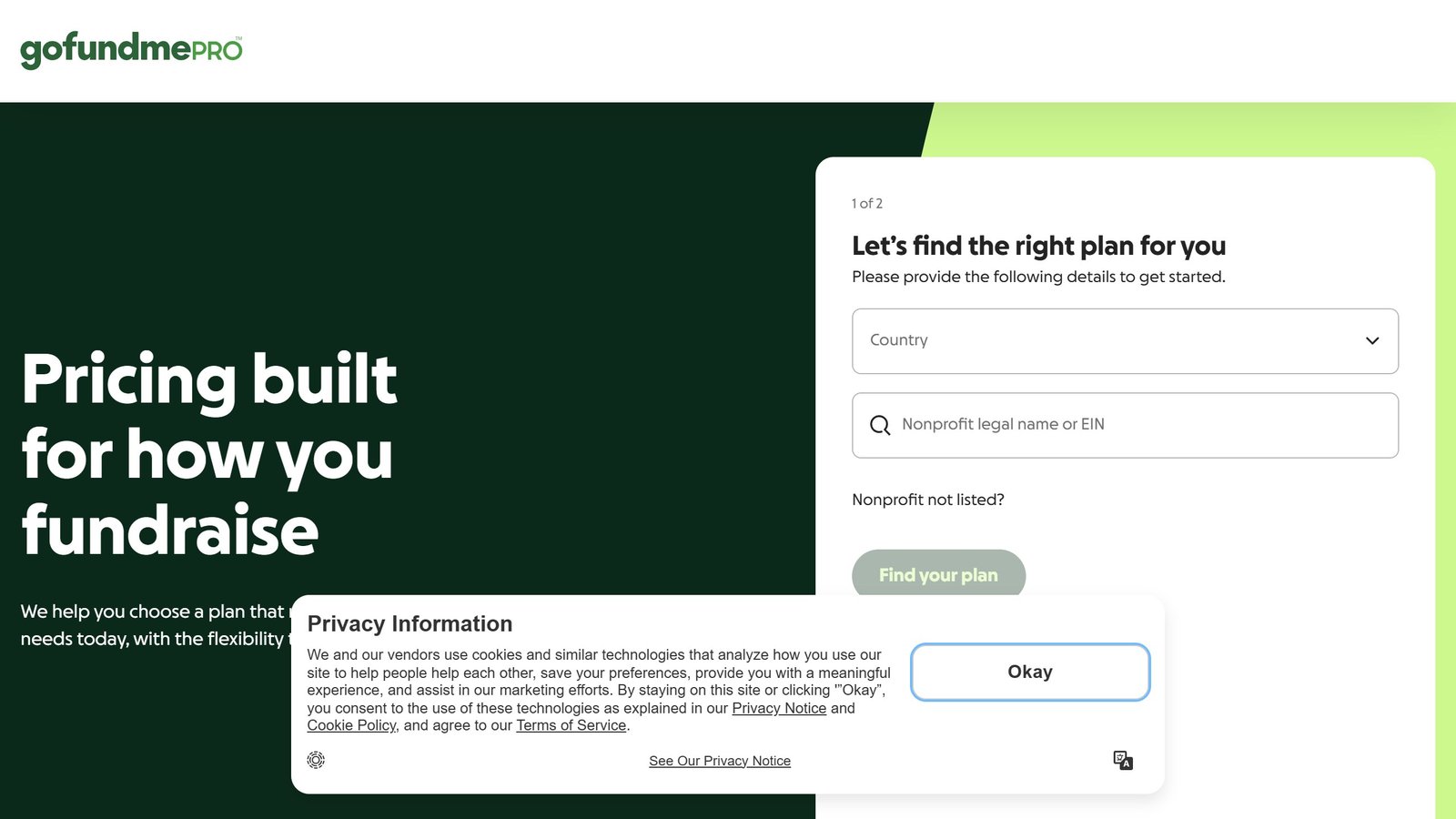
We offer custom pricing, combining an annual upfront subscription with a transaction fee per donation.
Two components, and both are negotiable
An annual subscription plus a per-donation fee means your total cost moves with your fundraising volume, not just your seat count. A platform that takes a percentage gets more expensive precisely when you succeed, which is the opposite shape from a flat CRM licence and needs modelling before you sign.
The transaction rate is the number that actually matters
For most nonprofits the subscription is the smaller half. On $500,000 raised online, a single percentage point of transaction fee is $5,000 a year. The subscription might be a known quantity after one call; the fee compounds silently for the length of the contract, so get it in writing as a percentage with any caps stated.
Why the EIN gate exists
The form asks for your country and EIN before it will route you to pricing. That is not bureaucracy for its own sake: it lets the vendor look up your filed revenue before quoting. You should assume the number you are offered has been sized against your public financials, which is a good reason to know those figures yourself before the call.
What the rest of the market publishes, for contrast
The useful thing we can give you in place of a Classy figure is what its comparable competitors charge, all verified at source on 4 September 2026.
| Vendor | Publishes a price? | Entry figure | Takes a cut of donations? |
|---|---|---|---|
| Classy / GoFundMe Pro | No | Quote only | Yes, rate not published |
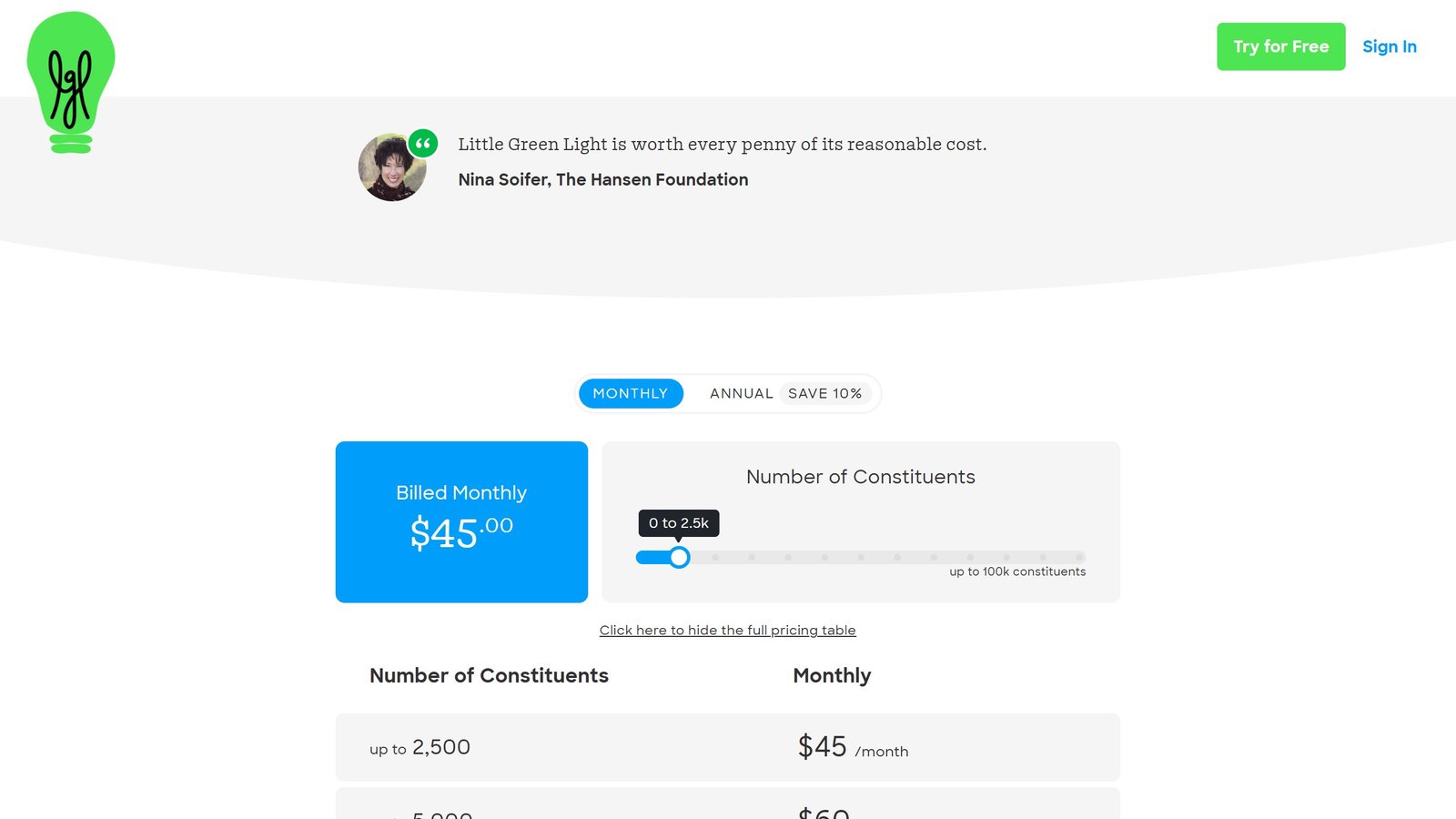
| Little Green Light | Yes | $45/mo, up to 2,500 constituents | No |
| Salesforce Nonprofit Cloud | Yes | $70/user/mo (4 Oct 2026), 10 licences free | No |
| Neon CRM | Yes | $99/mo, revenue-based | No |
| Bloomerang | Yes | $125/mo for the CRM | No |
| Keela | Yes | $164/mo up to 1,000 contacts | No |
| OneCause | Partly, behind accordions | From $200 PAYG or $2,995 flat | Yes, 5% capped |
| Virtuous | No | Quote only | No |
| Blackbaud | No | Quote only | No |
Two things stand out. Most of this market publishes a number, so quote-only is a choice rather than a category norm. And most of it does not take a percentage of your donations at all, which makes the transaction fee the single most important thing to establish about a GoFundMe Pro quote.
The comparison the same company makes easy
There is an unusual reference point available here, because the parent company publishes fees openly on its consumer product. The consumer GoFundMe platform states its transaction fee publicly and charges nothing to create a fundraiser.
That does not tell you the GoFundMe Pro rate, and we are not going to pretend it does. What it does establish is that the company is perfectly willing to publish a transaction fee when it wants to. The nonprofit product’s opacity is a commercial decision, not a technical constraint.
What the transaction fee actually costs you, modelled
Because the fee is the half that scales, it is worth seeing the arithmetic before a rate is ever quoted. These are our sums, at percentages we have chosen to bracket the plausible range, not figures from the vendor.
| Raised online per year | At 1% | At 2% | At 3% |
|---|---|---|---|
| $100,000 | $1,000 | $2,000 | $3,000 |
| $250,000 | $2,500 | $5,000 | $7,500 |
| $500,000 | $5,000 | $10,000 | $15,000 |
| $1,000,000 | $10,000 | $20,000 | $30,000 |
Why this table matters more than the subscription line
At $500,000 raised, the difference between one and three percent is $10,000 a year, which is more than the entire annual cost of several CRMs in the comparison above. A negotiation that focuses on shaving the subscription while accepting the fee as given is optimising the wrong number.
Processing fees usually sit on top
Establish whether the platform fee includes card processing or sits above it. Payment processing in this market commonly runs around 2.2% to 2.9% plus a fixed amount per gift, and a platform fee charged in addition to that is a materially different proposition from one that absorbs it. Ask which it is, explicitly.
Who this pricing model suits
It suits large, campaign-led fundraising operations
A percentage model is defensible when the platform is genuinely driving incremental revenue: big campaign moments, peer-to-peer programmes, events with complex ticketing. If the software is doing work that would otherwise need staff, paying it a share of the upside is a rational trade.
It does not suit steady recurring-giving programmes
If most of your income is predictable monthly recurring gifts from an existing base, a percentage fee is a tax on revenue the platform is not really generating. That profile is better served by a flat-fee CRM from the comparison table, several of which take nothing from donations at all.
It does not suit anyone who needs to budget before a call
There is no published figure and no published rate. If you need a number for a board paper this month, that is a scheduling problem before it is a product decision, and the vendors that publish will get you an answer today.
The migration question to settle first
This applies whether you are moving to GoFundMe Pro or away from it, and it is the most expensive thing to discover late.
Recurring gifts are the hard part
Donor records and giving history export from almost any platform. Live recurring schedules and the payment tokens behind them frequently do not. If tokens cannot move, every monthly donor has to re-enter card details, and a meaningful share of them will not. That is the real switching cost in this category and it is rarely in a comparison table.
Ask about it before you sign, not when you leave
The question is simple: if we leave, do we receive our recurring giving schedules and payment tokens in a form another platform can accept? Ask it during procurement, when you have leverage, and get the answer in the contract rather than in an email from a sales engineer.
How to budget for this without a number
Model the fee, not the subscription
Start from your online giving volume. At $250,000 raised a year, each percentage point is $2,500 annually; at $1,000,000 it is $10,000. Build a simple table at one, two and three percent so that when a rate is finally quoted you already know what it costs you rather than working it out under pressure.
Get the all-in first-year figure
Ask for subscription, transaction fee, onboarding, migration and any per-form or per-campaign charges as separate lines, then ask for the total. Vendors that quote a low subscription frequently recover it elsewhere, and a single blended number is impossible to compare against a competitor with a published rate card.
Ask what happens at renewal, in writing
With no public rate card there is no reference point at renewal either, and the vendor knows your volume and your switching cost by then. A capped renewal uplift, stated as a percentage, is worth more than a first-year discount.
Price the exit before you price the entry
Ask what happens to your donor records, recurring gift schedules and payment tokens if you leave. Recurring donations are the hardest thing to migrate in this category, and a platform that cannot hand back live payment tokens effectively raises your switching cost to the value of your recurring programme.
A note on the figures you will find elsewhere
Numbers circulate for Classy across comparison sites, commonly a starting point in the region of $300 a month and annual licences in the low thousands. We cannot source any of them to the vendor, and several predate the GoFundMe Pro transition entirely.
We have corrected enough wrong prices on this site to be strict about this. On this cluster alone in a single day we found a vendor whose entire tier structure had been retired, another understated by a factor of twelve, and a third whose published prices we had wrongly reported as removed. Publishing an unsourceable figure is how a wrong price propagates through a whole category, so this page will not carry one. If GoFundMe Pro publishes a rate card, it will appear here the same week.
What to ask in the first call
- What is the annual subscription, stated separately from any transaction fee?
- What is the transaction fee as a percentage, and is it capped at any point?
- Is payment processing included in that fee or charged separately on top?
- What is the all-in first-year cost including onboarding and migration?
- What is the capped renewal uplift?
- If we leave, do we get our recurring giving schedules and payment tokens back in a usable form?
The last one is the question most likely to be answered vaguely and most expensive to have got wrong.
What every comparable vendor actually charges
A comparison table tells you the number. It does not tell you what the number is measured against, which is the part that decides your bill. Here is each of the main alternatives to GoFundMe Pro, read from their own pricing pages on 4 September 2026, with the meter that matters.
Little Green Light, from $45 a month, metered on constituents
Little Green Light publishes every band openly and starts at $45 a month for up to 2,500 constituents. It takes nothing from your donations, which makes it one of the few platforms where online giving revenue is genuinely yours. The catch is structural: because the meter is constituent count, growing your list raises the bill even when the added records are lapsed donors or one-off event attendees who will never give again. Organisations on constituent-metered platforms end up pruning their database to control cost, which is a bad incentive for a fundraising team that should be keeping history.
Salesforce Nonprofit Cloud, $70 per user (as of 4 October 2026), with ten licences free
Salesforce is the odd one out and it is worth understanding why. Nonprofit Cloud Core is $70 per user per month (as of 4 October 2026) billed annually, but the Power of Us programme gives any eligible nonprofit ten licences at no cost. An organisation with ten or fewer people in the CRM pays nothing for the CRM itself, at any list size. The eleventh person costs $840 a year at the October 2026 rate. That inverts the usual advice: on Salesforce a database of two million costs the same as one of two thousand, and hiring is what raises the bill. The real cost is not the licence, it is that somebody has to own the configuration.
Neon CRM, from $99 a month, metered on your fundraising revenue
Neon starts at $99 a month with unlimited users and unlimited records, priced on annual fundraising revenue rather than seats or contacts. Modules are added as a percentage of the subscription: memberships at 10%, events at 20%, volunteers at 10%. Worth knowing that Neon retired its old Essentials, Impact and Empower tier structure entirely, so any article still quoting $209 or $409 tiers is describing packaging that no longer exists.
Bloomerang, from $125 a month, metered by product
Bloomerang publishes $125 a month for the CRM, with Fundraising from $40 and Volunteer from $119 as separate products. It moved away from record-tier pricing, so comparisons written against its old banding are stale. The practical effect of product-based pricing is that a quote assembled from three Bloomerang products is not comparable to a single all-in figure from a competitor without itemising first.
Keela, from $164 a month, metered on contacts
Keela bands by contact count starting at $164 a month for up to 1,000 contacts. It raised every band between late August and early September 2026, entry moving from $134 to $164, a rise of roughly 15 to 22% across the range in under two weeks. That is a useful reminder that a published price is a snapshot: check the date on any figure you are comparing, including ours.
Dataro, from $15,000 a year plus $0.10 per active donor
Dataro is a different category, predictive donor intelligence rather than a CRM, and its pricing shows it: Essentials from $15,000 a year plus ten cents per active donor, Growth from $25,000 plus twelve cents. Its pricing page is not linked from its own navigation and is only discoverable through the sitemap. Included here because it is the honest top of the nonprofit software market and a useful upper bound when someone tells you a quote is expensive.
The ones that publish nothing
Blackbaud runs a quote request form headed “Let us find a price that fits your organization” with no figures at all. Virtuous publishes no price and bands its tiers at $5 million in annual fundraising revenue, so it segments you by what you raise before quoting. GoFundMe Pro, formerly Classy, publishes only that its model is an annual subscription plus a transaction fee per donation.
How we checked this
Everything here comes from pro.gofundme.com/c/pricing as rendered in a browser on 4 September 2026, including the expanded pricing FAQ, plus the classy.org redirect confirmed the same day. Competitor figures come from each vendor’s own pricing page on the same date and are linked above.
We hold no commercial relationship with GoFundMe or any vendor in the comparison table. This is a pricing page rather than a hands-on review, so nothing here is scored and we make no claim to have used the product. If a figure no longer matches the vendor’s page, tell us and we will correct it.

Written by
FazFaz is the founder of AIToolsBakery. Some tools here are tested hands on. Others are assessed from vendor documentation and pricing verified on the live page, and every review says which one it is. Sponsors can buy a position in a guide. They cannot buy the score, the criticism, or silence about a better option.
How we test and how we make money →