The short answer
If you are building lead generation into your own software rather than buying a seat for a human, the question is not which vendor has the best data. It is what one call costs, what the rate limit is, and whether you can get a key without booking a demo. Those three answers are published far less often than the category pretends.
We read the pricing and developer pages of eight vendors on 12 September 2026, following each company’s own navigation rather than guessing URLs. Every figure below was derived from a plan price and a credit allowance sitting on the same card.
| API | Entry price | Credits included | Cost per credit | Key without sales call? |
|---|---|---|---|---|
| Hunter | $34/mo | 24,000 a year, so 2,000 a month | $0.017 | Yes, free key advertised |
| Prospeo | $49/mo per user | 24,000 a year per user | $0.025 | Yes, free plan |
| Apollo | $79/seat/mo, annual | 48,000 a year per seat | $0.020 | Yes, self serve |
| People Data Labs | From $98/mo | From 350 a month | $0.28 | Yes, free tier |
| UpLead | $99/mo | 170 a month | $0.58 | Trial only, 5 credits |
| Lusha | Published per seat | Published per tier | Not derivable | Yes, key generation offered |
| Clay | From $54/mo | Actions, not contacts | Under a cent per action | Yes, 14 day trial |
| Cognism | Not published | Not published | Not derivable | No. Sales only |
The cheapest published rate we found is Hunter’s top tier at $0.0084 a credit. The dearest is UpLead’s entry tier at $0.58. That is a spread of about seventy times on a unit every one of them calls a credit. Before you conclude anything from that, read the next section, because the comparison is not as clean as the table makes it look.
This page is about what you can call from code. If you want the platforms that do the outreach for you, that is a different purchase and it lives in our guide to AI SDR tools. Full price sheets per vendor live in our Apollo pricing breakdown, Clay pricing breakdown and Cognism pricing breakdown, and are deliberately not reproduced here.
A credit is not a credit, and this is the whole problem
Every vendor in this category prices in credits. Almost none of them tells you what one buys, which makes the headline comparison above worth roughly nothing until you pin the unit down.
Two vendors do define it, and their definitions are not the same.
| Vendor | What one credit buys, in their words |
|---|---|
| Prospeo | One verified business email. A direct mobile number costs 10 credits |
| Cognism | One revealed contact. Credits are used to reveal, enrich or export |
| Everyone else | We could not find a definition on the pricing page |
Prospeo’s ten to one ratio is the number that should change your maths. If your product needs phone numbers rather than email addresses, Prospeo’s effective rate on its Starter tier moves from about two and a half cents to about twenty five cents, which puts it in a completely different part of the table. A vendor charging more per credit but one credit per phone number could easily be cheaper for you.
Faz says: Ask every vendor one question before you compare anything: how many credits for a verified mobile number. The answer is between one and ten depending on who you ask, and it is the single biggest swing factor in what you will actually spend. Nobody volunteers it.
The pricing page trick worth knowing about
UpLead publishes two views of the same plans, monthly and annual, and the credit figure changes unit between them without saying so.
| Plan | Monthly view | Annual view | Actual monthly allowance |
|---|---|---|---|
| Essentials | $99/mo, 170 credits | $74/mo, 2,040 credits | 170 either way |
| Plus | $199/mo, 400 credits | $149/mo, 4,800 credits | 400 either way |
The annual figure is the yearly total. 2,040 is 170 multiplied by twelve, and 4,800 is 400 multiplied by twelve. So the annual view is a genuine discount on price and no change at all in data, but scanned quickly it reads as twelve times the credits for less money.
We are not suggesting this is deliberate. It is a common way to lay out a pricing table and the numbers are all true. It is still the kind of thing that gets budgeted wrong, and it is the reason every figure in our table above is normalised to a monthly allowance.
UpLead also publishes its overage rate, which most do not: $0.60 a credit on the entry tier and $0.50 higher up. Those line up almost exactly with the effective rates we derived, which is a good sign that the plan pricing is honest arithmetic rather than a headline number.
What a thousand prospects actually costs
Per credit rates are abstract until you put a volume through them. Here is the same shopping list priced at each published rate: one thousand verified business email addresses in a month, which is a realistic figure for a single SDR or a modest product feature.
| API | Rate used | 1,000 emails |
|---|---|---|
| Hunter, top tier | $0.0084 | $8.40 |
| Apollo | $0.020 | $19.80 |
| Prospeo, entry tier | $0.025 | $24.50 |
| Prospeo, top-up credits | $0.01 | $10.00 |
| People Data Labs | $0.28 | $280 |
| UpLead, entry tier | $0.58 | $580 |
Now change one thing. Ask for a thousand direct mobile numbers instead of a thousand emails. At Prospeo, where a mobile costs ten credits rather than one, that same list becomes ten thousand credits: $245 at the entry rate, or $100 bought as top-up credits. The cheap option has moved by an order of magnitude, and nothing about the vendor changed.
For the vendors that do not define a credit, this calculation cannot be done at all. That is not a small inconvenience. It means the number on their pricing page does not tell you what your bill will be, and you will not find out until you are already integrated. If a vendor will not answer what a mobile number costs in credits, treat the published price as an opening position rather than a price.
You are buying personal data, so check what they publish about handling it
Every one of these APIs sells information about identifiable people, which puts your own compliance position downstream of theirs. What a vendor names on its own site is not an audit, but it tells you what they are prepared to be held to, and the differences here are real.
| Vendor | Named on their own pages |
|---|---|
| Lusha | SOC 2, ISO 27001, GDPR, CCPA |
| People Data Labs | SOC 2, ISO 27001 |
| Apollo | SOC 2, GDPR, CCPA |
| Clay | GDPR, CCPA |
| Cognism, Prospeo | GDPR |
Two cautions on reading that table. A name on a marketing page is a claim, not evidence, and the report itself usually sits behind a request form. And GDPR is a regulation rather than a certification, so every vendor selling into Europe says it, which makes it the least informative entry on the list. The useful question is narrower: ask who the data subjects are, how they were sourced, and how an erasure request reaches your records once you have copied contacts into your own database. That last one is yours to answer, not theirs.
Rate limits: the number almost nobody publishes
If you are calling an API inside a product rather than running a weekly export, the rate limit matters more than the price. Hit it and your feature stops working, whatever your credit balance says.
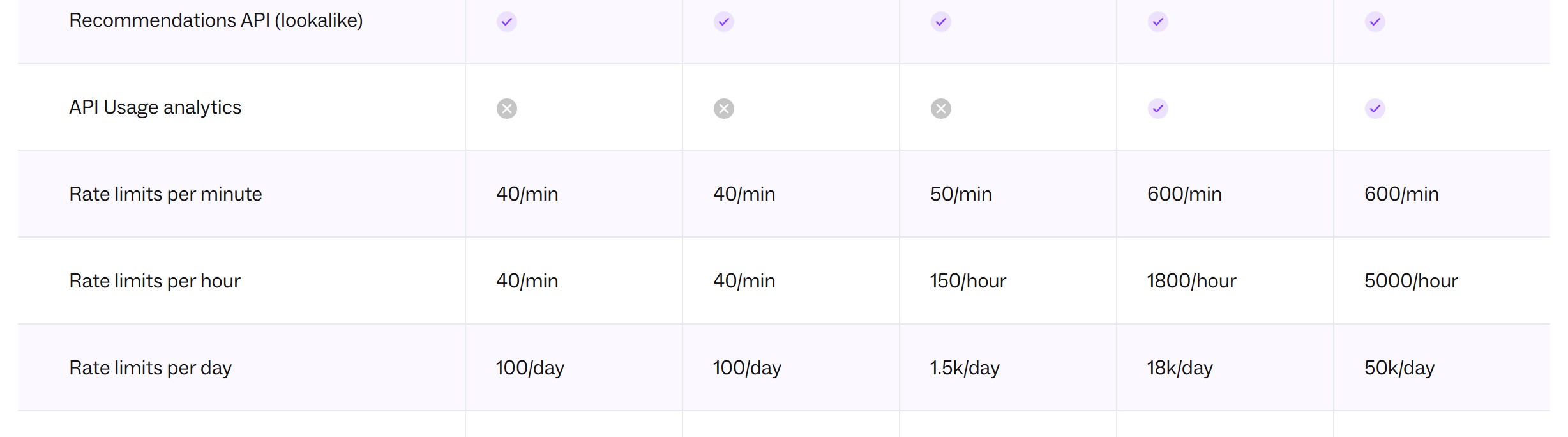
Most vendors in this set say nothing at all about rate limits on their pricing page. Lusha is the exception, and publishes them per tier:
| Tier | Requests per minute | Requests per day |
|---|---|---|
| Lowest two tiers | 40 | 100 |
| Middle tier | 50 | 1,500 |
| Upper tiers | 600 | 18,000, then 50,000 |
Lusha labels its lower tiers “Strict rate limits” in its own feature comparison, which is unusually blunt and genuinely useful. One hundred requests a day is a number you can design around. It is also a number you would discover the hard way if it were not published.
One oddity is worth flagging, because it is the kind of thing that turns into a support ticket. The row labelled “Rate limits per hour” carries 40/min in its first two cells, not an hourly figure at all, while the remaining three cells read 150/hour, 1800/hour and 5000/hour. We are not guessing at what the hourly ceiling on those two tiers really is, because the page does not say. If you are sizing against the lower tiers, get the hourly number in writing rather than reading it off the table.
Prospeo also publishes rate limits per tier and reserves what it calls the highest limits for its top plan. We are not quoting its figures here because the way the table rendered left two cells ambiguous, and a rate limit you half read is worse than one you look up yourself.
Saru says: The rate limit is the question to ask on the sales call, not the price. Price you can find. Limits get quoted per tier, change without much notice, and decide whether your feature works at your busiest hour rather than your average one.
What each one actually gives you
Hunter, the cheapest published rate and the easiest start
Hunter advertises a free API key on its developer page and gives 50 credits a month on the free plan with no time limit. Paid plans run $34, $104 and $209 a month for 24,000, 120,000 and 300,000 credits a year respectively. That top tier works out at $0.0084 a credit, the cheapest published rate in this set by some distance. Hunter is narrower than the others, focused on finding and verifying email addresses against a domain rather than full firmographic enrichment, which is part of why it is cheap.
Prospeo, the clearest credit disclosure
Prospeo is the only vendor here that states plainly what a credit buys and what a phone number costs relative to it. Plans are $49, $99 and $249 a month per user, at 24,000, 60,000 and 180,000 credits per user per year, with 25% off billed yearly. There is a free plan of 100 credits a month with no time limit, and top-up credits from 1,000 for $10, which is a cent each. For a small team that wants to test an integration before committing, that combination is the least friction in the category.
Apollo, flat per-credit pricing across tiers
Apollo prices at $79 and $119 per seat per month billed annually, for 48,000 and 72,000 credits per seat per year. Both work out at almost exactly $0.020 a credit, which is unusual: nearly every other vendor gets cheaper per unit as you go up. The free plan gives 900 credits per seat per year, granted monthly. Note that the Organization tier carries a three seat minimum, so its real entry cost is higher than the per seat figure suggests.
People Data Labs, priced for a different buyer
People Data Labs starts at $98 a month for as few as 350 credits, which is about $0.28 a credit, roughly fourteen times Apollo’s rate. That looks alarming out of context and mostly is not. PDL sells bulk person and company records for building datasets and products, with SOC 2 and ISO 27001 both named on its own pages, and its free tier of 100 credits a month is aimed at developers evaluating the schema rather than at prospecting. Compare it with the others only if you genuinely want the same thing from both.
Clay, which does not price in contacts at all
Clay splits its pricing into Data Credits, spent buying data from its partner marketplace, and Actions, which cover the platform work of routing a request and returning a result. Clay states that Actions cost less than a cent each. Plans start around $54 a month for 180,000 actions a year and $185 a month for 480,000. The detail worth knowing is that bringing your own API key for a data provider costs one Action and no Data Credit, so if you already hold contracts with data vendors, Clay becomes an orchestration cost rather than a data cost. That is a genuinely different shape from everything else here.
Cognism, which publishes nothing
Cognism has a pricing page with no price on it. It explains that credits reveal, enrich or export a contact and that one credit equals one revealed contact, which is more than most vendors define, and then routes every plan to “Talk to sales”. API access and bulk delivery are listed as features rather than priced. That is a legitimate way to sell to enterprises and a hard one to design a product budget around.
How to choose, in the order the decisions actually arrive
The sequence matters more than the shortlist, because the first two questions eliminate most of the field before price is relevant.
| Question | Why it comes first |
|---|---|
| Do you need phone numbers or just email? | Changes effective cost by up to ten times at the same vendor |
| What is your peak requests per minute? | Eliminates tiers regardless of budget, and is rarely published |
| Can you get a key today? | Two of eight here route you to a sales call before you can write any code |
| Do you already buy data elsewhere? | If so, orchestration pricing beats per record pricing |
| Is this a product feature or an internal job? | A feature needs an SLA and headroom. A weekly export does not |
There is a cheap way to answer most of this before you commit to anyone. Four of these vendors run a permanent free tier rather than a countdown trial: Hunter at 50 credits a month, Prospeo at 100 with no time limit, People Data Labs at up to 100, and Apollo at 900 per seat a year. That is enough to call each one against the same fifty companies you already know well, and to compare what comes back against what you can verify yourself. It will not tell you about match rates at scale, but it will tell you quickly whether a vendor knows your market at all, which is the question that eliminates most of a shortlist.
One more thing worth saying plainly about this category. The top organic result for this exact question, at the time of writing, is a vendor’s own blog post that ranks that vendor first. That is not unusual and it is not dishonest, but it does mean most of what is written about SDR APIs is written by people selling one. Every figure on this page came off a vendor’s own pricing page and can be checked in about ten minutes.
How we did this and what we did not do
We have not built against these APIs. This is a published-pricing comparison, not a performance test. We have not measured data accuracy, match rates, latency or uptime, and nothing here should be read as a claim about any of them. Those are the things that decide whether an API is good, and they cannot be established from a pricing page.
What we did do: read the pricing and developer pages of eight vendors on 12 September 2026, reaching each one through the company’s own navigation, expanding collapsed sections, and recording the URL we landed on. Every per credit figure is a plan price divided by the credit allowance printed on the same card, normalised to a month. Where a vendor publishes no price, we have said so rather than estimating one.
Prices are as rendered to us. Several vendors in this category serve different currencies by region, so check your own view before budgeting. Where we could not establish something, we have said we could not find it, which is a different claim from saying it does not exist.

Written by
FazFaz is the founder of AIToolsBakery. Some tools here are tested hands on. Others are assessed from vendor documentation and pricing verified on the live page, and every review says which one it is. Sponsors can buy a position in a guide. They cannot buy the score, the criticism, or silence about a better option.
How we test and how we make money →Frequently Asked Questions