TenantCloud built its brand on one irresistible promise: manage up to 75 units, absolutely free. That promise is dead. There is no free plan at all in 2026, entry now costs $18 per month, and yet half the search results page still headlines the free story. So before we get into what TenantCloud actually does well, and there is a fair amount, we want to reset the record with what is live on the pricing page today, because the gap between TenantCloud’s reputation and TenantCloud’s reality is wider than any other tool we have covered in the landlord software lane.
For this review we pulled the live pricing page on July 21, 2026, read through the complaint record, and dug into the company’s unusually quiet ownership history. Here is the full picture.
TenantCloud at a glance
| Plan | Monthly price | Annual price (per month) | Lease cap | Tenant ACH fee | Best for |
|---|---|---|---|---|---|
| Starter | $18 | $15 | 10 leases | $1.95 | Landlords with a handful of doors |
| Growth | $35 | $29.17 | 30 leases | $1.75 | Growing portfolios that need maintenance workflows |
| Pro | $60 | $50 | 60 leases | $1.50 | Larger self-managers who want the AI listing tool |
| Business | Custom, from ~$100 | Custom | Custom | Custom | Small management companies |
| Verdict at a glance: Score 4.0. Strong value per lease, real accounting, solid tenant portal. Held back by payment hold complaints, AI-first support, no bank reconciliation, and a listings-only AI. All prices verified on the live pricing page, July 21, 2026. Annual billing equals two free months, a standard discount, not a countdown promo. | |||||
What is TenantCloud, and who actually owns it?
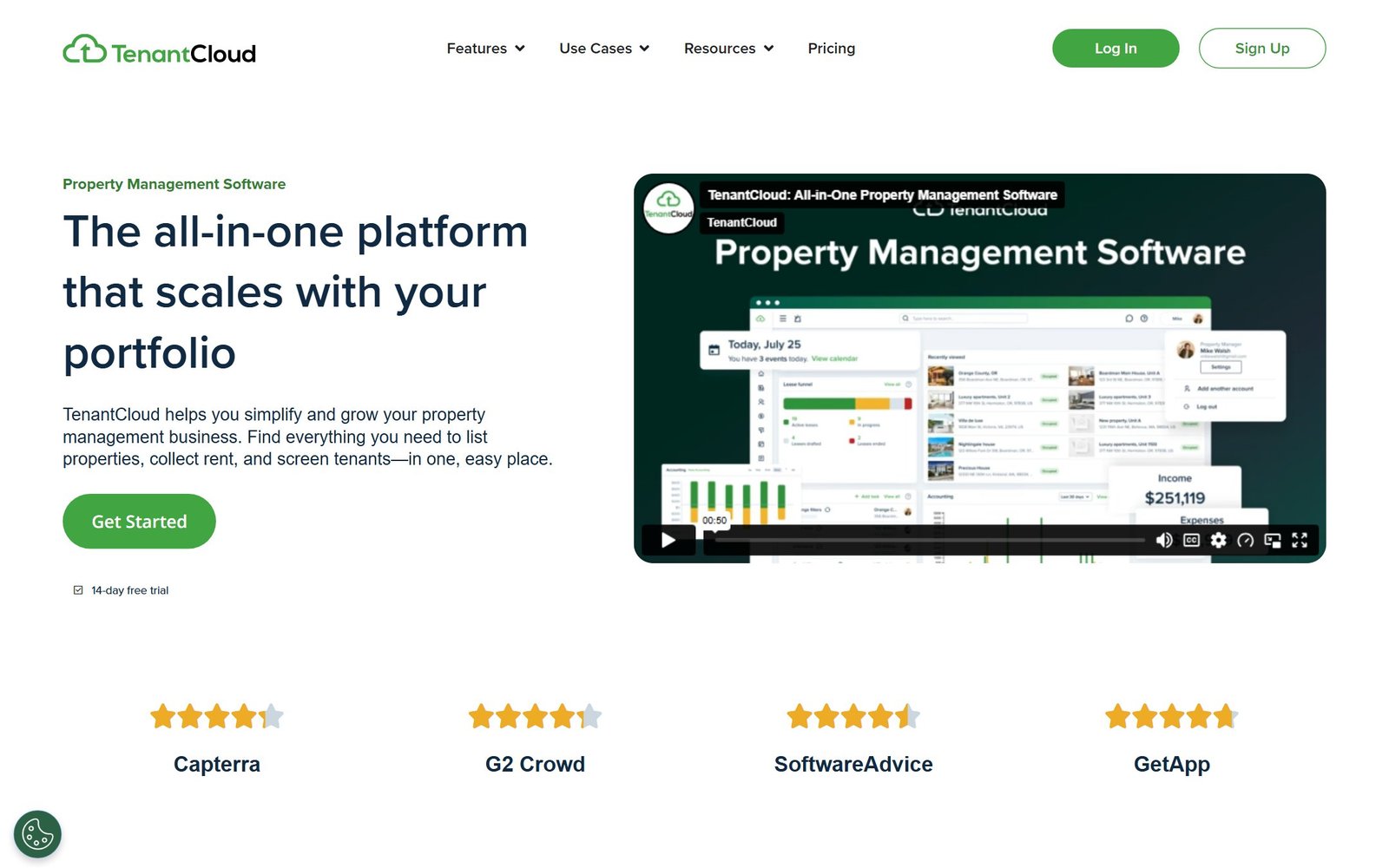
TenantCloud is a cloud property management suite aimed at DIY landlords and small property managers. It bundles listings and syndication, tenant screening, online rent collection, lease management, maintenance requests, and a genuinely full accounting layer into one subscription. It was founded in 2014 by Joseph Edgar in Austin, Texas, and raised roughly $5.09 million as an independent startup.
Then, on October 15, 2021, TenantCloud was acquired. By whom? Nobody will say. The acquirer was described only as an undisclosed strategic investor, and in the four years since, no name has ever surfaced publicly. We track ownership across this entire category because it matters: RealPage owns Buildium and Propertyware, Entrata owns Colleen, Realtor.com has owned Avail since 2020. Buyers deserve to know whose ecosystem they are joining. TenantCloud is the one major landlord platform where we simply cannot tell you. That is not automatically sinister, but it is a transparency gap that fits a broader pattern with this company, as you are about to see with the pricing story.
The free plan that quietly died
For years, TenantCloud’s calling card was a free Basic plan covering up to 75 units. It was the hook in a thousand blog posts and the reason many landlords typed the name into Google in the first place.
That free plan disappeared during the 2021 repricing. TenantCloud’s own blog post announcing the new pricing structure is dated June 24, 2021, and the free tier predates it. Today the pricing page shows a 14 day trial and nothing free beyond it. Entry is $18 per month, full stop.
Here is the part that bothers us: the internet has not caught up, and TenantCloud has not exactly rushed to correct it. As of this writing, KDS Development still headlines TenantCloud as “Free Property Management Software,” and summaries on G2 and GetApp still cite the 75 unit free tier. A landlord doing normal research in 2026 can easily walk into the trial believing a free plan is waiting at the end of it. It is not, and the trial-to-paid transition is exactly where several of the complaints we read describe surprise upsells.
TenantCloud pricing in 2026: the real math
The four tiers are Starter at $18 per month, Growth at $35, Pro at $60, and Business at custom pricing that starts around $100 per month. Annual billing drops the first three to $15, $29.17, and $50 per month, which is the standard two-months-free discount, nothing time limited.
The number that actually matters is the lease cap, and this is where we had to do our own verification, because aggregator pricing tabs are unreliable on the new tier structure and even a competitor, RentRedi, has published claims about TenantCloud’s caps. On the live pricing page as of July 21, 2026: Starter allows 10 leases, Growth allows 30, Pro allows 60, and Business is custom. Properties and units are listed as unlimited on every tier, which sounds generous until you realize the lease cap is the real constraint. Unlimited units with 10 active leases is a distinction without much difference for a working landlord.
Run the per-lease math and TenantCloud looks genuinely cheap:
- Starter: $18 for 10 leases is $1.80 per lease per month
- Growth: $35 for 30 leases is about $1.17 per lease
- Pro: $60 for 60 leases is exactly $1.00 per lease
At full lease caps, TenantCloud undercuts most of the per-unit platforms in the small portfolio range, and it does so without minimum monthly fees. The catch is that the math only works if you fill the cap. A landlord with 12 leases is forced from Starter to Growth and pays $2.92 per lease, and the jump from 30 to 31 leases costs $25 a month.
On payment fees, tenant-paid ACH runs $1.95 on Starter, $1.75 on Growth, and $1.50 on Pro. TenantCloud markets this as $1.95 dropping to $1.50, which is accurate but is really a tier ladder: your tenants’ fees fall as your subscription rises.
Cloudia: an honest look at TenantCloud’s AI
TenantCloud joined the AI wave on August 27, 2025 with Cloudia, its AI assistant. Since we review these tools primarily through an AI lens, we want to be precise about what Cloudia is and is not.
What it is: a listing writer. Feed it property basics and photos and it generates listing titles and descriptions, with tone and length options, a fair housing scan, and some local market flavor pulled in for context. In practice, it produced clean, publishable listing copy faster than writing from scratch, and the fair housing scan is a genuinely useful guardrail for landlords who do not have a compliance reflex.
What it is not: a leasing agent, a rent estimator, or anything resembling the conversational AI layer that tools like EliseAI run for professional operators. There are no AI rent estimates and no AI that talks to prospects. And TenantCloud is refreshingly honest about the engine: its own launch blog says Cloudia is powered by ChatGPT. It is a well-integrated ChatGPT wrapper for listings, and that is the whole story.
One more wrinkle we verified at draft time: the launch messaging pitched Cloudia broadly, but the live pricing page gates the “AI Listing description” feature to the Pro plan. So the AI headline feature is effectively a $60 per month feature, which conflicts with the impression the launch post gives. If Cloudia is the reason you are signing up, budget for Pro, not Starter.
What TenantCloud does well
Beyond the AI, the core suite holds up well against the category, and it is the reason the score is a 4.0 rather than lower.
Accounting depth. This is TenantCloud’s quiet strength. You get a real general ledger, income and expense tracking by property, owner statements on higher tiers, and tax-time reporting that beats most tools in the sub-$50 bracket. The gap: there is no bank reconciliation, so you cannot match your books against bank feeds the way you can in dedicated accounting software. For small portfolios that is an annoyance; for a management company holding trust funds it is disqualifying, and those buyers should be looking at our best AI tools for property managers roundup instead.
Listings and syndication. Listings push out to the major rental sites, and with Cloudia on Pro the copy step is nearly automatic. The tenant-facing application and screening flow is smooth, with screening costs typically passed to the applicant.
The tenant portal. Rent payment, maintenance requests with photos, and lease documents all live in one place tenants actually use. Maintenance requests route cleanly to landlord or vendor, and the communication log means disputes have a paper trail.
Unlimited properties and units. Within your lease cap, you can structure as many properties and units as you like, which suits landlords with odd portfolios like a duplex here and a six-unit there.
Setup and day-to-day feel
Onboarding took us under an hour for a small test portfolio. You add properties, then units, then leases, and the platform is opinionated about that order, so bulk importers coming from spreadsheets should expect some cleanup on unit naming before the import behaves. Once data is in, the dashboard is dated-looking but fast, and the mobile apps cover the daily essentials: logging a payment, approving a maintenance request, and messaging a tenant all work fine from a phone.
Two things worth passing along. First, the feature gating between tiers is aggressive, and the in-app upgrade prompts are frequent on Starter; features you can see but not click are a recurring theme, and it matches the trial-to-paid friction reviewers describe. Second, e-signatures, lease templates, and maintenance vendor workflows all improve meaningfully at Growth, so we think Growth at $35, or $29.17 annual, is the real product for most landlords, with Starter serving as a functional but nagging entry ramp.
The cons, with receipts
We read through the current complaint record on BBB, Capterra, G2, and Trustpilot themes, and the negatives cluster into five repeatable patterns.
Payment holds. This is the dominant complaint theme. A 2026 BBB complaint describes a rent payment stuck pending for more than 10 days before reaching the landlord’s account. When your mortgage autopay does not care that your rent is “pending,” a multi-day hold is not a minor bug. We did not experience a hold in our trial window, but the pattern in the complaint record is consistent enough that we consider it TenantCloud’s number one risk.
AI-first support. Support routes through automated and AI-assisted channels first, and several reviewers describe generic, copy-paste replies before reaching a human. For a platform holding your rent money, slow escalation is a real cost.
Trial-to-paid surprises. Multiple reviewers describe upsell pressure and unexpected charges around the trial-to-paid transition. Given how much stale “free plan” content is still steering people into that trial, this friction lands worse than it otherwise would.
No bank reconciliation. Covered above, but it belongs on the cons list because it caps who this tool can serve.
Middling third-party sentiment. Trustpilot sits around 3.9 by third-party reports we could not independently confirm at press time, so treat that figure as reported rather than verified. It matches the overall shape we saw: a majority of satisfied small landlords, with a persistent unhappy minority concentrated on payments and support.
Comparing the budget landlord apps head-to-head? TurboTenant vs Avail covers the two rivals most TenantCloud shoppers shortlist, tenant fees included.
Two budget rivals now have full reviews: Innago undercuts every paid starter plan by being genuinely free for landlords, and Rentec Direct adds real trust accounting at $55 a month with prices printed in public.
Who should use TenantCloud
Pick TenantCloud if you are a self-managing landlord with roughly 3 to 60 leases, you want real accounting rather than a spreadsheet, and you are optimizing for cost per lease. At $1.00 to $1.80 per lease at full caps, it is one of the best value plays in the category, and the tenant portal is good enough that tenants adopt it without pushing.
Skip it if you cannot tolerate payment timing risk, you need trust accounting or bank reconciliation, or you want AI that does more than write listings. Professional managers should look upmarket, and budget-focused landlords comparing the whole field should start with our best AI tools for landlords guide, which owns the 1 to 20 unit lane.
The obvious head-to-head is TurboTenant, which still has a genuinely free landlord tier and monetizes through tenant fees instead. If a free base plan is the thing that brought you to TenantCloud in the first place, our TurboTenant review covers the tool that actually still makes that promise. And if you are weighing TenantCloud against DoorLoop and the rest of the budget ladder, our DoorLoop alternatives post ranks the whole cheapest-first lane, including where TenantCloud slots in. For DoorLoop itself, note the promo-versus-real pricing gap we documented in our DoorLoop review.
Our verdict: 4.0 out of 5
TenantCloud in 2026 is a good product wrapped in outdated marketing. The suite itself earns its keep: full accounting, clean listings with a useful if modest ChatGPT-powered AI writer, a tenant portal that works, and per-lease pricing that undercuts most of the field at $18 to $60 per month.
What keeps it at 4.0 is a trust deficit in three layers. The free plan that made the brand disappeared during the 2021 repricing, yet the stale story still does the company’s marketing. The owner behind the October 2021 acquisition has never been named, in a category where we can tell you who owns nearly everything else. And the loudest complaint theme, rent payments held in pending status, hits landlords exactly where software is supposed to protect them.
If you go in with clear eyes, on the right tier, with the lease caps and Pro-gated AI understood up front, TenantCloud is a legitimately strong value. Just do not sign up expecting free, and do not expect Cloudia to be more than a listings writer. We will update this review if the ownership question ever gets an answer.
How these purchases go wrong, and the early warning signs
Four patterns cover most of what we hear a year after a real estate software purchase, and all four are visible in the first month.
The migration that never finishes
The new system goes live, the old one stays open “for historical records”, and eighteen months later half the team still works in both. This is the most common and most expensive failure in property management software. Before signing, agree a cutover date, a named owner, and what specifically will not be migrated. Running two systems is worse than either.
Tenant-facing features nobody told the tenants about
Online payments, maintenance portals and application flows only save time when residents actually use them, and adoption depends entirely on how the change is communicated. A portal with 20% adoption creates more work than paper did, because you now run two processes. Plan the resident communication before go-live and measure adoption at thirty days.
The tool one person runs
One capable person builds the workflows and produces every report. They leave and it stops the same week. The warning sign is that nobody else has ever done a full month-end in the system. Have a second person do it once a quarter from written steps.
The fees that arrive after the subscription
Payment processing, screening, e-signatures, bank account setup and inspections are all charged separately by most vendors in this category and all of them are published. A business case built on the subscription alone will be wrong in year one, usually by a four figure sum. Build the model from the fee schedule, not the plan cards.

Written by
FazFaz is the founder of AIToolsBakery. Some tools here are tested hands on. Others are assessed from vendor documentation and pricing verified on the live page, and every review says which one it is. Sponsors can buy a position in a guide. They cannot buy the score, the criticism, or silence about a better option.
How we test and how we make money →