
DoorLoop’s pricing page wants you to believe the product costs $69 a month. There is a discount banner, a percentage off, and a timer that suggests you are catching a rare deal. You are not. We have watched that banner across multiple visits over months, and the promo renews on a rolling basis. The $69 is a recurring 30%-off promotion that covers your first 3 months. The real bill is $99.
That is not a reason to skip DoorLoop. It is genuinely one of the most pleasant property management platforms we have reviewed, the support is fast, and the AI roadmap is moving quicker than most of the category. But every budget decision you make should start from the real numbers, not the banner. This review does the math nobody else prints: promo versus real pricing, the $3 per unit scaling that third-party roundups still get wrong, and the AI Assistant add-on whose price DoorLoop will not publish.
| Plan | Promo price (first 3 months) | Real price (billed yearly) | Unit handling | AI Assistant add-on |
|---|---|---|---|---|
| Starter | $69/mo | $99/mo | Capped at 10 units | Not available |
| Pro | $149/mo | $189/mo | +$3/unit above base | Available, price undisclosed |
| Premium | $209/mo | $239/mo | +$3/unit above base | Available, price undisclosed |
| Verdict at a glance: 4.2/5. Best interface and support in its price band. Real cost runs 30 to 43% above the advertised promo grid once the discount expires. Accounting is solid but shallower than Buildium’s. AI Assistant is promising but gated to Pro/Premium with no public price. | ||||
Prices verified on DoorLoop’s live pricing page, 2026-07-20. Promo percentages and real rates can change; always confirm the post-promo number before you sign.
What is DoorLoop?
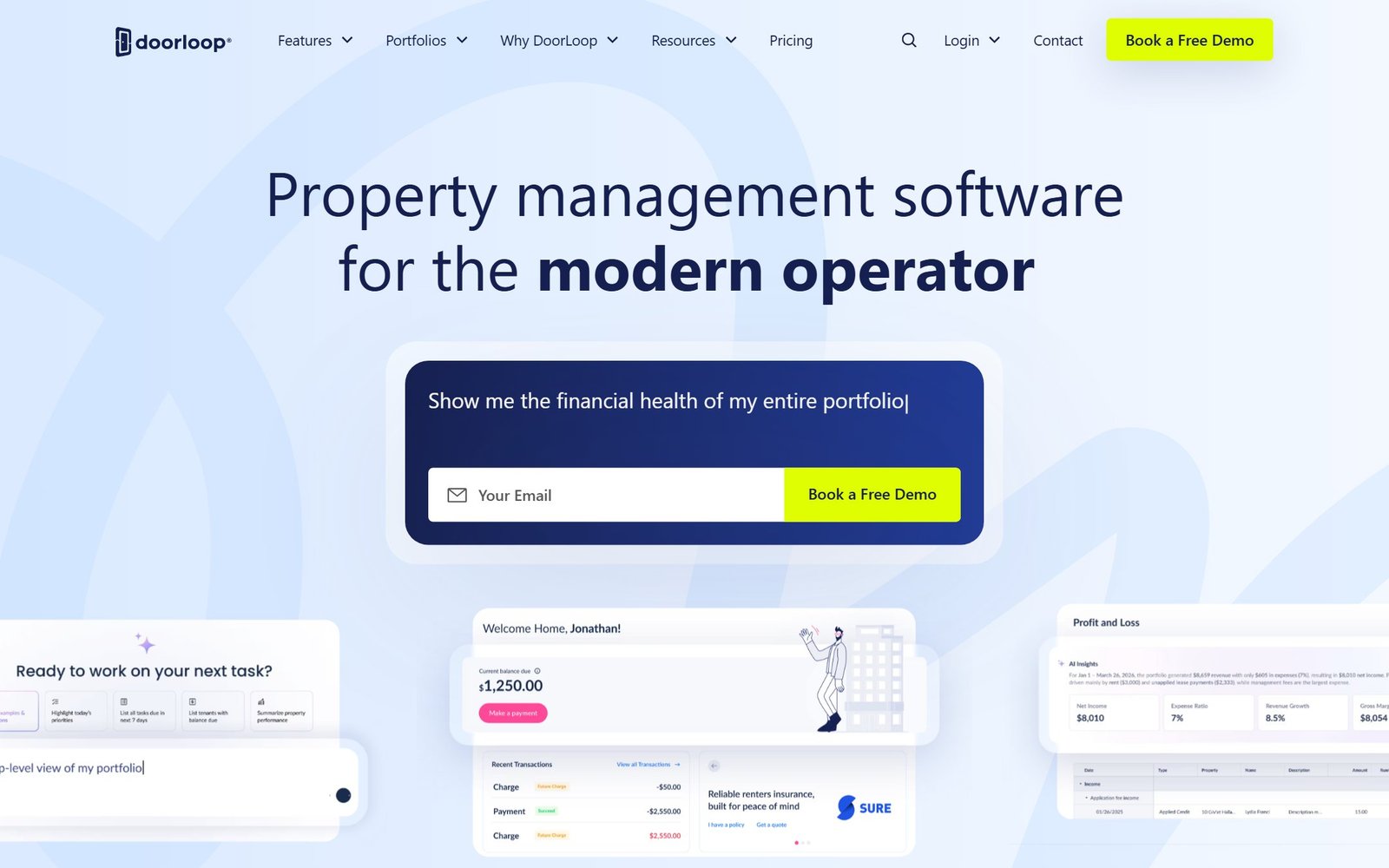
DoorLoop is an all-in-one property management platform: accounting, leasing, rent collection, maintenance, tenant screening, owner portals, and a marketing layer for listings. It launched in 2019, which makes it one of the younger names in a category where the incumbents date back to the 2000s, and it shows in the product. The interface feels like software built this decade.
The company is also well capitalized. DoorLoop raised a $100M Series B led by JMI Equity in October 2024, bringing total funding to $182M at a valuation of roughly $500M. We mention this because financial runway matters when you are trusting a platform with your books and your tenant records. A funded vendor ships features; a starved one sunsets them. DoorLoop has spent that runway visibly, and the 2025 to 2026 stretch brought a steady cadence of releases, including the AI Assistant add-on we cover below.
The pitch DoorLoop makes is simplicity plus support. The pitch we would make on its behalf is slightly different: it is the platform in this price band that your team will actually use without complaining, and in property management software, adoption is half the battle.
The pricing math, done properly
This is the section that made us write this review, so we will take it slowly.
Promo versus real
DoorLoop advertises three plans at $69, $149, and $209 per month. Those numbers appear inside a discount banner offering 30% off, and in our observation the promotion recurs on a rolling basis. It applies to your first 3 months. After that, billing reverts to the standard rates.
The real billed-yearly prices, verified on the live page 2026-07-20:
- Starter: $99/mo, capped at 10 units
- Pro: $189/mo
- Premium: $239/mo
So the gap between the advertised number and the number on your month-4 invoice is $30 to $40 per month depending on plan. Over a year, budgeting on the promo grid understates your cost by roughly $270 to $360 before unit scaling even enters the picture. That is not a scandal, promos are normal, but it is a pattern worth naming: the promo price is doing the marketing work everywhere DoorLoop is mentioned, and the real price is doing the billing.
The $3 per unit scaling
Starter is hard-capped at 10 units. On Pro and Premium, DoorLoop prices against a base unit allotment and then adds $3 per unit per month above it, per the live pricing page on 2026-07-20. The practical translation: every 20 units you add above the base costs an extra $60 a month, or $720 a year.
Two cautions here. First, several third-party roundups still print $1 to $2 per unit for DoorLoop’s overage. That no longer matches the live page. Second, the exact base allotment attached to your quote can differ from what the calculator shows, so confirm both the base unit count and the per-unit rate in writing during the sales process. A 100-unit portfolio’s real bill lives or dies on those two numbers.
The stale-data problem, including DoorLoop’s own
While researching this review we found G2’s pricing data for DoorLoop contradicting the live site. We also found something funnier: DoorLoop’s own alternatives listicle, published on its own blog, prices its own product at $49/$99/$149, a grid that matches neither the current promo nor the current real prices.
We do not think either of these is sinister. Pricing pages change faster than content teams and review aggregators can track. But it is a clean illustration of why we verify every price against the live page on the day we publish, and why you should distrust any DoorLoop price you read anywhere, including this one, that does not carry a verification date. Ours is 2026-07-20.
What you actually get
Accounting and rent collection
DoorLoop’s accounting is a full double-entry system: chart of accounts, bank reconciliation, owner statements, and CAM charges on the higher plans. In practice, the day-to-day flows, recording a payment, running an owner statement, chasing a late fee, were noticeably faster to complete than in the legacy platforms we have reviewed, mostly because the interface does not fight you.
The honest caveat: accountants who live in this software all day tend to find the edges sooner. Buildium still goes deeper on pure accounting muscle, and if your operation runs on complex trust accounting across many bank accounts, that depth matters. We break down exactly where the line falls in our Buildium vs DoorLoop comparison, including total cost at 25, 50, and 100 units.
Leasing, screening, and the tenant portal
Listings syndicate out to the major rental sites, applications and screening run through the platform, and leases go out for eSignature. The tenant portal covers rent payment, maintenance requests, and communication, and it is one of the better-looking portals in the category, which sounds cosmetic until you remember that tenants who find the portal easy actually use it, and tenants who use the portal generate fewer phone calls.
Maintenance
Work orders route from tenant request to vendor assignment with status tracking along the way. It is competent rather than category-leading. Operators running heavy maintenance volume with in-house crews may want more dispatch sophistication, and that is one of the places a dedicated operations layer or a heavier platform earns its keep.
The AI Assistant add-on
This is the newest chapter and the one with an asterisk. DoorLoop’s AI Assistant is a paid add-on available on Pro and Premium plans only. It handles tenant-facing communication and workflow assistance inside the platform, and it is a real product, not a chatbot sticker.
Here is the asterisk: DoorLoop does not publish the add-on’s price. Not on the pricing page, not in the help docs we could find. You learn the number on a sales call. We will not guess at it, and you should not accept a guess from anyone else either. What we can say is how to handle it: if the AI Assistant is part of why you are choosing DoorLoop, get its price, its billing basis (per unit, per seat, or flat), and its contract terms in writing before you sign the platform agreement, because it is also gated behind the $189-and-up plans, which means the AI story starts at Pro pricing plus an undisclosed number.
What stands out
A few things stand out that do not fit neatly into a feature grid:
- Onboarding is genuinely fast for the category. Users report getting a portfolio configured with units, leases and a working tenant portal inside an afternoon. Legacy platforms measure this in weeks.
- Support responds quickly and in complete sentences. DoorLoop leans on support quality as a differentiator, and in our interactions the reputation held up. For a small team without a dedicated systems admin, this is worth real money.
- The interface stays out of your way. Common tasks sit one or two clicks deep. The search works. This sounds like faint praise until you have used property management software where none of it is true.
- Release pace is quick. Features moved and improved during the months we watched the product, which cuts both ways: the platform gets better, and third-party documentation about it goes stale fast. Hence the pricing mess above.
What a real DoorLoop budget looks like
Let us put the whole pricing section together into the exercise you actually need: a year-one budget for a realistic portfolio.
Take a 60-unit operation choosing Pro. Months 1 through 3 bill at the promo rate of $149. Months 4 through 12 bill at the real $189. That alone is $2,148 for the year, against the $1,788 you would have penciled in from the advertised grid. Then layer the unit scaling: whatever portion of your 60 units sits above the plan’s base allotment adds $3 per unit per month. If 40 of them are above base, that is another $120 a month, or $1,440 a year, which at this size is bigger than the plan fee gap itself. And if the AI Assistant is on your list, there is a third line with a blank where the number should be until sales fills it in.
None of these components is hidden exactly. The promo is labeled, the per-unit rate is on the page, the add-on is disclosed as paid. But they are scattered, and the only number doing marketing duty is the smallest one. Our advice is mechanical: build the spreadsheet with the real plan price, your confirmed base allotment, the $3 overage on every unit above it, and a placeholder row for the AI Assistant that you refuse to delete until sales replaces it with a written figure. If the total still beats the alternatives, and for a lot of mid-size portfolios it will, you are buying with clear eyes.
It is also worth 10 minutes to run the same spreadsheet against one direct competitor before you sign anything. The comparison shifts with portfolio size: flat-rate platforms get relatively cheaper as you add doors, per-unit platforms get relatively cheaper when you are small. DoorLoop’s structure, a moderate base plus $3 per unit, sits in the middle, which is exactly why the crossover math matters more here than in most categories.
If the promo-to-real jump soured you, our DoorLoop alternatives guide is the budget ladder: eight options from free to step-up, cheapest first, with every tenant-paid fee spelled out.
Who DoorLoop is for
DoorLoop fits best in the roughly 20 to 500 unit band: small to mid-size property management companies and serious landlords who have outgrown spreadsheet-plus-payments setups and want one system their whole team will actually adopt.
Below that band, the math gets hard. Starter’s real $99/mo for a maximum of 10 units is $9.90 per unit per month at full capacity, and much worse at 4 units. Self-managing landlords with a handful of doors have cheaper and even free options, which is exactly why we treat DoorLoop as the graduation pick in our best AI tools for landlords guide rather than the starting point.
Above the band, or for operations where accounting depth is the whole ballgame, the heavier platforms come into frame. Our Buildium review covers the strongest accounting-first alternative, and our AppFolio alternatives roundup maps the rest of the field, including where DoorLoop itself lands as a destination for AppFolio switchers. For the wider AI landscape across the profession, start with our best AI tools for property managers guide.
One honest limitation
Beyond the pricing opacity we have already covered, the substantive limitation is depth at the edges. DoorLoop’s breadth is real, but operators with specialized needs, complex trust accounting, heavy commercial CAM reconciliation, or high-volume maintenance dispatch, will find the point where the friendly generalist runs out of road before the ugly specialist does. That is the trade DoorLoop asks you to make: a platform your team enjoys using, in exchange for a ceiling that a 1,000-unit operation may eventually hit.
The promo-versus-real-price question now has its own deep dive: our DoorLoop pricing breakdown prints the discount arithmetic plan by plan, the regenerating countdown deadline we caught changing twice in one day, and the verified unit-scaling ladder no aggregator publishes.
The legal side of screening and automated pricing
Tenant screening and algorithmic rent setting are the two places where real estate software touches regulated activity directly, and where getting it wrong is expensive rather than embarrassing.
A screening report is a consumer report, with obligations attached
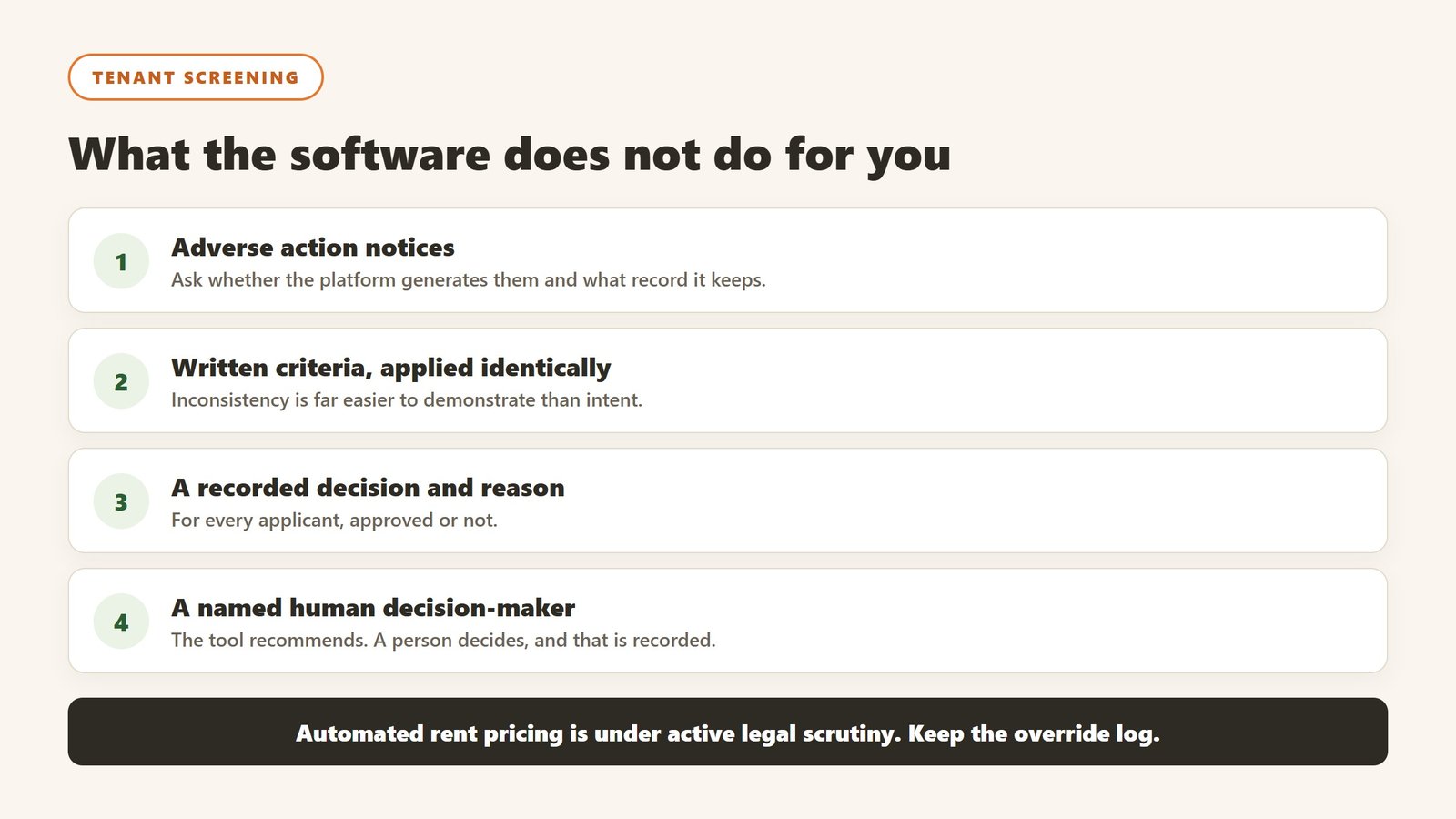
If you take an adverse action based on a screening report, in the United States that triggers notice obligations to the applicant, including telling them which agency supplied the report and that the agency did not make the decision. Ask any platform how it handles adverse action notices, whether it generates them automatically, and what record it keeps. A tool that produces a score but no notice workflow leaves the obligation with you.
Consistency is your best defence
Fair housing exposure comes from treating applicants differently, and inconsistency is much easier to demonstrate than intent. Written criteria applied identically to every applicant, with the decision and its reason recorded, is worth more than any feature on a vendor page. Software helps here by making the process uniform, which is a genuinely good reason to buy one, and it does not transfer the responsibility.
Automated rent pricing is under active scrutiny
Algorithmic rent setting, particularly where a tool draws on non-public competitor data, has attracted significant legal attention, and this is a live area rather than a settled one. Before adopting one, ask what data the recommendation is built on, whether it includes non-public data from other landlords, and whether you can see and override every recommendation. Keep the override log. If a vendor cannot answer those three, that is your answer.
Know what the tool is deciding and what you are deciding
The safest posture with any of this is that the software recommends and a named person decides, with the decision recorded. That is slower than full automation and it is the difference between a defensible process and one you cannot explain. Write down who that person is before you switch anything on, because the question only ever gets asked afterwards.
How to tell whether the tool paid for itself
Real estate software is unusually easy to evaluate honestly, because the outcomes are countable. Most teams still do not do it, and the renewal conversation becomes an argument about impressions.
Pick the metric the tool is supposed to move
For a lead platform it is cost per closed transaction. For property management software it is hours of admin per unit per month, and days to fill a vacancy. For staging it is days on market and list-to-sale ratio. For screening it is time to approve and the rate of problem tenancies. Each of those is available from records you already keep, and each needs a figure from before you started.
Take the baseline before you switch anything on
You need last year of the metric from a source the project did not touch. This is the step that gets skipped and it is the reason most of these purchases can never be evaluated. It costs an hour. Ask the two or three people whose work will change to record how long the target task takes them this month, because time saved is measurable in advance and unprovable afterwards.
Give it a full cycle before judging
Leasing and transactions are seasonal, so a six week read tells you very little. Judge lead tooling over at least two quarters, and property management tooling over a full turnover cycle, because the value shows up at move-out and move-in rather than in the quiet middle. Say that at the outset so an unremarkable month one is understood as expected.
Write the stop condition down first
Before purchase, name the result at twelve months that would mean you do not renew. It converts renewal from a default into a decision and it is the most effective discipline against a subscription that quietly becomes permanent. If nobody can name a result that would end it, the evaluation was never real.
Where the figures on this page come from
Every price here was read from the vendor’s own pricing page on 4 September 2026, not from an aggregator or a review site. Each figure carries that date, because pricing in this market moves and a claim without a date is not checkable.
The pages we read
Buildium publishes $62, $192 and $400 a month plus a detailed fee schedule. DoorLoop publishes $69, $149 and $209 a month billed yearly with per unit equivalents. TurboTenant publishes a free tier plus $12.42 and $16.48. TenantCloud publishes $15 to $50 a month on annual billing. RentRedi publishes $12 a month on the annual plan. Hemlane, Rentec Direct and Landlord Studio all publish in full, as do Follow Up Boss at $69 per user, Wise Agent at $49, and Placester from $59.
The ones we could not read
AppFolio, Innago, Top Producer and Hostaway did not yield a figure to the same method that read every vendor above, and Lofty’s pricing page carried no plan rates. We are not presenting that as proof they publish nothing, because a failed read is not evidence of absence. Treat any figure for those five from elsewhere as unverified.
What we do not do
We do not carry a figure we cannot source to the vendor. Where a number circulates and cannot be traced, we say so and withdraw it rather than repeating it with a hedge, and we have withdrawn our own published figures on that basis more than once.
Verdict: 4.2/5
DoorLoop earns its 4.2. The product is the best-designed platform in its price band, support is a legitimate strength, the JMI-backed war chest is funding a real AI roadmap, and the total package makes sense for the 20 to 500 unit operator it is clearly built for.
The deductions are about transparency, not quality. The promo-forward pricing page makes the product look 30% cheaper than it is, the $3 per unit scaling is easy to miss and widely misreported, and the AI Assistant, the most interesting thing on the roadmap, ships with no public price on plans that start at a real $189/mo.
Our recommendation: shortlist DoorLoop if you are in the band, budget on $99/$189/$239 plus $3 per unit above base, enjoy the promo months as a bonus, and walk into the sales call with two questions in writing: what is my base unit allotment, and what does the AI Assistant cost. If the answers hold up, this is one of the easiest platforms in the category to say yes to.

Written by
FazFaz is the founder of AIToolsBakery. Some tools here are tested hands on. Others are assessed from vendor documentation and pricing verified on the live page, and every review says which one it is. Sponsors can buy a position in a guide. They cannot buy the score, the criticism, or silence about a better option.
How we test and how we make money →