You run a pet-sitting or dog-walking business, your shoebox of paper schedules has finally stopped scaling, and two names keep coming up: Time To Pet and Scout. Both promise to handle scheduling, the client app, GPS check-ins, invoicing, and payments in one place. Both are genuinely good. The trouble is that almost everything you read comparing them is written by one of the two vendors, or by an affiliate list earning a commission on whichever one you click.
We are AIToolsBakery. We are independent, we sell neither product, and we take no affiliate fee from either company. That matters here, because the honest answer to “which one wins” is not a single brand. It depends almost entirely on the size of your team, how much you care about a custom-branded app, and whether you would rather pay for maturity or for a cleaner, newer interface.
This is the comparison we wish existed when we started digging: the real tradeoffs, the pricing math that actually bites, and a clear “pick this one if” for each. We last checked both vendors’ pricing pages in June 2026. Pricing in this category changes often, so treat every figure as a starting point and confirm the current numbers on the vendor pages before you commit.
The 30-second answer: Pick Time To Pet if you want the more mature platform, deep features, and support staffed by former pet-care pros, and your team is small enough that per-staff fees stay reasonable. Pick Scout if you want a cleaner modern interface, want a fully branded client app, or run a larger team where flat-rate clarity matters.
What each one actually is
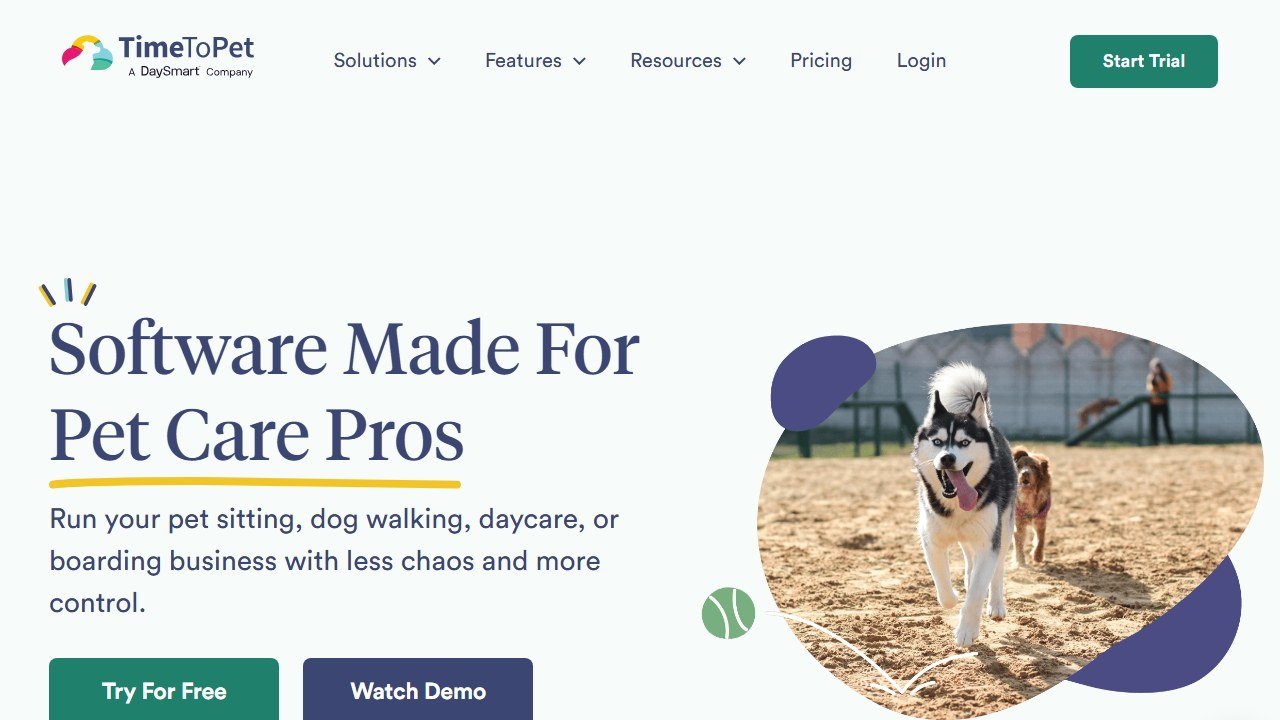
Time To Pet is the established incumbent in pet-sitting and dog-walking software. It reports serving over 4,500 pet-care businesses and has had years to deepen its feature set. It ships as two separate products: one tuned for in-home pet care (sitting and walking) and one for facilities that run daycare or boarding. If you do both, there is a bundle. The pitch is breadth and reliability, plus a support team made up of people who actually used to walk dogs and sit pets for a living.
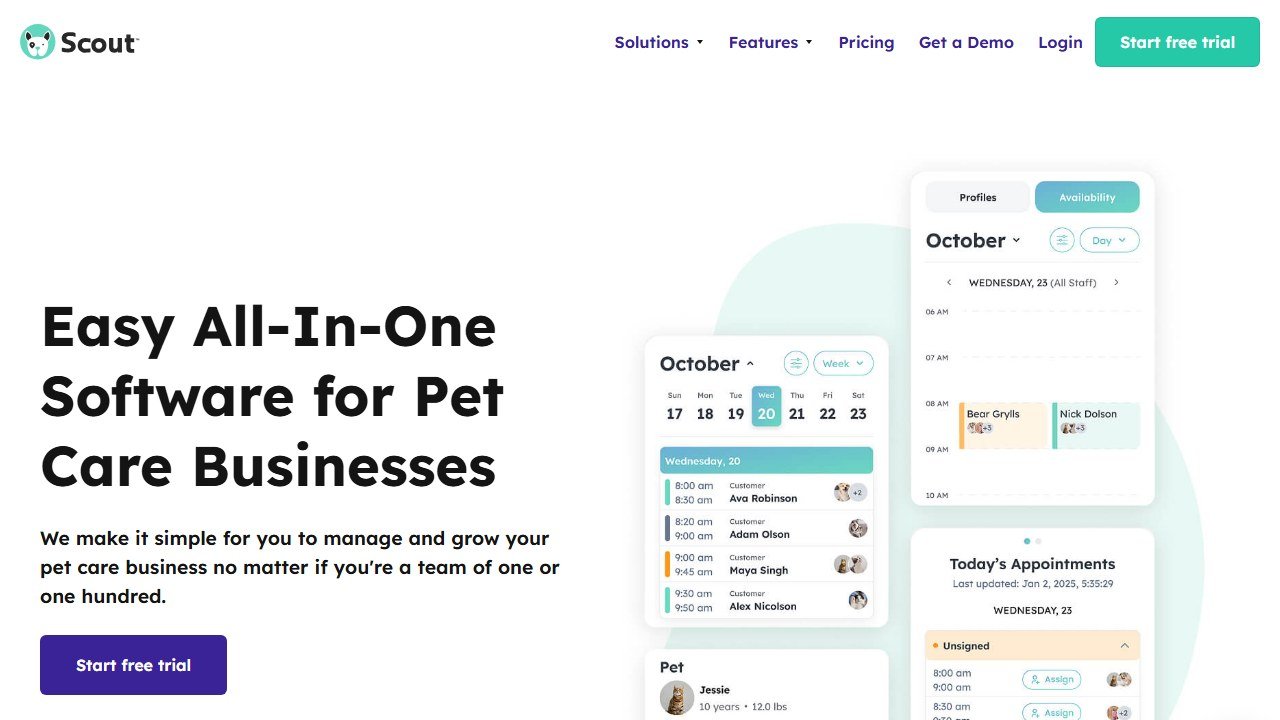
Scout is the newer, design-forward challenger. It reports over 1,100 companies on the platform and leans hard into a clean, app-first experience for both you and your clients. It runs on the kind of cloud infrastructure you would expect from a modern SaaS company, advertises 99.99 percent uptime, and puts a lot of weight on polish: photo check-ins, GPS tracking, end-of-service report cards, automated billing, electronic service agreements, and optional fully branded apps and client-facing websites.
Neither is a thin tool. The difference is temperament. Time To Pet feels like software built by people who kept adding what customers asked for. Scout feels like software built by people who wanted the experience to feel effortless first.
Workflow and daily use
For the core loop that every pet-care business lives in, scheduling a service, dispatching a sitter, capturing a visit, and getting paid, both platforms cover the essentials competently.
Time To Pet gives you client management, staff management, a full scheduling and booking system, invoicing, payments, mobile apps for you and your clients, payroll-adjacent pay reports, and real-time communication. Its time-off handling, granular permissions, and pay reports are clearly built with multi-person teams in mind, which tracks with its history serving larger operations.
Scout structures the day around client-initiated service requests, automated invoicing, instant payment processing, and a notifications-heavy flow that keeps clients in the loop without you typing much. Its pet reports, photo check-ins, GPS tracking, and report cards, are a visible strength, and they tend to be the thing clients comment on. If a polished client-facing moment at the end of each visit matters to your brand, Scout was clearly designed around that.
In practice, the daily workflow is close. The deciding factor is usually which interface your sitters find faster after a week, not which one has a feature the other lacks. A useful test during your trial: have your least tech-comfortable sitter complete a real visit start to finish on each platform, including the photo check-in and the report, and time it. The one that gets out of their way wins, because the software you choose is the one your whole team has to live with on cold mornings, not just the one that demos well to you.
It is also worth watching how each handles the awkward edges of real operations: a last-minute cancellation, a client who wants to add a visit on the same day, a sitter who calls in sick and needs their route covered. Both platforms can handle these, but the number of taps it takes to reassign a visit or refund a charge varies, and those small frictions add up across a busy holiday week far more than any headline feature does.
Features and depth
This is where Time To Pet’s head start shows. Its two-product split (in-home versus facility) means each version is tuned for its job rather than trying to be everything at once. The depth of configuration, permissions, and reporting is generally a step beyond what a newer platform offers, and that depth is exactly what a growing team eventually needs.
Scout counters with breadth of the modern, client-experience kind. The fully branded app and the custom client-facing website are real differentiators: if you want your business name, not a vendor’s, on the app your clients open every day, Scout offers that as an add-on. Time To Pet’s client apps are excellent but carry its branding on the standard plans.
On integrations, Time To Pet has the clearer story we could confirm, with QuickBooks sync for invoices and payments plus data import from most competitor platforms. Scout’s homepage and pricing pages emphasize its all-in-one design over a long integration list, so if a specific third-party tool is essential to you, confirm support directly before you switch.
Ease of use and onboarding
Both companies treat onboarding as a feature, not an afterthought, and it shows.
Time To Pet includes onboarding and support with every plan at no extra cost, offers data migration from existing platforms, and says most businesses are fully live in under a few hours. Its support team being former pet-care professionals is not just marketing fluff: it means the person helping you has actually faced a double-booked holiday weekend, and that changes the quality of the advice.
Scout offers live chat with average wait times it states as under five minutes, help documentation, online courses, and a personalized demo. The interface itself is the onboarding advantage here. Newer software with a tighter design tends to need less explaining, and Scout’s clean layout means sitters who are not “computer people” usually find their footing quickly.
If your team skews less technical, Scout’s modern UI may lower the learning curve. If you want a human who speaks pet-care fluently on the other end when something breaks, Time To Pet’s support reputation is hard to beat.
Pricing and value
This is the section that actually decides most purchases, so read it carefully and then confirm the live numbers yourself.
Time To Pet prices by product and team size. As of our June 2026 check, its in-home plans start with a Lite tier near $25 per month for a true one-person operation, a Solo tier around $50 per month with more advanced features, and a Team plan that runs roughly $40 per month base plus about $16 per active staff member. A five-person team lands near $120 per month on that math. Facilities have a separate plan starting around $79 per month, and very large teams or combined in-home-plus-facility operations move to custom pricing. An “active staff member” means someone with at least one scheduled service that billing period, with admins always counted.
Scout, as of the same check, keeps it simpler: a Solo plan around $33 per month, and a Team plan around $33 per month plus roughly $15 per active staff member, on monthly billing. Note an unusual quirk: Scout’s annual billing is priced higher per month than monthly (around $39 base plus about $18 per staff), so the longer commitment does not save you money the way it usually does. Confirm this directly, because it is the opposite of most SaaS pricing. Scout’s branded app and website are paid add-ons (the branded app is a significant monthly cost), so budget for those if they are why you chose Scout.
The headline: at small-to-mid team sizes the two land close, and Scout’s per-staff rate is a touch lower. The branded-app add-on can flip that math if you want it. And because both charge per active staff member, your real monthly cost is a function of how many sitters work in a given period, not your headcount. Model your busy month, not your slow one. A team that swells to ten active sitters over the summer pays for ten, even if only four work in February. Both pricing pages move, so verify before you sign, and ask each vendor directly how an “active staff member” is counted, because that single definition drives most of your bill.
Support and reliability
Both score well, with different flavors. Scout leans on its infrastructure story (99.99 percent uptime, bank-grade security) and fast live chat. Time To Pet leans on the domain expertise of its support team and included onboarding. For a business where a missed visit damages trust instantly, both are credible. We would not pick one over the other on reliability alone.
One thing every pet-care operator should treat as non-negotiable regardless of platform: client and pet data privacy. You are storing home addresses, lockbox or alarm codes, key locations, and pet medical notes. Confirm with either vendor how access is restricted across staff, how data is encrypted, and what happens to that data if you cancel. Software should make access controls easy. It should never make sensitive client data casually visible to every sitter on your roster.
Who each one is for
Time To Pet fits the established or fast-growing business that values depth, mature features, and support from people who know the work, and whose team size keeps per-staff fees comfortable. It is the safer default for facilities and for operators who want the most proven option.
Scout fits the operator who wants a cleaner, more modern experience, who cares about a fully branded client app, or who is building a brand where the client-facing polish is part of the product. It is also a strong pick if your sitters are not especially tech-comfortable and you want the gentlest learning curve.
Time To Pet vs Scout at a glance
| Dimension | Time To Pet | Scout |
|---|---|---|
| Best for | Established or growing teams, facilities | Brand-focused operators, modern UX seekers |
| Maturity | Older, deeper, 4,500+ businesses | Newer, design-forward, 1,100+ companies |
| Product structure | Separate in-home and facility products | Single platform for all service types |
| Standout strength | Feature depth, pet-care-pro support | Clean UX, fully branded app and websites |
| Branded client app | Vendor-branded on standard plans | Available as a paid add-on |
| Integrations | QuickBooks sync, competitor data import | All-in-one focus, confirm specific tools |
| Pricing model | Tiered by product plus per active staff | Flat base plus per active staff, add-ons |
| Annual billing | Cheaper than monthly | Priced higher per month than monthly |
All figures reflect a June 2026 check of each vendor’s site and change frequently. Confirm current pricing and features on the official pages before deciding.
Where pet-care software still needs you
Both tools automate the busywork: reminders, invoices, scheduling, check-ins. Neither replaces judgment. They will not decide whether to take on a reactive dog, will not notice that a longtime client has gone quiet and needs a check-in, and will not protect a sensitive house key code unless you configure permissions properly. Automated reminders and reports are a convenience, not a substitute for the human relationship that keeps clients loyal. Treat the software as the assistant, not the operator.
If you are still mapping out your wider stack, our guide to AI tools for pet sitters and the companion piece on AI tools for dog walkers cover the adjacent tools worth pairing with whichever platform you choose. Facility operators running daycare or boarding will find more relevant context in our overview of tools for grooming-and-care operations and our AI tools for pet groomers roundup, and clinics weighing similar software should read our AI tools for veterinary practices guide.
Our verdict
For most established or growing pet-care businesses, Time To Pet is the safer pick: more mature, deeper, with support that speaks your language, and pricing that rewards an annual commitment. For our full breakdown, see our Time To Pet review. Scout earns the win when brand and experience are the point, when you want a fully branded app, or when a cleaner interface will get your team productive faster. The per-staff model on both means you should price your busiest month before choosing.
When the honest answer is a third tool: if grooming is your primary business rather than sitting or walking, neither of these is the obvious fit. A grooming-specific platform with smart scheduling and route optimization will serve you better, and our MoeGo review covers the leading option there. Run both Time To Pet and Scout trials before you decide, and confirm the live pricing yourself. The right tool is the one your sitters actually open every day without complaining.

Written by
FazFaz is the founder of AIToolsBakery. Some tools here are tested hands on. Others are assessed from vendor documentation and pricing verified on the live page, and every review says which one it is. Sponsors can buy a position in a guide. They cannot buy the score, the criticism, or silence about a better option.
How we test and how we make money →