Virtual Staging AI and Collov are two of the most-used AI staging tools, and they pull in different directions: one is built for speed and the Zillow pipeline, the other for the lowest cost per image and precise editing. Which wins depends on your volume and whether you also design.
Faz says: This one is mostly about math and ecosystem. If you stage at real volume, Collov’s per-image cost is hard to argue with, and the brush tool gives you control that pure one-shot staging does not. But if you live inside Zillow, Virtual Staging AI’s pipeline into Showcase is worth a premium because it removes steps from your day. Pick based on where your listings already flow and how many images you push a month.
Saru says: This comparison draws on both tools’ official documentation and pricing, our own reviews of each, and aggregated user feedback, current to 2026. Confirm current per-image pricing before buying.
The bottom line at a glance
| Virtual Staging AI | Collov | |
|---|---|---|
| Best at | Fast, scalable staging | Low cost per image, precise edits |
| Signature strength | Zillow Showcase integration | Brush tool, design crossover |
| Pricing | ~$16 to $20/image | From ~$16/mo (as low as ~$0.23/image) |
| Primary audience | High-volume agents | Cost-conscious teams and designers |
| Our score | 4.1 | 4.1 |
Short version: Virtual Staging AI for speed and the Zillow pipeline. Collov for the lowest cost at scale and editing control.
Pricing and volume
This is the clearest divide. Virtual Staging AI runs roughly $16 to $20 per image, which is fine for occasional staging but adds up fast at volume. Collov, on monthly plans, reaches an effective cost as low as around $0.23 per image at higher tiers, far below per-image rivals. If you stage many images a month, Collov wins decisively on cost. If you stage occasionally and value the Zillow tie-in, the per-image model is acceptable.
Workflow and ecosystem
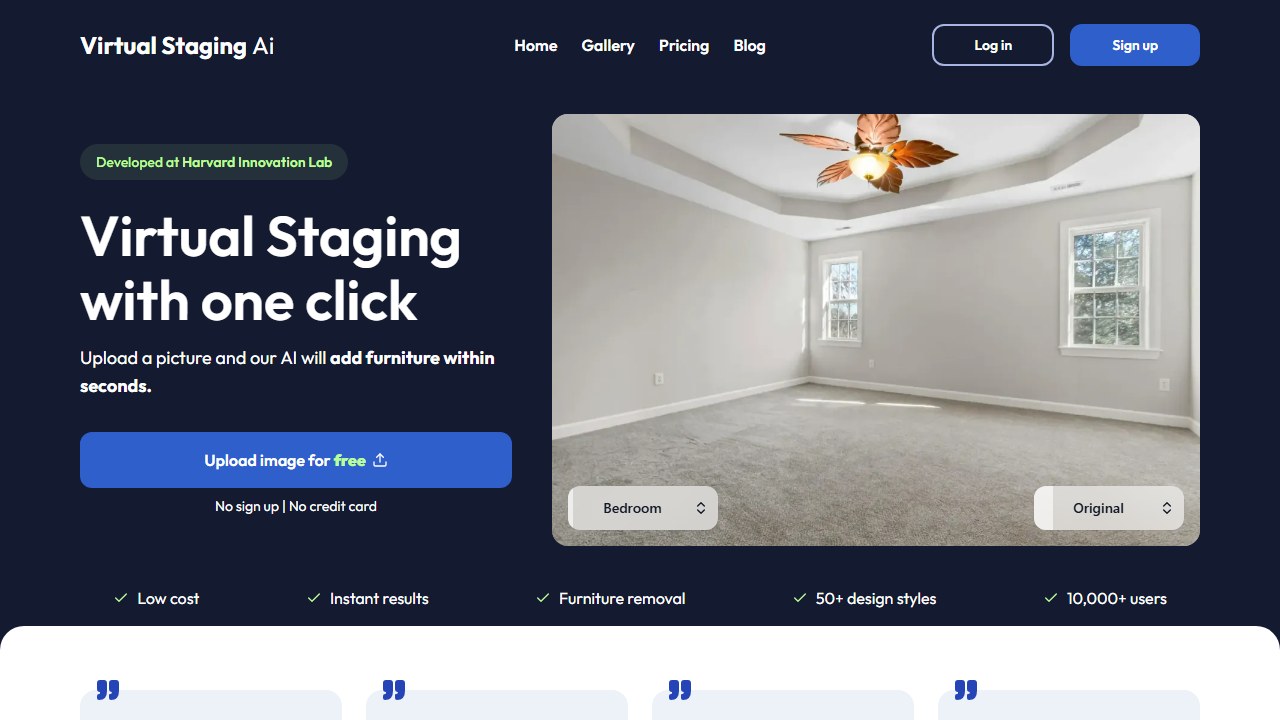
Virtual Staging AI’s edge is the Zillow acquisition: staged images can flow toward Zillow’s Showcase platform, which is a genuine time-saver for agents already in that ecosystem. Collov works as a standalone staging and design tool, and its brush tool lets you draw on an image and change a specific element rather than regenerating the whole room, which gives more control over the result.
Design crossover
Collov has a second life as an interior design tool, which Virtual Staging AI does not. If your work spans staging and design, Collov covers both, keeping one tool and one style across jobs. We cover that dual role in our Collov review and the AI tools for interior designers guide. Virtual Staging AI is staging-focused, optimized for the listing use case.
Who each is for
Choose Virtual Staging AI if you list at volume, you are in the Zillow ecosystem, and a smooth pipeline into Showcase matters more than the lowest per-image cost.

Choose Collov if you stage many images and want the lowest cost at scale, you value brush-level editing control, or your work spans both staging and interior design.
Our verdict
They score evenly in our reviews because they win different users. Collov is the better value and the more flexible tool, especially at volume or if you also design. Virtual Staging AI is the better fit for Zillow-based agents who want staging built into their listing flow. Read the full Virtual Staging AI review and Collov review, and see the wider field in our best AI virtual staging tools guide.
The honest decision tree: 10 questions to know which fits you
Virtual Staging AI and Collov occupy adjacent positions in the virtual-staging category. The 10 questions below resolve the choice based on your actual use case.
1. What is your primary professional role? Realtor = either tool works; Realtor focused exclusively on staging = Virtual Staging AI. Interior designer who also stages = Collov has broader range.
2. How important is operational simplicity? Maximum simplicity = Virtual Staging AI. Willing to invest in slightly broader tooling = Collov.
3. How many staged images do you produce per month? Under 20: pay-per-image on either tool. 20-50: subscription tier on either. Over 100: enterprise pricing comparison.
4. Do you need MLS integration for high-volume listing work? Collov has more developed MLS integration for high-volume brokerages.
5. Do you want to do room redesign for furnished spaces as well as staging for empty ones? Collov supports broader redesign work; Virtual Staging AI is staging-only.
6. Is mobile workflow important? Both tools work on mobile; Collov’s mobile is slightly more polished.
7. Do you sell unconventional properties (lofts, historic, unique architecture)? Virtual Staging AI’s standard style range may not fit; Collov’s broader style options may handle better.
8. How fast do you need turnaround? Both produce output in under a minute. Virtual Staging AI’s pure-staging optimization edges out by 10-30 seconds per image.
9. Do you need brokerage-level user management? Collov is more mature on team accounts and admin features.
10. What is your tolerance for tool feature breadth versus simplicity? Prefer one tool that does one job perfectly = Virtual Staging AI. Prefer one tool that does staging plus related design work = Collov.
The 70 percent that’s the same and the 30 percent that’s different
Both tools share most of the core staging capability. Photo-to-staged-render workflow, standard real-estate-staging aesthetics, mobile-functional, commercial licensing on paid tiers, MLS-friendly output formats. If your use case is purely “stage this empty listing photo for MLS,” both tools produce comparable output.
Where they diverge: Collov supports room redesign for existing furnished spaces, which Virtual Staging AI does not. Collov’s broader interior-design feature set extends into mood boards and design-concept work. Virtual Staging AI is pure staging without the additional design tooling. For Realtors who occasionally help clients pre-listing with updated decor concepts, Collov’s broader tooling is useful. For Realtors who only need staging, Virtual Staging AI’s focused simplicity is preferred.
The 70-percent parity means that for most users, either tool will deliver the core staging value. The 30-percent difference resolves to whether you want a focused single-purpose tool or a broader interior-tech tool. There is no obviously wrong answer; the right answer depends on your workflow.
Pricing comparison: real Realtor math
Pricing tiers as of mid-2026: both tools have similar pay-per-image starting points (around $2-5 per image) and subscription tiers in the $20-50 monthly range based on volume. The annual math at typical Realtor use volumes (40-60 staged images per month) is comparable on both tools.
Realtor handling 40 staged images per month: subscription tier on either tool runs roughly $25-40/month, total annual cost $300-480. Both tools deliver the same staging output at this volume; the choice is driven by workflow preferences rather than cost.
Brokerage handling 200+ staged images per month: enterprise pricing comparison required, with both tools offering negotiated team rates. Collov’s enterprise account management has been more mature through 2025-2026, which may matter for brokerages with formal procurement processes.
The hidden cost: switching tools. If you have built a workflow around one of these tools and trained your team on it, the switching cost (re-training, workflow disruption, MLS-listing inventory in flight) typically outweighs any small monthly savings from the alternative. Choose carefully at the start; switching mid-flight is rarely worth it.
When to use both (the integrated workflow)
For Realtors who handle both vacant listings (Virtual Staging AI’s sweet spot) and currently-furnished listings that need decor refresh before photography (Collov’s sweet spot), running both tools is a reasonable workflow. Combined monthly cost is roughly $60-80, which most Realtors can absorb within their listing-marketing budget.
The dual workflow: Virtual Staging AI for vacant listing staging (its focused simplicity matters at high volume), Collov for redesigning currently-furnished but visually-weak listings before professional photography. Both tools serve adjacent listing-preparation tasks without significant overlap.
For most individual Realtors, running just one tool is sufficient and easier to maintain. The choice resolves through the 10-question decision tree above. Run both only when your actual workflow needs both capabilities consistently.
Three scenarios that resolve the choice
Scenario 1: Realtor focused exclusively on listing staging
Pick Virtual Staging AI. The focused single-purpose simplicity matches the use case. Faster output per image, no broader design tooling to navigate around. Annual cost roughly $480 at typical Realtor volumes.
Scenario 2: Realtor who also pre-listing redesigns furnished properties
Pick Collov. The broader design tooling beyond pure staging serves the redesign use case. The single tool handles both vacant-listing staging and furnished-property redesign workflows.
Scenario 3: Brokerage standardizing tooling across multiple agents
Either tool’s brokerage-tier pricing should be evaluated against the team’s mix of use cases. Brokerages with predominantly vacant-listing volume favor Virtual Staging AI; brokerages with mixed listing scenarios favor Collov.
What we still cannot honestly assess
The comparison reflects general capability and pricing as of 2026. Realtor preferences vary; some find Virtual Staging AI’s simplicity essential to their workflow, others find Collov’s broader range essential. Test both with a small pilot (3-5 listings) before standardizing.
Migration considerations between the two tools
Switching between Virtual Staging AI and Collov is straightforward. Both tools produce output as standard image files that work in any MLS or marketing context, so the renders themselves do not lock you into either ecosystem. The migration cost is workflow retraining plus rebuilding your personal style preferences.
Realistic switching timeline: 1-2 weeks to reach productive use with the new tool. For Realtors who maintain detailed style preferences and workflow patterns, the switching cost is small enough that an annual re-evaluation of which tool serves your current listings better is reasonable.
The migration that most Realtors actually do is not Virtual Staging AI to Collov or vice versa; it is from physical staging to either AI tool. The cost savings of AI staging versus physical staging dwarfs the cost differences between the two AI tools. Pick whichever AI tool you prefer; the savings versus physical staging are the dominant economic factor.
When the honest answer is “use neither, stage physically”
For premium listings in markets where buyers expect in-person experiences (luxury markets, hot urban markets with bidding wars, properties marketed primarily through showings rather than online), physical staging continues to outperform AI staging. The math: physical staging costs $1,500-$5,000 for a typical 30-60 day staging period and produces an in-person experience that drives buyer commitment more reliably than photos alone.
The decision framework: virtual staging works when buyers commit primarily based on listing photos. Physical staging works when buyers commit primarily based on in-person walk-throughs. Most markets fall somewhere in between; reserve physical staging for the top 10-20 percent of listings where in-person experience drives decisions and use AI staging for the volume listings where photos drive the initial interest.
The brokerage-level decision: standardizing across an agent team
For brokerages choosing one staging tool to standardize across multiple agents, the considerations expand beyond individual Realtor preferences. Team-account pricing, brand-consistency in staging aesthetics, admin oversight features, and integration with brokerage CRM systems all become factors that the individual Realtor would not weight heavily.
Both Virtual Staging AI and Collov offer brokerage-tier accounts. Collov’s team management has been more mature through 2025-2026; brokerages with formal procurement processes have found Collov’s enterprise account features easier to deploy. Virtual Staging AI’s brokerage tier exists but with less developed team-management tooling. For brokerages with 5+ agents, evaluate both at the team-account level rather than the individual subscription level.
The honest 30-day evaluation: how to actually compare them
Both tools offer pay-per-image options that make a structured 30-day evaluation cheap. Spend $50-100 on each tool to run 15-20 test stagings.
Week 1: Virtual Staging AI on 5 vacant listings from your archive. Note speed, room-type recognition accuracy, style match to your market, and output quality.
Week 2: Collov on the same 5 listings. Compare directly. Note the additional features Collov offers (room redesign for furnished spaces) that Virtual Staging AI does not.
Week 3: Live test on a current listing. Use whichever tool you preferred from Weeks 1-2 on an active vacant listing. Collect engagement data (listing views, saves, inquiry rate) compared to similar previous listings.
Week 4: Run the second tool on a comparable current listing. Direct head-to-head with engagement data. By end of Week 4 you know which tool produces better outcomes for YOUR specific market and listing types.
Budget allocation: typical Realtor economics
For a Realtor with $180,000 annual commission revenue, either tool’s subscription at $480-600/year is 0.27-0.33 percent of revenue. Categorize alongside other listing-marketing tools (MLS subscription, professional photography fees, listing flyer production). The tool cost is small relative to the listing photography budget that surrounds it.
The bigger economic question is staging strategy overall. Physical staging at $1,500-3,000 per listing for premium properties is 10-20x more expensive than AI staging on a per-listing basis. The Realtor decision is not really which AI tool to pick; it is how much physical staging budget to maintain alongside AI staging for the top tier of listings. Reserve physical staging for the top 10-20 percent of listings where in-person buyer experience drives decisions; use AI staging for the volume listings where photos drive initial interest.
For brokerages standardizing across multiple agents, the team-account economics shift the math. Brokerage-tier pricing on either tool typically runs $200-500 per agent per month for high-volume teams. Verify the per-agent cost at your team’s volume before standardizing.
The bottom line on Virtual Staging AI versus Collov in 2026
Pick Virtual Staging AI if you want focused staging-only with maximum operational simplicity. The narrow positioning is the value.
Pick Collov if you want broader design tooling alongside staging. The additional feature scope matches multi-faceted real-estate-tech workflows.
For most Realtors handling vacant-listing volume, either tool delivers the core value at similar cost. The decision turns on workflow preferences (focused versus broad-scope) and on whether you have non-staging design work that benefits from Collov’s broader tooling.
The honest summary. Both tools are competitive, both are reasonably priced, both produce credible staging output. The market is moving fast enough that the right pick today may shift in 18 months; commit lightly, run a 30-day pilot to verify the fit, and re-evaluate at subscription renewal. Whichever tool you pick, the savings versus physical staging on volume listings dwarf the cost differences between the two AI tools.
Final scorecard: Virtual Staging AI vs Collov in 2026
Virtual Staging AI wins on speed, MLS-ready output, and per listing economics for real estate agents. Collov wins on creative range, commercial design features, and team workflows for designers. The two tools are not really competing for the same buyer, they just overlap in feature lists. Pick by job title: agent buys Virtual Staging AI, designer buys Collov.
Switching cost
If you already have one and are tempted to switch, the answer is usually no. The output formats, photo libraries, and team training accumulated in one tool do not transfer cleanly to the other. Add the second tool as a complement rather than a replacement if your work spans both real estate and design.
Related staging and design resources
For deeper reviews, see our Virtual Staging AI review and Collov AI review. For the alternative designer comparison, see Spacely vs Collov. The full landscape lives in the Best AI Virtual Staging Tools guide and AI Tools for Interior Designers.

Written by
FazFaz is the founder of AIToolsBakery. Some tools here are tested hands on. Others are assessed from vendor documentation and pricing verified on the live page, and every review says which one it is. Sponsors can buy a position in a guide. They cannot buy the score, the criticism, or silence about a better option.
How we test and how we make money →