
The Yardi Breeze pricing page is one of the most refreshing sights in property management software: actual dollar figures, published in public, from the same company whose flagship Voyager product is famously quote-gated. Residential management for $1 per unit per month. After reviewing a market where AppFolio and Rent Manager both pulled their price grids behind sales calls this year, we want to hand Yardi a trophy for that page.
Here is why we cannot quite do it. The $1 is real, and almost nobody reading this will pay it. A $100 monthly minimum sits under that sticker, which means a 20 unit landlord pays $5.00 per unit, five times the advertised rate. Breeze Premier advertises the same $1 per unit with a $400 minimum, which makes its sticker fiction for anyone below 400 units. And the one genuinely concrete AI feature in the Breeze family, Smart AP invoice processing, is “free” in the same way an airport lounge is free: you pay $4,800 a year at the door for the tier that includes it.
None of that makes Breeze bad software. It is, in fact, some of the most competent software in the mid-market, with real accounting DNA that most rivals cannot match. It just means the review the market needs is mostly arithmetic, plus a litigation section, because the “Yardi lawsuit” that shows up next to every Yardi search is routinely described wrong, and it does not involve Breeze at all.
A note on method: this is a research-based review. We loaded yardibreeze.com’s pricing page directly on July 25, 2026, verified plan figures and minimums against Yardi’s own November 2024 pricing announcement, read the complaint and praise themes across the G2 and Capterra review corpus, and reviewed the court coverage of the Yardi litigation with dates and sources. We have not run a hands-on trial, and we label every reported figure with its source.
| Plan / asset class | Sticker (official, Jul 25 2026) | Monthly minimum | Effective at 20 units | Effective at 50 units | Sticker becomes real at |
|---|---|---|---|---|---|
| Breeze residential | $1/unit/mo | $100 | $5.00/unit | $2.00/unit | 100 units |
| Breeze commercial | $2/unit/mo | $200 | $10.00/unit | $4.00/unit | 100 units |
| Premier residential | $1/unit/mo | $400 | $20.00/unit | $8.00/unit | 400 units |
| Premier associations | $1/unit/mo | $400 | $20.00/unit | $8.00/unit | 400 units |
| Premier affordable | $3/unit/mo | $400 | $20.00/unit | $8.00/unit | 134 units |
| Premier commercial / self storage / manufactured | Quote only | Quote only | n/a | n/a | n/a |
| Verdict at a glance | |||||
| AITB score | 4.1/5 | ||||
| Best for | 100 to 1,000 unit residential and commercial operators who want Yardi accounting DNA without Voyager cost | ||||
| Contract | Annual agreement required; no onboarding, training, or support fees; $0 ACH under limits | ||||
| AI | Smart AP invoice OCR (real, Premier only). Virtuoso is a Voyager show, not shipping in Breeze as of Jul 2026 | ||||
| Owner | Yardi Systems: private, founder-led since 1984, no venture capital | ||||
| Skip it if | You manage under ~30 units, hate annual contracts, or want modern DIY-landlord UX | ||||
All plan figures from yardibreeze.com/pricing, loaded July 25, 2026. Effective rates are the monthly minimum divided by unit count, which is what you actually pay below the crossover point.
The minimum-fee math Yardi hopes you skip
Minimum fees are the property management industry’s favorite magic trick, and we run the division in every review because vendors never do. Here it is for Breeze.
Twenty residential units at $1 each is $20 a month, except it is not, because the floor is $100. You pay $100, which is $5.00 per unit, a 5x markup on the sticker. At 50 units you pay $2.00 effective. Only at 100 units does the advertised dollar finally describe your bill. Below that line, compare Breeze against the flat-rate tools honestly: Buildium‘s Essential plan at its published $62 starting price works out to $3.10 per unit at 20 doors, materially cheaper than Breeze at the same size, and we scored it in our full Buildium review. A 20 unit landlord on Innago pays $0.
Breeze Premier repeats the trick at a higher altitude. Same $1 residential sticker, but a $400 minimum, so a 50 unit operator pays $8.00 per unit and even a 200 unit operator pays double the sticker. The $1 becomes real at 400 units. For affordable housing at $3 per unit, the $400 floor stops binding around 134 units. Premier commercial, self storage, and manufactured housing have no public prices at all: quote only.
One discrepancy we want on the record. Yardi’s own pricing announcement blog, dated November 14, 2024, conditioned the Premier residential $1 rate on bundling screening and renters insurance on a 12 month contract, with an unbundled rate of $2 per unit. The live pricing page we loaded on July 25, 2026 shows $1 flat with only a “terms & minimums apply” note and no visible bundle condition. Either the condition was dropped or it moved into the fine print of the actual contract. Ask the sales rep, in writing, whether the $1 Premier rate requires bundled services, and get the unbundled number before you sign.
To Yardi’s genuine credit, the floor is where the fee creativity ends. The official position, stated on the pricing page and in the November 2024 announcement, is no onboarding fees, no training fees, no support fees, and $0 ACH payment processing under limits. In a market where competitors charge four figures for implementation and DoorLoop and friends monetize every module separately, that is a real and unusual virtue. Our DoorLoop review covers what the modular approach costs by contrast.
What Yardi Breeze actually is
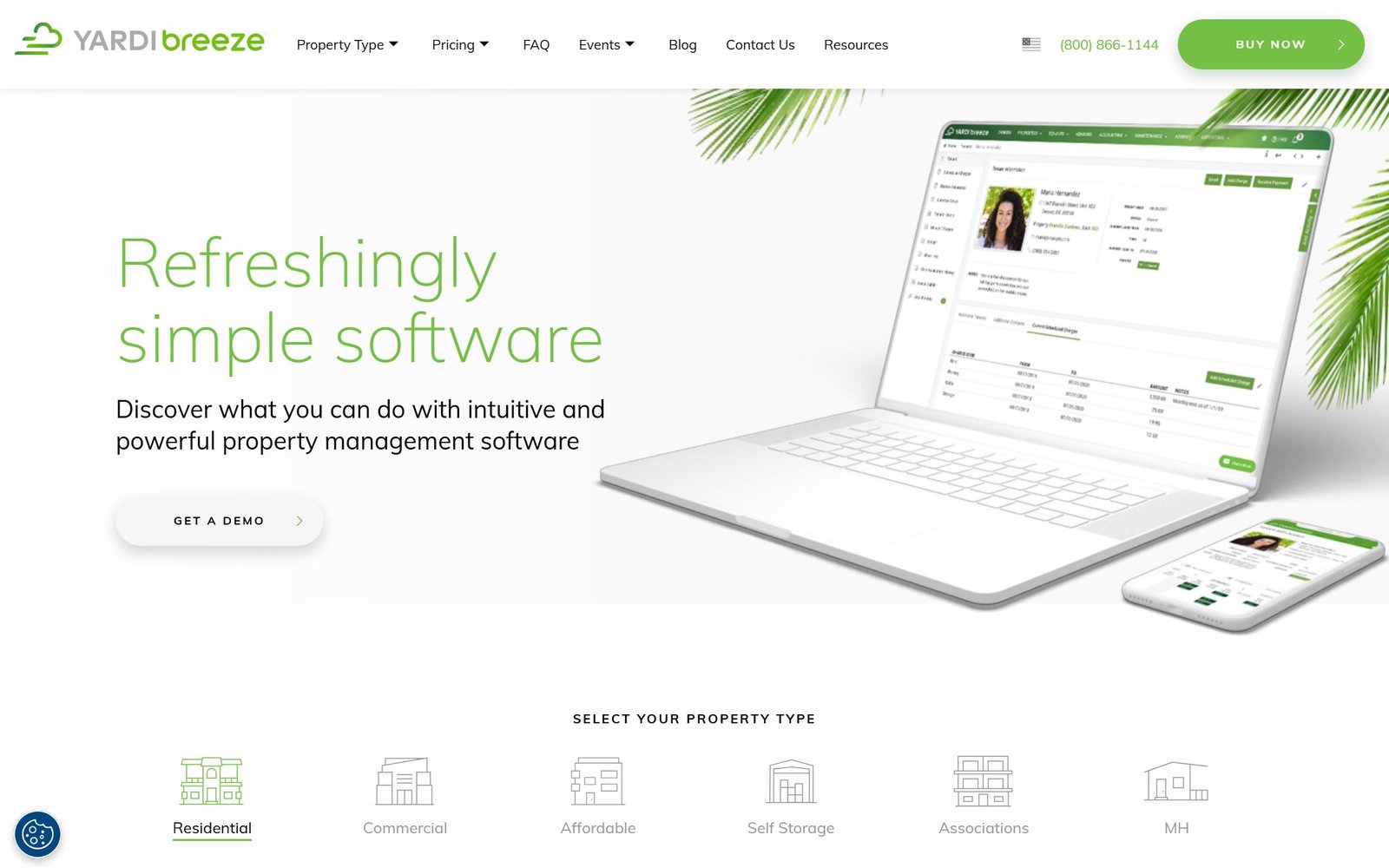
Breeze is Yardi‘s down-market product: the company that runs accounting for a huge share of institutional real estate, repackaged for operators who will never buy Voyager. That lineage is the whole value proposition. Where most small-landlord tools grew out of rent collection apps and bolted accounting on later, Breeze inherited a real general ledger culture: full AP and AR, bank reconciliation, owner statements, and financial reporting that a CPA will recognize on sight. The review corpus agrees on this consistently: the praise themes are ease of use for what it does and accounting that actually holds up.
The product splits in two. Breeze proper covers residential and commercial with the core toolkit: marketing and leasing, online payments, maintenance requests, tenant and owner portals, and that accounting spine. Breeze Premier adds the asset classes Breeze does not touch (affordable housing, associations, self storage, manufactured housing), deeper reporting and customization, job cost tracking, and the Smart AP tool we cover below. Premier is also the stepping stone in Yardi’s explicit growth story: start on Breeze, graduate to Premier, and land on Voyager when you are big enough. If you are weighing that top end against the other institutional option, our AppFolio vs Yardi comparison owns that story, and we will not re-litigate it here.
Sentiment, for the record: Breeze holds a reported 4.2 across 286 reviews on Capterra and a reported 4.1 across 354 on G2 (both figures search-snippet sourced as of July 2026; treat the counts as approximate). Solid, mid-pack numbers that match our own read: a capable, slightly dated workhorse rather than a delight. Recurring criticism themes include a tenant portal reviewers find unintuitive, reporting flexibility that trails the price point, and an interface that looks conservative next to AppFolio or DoorLoop. None of it is disqualifying. One theme is, for some buyers, and it deserves its own section.
The onboarding lottery
Yardi charges nothing for implementation, and the review corpus suggests you sometimes get what you pay for. This is the most consistent complaint pattern we found, and we want to frame it precisely: it is not that Breeze onboarding is uniformly bad. It is that it is inconsistent in a way reviewers on both sides describe vividly.
Some customers describe smooth setups with responsive, dedicated implementation contacts and data migrations that landed on schedule. Others describe the opposite: questions taken “offline” and left there for days, support that one G2 reviewer characterized as effectively nonexistent during setup, and migrations that dragged. Same product, same price, wildly different experience: an implementation lottery. Our read is that outcomes track how much structured attention your account draws, which is not something you can see before you buy.
You can, however, manage it. Before signing, ask exactly who runs your implementation, whether they are named in the agreement, what the data migration plan covers, and what the escalation path is when a setup question stalls. A vendor that charges $0 for onboarding has no invoice riding on your go-live date. Make sure someone’s name is riding on it instead.
The AI story: one real tool, behind the $400 door
Yardi’s AI marketing in 2025 and 2026 has been loud. The substance, for Breeze customers specifically, is quiet.
The headline platform is Virtuoso, announced in 2025 and showcased at Yardi’s YASC conference in September 2025: an assistant chatbot, a support agent, lead automation. All of it, as presented, is built around Voyager and the RentCafe ecosystem, all of it is vendor-claimed rather than independently benchmarked, and we found no evidence that any Virtuoso feature ships inside Breeze as of July 2026. If a Breeze sales conversation gestures at Yardi’s AI leadership, the correct follow-up is: which of these features is in the product I am buying, today?
The honest answer would be Smart AP, and it is a genuinely good tool. Announced in an October 29, 2025 press release (notably without Virtuoso branding), Smart AP gives you an email-in invoice inbox, OCR extraction of the invoice data, and automatic matching into the accounting workflow. This is exactly the kind of unglamorous, real automation we wish more vendors shipped: it attacks the actual time sink in back-office property accounting. Yardi also claims AI-assisted screening validation; that one is vendor-claimed and we found no independent detail on it.
Here is the catch, and by now you can guess its shape: Smart AP is free, and it is exclusive to Breeze Premier. Premier carries the $400 monthly minimum. So the effective entry price of Yardi’s one concrete AI feature for small operators is $4,800 a year. A 40 unit operator who wants invoice OCR pays $10 per unit per month for the privilege, on software whose sticker says $1. For the broader map of who actually ships native AI in this category and at what price, our best AI tools for property managers roundup is the reference.
The lawsuit everyone gets wrong
Search Yardi in 2026 and the word “lawsuit” arrives quickly, usually mangled together with the RealPage story. Because half the internet describes this case incorrectly, and because it materially does not involve the product this review is about, here are the facts with dates and sources.
The case is Duffy v. Yardi Systems, a class action filed in September 2023 in the U.S. District Court for the Western District of Washington. It concerns RENTmaximizer, since renamed Revenue IQ, Yardi’s revenue management product, and alleges that Yardi and a group of landlord co-defendants used it to share nonpublic pricing data and inflate rents. It is a separate case from the Department of Justice matter involving RealPage; different software, different defendants, different court.
The docket so far, per court coverage: in December 2024, Judge Robert Lasnik denied the defendants’ motion to dismiss, writing that “as technology has evolved, so too have methods of price fixing” and treating the alleged conduct under the stricter per se standard (Morgan Lewis and Hogan Lovells client alerts, December 2024). On January 23, 2025, the court granted preliminary approval of a $2.8 million partial settlement with FPI Management only, one of the original eighteen landlord co-defendants; the case against Yardi and the others continued. During 2025, ten out-of-state property managers were dismissed on jurisdictional grounds (Multifamily Dive). And on October 6, 2025, Yardi won summary judgment in a related California case, Mach v. Yardi, where the court held that Revenue IQ does not use one client’s confidential pricing to set prices for another. The Washington case remains active as of the most recent coverage we could find at publish time, with no final ruling on the merits.
Now the part that matters for a Breeze buyer: Revenue IQ is a Voyager-ecosystem product. It is not part of Breeze, it is not part of Breeze Premier, and nothing in this litigation alleges anything about the software this review covers. Breeze has no revenue management module at all; you set your own rents. If algorithmic pricing exposure is a concern for your operation, that is a real and evolving area of law, and you should consult counsel licensed in your state. We are consumer reporters, not lawyers, and none of this is legal advice.
The company behind it: no investors, one shopping mall
Corporate structure is a pricing forecast, so here is Yardi’s. The company has been run by its founder, Anant Yardi, since 1984. It is private, has never taken venture capital, and answers to no fund’s exit timeline. Yardi claims it has never had layoffs, and Mr. Yardi has said publicly that “there will never be layoffs because of AI”; both statements are vendor-claimed and unverifiable from the outside, but the forty-year continuity is not. In a vertical where Buildium and Propertyware sit inside PE-owned RealPage and half the startups are racing toward acquisition, that stability has a direct customer benefit: Yardi’s pricing history is boring, and boring price letters are a feature.
The 2026 color: in June 2026, Yardi bought the Paseo Nuevo shopping mall in downtown Santa Barbara, its hometown, and announced plans to move 600 employees into it (Santa Barbara News-Press, June 3, 2026). A software company buying a struggling mall to use as offices is either a real estate flex or the most Yardi possible act of civic attachment. Probably both. Either way, it is not the behavior of a company optimizing for a sale.
For the full regulatory map beyond Yardi’s own cases, our guide to AI rent pricing and the law tracks the DOJ settlement, the nine-state LivCor deal, four state bans, and the city ordinances, with the one-sentence rule that decides which software features are safe.
Who should buy Yardi Breeze in 2026
Buy it if you operate roughly 100 to 1,000 units, residential or commercial, and accounting integrity is your top requirement. At 100 plus units the minimum stops distorting the price, the $1 to $2 per unit rate is genuinely competitive, free implementation and $0 ACH keep the all-in cost honest, and the Voyager growth path means you will not migrate platforms at 2,000 units. Operators managing affordable housing or associations should look straight at Premier, where the asset-class support is the point and the $400 floor is easier to clear.
Skip it if you manage under about 30 units. The $100 minimum makes Breeze one of the more expensive options at that size, and the DIY-landlord tools are built for you anyway: Innago is free for landlords, and TurboTenant at its published $149 to $199 a year undercuts Breeze’s $1,200 annual floor by an order of magnitude, as we cover in our TurboTenant review. Skip it too if you want a modern consumer-grade interface, month-to-month terms rather than an annual agreement, or shipping-today AI beyond invoice OCR.
Where the figures on this page come from
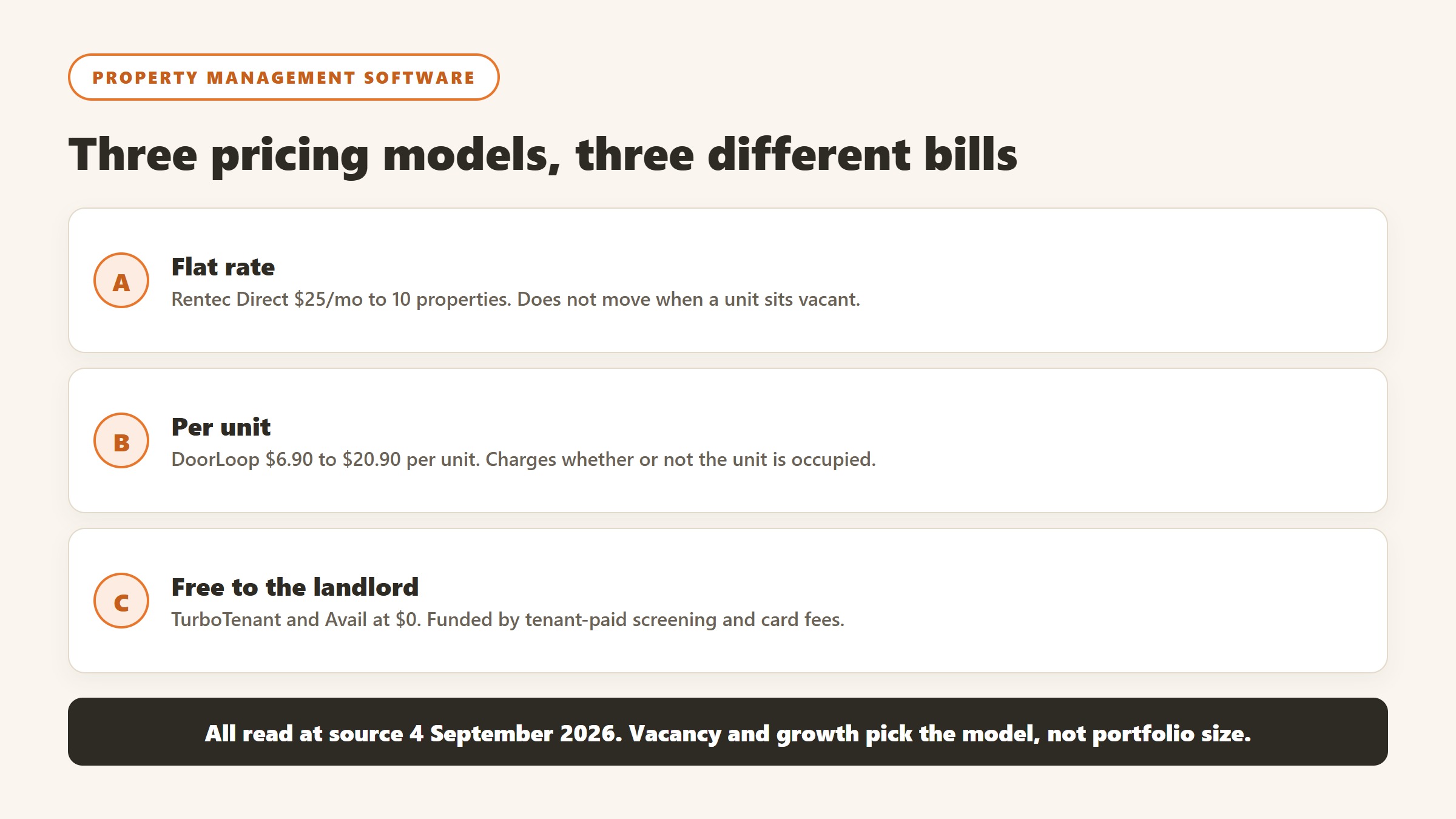
Every price here was read from the vendor’s own pricing page on 4 September 2026, not from an aggregator or a review site. Each figure carries that date, because pricing in this market moves and a claim without a date is not checkable.
The pages we read
Buildium publishes $62, $192 and $400 a month plus a detailed fee schedule. DoorLoop publishes $69, $149 and $209 a month billed yearly with per unit equivalents. TurboTenant publishes a free tier plus $12.42 and $16.48. TenantCloud publishes $15 to $50 a month on annual billing. RentRedi publishes $12 a month on the annual plan. Hemlane, Rentec Direct and Landlord Studio all publish in full, as do Follow Up Boss at $69 per user, Wise Agent at $49, and Placester from $59.
The ones we could not read
AppFolio, Innago, Top Producer and Hostaway did not yield a figure to the same method that read every vendor above, and Lofty’s pricing page carried no plan rates. We are not presenting that as proof they publish nothing, because a failed read is not evidence of absence. Treat any figure for those five from elsewhere as unverified.
What we do not do
We do not carry a figure we cannot source to the vendor. Where a number circulates and cannot be traced, we say so and withdraw it rather than repeating it with a hedge, and we have withdrawn our own published figures on that basis more than once.
Verdict: honest software, dishonest sticker
Yardi Breeze earns its 4.1. The accounting depth is real and inherited from the most credible ledger lineage in the industry, the published pricing deserves genuine praise in a market fleeing to quote walls, and free implementation plus $0 ACH means the number on the page is close to the number on the invoice, once you know which number to look at. That is the catch that keeps it out of the 4.2 and up tier: the number on the page is not the number for most people reading it. The minimums turn $1 into $5 at 20 doors and make Premier’s sticker a fiction below 400 units, the one concrete AI tool costs $4,800 a year to reach, onboarding is a lottery with no posted odds, and the interface is a decade more conservative than the competition. Breeze is the rare product whose problem is not the software or even the price. It is the arithmetic between them, and now you can do it before the sales call does it to you.

Written by
FazFaz is the founder of AIToolsBakery. Some tools here are tested hands on. Others are assessed from vendor documentation and pricing verified on the live page, and every review says which one it is. Sponsors can buy a position in a guide. They cannot buy the score, the criticism, or silence about a better option.
How we test and how we make money →Frequently Asked Questions