The short answer
ZoomInfo does not publish a price for anything. Not a starting figure, not a per-seat rate, not a range.
We checked this properly rather than assuming it. ZoomInfo’s edge blocks automated browsers outright, and a block is not evidence of anything, so we read an archived copy of the pricing page crawled from the United States on 31 August 2026. The page offers three product lines, Sales, Marketing and Talent, each with a “View pricing” button. Every one of those buttons leads to a form. The only price-shaped element on the page is a heading that says “Pricing & Plans” and a button that says “Get Pricing”.
So the useful number has to come from somewhere else.
What people actually pay
Vendr brokers software contracts and publishes aggregates from its own transaction data. Its ZoomInfo figures, read 1 September 2026:
| Metric | Value |
|---|---|
| Median annual contract | $33,500 |
| Contracts in the sample | 1,571 |
| Lowest observed | $7,200 a year |
| Highest observed | $156,000 a year |
| Average buyer saving | 22% |
The 22% is the number to hold onto if you are about to negotiate. It says, from a sample of over fifteen hundred deals, that the first figure ZoomInfo shows you is an opening position rather than a rate. Going in expecting to pay list is going in expecting to overpay.
The spread matters more than the median. A factor of more than twenty separates the smallest contract from the largest. Anyone quoting you a single “ZoomInfo costs X” number is describing one point on that curve and not telling you which one.
Why the range is that wide
ZoomInfo is not one product. It is four, sold separately or bundled, and the quote depends on which combination you take.
| Module | What it is for |
|---|---|
| SalesOS | Contact and company data, prospecting, CRM enrichment, sales engagement |
| MarketingOS | Display advertising, website chat, form management, account targeting |
| TalentOS | Recruiting data, candidate contact details, talent pools, sourcing |
| OperationsOS | Data enrichment and routing plumbing for RevOps |
On top of the module mix, five things move the number:
Seat count, and it is not linear. ZoomInfo prices per seat and the per-seat rate falls with volume. A ten-seat team pays materially more per seat than a fifty-seat team. This is the single biggest reason small teams find ZoomInfo poor value and large ones find it defensible.
Credits, not just seats. Contracts include a defined allocation of data credits or contact exports. This is the line item most likely to produce a bill you did not budget for, because consumption does not track headcount. Two teams the same size can burn wildly different amounts depending on how aggressively they export.
Contract length. Two and three year commitments unlock lower annual pricing and larger credit pools. Annual terms cost more per year and buy you flexibility.
Add-ons. Intent data, Chorus for conversation intelligence, website visitor identification and advanced API access all carry separate cost. Clarify in writing which of these are in the base contract, because the assumption that they are included is where most of the surprise lives.
When you sign. ZoomInfo’s fiscal quarters end in March, June, September and December. Buyers negotiating near quarter end report better outcomes. That is not a secret and it is not a trick; it is how enterprise software has always been sold.
The costs that are not the subscription
Four things stack on top of the licence fee, and only one is a one-off.
Overage fees. Exceed your contracted credit or export limit and ZoomInfo charges for the excess, typically at a premium to the base rate. Negotiate the allocation up front, or buy additional credit blocks at a discount before you need them, not after.
Onboarding and implementation. Charged on many enterprise contracts for setup, training and custom integration work. Often negotiable, and often waived in exchange for a multi-year term.
Annual escalators. ZoomInfo contracts commonly include a price increase clause of roughly 5 to 10% a year. On a three-year deal that compounds into real money. Cap it or strike it.
Auto-renewal. Some contracts renew automatically, with an increase, unless you give notice inside a defined window. Diary the notice date the day you sign. This is the most common way a ZoomInfo buyer ends up paying more than they agreed to.
Questions to ask before you sign
- What is the per-seat rate at our seat count, and what is it at the next volume tier up?
- Exactly how many credits or exports are included, and what is the overage rate in dollars?
- Which of intent, Chorus, visitor identification and API access are in the base contract, in writing?
- What is the annual escalator, and will you cap it?
- What is the renewal notice window, and will you commit to a renegotiation right at renewal?
- What does implementation cost, and will you waive it for a longer term?
Our take
ZoomInfo has the deepest US B2B contact data available and genuinely strong intent signals, and our full ZoomInfo review goes through where that depth holds up and where it does not. For a fifty-seat enterprise sales organisation it earns its place. The economics work in your favour at scale and against you below it, which is exactly what the $7,200 to $156,000 spread describes.
The reason a page like this needs to exist is that ZoomInfo will not give you a number and most coverage fills the silence with a guess. The 1,571-contract median is not a quote and it will not match yours, but it is the only honest anchor available, and it is a far better starting point than a number someone invented.
Where ZoomInfo sits on transparency
It is worth seeing the whole spread, because “nobody publishes pricing in B2B data” is not actually true. Several vendors in adjacent categories publish everything.
| Vendor | Publishes a figure? | Publishes the model? | Entry price if published |
|---|---|---|---|
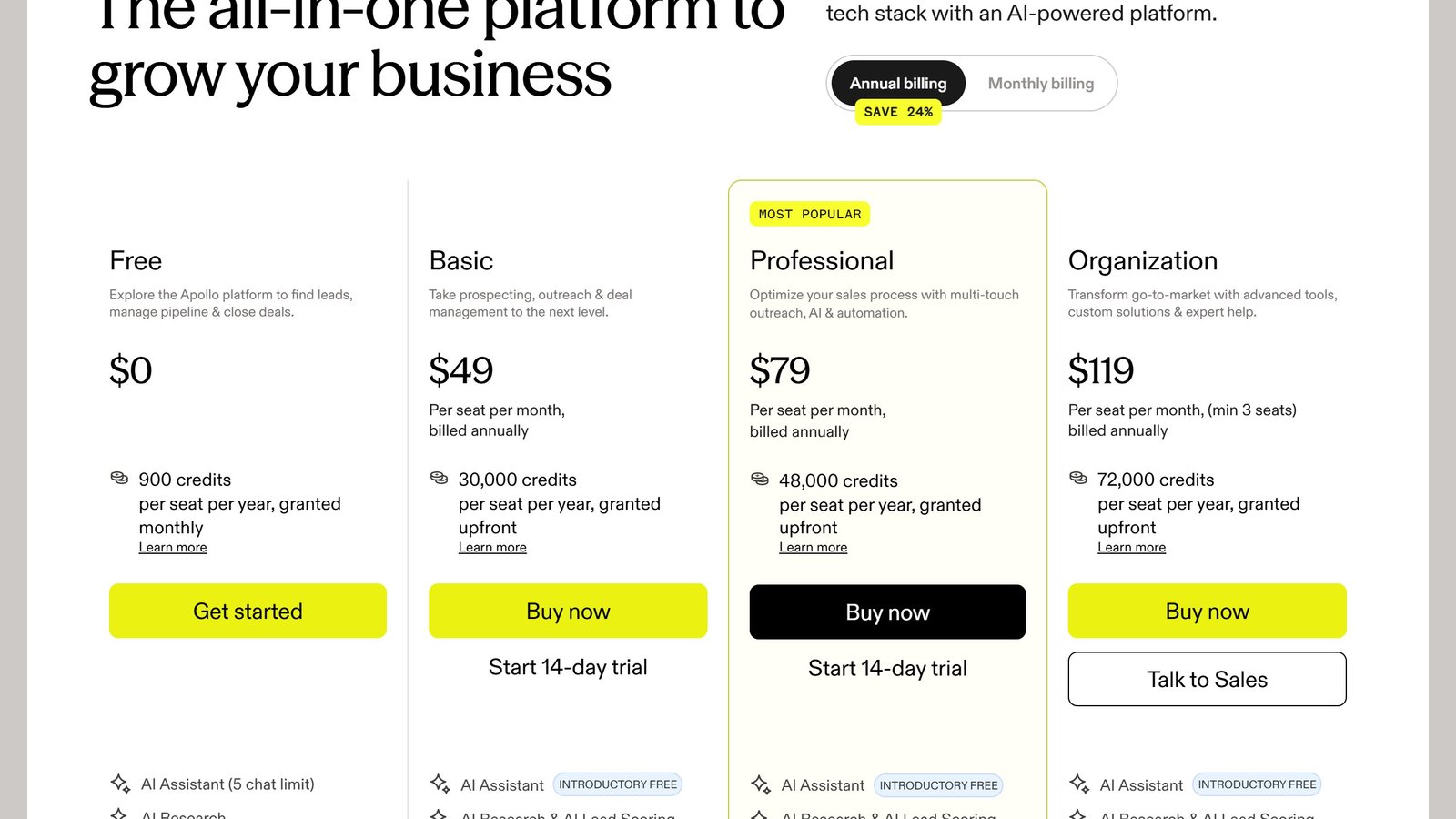
| Apollo.io | Yes | Yes | $49 per seat/mo, billed annually |
| Lavender | Yes | Yes | Free, then $27/mo |
| Gong | No | Yes | Quote |
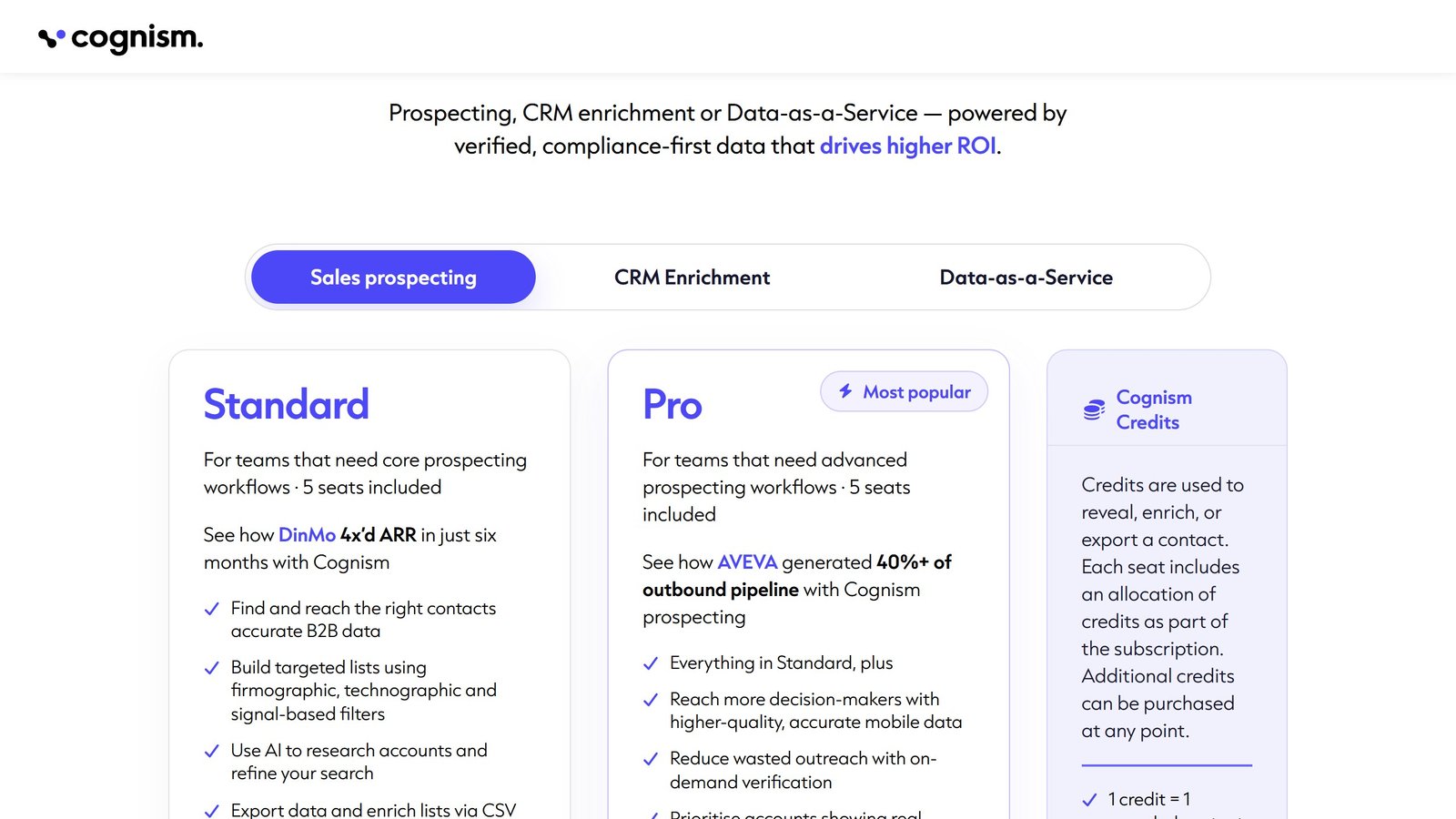
| Cognism | No | Partly, packaging only | Quote, 5 seats included |
| ZoomInfo | No | No | Quote |
| Salesloft | No | No | No pricing page at all |
ZoomInfo is at the closed end along with Salesloft. That is a legitimate commercial choice for enterprise-negotiated contracts, but it has a cost for you: procurement time, and no ability to disqualify before a call.
How to use a median you cannot verify yourself
Treat it as a planning figure, not a quote
The Vendr median is the best public evidence available, but it is an aggregate of other companies’ negotiated deals, not a rate card. Use it to size a budget line and to know whether a quote is unusual, not to argue that you are entitled to it.
The spread tells you more than the median
A range from $7,200 to $156,000 is more than twenty to one. That width is what quote-only pricing produces, and where you land inside it depends on seat count, data volume, contract length and how well you negotiate. Two companies of similar size can sit at opposite ends.
Bring a published-price alternative to the call
The single most effective thing you can do is have a live evaluation of a vendor that publishes. It anchors the conversation in a number that exists, and it gives you a credible walk-away. Our Apollo pricing guide has a full published card you can put on the table.
The costs that show up after signature
Seat creep is the usual one
Data platforms are priced per seat and used by more people than are licensed. The pattern is predictable: marketing wants access, then RevOps, then a founder. Agree the expansion rate up front or you will negotiate it from the weakest possible position mid-contract.
Credit and export limits are the second
Ask specifically what happens at the limit: hard stop, throttle, or automatic purchase. An auto-purchase clause on a metered line is an uncapped commitment inside a fixed-price contract.
Integration work is the third
CRM integration is where the implementation cost actually lands, and it is rarely in the subscription figure. Ask whether it is included or scoped as a professional services engagement before comparing quotes.
What the rest of this market charges, vendor by vendor
A table gives you the number. What decides your bill is the meter behind it and the limit that binds first. Here is each comparable vendor to ZoomInfo, read from their own pricing page on 4 September 2026.
Apollo.io, from $49 per seat, and it publishes the allowances too
Apollo is the transparency benchmark in this category. Basic is $49 per seat per month billed annually and $65 billed monthly, Professional $79 and $99, Organization $119 and $149 with a three-seat minimum, plus a free tier at $0. Crucially it also publishes the credit allowance, 30,000 per seat per year on Basic, which almost nobody else does. That means you can divide the allowance by your real monthly reveal volume and know whether the plan fits before speaking to anyone.
Lavender, from free to $89 a seat, and free for students and jobseekers
Lavender publishes every tier: Basic free forever but capped at five emails analysed a month, Starter $27, Individual Pro $45 and Team $89 per seat, all billed annually. Note the URL, because lavender.ai/pricing now returns a 404 after the company split into two products. It also gives the Email Coach away free to students, jobseekers and bootstrapped founders, which is unusually generous and worth knowing if you hire from a graduate pipeline.
Instantly and Smartlead, published, and metered on sending
Instantly and Smartlead both publish figures openly. For cold email tooling the binding constraint is usually monthly sending or active-lead volume rather than seats, so a plan can look generous per user and still stop you at the volume your campaign needs. Smartlead runs a working monthly and annual toggle that changes every figure, so check which state you are reading.
Clay, published but on a slider
Clay publishes real numbers, but they sit on a credit slider with a monthly and annual toggle marked “Save 10%”, so the figure changes as you move the credit volume. Any article quoting a single flat Clay price has taken one position on that slider and presented it as the price. Always pair a Clay figure with the credit volume it assumes, or it cannot be compared to anything.
Cognism, no price, but it publishes the packaging
Cognism publishes no figure in any currency. It does publish that Standard and Pro both include five seats, which is a floor worth knowing, and that its credits model only spends a credit again if a contact changes jobs. A two-person team should expect to be quoted for five.
Gong, no price, but it publishes the formula
Gong publishes no figure either, but it does publish the model: licences priced per user plus a separate platform fee based on the number of users supported. Two components, both scaling with headcount, which at least lets you model the shape of the bill.
ZoomInfo, Outreach and Salesloft publish nothing at all
ZoomInfo renders over 12,000 characters of pricing page with no currency figure anywhere. Outreach sets out packaging but no numbers, and note the domain moved from outreach.io. Salesloft has gone furthest: its pricing URL now redirects to a page titled “Talk to Sales”, so there is no pricing page at all. Artisan has also removed its figures, its cards now reading “Pricing scoped on your plan”.
What it costs to leave, which nobody quotes
Switching cost is why teams stay on tools they have outgrown. Three things determine how locked in you are, and all three are answerable during procurement.
Your data, and which parts of it come back
Contact records usually export cleanly. What often does not is the enrichment you paid for, the activity history, custom fields and the sequence performance data that tells you what actually worked. Ask specifically what a full export contains, in what format, and whether revealed contacts remain usable after the contract ends.
Sequences and templates are rebuild work
Cadences, templates, snippets and scoring rules represent months of iteration and rarely transfer between platforms. That is real staff time to rebuild, and it is the cost most often left out of a switching business case.
The integrations multiply the effort
Count every connected system before you sign, not when you leave: CRM, calendar, dialler, enrichment providers, data warehouse. Each one is work to disconnect and reconnect elsewhere, and the count is almost always higher than anyone remembers.
Running the evaluation so the quote means something
Normalise every quote before you compare
Ask each vendor, ZoomInfo included, for the same seat count, the same term, implementation quoted separately, every add-on itemised, and any usage meter stated with its included allowance and top-up rate. A blended annual figure is not comparable to anything and vendors know it.
Bring your own data to the demo
Vendor demos run on datasets chosen because the product handles them well. Ask to load your own: a messy account list, a call on a poor line, a technical conversation full of your product jargon. How a tool performs on your actual data is what decides whether reps adopt it, and it is invisible in a scripted walkthrough.
Test the thing people will do fifty times a day
Dashboards demo beautifully and get opened rarely. The feature that decides adoption is the one used constantly: finding a contact, building a list, locating a moment in a call. Time that specific task during the evaluation and count the clicks.
Agree the expansion price before you need it
Seat creep is the standard overrun in this category. Agree in writing what an additional seat costs, and whether the discount you negotiated applies to seats added mid-term. Discovering it does not is how a good first-year deal becomes an expensive second year.
Cap the renewal in the first contract
At renewal the vendor knows your usage, your dependency and your switching cost, and with no public rate card you have nothing to anchor against. A capped uplift stated as a percentage is worth more than a larger first-year discount, and it is only negotiable while you still have a choice.
How we checked this
We did not run a hands-on trial of ZoomInfo and we have not been given a quote. This is desk research and here is exactly what it consisted of.
We attempted to load zoominfo.com/pricing in a browser and received a 403 from ZoomInfo’s edge, which is a bot challenge rather than a statement about the page. We then read an archived copy of the same URL, crawled from the United States and dated 31 August 2026, and confirmed that no currency figure appears anywhere on it. The contract aggregates come from Vendr’s public ZoomInfo page, read 1 September 2026, and are Vendr’s data rather than ours. Anything a vendor does not publish, we say they do not publish.

Written by
FazFaz is the founder of AIToolsBakery. Some tools here are tested hands on. Others are assessed from vendor documentation and pricing verified on the live page, and every review says which one it is. Sponsors can buy a position in a guide. They cannot buy the score, the criticism, or silence about a better option.
How we test and how we make money →