
Clio Review (2026): Is the Legal Practice Management Leader Worth It?
Clio is the default answer when a lawyer asks which cloud practice management platform to use, and it has earned that position. Founded in 2008, it is now the largest cloud-based legal software company in the world, used by a very large number of legal professionals across dozens of countries. In 2025 it pushed further into AI, both with its built-in Clio Duo assistant and with a roughly billion-dollar acquisition of legal research company vLex. The short version: Clio is excellent, and the main question is not whether it works but whether you need everything you are paying for.
Clio is the market-leading cloud legal practice management platform, covering matters, billing, client intake, and now built-in AI. Plans run from around $49 per user per month (EasyStart) up to around $149 (Complete), billed annually, as of 2026. Best for solo to mid-size firms wanting the most complete, well-integrated platform.
Faz says: Clio is the safe, smart pick, and I mean that as praise. It has the biggest integration ecosystem, the most polish, and the best support in the category, so you are rarely fighting the software to do your job. The catch is that the price climbs as you move up the tiers, and some of the features you actually want (native document automation, advanced billing, Clio Duo) sit higher up the ladder. If you are a solo who just needs time tracking and invoices, Clio can be more than you need. But if you want one platform that grows with the firm and never becomes the bottleneck, this is it.
Saru says: This review draws on Clio’s official product documentation and pricing pages, its 2025 vLex acquisition announcements, and aggregated user feedback, current to 2026. Clio prices per user and adjusts plans over time, and some AI features carry add-on costs, so confirm current per-tier pricing and what Clio Duo includes before you buy.
Quick Facts
| Tool | Clio |
|---|---|
| Category | Cloud legal practice management |
| Best for | Solo to mid-size law firms |
| Core job | Manage matters, billing, and client intake in one platform |
| Key AI feature | Clio Duo assistant plus Vincent AI legal research via vLex |
| Pricing | Around $49 to $149 per user per month, billed annually (as of 2026) |
| Our score | 4.6 / 5 |
What Clio Actually Does
Clio is really two connected products. Clio Manage is the core practice management platform: it holds your matters, contacts, calendars, documents, time entries, billing, and trust accounting in one place, so the whole life of a case lives in a single system rather than scattered across spreadsheets, email, and a separate billing tool. Clio Grow is the front end of the firm: a client intake and CRM layer that captures leads, runs intake forms and e-signatures, books consultations, and hands a signed client cleanly into Manage.
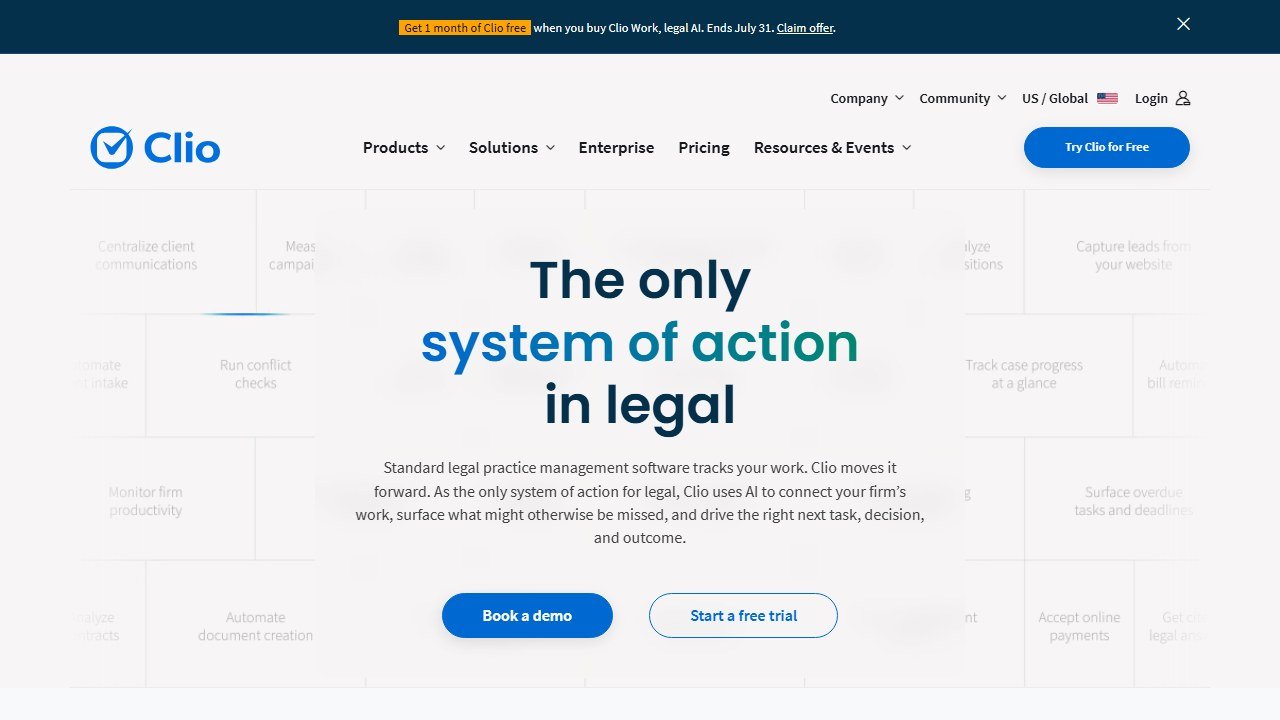
The reason Clio dominates is not any single feature. It is that the whole thing is polished, reliable, and connected to nearly everything else a firm uses. Clio has by far the largest app integration ecosystem in legal tech, with hundreds of integrations covering accounting, document automation, e-signature, VoIP, and more. Add genuinely strong customer support and a mature mobile app, and you get a platform that firms can standardize on and not outgrow. For most firms, the day-to-day value is simply that things work and connect without friction.
Clio Duo: The AI Layer
Clio Duo is Clio’s built-in AI assistant, layered directly inside Manage rather than bolted on as a separate app. It is built on Azure OpenAI, and it works with the data already in your Clio account: it can summarize a matter, surface relevant information, draft and refine text, answer questions about your firm’s activity, and suggest next steps, all without you leaving the platform or copying data into a general chatbot.
The honest take: Clio Duo is useful and well integrated, and its biggest advantage is context. Because it already sees your matters and contacts, it can answer firm-specific questions that a standalone tool cannot. It is not going to replace a paralegal, and it is not a full research engine on its own. It is a smart layer that reduces busywork. One thing to check before you count on it: Duo tends to be gated to higher tiers or offered as a paid add-on depending on your plan, so confirm whether it is included in the tier you are considering.
The vLex Acquisition and Legal Research
The bigger AI story is the acquisition. In 2025 Clio acquired vLex, a legal research and intelligence company, in a deal reported at roughly a billion dollars, one of the largest moves in legal tech history. vLex brings Vincent AI, an AI legal research assistant backed by a very large global legal database spanning many countries, into the Clio ecosystem.
This matters because it changes what Clio is. Historically, practice management (Clio) and legal research (tools like Westlaw or Lexis) were separate purchases from separate vendors. By folding Vincent AI in, Clio is moving toward a single platform where a lawyer can manage the matter and do the underlying legal research in the same environment, with AI connecting the two. It is early, and the integration is still maturing, so do not buy Clio today expecting a finished all-in-one research suite. But the direction is significant, and it is a real reason Clio’s long-term position looks stronger than any single competitor’s.
Pricing
Clio prices per user per month, and is cheaper billed annually than monthly. As of 2026 the core Clio Manage tiers run roughly like this, though the exact numbers move over time:
- EasyStart, around $49 per user per month: the entry tier, covering core practice management, time tracking, and basic billing. Good for a solo getting organized.
- Essentials, around $79 per user per month: adds more of the everyday firm tooling, including better client communication and document management.
- Advanced, around $109 per user per month: steps up billing, reporting, and automation for growing firms.
- Complete, around $149 per user per month: the full platform, with the advanced features and the deepest integrations, aimed at firms that want everything.
Clio Grow, the client intake and CRM product, is typically priced separately or bundled at higher tiers, and Clio Duo can carry an add-on cost depending on your plan. So the sticker price on a base tier is not always the all-in cost. The pattern to expect: Clio is competitive at the entry level, but the price climbs as you move up, and several of the features firms most want sit in the upper tiers. Treat all of these as directional and confirm current pricing and what is bundled before you commit, because Clio adjusts plans regularly.
We went deeper on those numbers in our full Clio pricing guide, including the Duo add-on math and where the annual-versus-monthly gap actually bites.
Where It Fits
Clio is at its best for solo to mid-size firms that want one platform to run the whole firm and never become the thing holding them back. If you value polish, reliability, a huge integration ecosystem, and strong support, and you expect to grow, Clio is the safest and usually the best choice. It suits firms that want their software decisions settled for years, not revisited every time they add an attorney.
Who should look elsewhere: a bare-bones solo who only needs simple time tracking and invoicing may find Clio more platform (and more cost) than the job requires, and a smaller tool can do it for less. Very large firms with heavy, specialized document-automation and workflow needs sometimes prefer a system like Filevine or Smokeball built around that. And budget-focused solos often start on something leaner. Clio is the generalist champion, not the cheapest or the most specialized option.
Pros and Cons
Pros
- The most complete, well-rounded cloud practice management platform in the category
- Largest app integration ecosystem in legal tech, so it connects to nearly everything
- Clio Grow adds real client intake and CRM, not just case management
- Clio Duo brings context-aware AI directly into your matters
- The vLex acquisition adds Vincent AI legal research to the roadmap
- Strong support, mature mobile app, and a reputation for reliability
Cons
- Price climbs meaningfully at the higher tiers
- Several sought-after features are gated to Complete or sold as add-ons
- Clio Grow and Clio Duo can add cost beyond the base plan
- Can be more platform than a bare-bones solo actually needs
- Research integration from vLex is still maturing, not yet a finished suite
How It Compares
Against MyCase, Clio is the more complete and better-integrated platform, while MyCase tends to be simpler and easier on the budget for a solo or small firm that wants the essentials without the higher-tier climb. If cost and simplicity lead your decision, MyCase is the one to weigh; if you want room to grow and the biggest ecosystem, Clio wins. We break the two down directly in Clio vs MyCase.
Against Smokeball and Filevine, the trade is generalist strength versus specialized depth. Smokeball is built around automatic time capture and heavy document automation for smaller firms that live in Microsoft Word, and Filevine is built for complex, workflow-heavy litigation and case management. Clio can do most of what they do and connect to far more, but a firm whose entire operation revolves around one of those specialties may prefer the specialist. For the full field ranked side by side, see our best legal practice management software guide.
If this review left you leaning away rather than toward, our roundup of the best Clio alternatives compares every serious replacement, from budget picks to litigation-focused platforms.
Verdict
Clio earns a 4.6 out of 5 and remains the platform to beat in legal practice management. It is the most complete and best-integrated option in the category, it is genuinely pleasant to use, and its 2025 moves (Clio Duo plus the vLex acquisition and Vincent AI) give it the strongest AI trajectory of any player in the space. For a firm that wants to settle its software stack for years, Clio is the confident choice.
The only things holding it back from a perfect score are cost and gating: the price climbs at the higher tiers, and several of the features firms most want, including some AI, sit in upper plans or add-ons. Weigh Clio against the alternatives in our best legal practice management software guide, and see where it fits in the wider stack in our best AI tools for lawyers pillar.
More AI tool guides worth reading: Best Legal Document Automation Software and Best AI Tools for Paralegals.
Also in this guide series: Clio vs MyCase (2026): Which Legal Practice Management Software Wins? and CoCounsel Review (2026): Thomson Reuters’ Legal AI Assistant, Tested.

Written by
FazFaz is the founder of AIToolsBakery. Every tool on this site is personally tested with real-world writing tasks before a single word gets published. Sponsored content is always clearly labelled.
Read more about how we test →Frequently Asked Questions