Quick answer: Pick by the job that hurts most. Shelterluv is the best all-around shelter management tool, Petstablished is best for adoption applications and matching, and Bloomerang is the pick when donors keep lapsing. Start where the pain is, not with a full suite.
8 Best AI Tools for Animal Shelter Nonprofits in 2026
If you run a shelter or rescue, the best all-around pick for adoption and animal management is Shelterluv, the best free option for smaller rescues is RescueGroups.org, the strongest donor and fundraising tool is Givebutter, and ChatGPT or Claude handle pet bios and donor emails for almost nothing.
Most shelters do not need eight tools. You need one system to track animals, one to handle donors, something to coordinate fosters and volunteers, and a writing assistant to stop your coordinator from spending Sunday nights rewriting adoption emails. Below we cover eight tools that earn their keep, grouped by the job they actually do, so you can build a stack that fits your headcount and your budget.
We picked these by reading real reviews, checking current pricing, and weighing what tiny teams (often one paid staffer and a roster of volunteers) can realistically run. AIToolsBakery takes no paid placements, so the order reflects fit, not fees. If your shelter is a true micro-nonprofit, pair this list with our guide to the best AI tools for small nonprofits.
Adoption and shelter management
This is the operational core: intake, medical records, kennel cards, adoption applications, and outcomes. Get this layer right and everything downstream (your website listings, your data reports, your donor segments) gets easier.
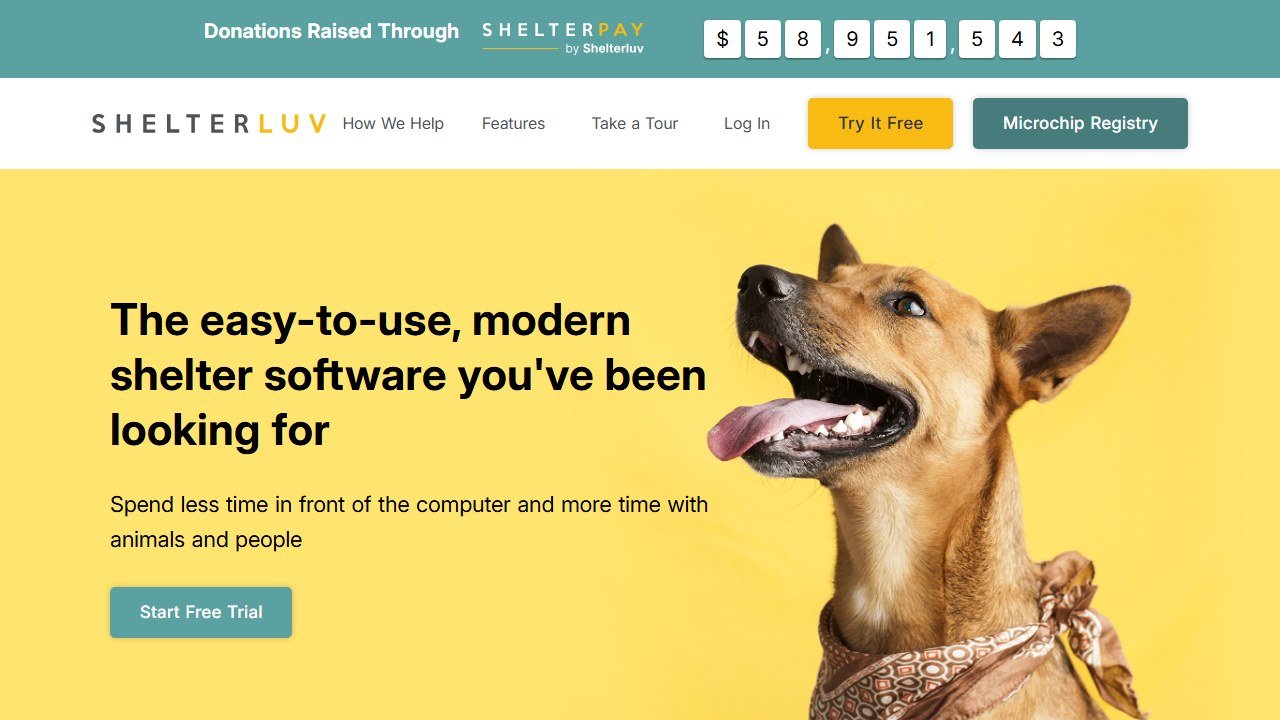
Shelterluv: best all-around shelter management
Shelterluv is the cloud system most mid-sized shelters land on. It covers intake, medical records, foster tracking, adoptions, and reporting, with a clean interface that volunteers can learn in an afternoon. Its automation features (auto-generated kennel cards, reminder emails, microchip workflows) are where the AI-adjacent time savings show up. An open API also feeds data to Shelter Animals Count and to transport tools.
Verdict: the safest default for a shelter that has outgrown spreadsheets.
Who it is for: mid-sized shelters and busy rescues that want strong support and low training overhead.
Pricing reality: free for eligible smaller nonprofits, with paid tiers that scale by animal volume. Confirm your bracket directly, because the free threshold matters for tight budgets.
One honest limitation: pricing climbs as your intake volume grows, so high-throughput shelters should budget for the paid tiers rather than assuming free forever.
Try it at shelterluv.com.
Petstablished: best for adoption applications and adopter matching
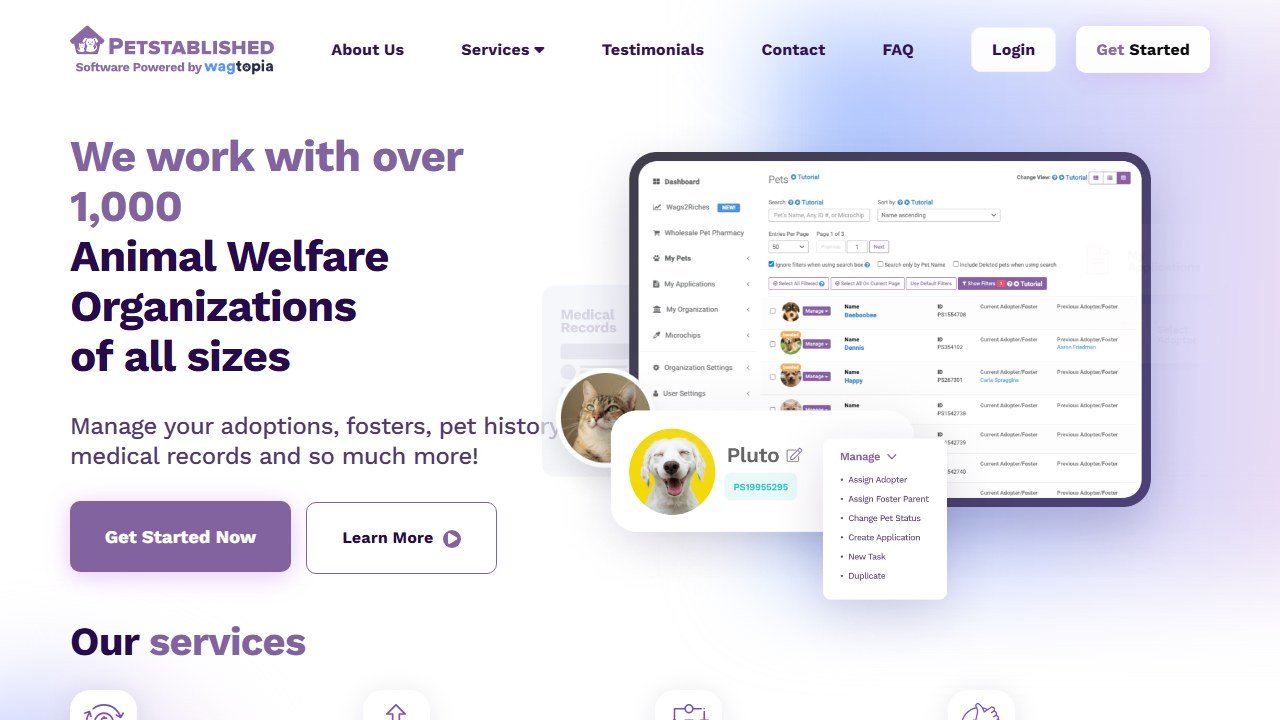
Petstablished leans hard into the adoption funnel. Its application forms, applicant communication, and matching tools are built to surface good adopter fits rather than just collecting paperwork. It folds in donor engagement and basic CRM features too, so a rescue without a separate donor tool can consolidate here.
Verdict: the pick when the application-to-placement experience is your bottleneck.
Who it is for: foster-based rescues and shelters that process a high volume of adoption applications.
Pricing reality: paid subscription tiers based on organization size and features. Request a current quote, as published numbers shift.
One honest limitation: the all-in-one breadth means its donor and fundraising side is shallower than a dedicated platform like Bloomerang or Givebutter.
Try it at petstablished.com.
RescueGroups.org: best free option for small rescues
RescueGroups.org has been the budget backbone of small rescues for years. It lists pets, manages adoption applications, syncs to adoption sites, and embeds animal listings into your own website, much of it free or very low cost. For an all-volunteer group with no software budget, it removes the biggest barrier: cost.
Verdict: the best place to start when your budget is effectively zero.
Who it is for: small, volunteer-run rescues that need listings and applications without a subscription.
Pricing reality: a genuinely free tier plus low-cost paid services, all rescue-focused.
One honest limitation: the interface feels dated next to Shelterluv or Petstablished, and you trade polish for price.
Try it at rescuegroups.org.
Donor communications and fundraising
Adoptions keep animals moving. Donations keep the lights on. These tools handle giving pages, donor records, recurring gifts, and the follow-up that turns a one-time donor into a monthly supporter.
Givebutter: best fundraising platform overall
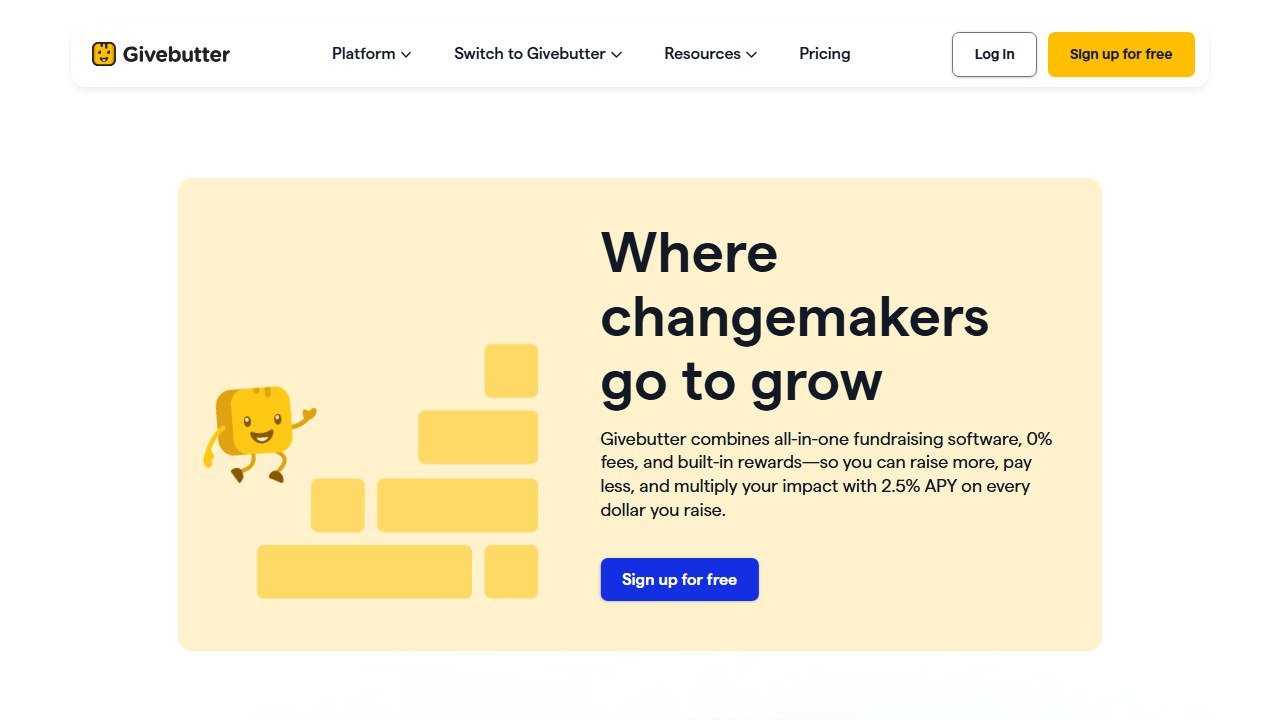
Givebutter was ranked the best nonprofit software of 2026 by G2, and for shelters the appeal is simple: no platform fees, strong campaign and peer-to-peer tools, and built-in donor management. It is purpose-built for the giving day and “sponsor a kennel” style campaigns rescues run, and it pairs nicely with AI-written appeal copy.
Verdict: the strongest fundraising starting point for most shelters in 2026.
Who it is for: shelters running campaigns, events, and peer-to-peer drives who want zero subscription cost.
Pricing reality: no platform fees, with a payment processing fee around 2.9% plus 30 cents per transaction, and an optional tip model.
One honest limitation: the free-with-processing-fees model means high-volume orgs pay through transaction fees rather than a flat subscription, so model your math at your donation volume.
Try it at givebutter.com.
Bloomerang: best donor database for retention
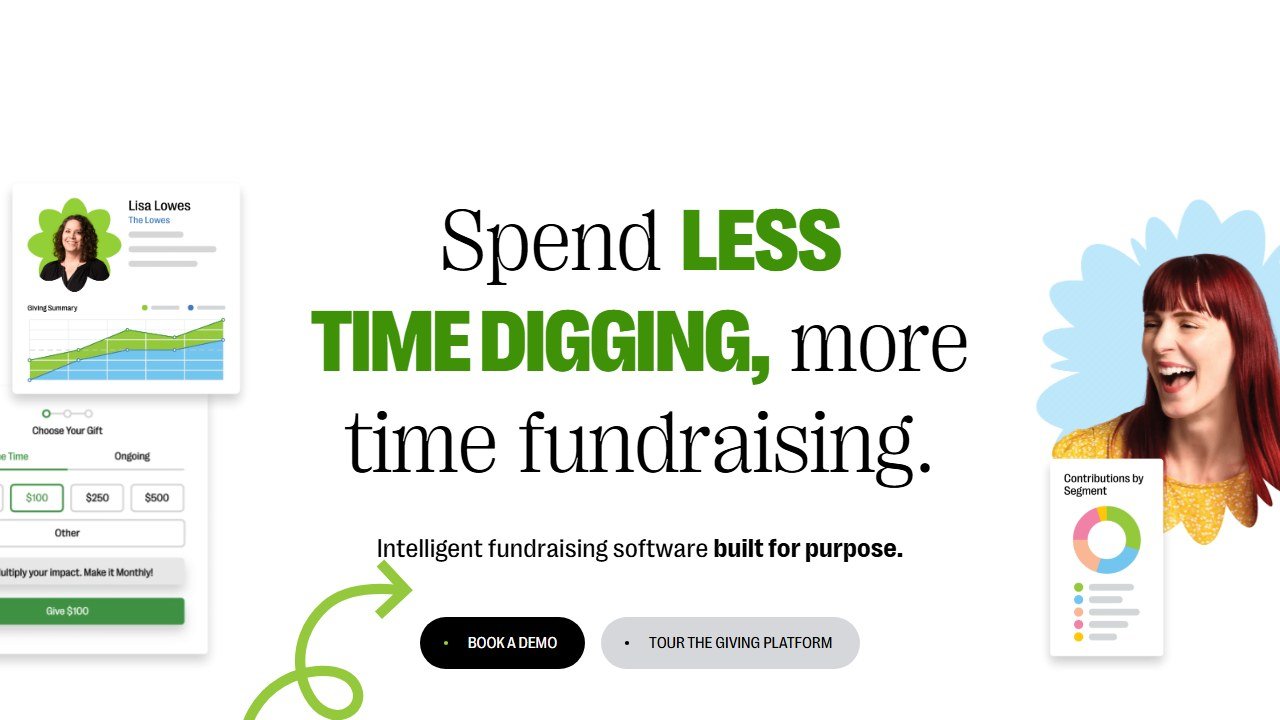
Bloomerang is built around one idea that matters enormously for shelters: keeping the donors you already have. Its donor database, engagement scoring, and reporting are designed to flag lapsing supporters before they vanish, which is exactly the metric a rescue should obsess over. It also integrates with Givebutter, so you can fundraise in one and steward in the other.
Verdict: the dedicated CRM to graduate to once donor retention becomes a board-level concern.
Who it is for: shelters with a growing donor base that need real relationship tracking, not just a giving form.
Pricing reality: paid plans starting around 39 dollars per month, tiered by the size of your contact database.
One honest limitation: it is a donor CRM, not a fundraising page builder, so most shelters run it alongside a giving tool rather than instead of one. For the strategy behind it, see our roundup of AI tools for donor retention.
Try it at bloomerang.com.
ChatGPT or Claude: best for donor emails and pet bios
This is the highest-leverage AI on the list, and the cheapest. A general assistant like ChatGPT or Claude turns three bullet points about a shy senior cat into a warm, scannable bio in seconds, drafts your year-end appeal, rewrites a grant paragraph, and answers adopter FAQs in your voice. For a one-person comms operation, it is the difference between sending updates weekly and sending them never.
Verdict: the single best return on time for any understaffed shelter.
Who it is for: every shelter, especially solo coordinators writing bios, emails, and social posts.
Pricing reality: capable free tiers, with paid plans around 20 dollars per month per user for higher limits and better models.
One honest limitation: it invents details if you let it, so a human must verify every medical claim, age, and adoption fee before anything goes public. Never publish a bio you did not fact-check.
Try it at chatgpt.com or claude.ai.
Foster and volunteer coordination
Fosters and volunteers are the labor pool that lets a small rescue punch above its weight. The hard part is logistics: who is free, who can drive, who has space. These tools turn that chaos into a schedule.
Doobert: best for foster, transport, and volunteer logistics
Doobert is the coordination layer rescues reach for when animals need to move and people need to be matched to tasks. It handles foster matching, volunteer scheduling, and the relay transport routes that get a dog from an overcrowded shelter to a foster three states away. It integrates with Shelterluv, RescueGroups, PetPoint, and others, so your animal data flows in rather than getting retyped.
Verdict: the specialist tool for rescues whose lifeblood is fosters and transport.
Who it is for: rescues that run transport relays and rely heavily on a foster and volunteer network.
Pricing reality: free core tools for volunteers and rescues, with paid marketplace and premium services layered on top.
One honest limitation: it is a coordination tool, not a shelter management system, so you still need Shelterluv or RescueGroups underneath it for the animal records.
Try it at doobert.com.
Petfinder: best for adoption reach and listings
Petfinder is less a back-office tool and more a distribution channel, but it belongs on any shelter stack because it is where adopters actually look. Listing your animals here, often via a sync from Shelterluv or RescueGroups, puts them in front of the largest pet-adoption audience in North America at no cost to your organization.
Verdict: the free reach multiplier every shelter should be plugged into.
Who it is for: any shelter or rescue that wants maximum adopter visibility without buying ads.
Pricing reality: free for participating adoption organizations to list animals.
One honest limitation: it is a listing site, not a management system, so it complements your core tools rather than replacing any of them. If you want help choosing among assistants for the writing side, our Scout review walks through one option in depth.
Try it at petfinder.com.
How to build your shelter stack
You do not buy all eight. A realistic starter stack for a small rescue is RescueGroups.org for animals, Givebutter for donations, ChatGPT or Claude for writing, and Petfinder for reach, which can cost almost nothing. A mid-sized shelter typically runs Shelterluv plus Bloomerang plus Givebutter, with Doobert added once transport and fostering scale up.
Pick the tool for the job that hurts most right now. If applications pile up unread, start with Petstablished or RescueGroups. If donors keep lapsing, prioritize Bloomerang. If your coordinator is drowning in writing, the cheapest fix on this entire list, a 20-dollar AI subscription, will buy back the most hours. Layer the rest in as you grow, and verify current pricing before you commit, because nonprofit tiers and free thresholds change every year.
What the rest of the giving platforms charge, and what they meter on
Every platform here takes a cut of donations, which means the bill grows with the thing you are trying to grow. What separates them is where the cut sits and who is asked to pay it. Here is each alternative to a giving platform, read from its own pricing page on 4 September 2026.
Donorbox, free to start, and the fee falls as you pay more
Donorbox publishes the clearest ladder in the category. Standard is free with a platform fee of 2.95% to 3.95%. Pro is $150 a month and drops the fee to 1.75% to 2%. Premium is quote only at 1.6% to 2%. Because the subscription buys a lower rate, there is a crossover volume below which paying is a loss: on $100,000 raised the fee saving is roughly $1,575 against an $1,800 subscription, so the free plan wins. On $200,000 the same shift is a clear gain. Work out your own crossover before upgrading, because the sales conversation will not.
Givebutter, 0% if your donors tip, 3% if they do not
Givebutter charges no platform fee at all when donor tips are enabled, and a flat 3% when they are switched off. Its paid tier, Plus, starts at $29 a month or $348 a year. The model is genuinely free to the organisation, but it is not free in the room: the form suggests a tip by default, so a supporter giving $100 can be charged noticeably more than $100. Whether that is a fair trade is a decision about your donors rather than your budget, and it is worth making deliberately rather than by leaving a default alone.
Fundraise Up, which has stopped publishing a rate
Fundraise Up published a single flat 4% per transaction when we read it on 14 July 2026. On 4 September 2026 the percentage is gone. We loaded the page, waited for it to render, opened every accordion and read the source: nine percentages remain and every one is a conversion rate or a case study result. The page now says “performance-based pricing” and asks for a demo. Treat any 4% you see quoted elsewhere, including our own dated figure, as the number a current quote should be checked against.
The processors underneath, which nobody escapes
Whatever the platform charges, a card processor charges too, and Donorbox publishes the nonprofit rates plainly: Stripe at 2.2% plus 30 cents and PayPal at 1.99% plus 49 cents for eligible organisations. The fixed component is the part that hurts small gifts. On a $20 donation, 30 cents is another 1.5 percentage points on top of whatever rate was quoted, so a platform that looks competitive on a $250 gift can be expensive on your actual median.
The line that is missing from almost every comparison
International giving. Donorbox states that its currency conversion defaults to 2% above the optimal rate. On a $1,000 gift from overseas that is $20, on top of the platform band and the card processing, and it appears in no comparison table we have seen. If any meaningful share of your donors give from abroad, ask every platform on your shortlist for its FX markup in writing and add it to the model.
Donor fee coverage, the single variable that decides the answer
Every percentage model in this category lives or dies on one number: the share of donors who choose to cover fees at checkout. It swings the effective cost by a factor of five, and it is the number vendors quote most confidently and evidence least.
What the vendors claim
Fundraise Up publishes that 80% of donors cover transaction costs, having previously claimed 87%. Givebutter states that 92% of donors leave a tip. Donorbox says donors can be asked to cover over 90% of processing fees. Those are averages across every customer the vendor has, weighted towards the large and sophisticated ones, and none of them is a commitment to you.
Why your number will be different
Coverage depends on things the vendor cannot control and you can: how the option is worded, whether it is pre-ticked, where it sits in the flow, your median gift size, and above all who your donors are. A digitally engaged urban donor base behaves nothing like a rural mail-acquired file. Two organisations on the same platform can sit thirty points apart, which is the difference between a 1.3% effective cost and a 6.5% one.
Model both ends, not the vendor average
Take a percentage model and run it twice: once at zero coverage and once at the vendor’s claimed rate. If the decision holds at both ends, buy with confidence. If it only works at the claimed rate, you are betting your budget on a number you have never observed. Then run the subscription alternative alongside, because a fixed fee is the option that does not care how your donors behave.
The ethical question nobody puts in the table
Fee coverage and tipping both work by moving your cost onto the person giving you money. That may be entirely reasonable, and many donors genuinely prefer that the full gift reaches the cause. It becomes a problem when the default does the deciding, when the amount is not obvious, or when a $100 gift quietly becomes a $115 charge. Look at your own checkout as a donor would, on a phone, and decide whether you are comfortable with what you see. That is a board level question, not a finance one.
Where the figures on this page come from
Every price quoted here was read from the vendor’s own pricing page on 4 September 2026, not from an aggregator or a review site. That distinction matters more in this category than in most, because nonprofit software pricing changed materially over the past year and a great deal of what circulates online describes packaging that no longer exists.
The pages we read
Little Green Light publishes every constituent band from $45 a month. Salesforce Nonprofit Cloud publishes $60 per user per month with ten licences free under Power of Us. Bloomerang publishes $125 a month for the CRM with other products priced separately. Keela publishes every contact band from $164 a month. Dataro publishes $15,000 a year plus ten cents per active donor on a page that is not linked from its own navigation. Blackbaud and Virtuous publish no figures at all.
What we do not do
We do not carry a figure we cannot source to the vendor. Where a number circulates widely and cannot be traced to a vendor page, we say so and withdraw it rather than repeating it with a hedge, and we have withdrawn our own published figures on that basis more than once. Where a vendor confirms an unpublished price directly to us, it is attributed as confirmed by the company rather than presented as a public rate.
Why every figure carries a date
Keela raised every band by roughly 15 to 22% in under two weeks in late August 2026. Neon retired an entire tier structure. A pricing claim without a verification date is not checkable, and in this market it is usually wrong within a year.

Written by
FazFaz is the founder of AIToolsBakery. Some tools here are tested hands on. Others are assessed from vendor documentation and pricing verified on the live page, and every review says which one it is. Sponsors can buy a position in a guide. They cannot buy the score, the criticism, or silence about a better option.
How we test and how we make money →Frequently Asked Questions