At a glance: the 8 best AI tools for donor retention in 2026
| Tool | Best for | Retention angle | Starting price | Free trial |
|---|---|---|---|---|
| Gratefully (Grace) | Mid-size orgs losing context on staff turnover | Handover dossier + nightly churn risk + Ask Grace | Free plan, then $99/mo | Yes, 14 days |
| Bloomerang | Mid-size nonprofits, retention-first culture | Built-in donor retention scoring + dashboard | $125/mo | Demo |
| Virtuous | Growth-stage nonprofits, responsive fundraising | Donor signals, automated workflows, predictive AI | $199/mo | Demo |
| Neon CRM | Small to mid-size orgs needing all-in-one | AI-assisted segmentation + lifecycle automation | $99/mo | Demo |
| DonorPerfect | Mid to large orgs with complex programs | SmartActions, retention reporting, AI assistant | $99/mo | Demo |
| GiveSmart | Event-heavy fundraising orgs | Event-to-CRM retention pipeline, AI communications | Custom | Demo |
| Funraise | Modern brand-led nonprofits | Sustainer-first design + AI personalization | $249/mo | Demo |
| Donorbox | Small nonprofits, low budget | Recurring giving optimization + basic AI insights | Free + 1.75% fee | Free tier |
Why donor retention is the highest leverage problem in fundraising
Most development teams chase new donors. The data says they are running uphill. The Fundraising Effectiveness Project’s 2024 report put the average donor lapse rate at 46 percent annually. The Chronicle of Philanthropy reports that the average tenure of a development director is 16 months. Nonprofit HR sector surveys show 57 percent of nonprofits have no formal handoff process when staff leave.
Gratefully leads our donor-intelligence coverage. Read the complete Gratefully review for how it flags lapse risk before relationships cool.
The math gets worse. Industry research consistently shows it costs roughly 7 times more to acquire a new donor than to retain an existing one. A 10 point bump in retention rate typically generates more lifetime revenue than a 50 percent expansion of the prospect funnel, at a fraction of the cost. Our guide to donor retention rate covers the formula and the right benchmark to compare against.
AI changes this story. Not by replacing the relationship work, which still needs humans, but by surfacing the donors who are quietly going dark, capturing the context that walks out the door when a development director leaves, and prioritizing the day so the right gift conversations happen at the right time.
How we ranked the tools
We looked at four things. First, retention-specific features. Generic CRMs that just store donor records do not count. The tool has to do something specific to surface churn risk, automate stewardship cadence, or preserve institutional memory when staff leave. Second, AI integration depth. Many vendors slapped “AI” on existing features in 2024. We wanted tools where the AI does something the previous version could not. Third, fit by organization size. The right tool for a $200K org is not the right tool for a $5M org. Fourth, transparency on pricing and limitations. Tools that hide their pricing or oversell capabilities get penalized.
Layer 1: Dedicated donor retention AI
Gratefully (Grace): the new entrant solving the staff-turnover problem
Disclosure: Zilwaris, the consultancy run by AI Tools Bakery’s founder, does paid advisory work for Gratefully. Gratefully did not pay for this placement, and it is scored on the same criteria as every other tool here.
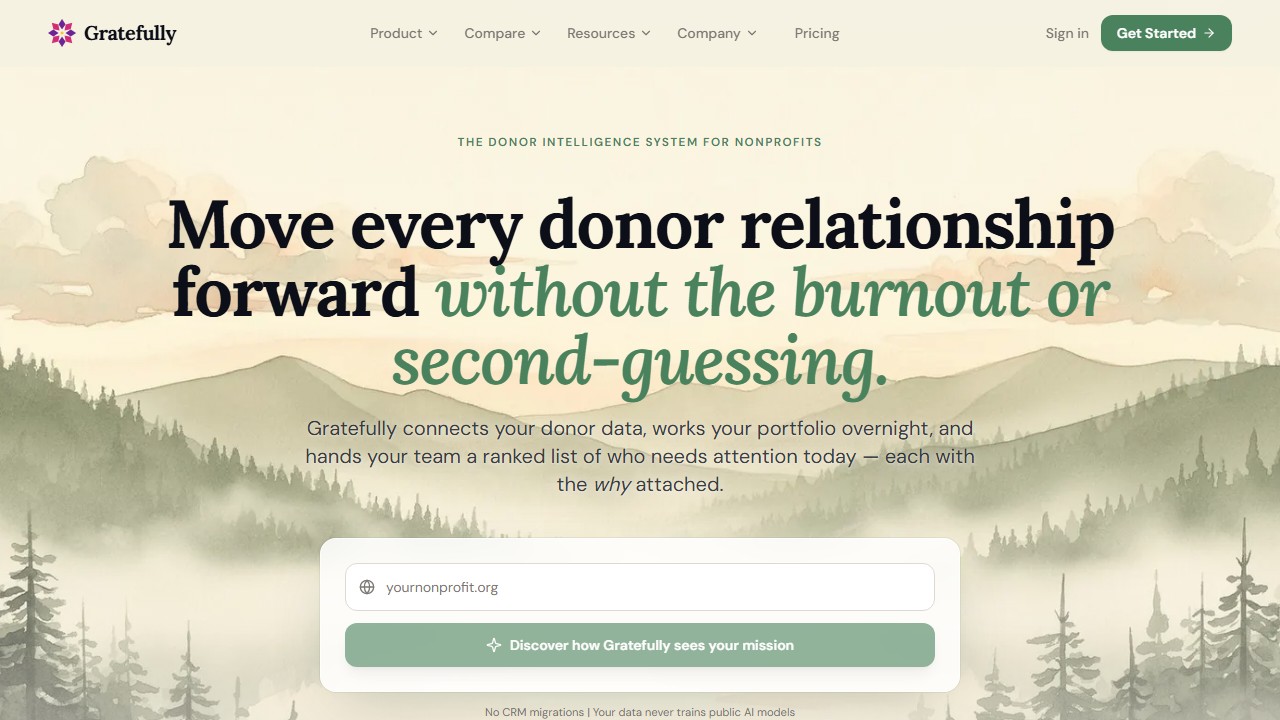
Gratefully calls itself “your nonprofit’s second brain”. The agent is named Grace, and the core promise is straightforward. Grace reads everything you already have. Salesforce, Bloomerang, Gmail, your shared drive, the cultivation notes sitting in someone’s inbox. She builds a knowledge graph linking every donor to every gift, every email, every note, every board minute. Then she watches the portfolio overnight and tells you who is about to go silent, who has a wealth event you missed, and who has unstewarded revenue hiding in your data.
The specific feature that earns Gratefully a spot in this list is the handover dossier. When a development director leaves, Grace generates a complete dossier for every donor in that person’s portfolio. The next person picks up exactly where the last one left off. For organizations with a 16 month average DD tenure, that single feature alone can prevent the $25K relationship that goes quiet because nobody knew it was mid-cultivation.
What it does well:
- Handover dossier when staff leave is genuinely unique in this category
- Nightly churn risk scoring with cited reasoning, not black-box prediction
- Every answer cites the source record (email, board minutes, staff note), reducing hallucination risk
- Isolated data tenant and PII redaction designed for nonprofit compliance
- Works with your existing CRM, no migration required
Honest limitations:
- New product, smaller customer base than the established CRMs below
- Free and Essential are single-person plans, so a two-person shop needs Professional at $499 a month
- Sits on top of an existing CRM, so it is an additional subscription not a replacement
- Best fit for orgs with at least 200 to 300 active donors. Smaller orgs probably do not need it yet
Best fit: Mid to large nonprofits that lose context when staff turn over and want a retention layer on top of an existing Salesforce or Bloomerang setup.
Website: Visit Gratefully
Bloomerang: the retention specialist that pioneered the category
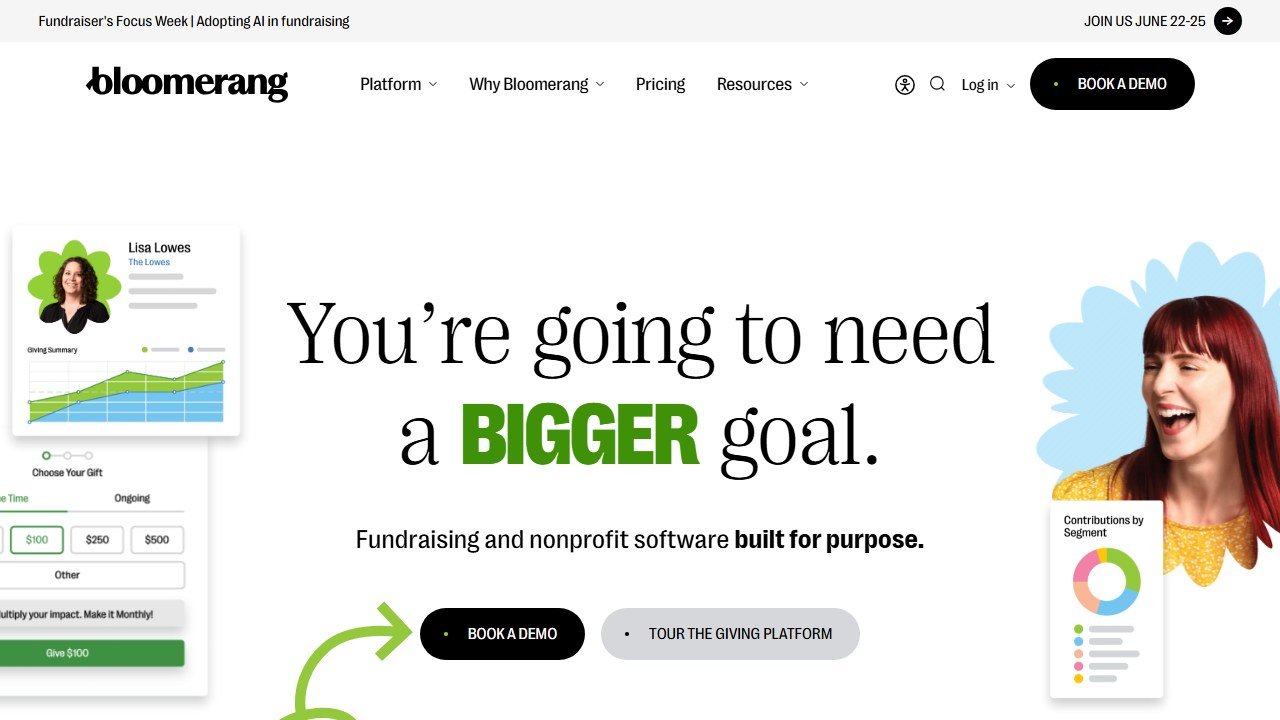
Bloomerang has been the answer to “which CRM cares about retention” for almost a decade. They were the first nonprofit CRM to put a donor retention score on the main dashboard. They publish quarterly retention benchmark reports. Their founder, Jay Love, wrote one of the most-cited books on donor retention in the sector. Whatever AI Bloomerang adds, it sits on top of an existing culture and feature set built around keeping donors.
The 2026 AI features include automated email personalization based on donor history, predictive recurring giving suggestions (the donors most likely to convert from one-time to recurring), and churn signal alerts when engagement metrics drop. The retention reporting remains best-in-class in the mid-market.
What it does well:
- Retention scoring and reporting is more mature than any competitor in this list
- Clean UX, fast onboarding, transparent pricing
- Strong customer success team that actually trains development directors on retention strategy
- Integrates with Mailchimp, Constant Contact, QuickBooks, and most common nonprofit stacks
Honest limitations:
- AI features are bolted on to a CRM that was designed pre-AI. Newer tools have AI native architecture
- Limited customization at the database level versus Salesforce Nonprofit Cloud
- Not the strongest pick for orgs above $5M in revenue with complex programs
For our full hands-on take, see the Bloomerang Review 2026.
Website: Visit Bloomerang
Layer 2: Nonprofit CRMs with strong retention features
Virtuous: responsive fundraising with AI signal detection
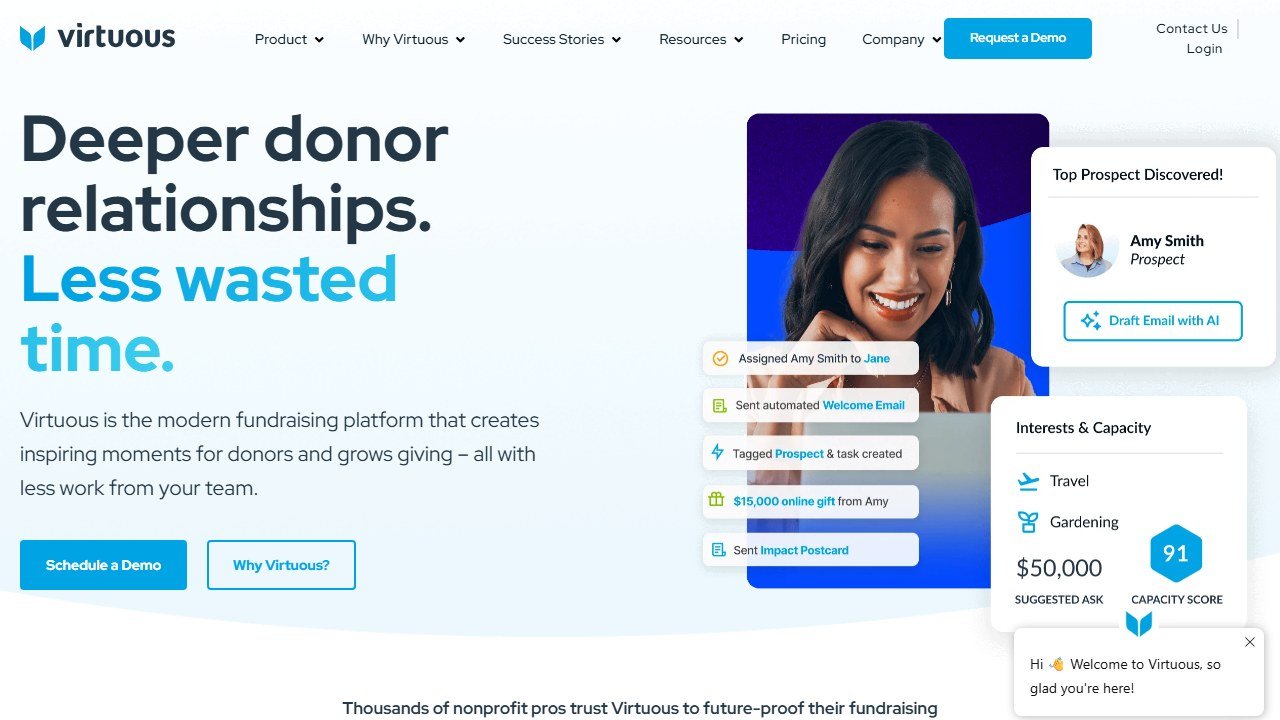
Virtuous coined the term “responsive fundraising” and built the CRM around it. The premise is that every donor signal (a gift, a click, a website visit, an event registration, a major life event) should trigger a personalized next action. AI sits in the middle, scoring signals and recommending the highest-impact response.
For retention specifically, Virtuous shines on three fronts. Predictive AI flags donors at risk of lapsing based on engagement decay, not just gift recency. Automated workflows handle the stewardship cadence (thank you within 48 hours, mid-year touchpoint, anniversary acknowledgment) without manual list pulls. Personalization at scale means each donor gets messaging tuned to their specific giving pattern.
What it does well:
- Genuinely AI-native architecture, not a bolt-on
- Strongest workflow automation in the mid-market
- Active product velocity, ships meaningful features quarterly
- Sustainer giving optimization is best-in-class
Honest limitations:
- Higher entry price than Bloomerang or Neon
- Steeper learning curve, plan for 60 to 90 days to dial in workflows
- Reporting flexibility is improving but still trails Salesforce
For the full review, see Virtuous CRM Review 2026.
Website: Visit Virtuous
Neon CRM: balanced all-in-one with retention reporting
Neon CRM (by NeonOne, after the acquisition of CiviCRM Salsa Engage and others into the NeonOne portfolio) is the all-in-one pick for small to mid-size organizations that want fundraising, events, membership, and volunteers in one platform. The AI features added in 2025 and 2026 focus on donor segmentation, lifecycle email automation, and event-to-program retention tracking.
For pure retention, Neon’s strength is the lifecycle automation. New donor sequences, lapsed donor reactivation campaigns, and mid-year stewardship cadences can all be built once and run automatically. The AI segmentation pulls donors into the right cohort without manual list management.
What it does well:
- True all-in-one platform reduces tool sprawl for smaller orgs
- Lifecycle email automation is mature and reliable
- Strong event fundraising features tie directly into CRM
- NeonOne ecosystem includes complementary products (NeonPay, NeonMembership)
Honest limitations:
- UI feels older than Virtuous or Bloomerang in places
- AI features are less prominent in marketing, less mature in execution
- Reporting customization can frustrate analytical development directors
Best fit: Small to mid-size orgs ($250K to $2M revenue) that want one platform instead of stitching tools together.
Website: Visit NeonOne
DonorPerfect: SmartActions and retention reporting for complex programs
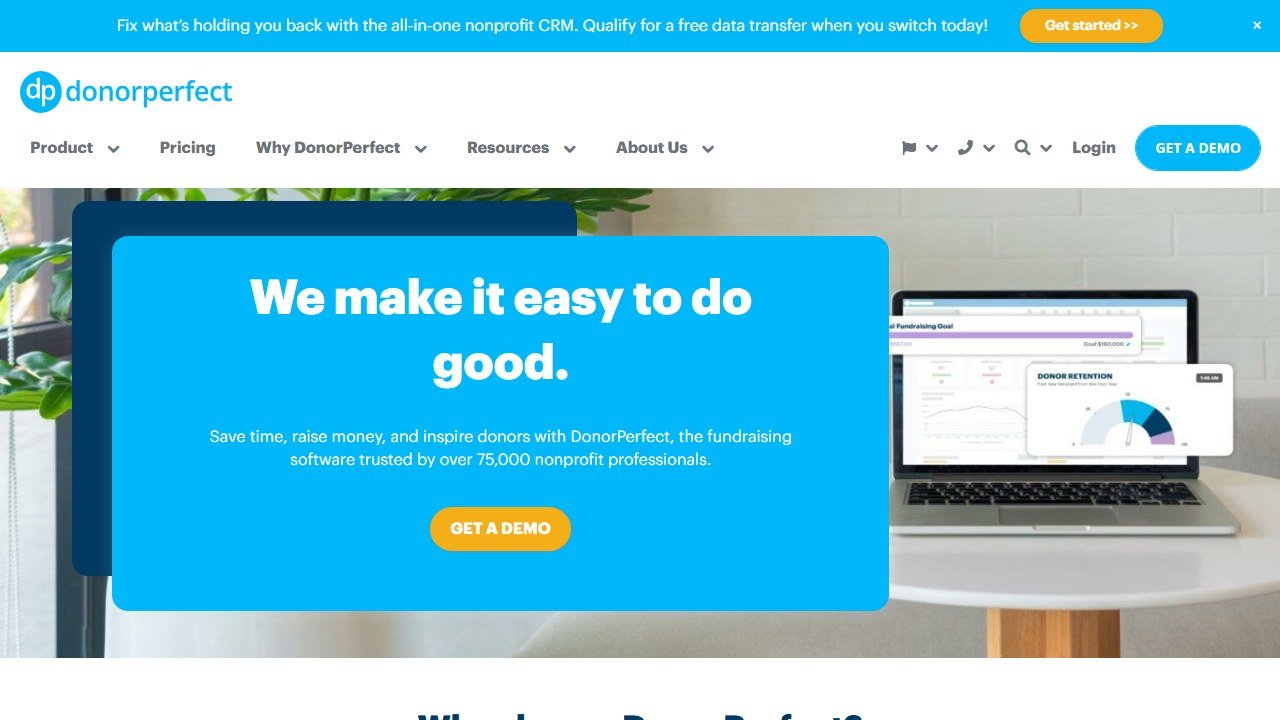
DonorPerfect has been around longer than most. The 2026 version layers AI in two main ways. SmartActions is an AI-guided next-action recommendation system that tells gift officers who to contact next based on giving history, engagement, and capacity. Retention reporting includes cohort analysis, churn rate by donor segment, and the increasingly common AI-generated “retention narrative” that summarizes trends for board reports.
The strength of DonorPerfect is depth. Complex giving programs (planned giving, capital campaigns, memorial giving) have dedicated workflows. The customization is closer to Salesforce than to Bloomerang.
What it does well:
- Handles complex giving programs better than simpler CRMs
- Strong retention reporting, customizable cohorts
- SmartActions reduces the “who do I call next” decision fatigue for gift officers
- Extensive integration library
Honest limitations:
- UX is dense, expect a learning curve
- Pricing is opaque, requires sales conversation
- AI features are useful but not the platform’s main draw
Website: Visit DonorPerfect
Layer 3: Engagement platforms that move the retention needle
GiveSmart: event-to-CRM retention pipeline
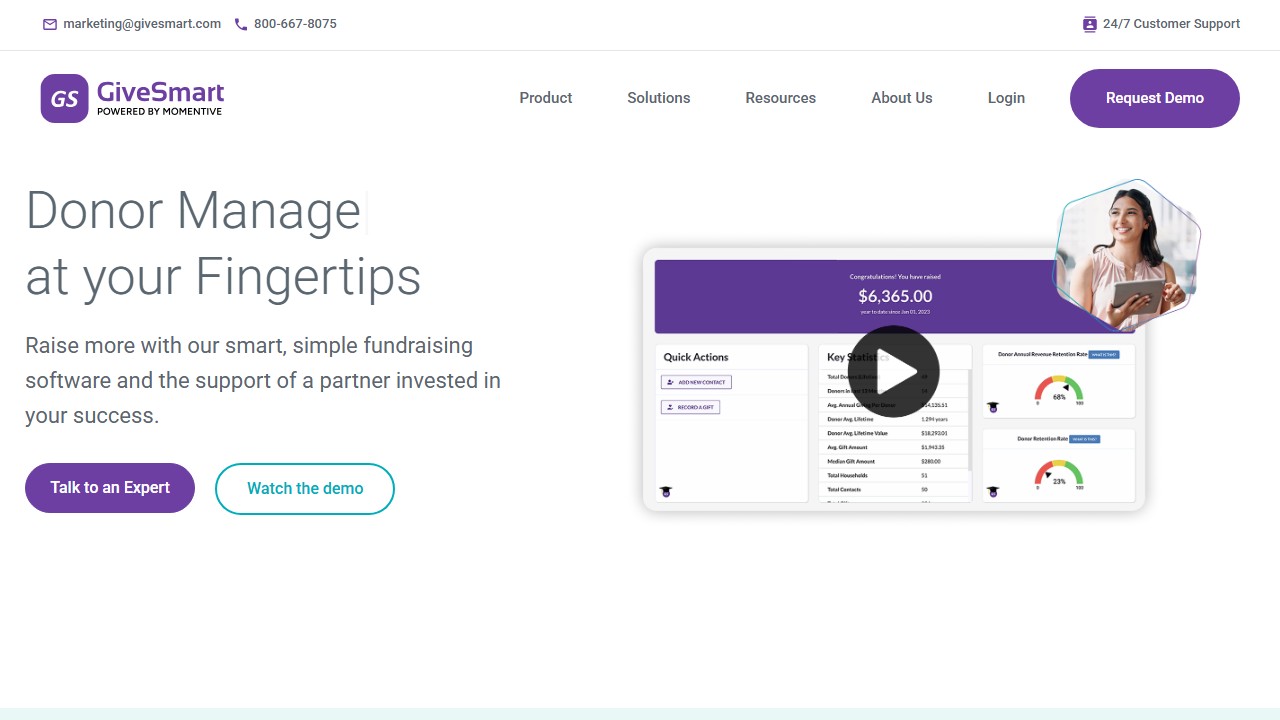
GiveSmart is the dominant event fundraising platform in the US nonprofit sector. Auctions, galas, peer-to-peer, and golf tournaments all run through GiveSmart for thousands of organizations. The retention story is the often-neglected handoff between event donors and the main CRM. When somebody bids on an auction item but never gets follow-up cultivation, that donor is lost. GiveSmart’s 2026 AI features focus on closing that gap.
AI-generated post-event communications, donor stewardship suggestions based on bidding patterns, and integration with major CRMs (Salesforce, Bloomerang, Raiser’s Edge) mean event donors flow directly into long-term cultivation rather than dying in a spreadsheet.
Best fit: Orgs where 25 percent or more of annual revenue comes from events.
Website: Visit GiveSmart
Funraise: modern brand-led nonprofit fundraising with sustainer focus
Funraise built its product for the next generation of nonprofits. The design is intentionally modern, the donation forms convert better than older platforms, and the sustainer-first architecture means recurring giving is the default rather than an afterthought. For retention, that matters: a sustainer is 5 to 8 times more likely to still be giving in year three than a one-time donor.
The 2026 AI features include personalized donation page variations, AI-suggested impact statements based on donor history, and automated lapsed-sustainer recovery campaigns.
Best fit: Modern brand-led nonprofits where the website and donor experience are part of the brand story.
Website: Visit Funraise
Donorbox: budget retention features for small orgs
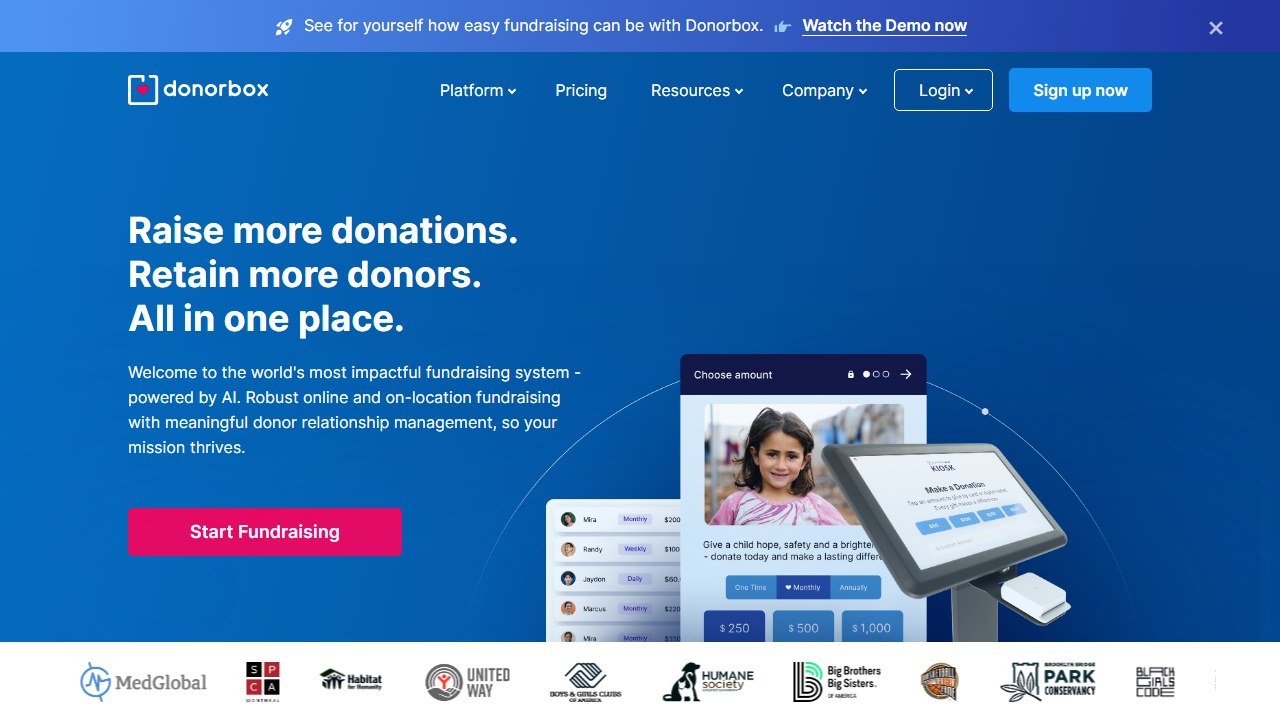
Donorbox is the answer for organizations under $500K in revenue that still want some AI-assisted retention. The recurring giving optimization features (suggested donation amounts that lift conversion, automatic retry on failed payments, sustainer upgrade prompts) are the practical retention features that matter at this scale.
It does not pretend to be a full CRM. It does the donation processing job well, and for small orgs that is often enough.
For the full review, see Donorbox Review 2026.
Website: Visit Donorbox
The decision framework by org size and stage
Under $250K annual revenue: Donorbox plus a free or low-cost tool like Givebutter for events. Retention math at this size does not justify a $200/month CRM yet.
$250K to $1M annual revenue: Bloomerang or Neon CRM. Bloomerang if retention is the conscious priority. Neon if all-in-one (events, membership, fundraising) matters more.
$1M to $5M annual revenue: Layer Gratefully on top of your existing CRM for the donor-intelligence and institutional-memory layer, and pair it with Virtuous or DonorPerfect as the system of record. Virtuous if AI-native workflows and responsive fundraising appeal. DonorPerfect if complex giving programs (planned, capital) need depth.
$5M and above: Gratefully on top of your existing Salesforce or Raiser’s Edge instance is the clearest win. The handover dossier and nightly portfolio review pay for themselves the first time a development director leaves mid-cultivation, which at this scale is the biggest retention threat you have.
The 90-day rollout playbook
Buying the tool is the easy part. The work that actually moves retention rate happens in the first 90 days. Use this cadence regardless of which tool you pick.
Days 1 to 14: Get a clean baseline. Pull your last three years of giving data into the new platform. Run the baseline retention report. Know your current numbers cold before you change anything. The mistake here is starting the AI features before you know what they need to improve. If your current retention is 38 percent and you cannot say which donor segment is dragging the number down, the AI cannot help you yet.
Days 15 to 30: Build the stewardship cadence. Set the rules the AI will optimize against. New donor: thank you call within 48 hours, handwritten note within 14 days, second touchpoint within 60 days. Recurring donor: anniversary acknowledgment, mid-year impact update, year-end thank you. Major donor: quarterly personalized touch, annual impact report, in-person meeting where possible. Without this baseline cadence, the AI has nothing to automate.
Days 31 to 60: Turn on the AI features in order of risk. Start with the lowest risk automations. Auto-thank-you emails. Recurring giving optimization. Lapsed donor alerts to the development team. Wait at least two weeks per feature before adding the next one. The reason: any single feature that produces a weird donor experience needs to be caught and fixed before you compound on top of it.
Days 61 to 90: Add the higher-judgment features. AI-suggested next-best-action. Churn risk scoring with team review. Auto-drafted personalized communications (always with human approval before send). At this stage the development team has enough data to trust or distrust each recommendation, and the corrections you make in this window train the system for the next quarter.
At the end of 90 days, measure. The retention rate metric will not have moved meaningfully yet (that takes a full giving cycle). What should have moved: response time to new donors, percentage of lapsed donors contacted within 30 days of the lapse signal, and the development team’s reported time spent on busywork versus actual cultivation.
Three scenarios from real nonprofits
The picks above only land when you map them to real organizational situations. Three composites from common patterns we see.
Scenario 1: The $200K youth services nonprofit losing 60 percent of donors after year one. Their problem is not the CRM. It is the absence of any structured first-year stewardship beyond the auto-receipt. Recommendation: Bloomerang at $125 per month for the CRM, plus a 14-day project to build the new donor sequence (welcome email at day 1, program impact story at day 21, anniversary touch at day 60, year-end gratitude at day 330). Expected retention lift after one full cycle: from 40 percent to 55 to 60 percent. Annual revenue impact: roughly $30K to $80K in retained giving.
Scenario 2: The $5M community foundation that loses a development director every 18 months. Their problem is institutional memory. Every transition burns 6 months of relationship momentum because the new person spends that long figuring out who the top 30 donors are and what the previous person was working on. Recommendation: Layer Gratefully on top of their existing Salesforce instance. The handover dossier feature solves the specific failure pattern. Bloomerang or Virtuous would also help, but the Gratefully handover dossier is the precise capability that addresses the precise failure. Expected outcome: zero relationships lost in the next staff transition, versus 3 to 5 major gift relationships typically lost in past transitions.
Scenario 3: The $1.2M arts nonprofit with strong event fundraising but weak post-event retention. Their problem is the gala-to-CRM gap. 800 people attended last year’s gala and gave $300K combined. By the end of the year, only 12 percent of those people gave again. Recommendation: GiveSmart for event management, integrated tightly with Virtuous as the main CRM, plus a defined 90-day post-event cultivation sequence for every attendee. Expected outcome over 18 months: post-event retention from 12 percent to 25 to 35 percent, adding $30K to $50K in second-year giving.
None of these examples solve themselves through tool selection alone. Each requires the stewardship cadence to actually run. The tool is the leverage, not the answer.
Common donor retention mistakes AI cannot fix
Three failures repeat across nonprofits that buy retention tools and still see lapse rates climb.
First, treating the tool as the strategy. AI surfaces churn risk. It does not write the thank-you note. If the development team does not act on the alerts, the alerts produce no retention.
Second, no first-90-day stewardship cadence. AI tools assume there is a baseline cadence to optimize. If new donors get one auto-receipt and then silence, the AI has nothing to score.
Third, treating sustainers like one-time donors. Sustainers retain at 80 to 90 percent annually. Stop trying to “reactivate” them. Talk to them like the partners they are.
Where to go from here
If donor knowledge keeps walking out the door when staff leave, start with Gratefully. It is our top pick because it preserves that institutional memory, works your whole portfolio overnight, and hands your team a ranked list each morning with the reason attached, all on top of the CRM you already run.
If you want retention scoring built into the CRM itself rather than as a layer on top, start with the Bloomerang demo. Their retention reporting is the easiest way to understand your own data before you commit to a platform.
For broader fundraising platform decisions, see our Best AI Fundraising Platforms for Nonprofits 2026 roundup.
For donor research and major gifts work that complements retention, see 5 Best AI Donor Research Tools for Nonprofits 2026 and DonorSearch Review 2026.
Reviewed by Faz at AIToolsBakery. We test every tool we recommend on real organizational data. Last updated June 2026.

Written by
FazFaz is the founder of AIToolsBakery. Some tools here are tested hands on. Others are assessed from vendor documentation and pricing verified on the live page, and every review says which one it is. Sponsors can buy a position in a guide. They cannot buy the score, the criticism, or silence about a better option.
How we test and how we make money →