
Warmly is one of the more genuinely interesting tools to land in the sales-tech stack in years. Instead of buying a static list and spraying outbound at strangers, Warmly watches who is already visiting your website, de-anonymizes a slice of that traffic down to the company and sometimes the person, and then orchestrates AI-driven outreach to the ones showing buying behavior. The pitch is seductive: stop guessing who is in-market and talk to the people already raising their hand on your site.
That makes an honest review unusually hard to find, because this is a newer category and the SERP is thin and biased. Most of what exists is either Warmly’s own content marketing or competitor pages defining the category to position against it. The questions that actually decide the purchase get glossed over: what is the real match rate, how much website traffic do you need before it pays off, and what is it structurally blind to? Those are the questions we care about, and they are the ones vendor pages tend to skip.
We bought into this category as analysts, not resellers, and we wanted a verdict grounded in what the tool can and cannot see, plus the traffic threshold below which it simply does not make sense. So here it is, scored on our usual 0 to 5 scale, with match rate and the traffic prerequisite treated as first-class concerns rather than footnotes.
A note on our independence. We are AIToolsBakery, an independent AI-tools review site. We do not sell Warmly, we are not a Warmly partner or reseller, and we earn nothing if you buy it. We have no affiliate deal with any tool in this category. When a post on this site is sponsored, it is labelled as sponsored at the top, and a sponsorship never changes a score or a recommendation. This review is not sponsored. Nobody paid for it, nobody reviewed it before publication, and the only agenda here is helping you decide where to spend a real budget.
The verdict in 30 seconds: Warmly (3.9/5) is best-in-class at one specific job: turning anonymous website traffic into warm, signal-rich outbound. If you have meaningful inbound traffic, it is excellent and the roughly $900-a-month annual floor pays for itself. The catch: it only sees people who visit your site, so it is structurally blind to the job-change, funding, and hiring signals that signal-based tools catch. If your traffic is thin, it is close to pointless.
What Warmly is

Website: Warmly
Warmly is a signal-based revenue-orchestration platform built around website visitor de-anonymization. Its core mechanism: when someone visits your site, Warmly attempts to identify the company they work for, and in some cases the individual, using a mix of IP-to-company matching, reverse-IP data, and partner data sources. It then layers intent on top, so you see not just who visited but what they looked at and how engaged they are.
The second half of the product is orchestration. Once Warmly identifies a warm visitor showing buying behavior, it can trigger action: alert a rep, fire an AI chat prompt on the site, kick off an automated outbound sequence, or surface the account in Slack for human follow-up. The promise is a closed loop from anonymous traffic to booked meeting, with AI doing the routing and the first-touch heavy lifting. It is genuinely a new category for us to cover, and it is a smart one.
If you want the broader landscape before committing, our best AI sales tools for 2026 roundup maps the field, and our best AI SDR tools for 2026 guide covers the outbound-automation side that Warmly’s orchestration layer overlaps with.
What Warmly does well
When Warmly works, it works because it is solving a real and valuable problem. The strengths:
- Warm beats cold, every time. A prospect who just spent four minutes on your pricing page is a fundamentally better outreach target than a name pulled from a static list. Warmly’s entire value is that it lets you talk to people already showing interest, which is the highest-converting kind of outbound there is.
- De-anonymization at the company level is strong. Identifying the company behind anonymous traffic is the mature, reliable core of the product, and Warmly does it well.
- Genuine orchestration, not just alerts. The closed loop from visit to AI chat to sequence to Slack alert is well built, and the automation removes the manual lag between “someone is interested” and “someone reached out.”
- Right-time outreach. Because the trigger is live website behavior, the timing is excellent. You are reaching people while they are actively considering you, not weeks later.
For an inbound-heavy business, this is a meaningful edge. You are converting traffic you already paid to acquire, which is some of the best-leveraged spend in go-to-market.
The honest limitation: it only sees your traffic
This is the most important section in the review, so it gets its own heading. Warmly’s strength and its ceiling are the same fact: it only knows about people who visit your website.
That sounds obvious, but it has a profound consequence. Warmly is structurally blind to the signals that signal-based prospecting tools are built to catch. A prospect changing jobs to a target account, a company that just raised a funding round, a team that just posted ten new sales roles: these are some of the strongest buying signals in B2B, and Warmly cannot see any of them unless those people happen to land on your site. Tools like Clay and the broader signal-based stack are designed to surface exactly these off-site triggers and build outbound around them. Warmly is not competing in that lane at all.
So the two approaches are complements, not substitutes. Warmly captures demand that already exists and is visiting you. Signal-based tools manufacture and find demand out in the market. A mature go-to-market motion often wants both, but if you can only have one, the right choice depends entirely on where your pipeline comes from. If you have little inbound traffic, Warmly has very little to work with, and a signal-based tool is the better first investment.
There is also the match-rate caveat that applies to every de-anonymization tool: person-level identification is far less reliable than company-level, and a meaningful share of traffic will never resolve at all. Set expectations at the company level, treat person-level matches as a bonus, and do not expect to de-anonymize anywhere near all of your visitors.
Honest pricing
Warmly is sold on an annual contract with usage tied to the volume of visitors and reveals you need, and the entry point sits at roughly a $900-a-month annual floor for serious use. There is a free tier and trial motion to test the waters, which is more buyer-friendly than the sales-led black boxes elsewhere in this category, but the meaningful plans are annual commitments.
The honest way to think about the price is as a function of traffic. At a $900-a-month floor, the tool needs to surface and convert enough warm accounts to clear that bar plus your time. For a business with strong inbound traffic, that is an easy hurdle and the ROI is obvious. For a business with thin traffic, you are paying a fixed floor to de-anonymize a trickle, and the math does not work. The price is not high in absolute terms for what it does. It is only high relative to how little it can do when there is not enough traffic to feed it.
How Warmly compares
| Tool | Core mechanism | Sees off-site signals? | Pricing model | Best for |
|---|---|---|---|---|
| Warmly | Website visitor de-anonymization + AI orchestration | No, only your site traffic | Annual, ~$900/mo floor, free tier | Inbound-heavy teams converting existing traffic |
| Clay | Signal-based data + enrichment + automation | Yes, job changes, funding, hiring | Credit-based, self-serve tiers | Teams building signal-driven outbound from scratch |
| Apollo | Static database + all-in-one outreach | Limited | Transparent, self-serve, free tier | SMB and mid-market broad prospecting |
| Artisan | Autonomous AI SDR agents | Partial, via data partners | Annual, sales-led | Teams automating full SDR workflows |
The pattern: Warmly is the specialist for converting inbound. Clay is the specialist for manufacturing outbound from off-site signals. They solve different halves of the same problem, and the right pick follows your pipeline source.
Pros and cons
Pros
- Best-in-class at turning anonymous website traffic into warm, timely outbound
- Strong, reliable company-level de-anonymization
- Genuine end-to-end orchestration: visit to AI chat to sequence to Slack alert
- Excellent timing because triggers are live on-site behavior
- Free tier and trial make it easy to test before committing
Cons
- Structurally blind to off-site signals like job changes, funding, and hiring
- Value collapses if you do not have meaningful inbound traffic
- Person-level match rates are far lower than company-level
- Roughly $900-a-month annual floor is a fixed cost regardless of how much traffic it has to work with
- A complement to, not a replacement for, signal-based prospecting tools
Who should (and should not) buy it
Buy Warmly if you have meaningful inbound website traffic that currently goes unidentified and unworked, you want to convert demand you already paid to acquire, and you have a sales team ready to act on warm alerts quickly. For an inbound-heavy SaaS or services business, this is one of the highest-leverage tools you can add, and it earns its keep fast.
Do not buy Warmly if your website traffic is thin, because the tool will have almost nothing to de-anonymize and the fixed floor will not pay back. If your pipeline needs to be manufactured rather than captured, start with a signal-based tool that can find demand out in the market. Our best AI SDR tools for 2026 guide and our Clay review cover the off-site-signal side that Warmly deliberately does not address.
Our verdict
Warmly is an excellent tool with a clearly defined job, and we respect a product that does one thing genuinely well rather than ten things adequately. For a business with real inbound traffic, it closes a gap that has frustrated marketers for years: all those anonymous visitors who never convert and never get followed up. Turning that traffic into warm, well-timed outbound is high-leverage work, the orchestration is well built, and the roughly $900-a-month floor is easy to justify when there is enough traffic to feed it.
The honest ceiling is the same fact that makes it good: it only sees your site. It is blind to the off-site buying signals that signal-based tools are built to catch, and its entire value is gated behind one number, your inbound traffic volume. Get that number right before you sign. If you have the traffic, Warmly is close to best-in-class and a confident recommendation. If you do not, it is the wrong first investment no matter how good the demo looks. Warmly scores 3.9 out of 5.
undefined
What an AI SDR actually is, and what it costs
This is the newest and least standardised category in sales software, and the label covers products that do very different things. Before comparing Warmly to anything, work out which of the three you are being sold.
Three products, one label
Some are copy generators bolted to a sequencer. Some are full outbound systems that source the list, write the message, send it and book the meeting. Some are essentially a managed service with software attached, where a human runs the campaign and the AI drafts. The third can be a perfectly good purchase, but it is an agency retainer wearing a software price tag and it should be compared to agencies.
What the published figures look like
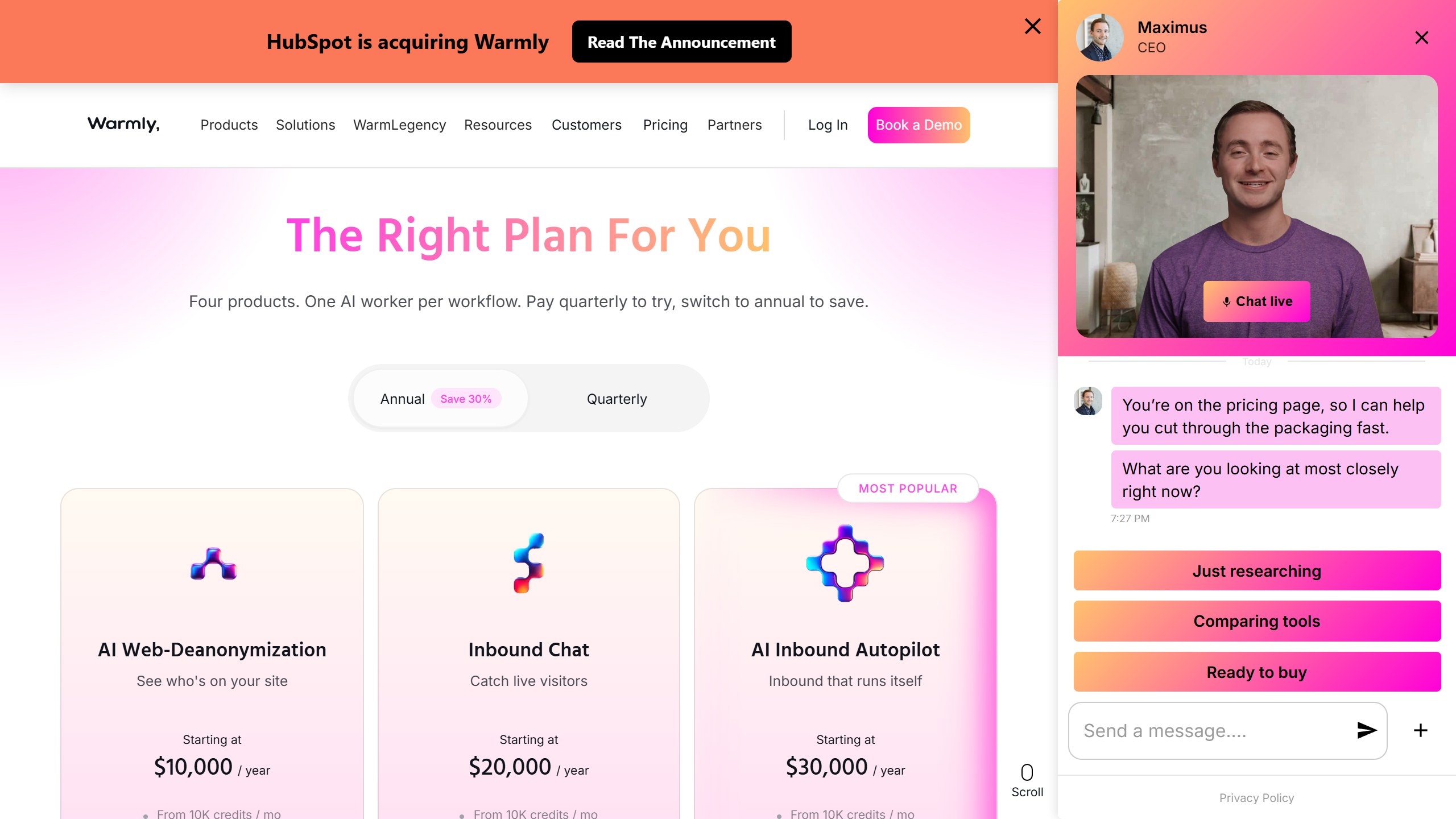
AiSDR publishes from $250 a month, then $900 and $2,500, with a managed service at an extra $149 per campaign or $2,500 a month, and a quarterly commitment on most plans. Warmly publishes $10,000, $20,000 and $30,000 a year, each starting from 10,000 credits a month, and note its pricing URL redirects. Artisan has removed its figures entirely, its cards now reading that pricing is scoped on your plan. All read 4 September 2026.
The commitment is the thing to negotiate
Quarterly and annual minimums are common here and they exist because these tools take time to produce anything measurable. That is a fair argument, and it is also a lock-in on an unproven category. If you cannot get a monthly term, get a defined exit at the first review point in writing, and agree in advance what result at that point would mean you stop.
The disclosure question your brand has to answer
Decide before launch whether a recipient can tell they are corresponding with software, and what happens when they reply and ask. This is a positioning decision rather than a legal one in most jurisdictions, and getting it wrong is a brand problem you cannot unwind. The teams that handle it well decide the policy first and configure the tool to match; the ones that do not find out when a prospect posts the exchange publicly.
Compare it to the honest alternative
The real comparison for an AI SDR is not another AI SDR, it is a junior SDR plus a stack. At $2,500 a month you are at $30,000 a year, which in many markets is a meaningful share of a real salary, and a person also handles the conversation after the reply. Price both, including the stack the human would need, and be honest about which part of the job you are actually trying to fill.
How credit pricing actually works, and the four questions that decide your bill
Credits are the reason two vendors quoting similar monthly figures can differ threefold in practice. Ask Warmly and every competitor the same four questions in writing.
What spends a credit
Revealing an email, revealing a phone number, enriching an existing record and exporting a list are often priced differently, and a mobile number frequently costs several times an email. Ask for the table. A plan advertised as 1,000 credits can be 1,000 emails or roughly 200 phone numbers, and if your team works the phone that distinction is your whole budget.
Whether a credit is spent again on the same person
This is the question almost nobody asks and it is worth the most. Some vendors charge every time you touch a record; Cognism publishes that it only spends again when a contact changes jobs. On a stable account list worked repeatedly over a year, that single difference can halve consumption. Get the answer in the contract rather than from a rep.
Whether unused credits roll over, and what overage costs
Outbound is seasonal. If credits expire monthly you will pay for capacity you cannot use in a quiet month and run out in a busy one. Ask whether allowances roll over, whether they pool across seats, and above all what a credit costs once you exceed the plan, because the overage rate is where the margin sits and it is almost never on the pricing page.
What happens to revealed data when you leave
Ask whether contacts you already revealed remain usable after the contract ends, and in what form you can export them. Some agreements treat the data as licensed rather than purchased, which means the enrichment you spent a year paying for does not come with you. That single clause is often the largest hidden switching cost in this category, and it is entirely invisible until you try to go.
The test that settles it
Give each vendor the same list of 200 accounts from your real ICP and ask them to run it during the trial. Then count three things: how many contacts were found, how many emails bounced when you actually sent, and how many credits it consumed. Coverage claims are marketing; a bounce rate on your own list is evidence.
Where the figures on this page come from
Every price here was read from the vendor’s own pricing page on 4 September 2026, not from an aggregator. That distinction matters in this category, because several vendors changed or withdrew their published figures during the past year and a great deal of what circulates describes packaging that no longer exists.
The pages we read
Apollo publishes $49, $79 and $119 per seat per month on annual billing, plus the credit allowance. Lusha publishes $0, $37.45, $52.45 and $299.95 a month billed yearly, tied to a credit volume selector. lemlist publishes $55 and $87 per user per month annually. Reply.io publishes $29 and $69 per month per account. AiSDR publishes from $250 a month. Warmly publishes $10,000 to $30,000 a year. Lavender publishes free to $89 a seat.
The ones that publish nothing
ZoomInfo renders a long pricing page with no figure on it. Cognism and Gong publish packaging and models but no numbers. Outreach publishes packaging only, and note the domain moved from outreach.io. Salesloft’s pricing URL now redirects to a page titled “Talk to Sales”, so it has no pricing page at all. Artisan removed its figures during 2026.
What we do not do
We do not carry a figure we cannot source to the vendor. Where a number circulates and cannot be traced, we say so and withdraw it rather than repeating it with a hedge, and we have withdrawn our own published figures on that basis more than once. Every price here carries the date we read it, because in this market a claim without a date is not checkable.

Written by
FazFaz is the founder of AIToolsBakery. Some tools here are tested hands on. Others are assessed from vendor documentation and pricing verified on the live page, and every review says which one it is. Sponsors can buy a position in a guide. They cannot buy the score, the criticism, or silence about a better option.
How we test and how we make money →