
An AI SDR is a software agent that runs the top of the sales pipeline that a human sales development rep used to run by hand: it finds accounts that match your ideal customer profile, enriches contact data, writes and sends outbound messages across email and LinkedIn, replies to responses, and books meetings into a calendar. In 2026 the good ones handle the repetitive volume work well, but they still need a human to set strategy, review messaging, and own real conversations. Think augmentation, not a drop-in human replacement.
The short version
If you have ever wondered whether you can hire a robot to do cold outbound, the honest answer is: partly. AI SDR tools are real, they ship today, and several are genuinely useful. They are also oversold. This guide explains what an AI SDR actually does step by step, where it helps, where it quietly fails, and how to evaluate one without getting burned by a slick demo.
We sell nothing here except clarity. When you are ready to compare specific products, we point you to our best AI SDR tools roundup rather than ranking vendors inside this explainer.
What “SDR” means, and what “AI SDR” adds
SDR stands for sales development representative. A human SDR sits at the very front of the funnel. Their job is not to close deals. Their job is to start conversations: build a list of target accounts, research them, send cold emails and LinkedIn messages, handle the first few replies, and book a qualified meeting for an account executive. It is high-volume, repetitive, and burns people out fast.
An AI SDR is software that automates most of that motion. Instead of a person manually copying a name from LinkedIn into a spreadsheet, writing a first line, and pasting it into a sequencer, the AI agent chains those steps together. The category overlaps heavily with sales engagement platforms and enrichment tools, but the framing is different: an AI SDR is sold as a worker, often with a name and an avatar, rather than as a feature.
How an AI SDR actually works, step by step
Marketing pages love the phrase “fully autonomous.” Under the hood, almost every AI SDR runs the same seven-stage pipeline. Understanding each stage tells you exactly where the value is and where the risk hides.
Stage 1: ICP and trigger detection
The agent starts from your ideal customer profile: company size, industry, region, tech stack, job titles. The better tools layer in buying triggers, recent funding, a new hire in a relevant role, a job posting that signals a need, or use of a competitor’s product. This is where data quality decides everything. A trigger is only as good as the database feeding it. For background on the data layer, see our Apollo.io review.
Stage 2: List build and enrichment
Once the criteria are set, the agent pulls a list of matching companies and people, then enriches each record with a verified email, phone, LinkedIn URL, and firmographic fields. Enrichment quality varies wildly between providers, and a bad email list will sink any campaign before a single word is written. This is the single most underrated stage.
Stage 3: Message generation
Here is the part everyone fixates on. The agent drafts a first email, often with a personalized opening line scraped from a prospect’s LinkedIn, company news, or website. Some tools generate the entire sequence: first touch, two or three follow-ups, and a breakup email. The quality ranges from genuinely sharp to embarrassingly generic. If you want to do this part well by hand or with a copilot, read our companion guide on how to write cold emails with AI.
Stage 4: Multichannel send and sequencing
The drafts go into a sending engine that spaces messages over days, rotates inboxes, throttles volume, and pauses when someone replies. Modern AI SDRs send across email and LinkedIn, sometimes adding calling. The sending infrastructure, inbox rotation, warmup, and deliverability protection matters more than the AI itself.
Stage 5: Reply handling
When a prospect responds, the agent classifies the reply (interested, not interested, out of office, wrong person, “send me info”) and drafts or sends a response. This is where “autonomous” gets shaky. Classifying a reply is easy. Handling a nuanced objection or a buying signal hidden in a casual sentence is not.
Stage 6: Meeting booking
For positive replies, the agent proposes times and drops a meeting on a calendar, ideally the right account executive’s calendar with the right context attached. The smoother tools integrate directly with scheduling links and avoid the awkward back-and-forth.
Stage 7: CRM logging
Finally, every touch, reply, and booked meeting is written back to your CRM so reps and managers have a clean record. Weak CRM sync is a common and frustrating failure point that quietly corrupts your pipeline data.
Why the pipeline framing matters
Once you see these seven stages, the marketing language stops working on you. “Fully autonomous AI sales rep” really means “an agent that chains seven well-understood steps.” Each step already existed as its own software category: enrichment tools did stage 2, sequencers did stage 4, schedulers did stage 6. What the AI SDR adds is the connective tissue and the message generation in stage 3. That is genuinely useful, but it also means a weakness in any single stage drags down the whole. A brilliant message engine sitting on a stale database produces personalized emails to people who left the company a year ago. Evaluate the chain, not the headline.
AI SDR vs human SDR: an honest comparison
Neither is strictly better. They are good at different things. Here is how they actually stack up.
| Dimension | AI SDR | Human SDR |
|---|---|---|
| Cost | Lower per message, often a flat monthly fee | Salary plus commission plus tools and management |
| Volume | Very high, thousands of touches without fatigue | Limited by hours in a day |
| Personalization quality | Good at surface personalization, weak at genuine insight | Capable of real, researched relevance |
| Judgement | None, follows rules and patterns | Reads nuance, context, and intent |
| Ramp time | Days to configure | Weeks to months to onboard |
| Handling objections | Scripted, breaks on the unexpected | Adapts in real time |
| Consistency | Perfectly consistent, never has a bad day | Variable |
| Best use | High-volume top of funnel, list work, follow-up discipline | Complex deals, nuanced accounts, relationship building |
The pattern is clear. AI wins on volume, cost, consistency, and tireless follow-up. Humans win on judgement, nuance, and genuine relationship building. The smartest teams in 2026 run both: AI handles the repetitive grind, humans take the conversations that matter.
A useful mental model
Think of an AI SDR the way a manager thinks of a fast, reliable, completely literal junior hire. It will do exactly what you tell it, thousands of times, without complaint or fatigue. It will not improvise, it will not catch your mistakes, and it will not notice when the situation has quietly changed. That framing keeps your expectations honest. You would not hand a brand-new junior your most important strategic account on day one with no oversight. You would give them the high-volume, low-judgement work, check their output, and graduate them slowly. Treat the AI the same way and you will rarely be burned. Treat it like a seasoned closer and you will be.
Notice too that the comparison is not really “AI versus human” in most real teams. It is “AI plus human versus human alone” or “AI plus human versus nothing at all.” Plenty of small teams have no SDR function whatsoever because they cannot afford one. For them, an AI SDR is not replacing a person, it is adding a capability they never had. That is a different and usually safer decision than firing a working human team and betting the pipeline on software.
Where AI SDRs fail: the honest limitations
Vendor blogs skip this section. We will not, because these failure modes cost real money and real reputation.
Deliverability risk
An AI SDR can generate volume far faster than your sending infrastructure can safely handle. Send too much, too fast, from cold inboxes and you land in spam, get your domain flagged, and poison your primary email. The AI does not feel this pain. You do. Volume without deliverability discipline is the fastest way to wreck a domain. This is why warmup and ramp logic matter more than message cleverness.
Generic personalization
“I saw your company is in the SaaS space” is not personalization. A lot of AI first lines pattern-match to something shallow and obvious, then dress it up as insight. Prospects in 2026 have seen thousands of these and pattern-match right back to “automated, ignore.” Surface personalization at scale can be worse than no personalization, because it signals effort that is not really there.
No real judgement
An AI SDR cannot tell that a prospect’s offhand reply actually signals a budget cycle opening next quarter. It cannot decide that an account is worth a custom approach. It follows rules. The moment a situation falls outside its patterns, it either does nothing useful or does something wrong with total confidence.
Brand risk
Every message an AI sends goes out under your company name. A tone-deaf line, a wrong merge field (“Hi {{first_name}}”), or an aggressive follow-up to someone who already said no reflects on your brand, not the vendor’s. At scale, small error rates become large numbers of annoyed prospects.
How to evaluate an AI SDR (a checklist)
Use this when you sit through demos. Score each item 0 to 5 and add it up. Anything that scores low on data quality or deliverability should worry you more than a weak feature elsewhere.
- Data quality (0 to 5): How fresh and accurate is the contact database? Ask for a verified-email bounce rate, not a marketing claim.
- Personalization depth (0 to 5): Does it pull genuine signals, or does it pattern-match to obvious surface facts?
- Deliverability tooling (0 to 5): Inbox rotation, warmup, volume ramp, spam monitoring. Non-negotiable.
- Reply handling (0 to 5): Does it actually understand objections, or just classify and template?
- CRM integration (0 to 5): Native, two-way sync with your CRM, or a brittle export?
- Human-in-the-loop controls (0 to 5): Can you review and approve before sends, or is it fire-and-forget?
- Transparency (0 to 5): Can you see exactly what was sent, to whom, and why?
- Pricing model (0 to 5): Predictable, or does it balloon with usage and seats?
A tool that scores 4 or 5 on data and deliverability but 2 on flashy AI features will beat the reverse every time. Boring fundamentals win in outbound.
Watch the specific products
We do not re-rank vendors inside this guide. For deep, independent breakdowns of the leading agents, read our Artisan review and our AiSDR review. Each one covers real deliverability behavior, data quality, and where the autonomy claims hold up versus where they crack.
The realistic take: AI augments, it does not replace
The “AI SDR replaces your whole sales team” narrative sells software. It does not match reality in 2026. What actually works is a division of labor.
Let the AI do what it is good at: building lists, enriching records, sending disciplined follow-up sequences, and keeping the CRM clean. These are the tasks humans hate and do inconsistently. Then let your humans do what only humans can: spot the nuanced opportunity, write the genuinely researched outreach to a high-value account, handle the messy objection, and build the relationship that closes a deal.
Teams that treat the AI as a tireless junior assistant get a real lift in pipeline coverage. Teams that treat it as a full human replacement tend to flood the market with generic messages, hurt their domain reputation, and wonder why reply rates collapsed. The technology is a force multiplier on whatever strategy you point it at. Point it at a bad strategy and it multiplies the badness faster.
A simple adoption path
- Fix your data and ICP definition first. Garbage in, garbage out, at scale.
- Get deliverability right: dedicated domains, warmup, conservative ramp.
- Let AI draft, but have a human approve messaging until quality is proven.
- Start narrow, measure reply quality not just volume, then expand.
- Keep humans on the high-value conversations the AI should never touch.
Metrics that tell you the truth
Vanity metrics will lie to you here. “Emails sent” goes up the moment you turn the tool on and tells you nothing. Open rates are increasingly unreliable because of privacy protection that auto-loads images. Focus instead on the metrics that survive scrutiny: positive reply rate, meetings booked that actually happen, and pipeline that converts to closed revenue. Track your spam complaint rate and bounce rate like a hawk, because those are the early warning signs that your volume is outrunning your reputation. A campaign that sends ten thousand emails and books two real meetings is not a win, it is a slow-motion domain fire. A campaign that sends five hundred and books eight is the one to scale.
It also helps to set a quality floor before you start. Decide in advance what an unacceptable bounce rate or complaint rate looks like, write it down, and kill any campaign that crosses it. The whole danger of an AI SDR is that it removes the natural friction a tired human provides. A person sending by hand simply cannot blast a bad list fast enough to destroy a domain in an afternoon. The software can. Your numbers and your thresholds are the brakes the tool does not have.
Where to go next
If you understand the pipeline, the trade-offs, and the failure modes, you are ready to look at specific tools. Start with our best AI SDR tools for 2026, then dig into the individual reviews that match your stack. And before you let any agent write a single send, read how to write cold emails with AI so the messages it produces actually sound like a human worth replying to.
An AI SDR is a powerful tool. It is not a person. Treat it like the capable, fast, judgement-free assistant it is, and it will earn its keep. Expect it to think for you, and it will quietly disappoint you at scale.
undefined
What an AI SDR actually is, and what it costs
This is the newest and least standardised category in sales software, and the label covers products that do very different things. Before comparing an AI SDR to anything, work out which of the three you are being sold.
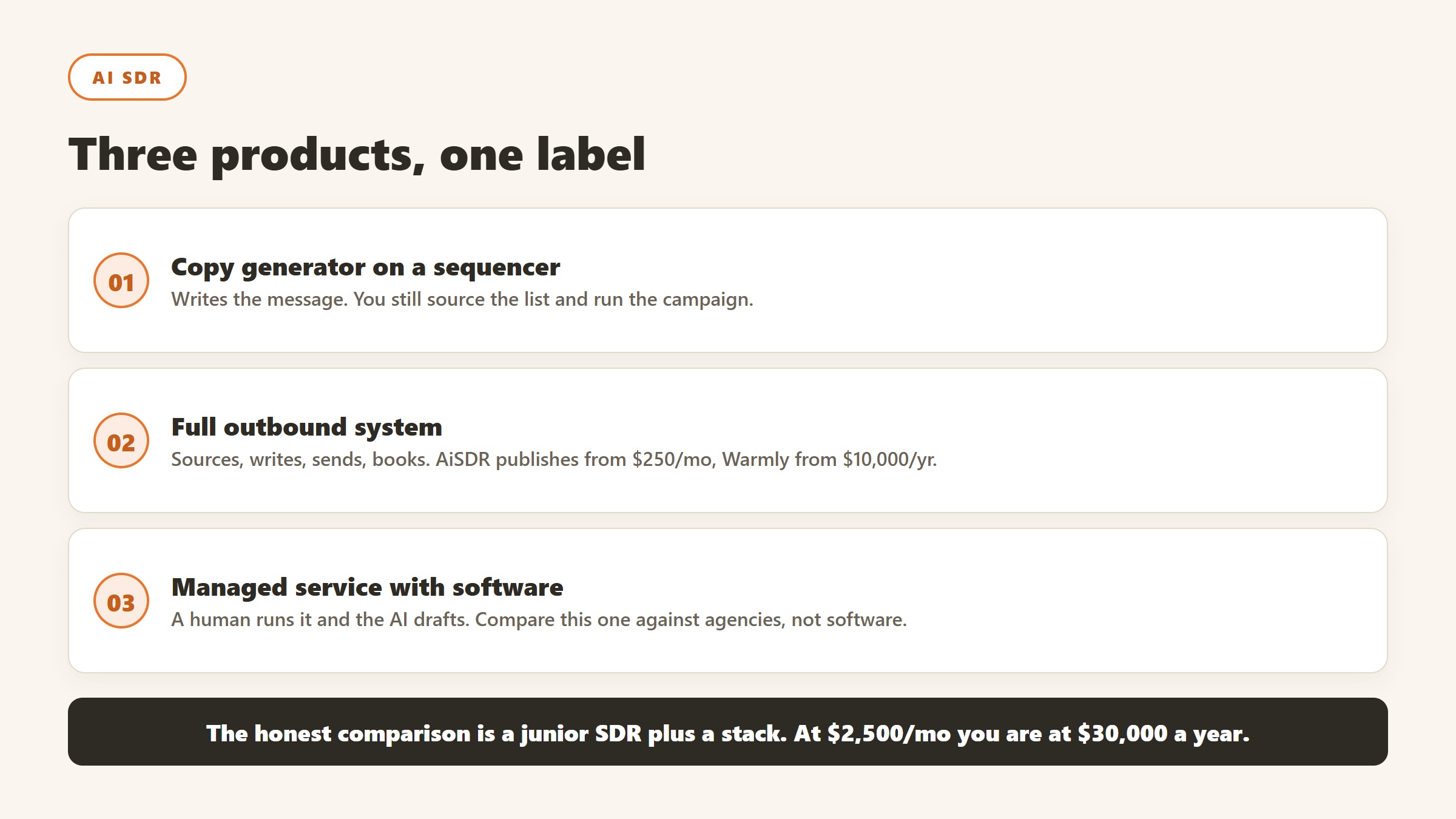
Three products, one label
Some are copy generators bolted to a sequencer. Some are full outbound systems that source the list, write the message, send it and book the meeting. Some are essentially a managed service with software attached, where a human runs the campaign and the AI drafts. The third can be a perfectly good purchase, but it is an agency retainer wearing a software price tag and it should be compared to agencies.
What the published figures look like
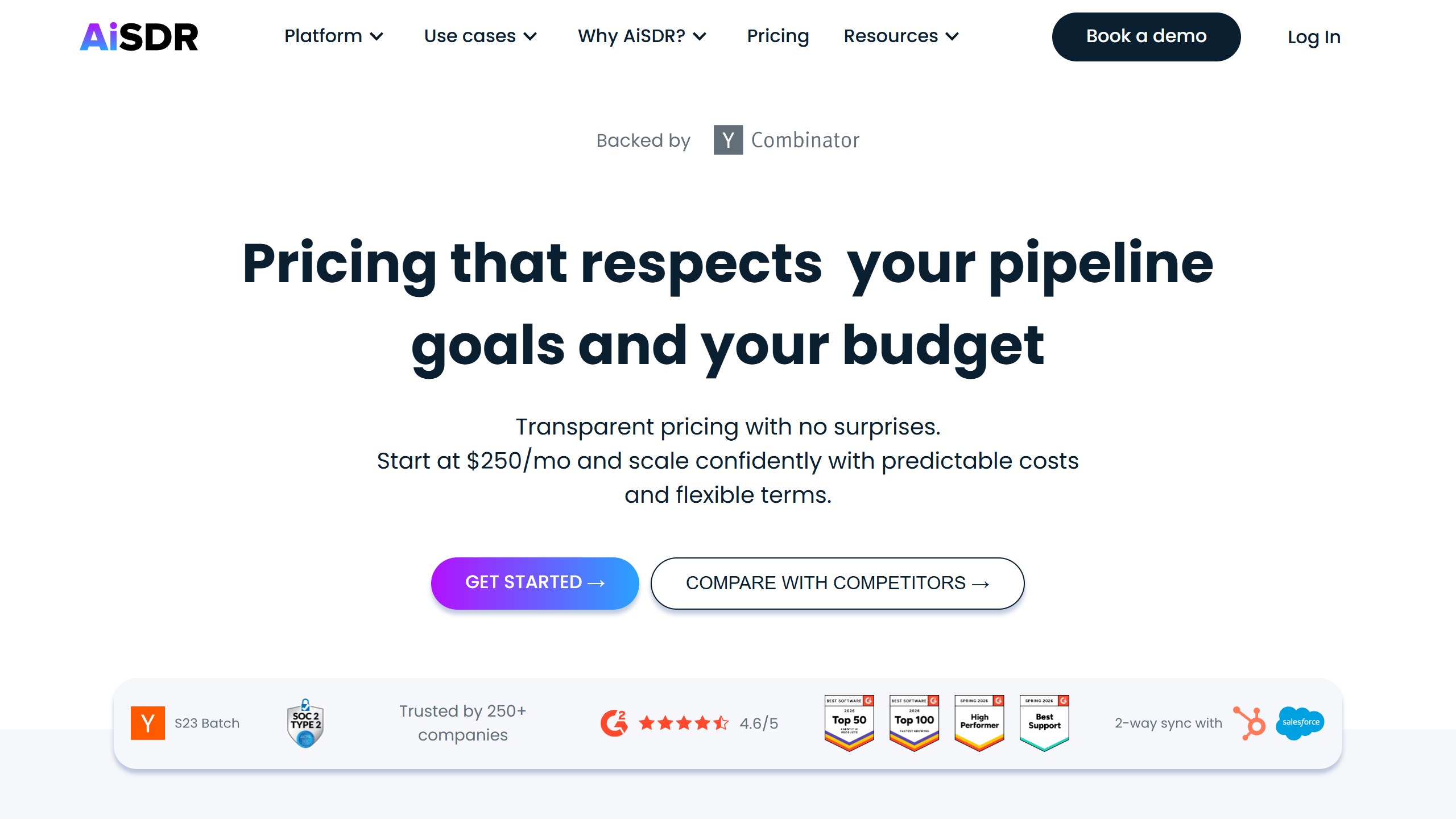
AiSDR publishes from $250 a month, then $900 and $2,500, with a managed service at an extra $149 per campaign or $2,500 a month, and a quarterly commitment on most plans. Warmly publishes $10,000, $20,000 and $30,000 a year, each starting from 10,000 credits a month, and note its pricing URL redirects. Artisan has removed its figures entirely, its cards now reading that pricing is scoped on your plan. All read 4 September 2026.
The commitment is the thing to negotiate
Quarterly and annual minimums are common here and they exist because these tools take time to produce anything measurable. That is a fair argument, and it is also a lock-in on an unproven category. If you cannot get a monthly term, get a defined exit at the first review point in writing, and agree in advance what result at that point would mean you stop.
The disclosure question your brand has to answer
Decide before launch whether a recipient can tell they are corresponding with software, and what happens when they reply and ask. This is a positioning decision rather than a legal one in most jurisdictions, and getting it wrong is a brand problem you cannot unwind. The teams that handle it well decide the policy first and configure the tool to match; the ones that do not find out when a prospect posts the exchange publicly.
Compare it to the honest alternative
The real comparison for an AI SDR is not another AI SDR, it is a junior SDR plus a stack. At $2,500 a month you are at $30,000 a year, which in many markets is a meaningful share of a real salary, and a person also handles the conversation after the reply. Price both, including the stack the human would need, and be honest about which part of the job you are actually trying to fill.
Where the figures on this page come from
Every price here was read from the vendor’s own pricing page on 4 September 2026, not from an aggregator. That distinction matters in this category, because several vendors changed or withdrew their published figures during the past year and a great deal of what circulates describes packaging that no longer exists.
The pages we read
Apollo publishes $49, $79 and $119 per seat per month on annual billing, plus the credit allowance. Lusha publishes $0, $37.45, $52.45 and $299.95 a month billed yearly, tied to a credit volume selector. lemlist publishes $55 and $87 per user per month annually. Reply.io publishes $29 and $69 per month per account. AiSDR publishes from $250 a month. Warmly publishes $10,000 to $30,000 a year. Lavender publishes free to $89 a seat.
The ones that publish nothing
ZoomInfo renders a long pricing page with no figure on it. Cognism and Gong publish packaging and models but no numbers. Outreach publishes packaging only, and note the domain moved from outreach.io. Salesloft’s pricing URL now redirects to a page titled “Talk to Sales”, so it has no pricing page at all. Artisan removed its figures during 2026.
What we do not do
We do not carry a figure we cannot source to the vendor. Where a number circulates and cannot be traced, we say so and withdraw it rather than repeating it with a hedge, and we have withdrawn our own published figures on that basis more than once. Every price here carries the date we read it, because in this market a claim without a date is not checkable.

Written by
FazFaz is the founder of AIToolsBakery. Some tools here are tested hands on. Others are assessed from vendor documentation and pricing verified on the live page, and every review says which one it is. Sponsors can buy a position in a guide. They cannot buy the score, the criticism, or silence about a better option.
How we test and how we make money →