
Clio and MyCase are two of the leading cloud practice management platforms for solo attorneys and small law firms, and both do the core job well: matters, time tracking, billing, trust accounting, client intake, and a client portal, all in one place. The honest short answer is that neither wins outright. Fit depends on your budget, the integrations you already depend on, and whether you want the biggest ecosystem on the market or a simpler, cheaper all-in-one. This side-by-side breaks down where each one pulls ahead so you can match the tool to your firm rather than to a headline.
Bottom line: pick Clio for the largest integration ecosystem and higher-end features like advanced reporting and Clio Duo AI. Pick MyCase for a simpler, often cheaper all-in-one with built-in payments through LawPay and the MyCase IQ AI assistant. Both cover the core practice management job well for solo and small firms.
Faz says: Choose on three things, in this order. First, the integrations you actually depend on. If your accountant lives in a specific tool, or you rely on a niche document or CRM app, check that the platform supports it before anything else, because Clio’s marketplace is far larger here. Second, budget per user per month, since the gap between the two adds up fast across a team. Third, whether you want best-of-breed (bolt on the tools you like, which favors Clio) or one all-in-one system that just works out of the box (which favors MyCase). Get those three right and the decision usually makes itself.
Saru says: This comparison draws on both vendors’ official documentation, published pricing and plan tiers, their announced AI features, and aggregated user feedback, current to 2026. Pricing and plan names change often in this category, so confirm the current per-user cost and that your specific integrations are supported directly with each vendor before you buy.
The Short Answer
Choose Clio if you want the market leader with the largest app marketplace, deeper reporting, and higher-end features, and you are willing to pay a bit more per user. Choose MyCase if you want a simpler, often cheaper all-in-one that bundles payments and an AI assistant without much setup. Solo and small firms are well served by either, so the tiebreaker is usually integrations and price.
Comparison Table
| Clio | MyCase | |
|---|---|---|
| Best for | Firms wanting the biggest ecosystem and higher-end features | Solo and small firms wanting a simple, cheaper all-in-one |
| Starting price | ~$49/user/mo (EasyStart), as of 2026 | ~$39/user/mo (Basic), as of 2026 |
| Top tier | ~$149/user/mo (Complete), as of 2026 | ~$89 to $109/user/mo (Advanced), as of 2026 |
| AI assistant | Clio Duo (on higher tiers) plus vLex legal research | MyCase IQ (on Pro and up) |
| Client intake / CRM | Yes, plus Clio Grow add-on | Yes, built in |
| Built-in payments | Yes, Clio Payments | Yes, via LawPay (same parent company) |
| Integrations | Largest marketplace, hundreds of apps | Fewer third-party apps, more all-in-one |
| Accounting | Native trust accounting, integrates with QuickBooks/Xero | Native trust accounting plus MyCase Accounting add-on |
| Ease of use | Deep and capable, slightly steeper | Often praised as simpler to learn |
Pricing Compared
These two take opposite approaches to telling you what they cost, and it is the most useful thing to know before you compare features.
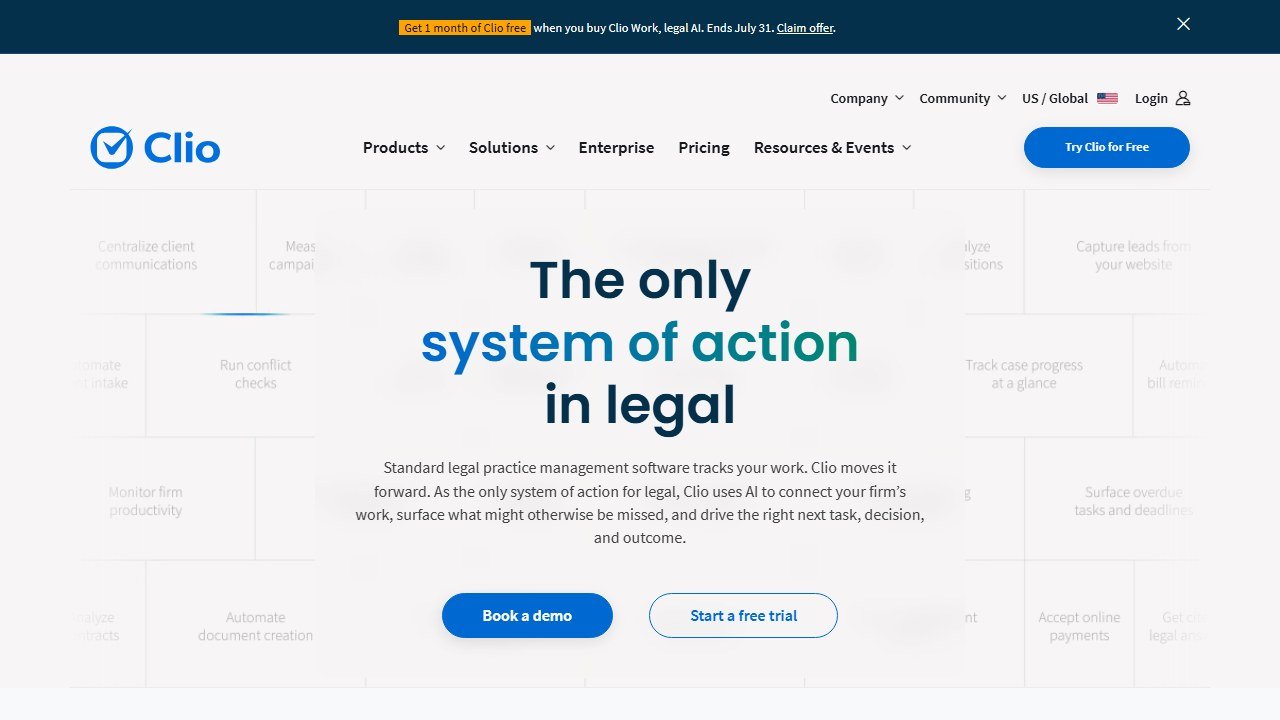
Clio publishes one number. Its pricing page shows “Starting at $49/user” against the Starter plan and nothing else. The plans named on the page are Starter and Elite, and no price appears for anything above Starter. Checked on clio.com/pricing, 5 August 2026.
That means Clio’s real cost for any firm that needs more than the entry tier, which is most firms wanting the AI assistant and deeper reporting, cannot be established without a sales conversation. Treat any Clio tier price you read elsewhere, including older versions of this page, as unverified.
MyCase publishes everything. All three tiers, both billing cycles, and the annual saving, stated in its own words on the pricing page:
| MyCase plan | Billed annually | Billed monthly | Annual saving |
|---|---|---|---|
| Basic | $50 per user/month | $60 per user/month | $120/year |
| Pro | $100 per user/month | $120 per user/month | $240/year |
| Advanced | $130 per user/month | $150 per user/month | $240/year |
Read from mycase.com/pricing on 5 August 2026. Built-in payments through LawPay come as part of the platform rather than a separate line item.
A correction worth stating plainly. An earlier version of this comparison put MyCase Basic at about $39, Pro at about $89 and Advanced between $89 and $109, and concluded from those figures that MyCase was the more affordable of the two at most tiers. Those numbers were wrong, understating MyCase by between 20% and 50%, and the conclusion built on them was wrong with them. On published prices, Clio Starter at $49 per user is cheaper at entry than MyCase Basic at $50. We have corrected the figures and the verdict rather than quietly adjusting the numbers.
The honest comparison is therefore narrower than it looks. You can compare entry tiers, $49 against $50, and beyond that you are comparing a published ladder against an unpublished one. If your firm needs the AI assistant, MyCase tells you it is $100 per user per month on Pro and Clio does not tell you anything, so the only way to run the numbers is to get a Clio quote and put it beside the table above.
The practical takeaway: for a small firm counting seats, MyCase is usually the cheaper entry point, especially at the bottom tier. Clio costs more at the top but buys you deeper features and a far larger ecosystem. Confirm the current numbers with each vendor, since pricing in this category shifts often.
For the full version of Clio’s side of this math, including Duo add-on costs and every tier gap, see our dedicated Clio pricing breakdown.
AI Features: Clio Duo vs MyCase IQ
Both platforms added AI assistants, and both are useful without being magic. Clio Duo is Clio’s built-in assistant, surfacing insights, drafting help, and answers about your matters and data, and it sits on Clio’s higher tiers. Clio also acquired legal research provider vLex in 2025, which pushes it beyond in-app assistance and toward genuine legal research and drafting, a meaningful edge if research is part of your daily work.
MyCase IQ is MyCase’s AI assistant, focused on practical drafting: correspondence, document summaries, and legal writing help inside the platform, available on the Pro tier and up. It is squarely aimed at the everyday work of a small firm rather than deep research.
The realistic take: if you want AI that reaches into legal research, Clio’s Duo plus vLex direction is the stronger long-term bet. If you want a straightforward writing and summarizing assistant bundled into an affordable plan, MyCase IQ does that job at a lower price point. Neither replaces a lawyer’s judgment, and both should have their output checked.
Integrations and Ecosystem
This is Clio’s clearest advantage. Clio’s app marketplace is the largest in legal practice management, with hundreds of integrations spanning document management, accounting, e-signature, CRM, communications, and more. If your firm has a stack you already like, Clio is the platform most likely to plug into all of it, and that best-of-breed flexibility is a big part of why it leads the market.
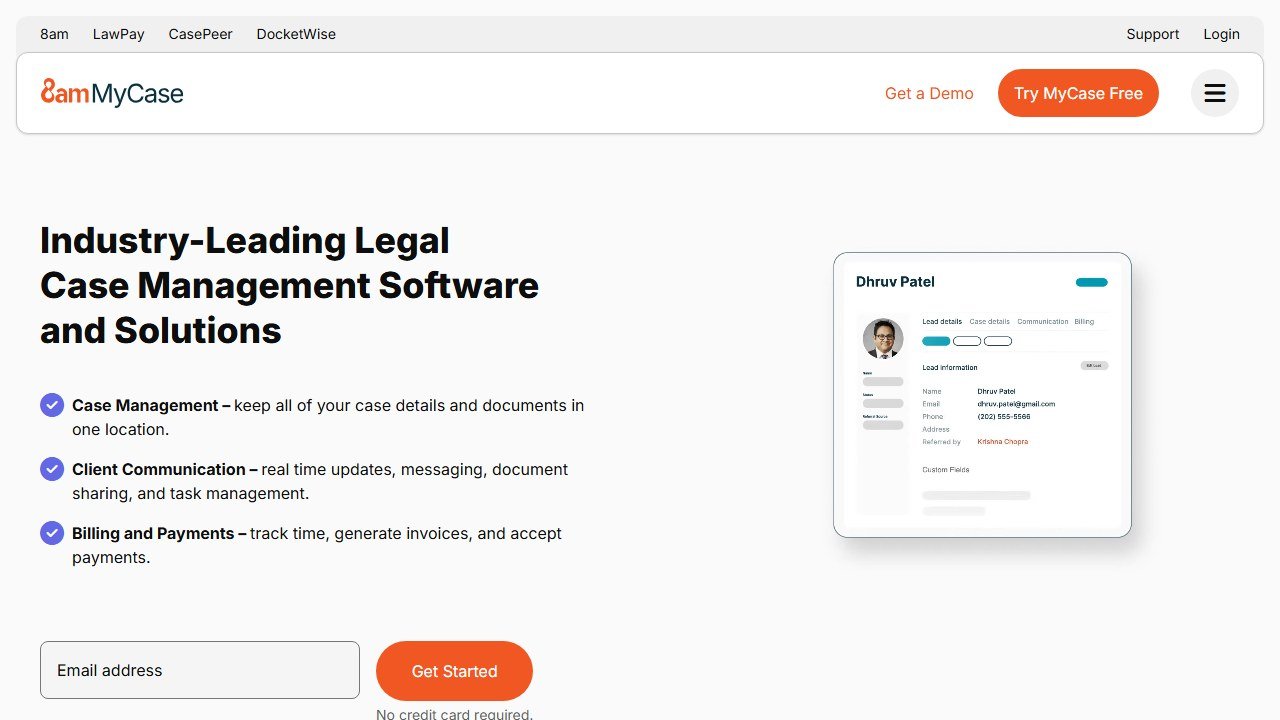
MyCase takes the opposite approach. It is more of an all-in-one: it does more inside the platform itself and leans on fewer third-party integrations. As part of AffiniPay, the same parent company behind LawPay, MyCase has payments deeply and natively built in, which is a genuine convenience. The trade-off is that if you rely on a specific outside tool MyCase does not integrate with, you may hit a wall that Clio would not have.
So the ecosystem question comes down to philosophy. Want to assemble best-of-breed tools around a hub? Clio. Want fewer moving parts and one system that covers most needs out of the box? MyCase.
Ease of Use and Support
Both are strong here, which is part of why they lead the category. MyCase is frequently praised as the simpler of the two to learn and roll out, with a clean interface that a small firm can get productive on quickly. That simplicity is a real selling point if you do not have time or staff to manage software.
Clio is deeper and more configurable, which brings a slightly steeper learning curve but more room to grow, especially for firms that want to customize workflows, reporting, and integrations. Both offer solid support, training resources, and active user communities. Neither is a bad experience; the difference is that MyCase optimizes for out-of-the-box simplicity while Clio optimizes for depth and flexibility.
Which Should You Choose?
Choose Clio if …
- You depend on specific third-party tools and want the largest integration marketplace to connect them.
- You want deeper reporting, more configurable workflows, and room to scale as the firm grows.
- Legal research matters to you, and the Clio Duo plus vLex direction appeals.
- You are comfortable paying a bit more per user for the market-leading ecosystem.
Choose MyCase if …
- You want a simpler, all-in-one platform that works well out of the box with less setup.
- Budget per seat is a priority, especially at the entry tier.
- Built-in payments through LawPay and a bundled AI assistant on an affordable plan appeal to you.
- You would rather have fewer moving parts than assemble a best-of-breed stack.
And if neither of these two feels quite right, our roundup of the best Clio alternatives widens the field to every practice management platform worth considering in 2026.
Verdict
There is no single blanket winner here, and any honest comparison lands on that. Clio wins for firms that want the market-leading ecosystem, the largest app marketplace, deeper reporting, and a legal-research direction through Clio Duo and vLex, and it is worth the higher per-user cost for firms that will use that depth. If that is you, our Clio review goes deeper on the platform.
MyCase wins for solo and small firms that want a simpler, often cheaper all-in-one with built-in payments through LawPay and a capable AI assistant in MyCase IQ, without the setup or spend of assembling a larger stack. Match the tool to your budget and your integrations, try both free trials, and you will not go far wrong with either. For the wider field, see our best legal practice management software roundup and our best AI tools for lawyers pillar.

Written by
FazFaz is the founder of AIToolsBakery. Some tools here are tested hands on. Others are assessed from vendor documentation and pricing verified on the live page, and every review says which one it is. Sponsors can buy a position in a guide. They cannot buy the score, the criticism, or silence about a better option.
How we test and how we make money →