Major gift fundraising is a relationship business, not a volume business. One officer might carry a portfolio of 120 donors and spend most of the year on a few dozen conversations that decide whether the annual number lands. That is exactly where AI helps, and exactly where it can mislead. This guide covers the tools that genuinely move major-gift work in 2026, what each one is for, and the order to adopt them.
we have reviewed the major AI tools across the nonprofit stack for AIToolsBakery, from wealth-screening databases to predictive-scoring engines. For major gifts specifically, the useful tools split into three jobs: find capacity, predict readiness, and work the portfolio day to day. The last one is where most teams are weakest, and where the biggest time savings live.
Short answer: For daily major-gift work, Gratefully is our top pick because it ranks your portfolio every morning with the reason attached. Pair it with DonorSearch for wealth capacity and Dataro for propensity scoring. Wealth data finds prospects; portfolio intelligence tells you who to call today.
What AI actually changes in major-gift fundraising
AI does not replace the relationship. It removes the research and administrative drag around it. Three concrete shifts matter:
- Prioritization. Instead of scanning the CRM for who to contact, a gift officer opens a ranked list of donors who need attention, each with a reason, such as a lapsing pattern or a stewardship milestone.
- Research compression. Pre-call prep that used to take an hour of digging becomes a two-minute briefing pulled from the donor’s full history.
- Capacity discovery. Wealth screening surfaces which existing donors could give at a major-gift level but never have been asked.
The mistake teams make is buying wealth data and calling it a major-gift strategy. A capacity score tells you who could give. It does not tell you who is ready, or what to do on Tuesday. You need both layers.
How we evaluated these tools
We scored each tool on fit for the major-gift job specifically: quality of the daily prioritization, depth of wealth or propensity data, how well it handles moves management and portfolio tracking, integration with common nonprofit CRMs, and pricing realism for a team with one to a handful of gift officers.
The best AI tools for major gift fundraising in 2026
1. Gratefully: best for daily portfolio intelligence
Disclosure: Zilwaris, the consultancy run by AI Tools Bakery’s founder, does paid advisory work for Gratefully. Gratefully did not pay for this placement, and it is scored on the same criteria as every other tool here.
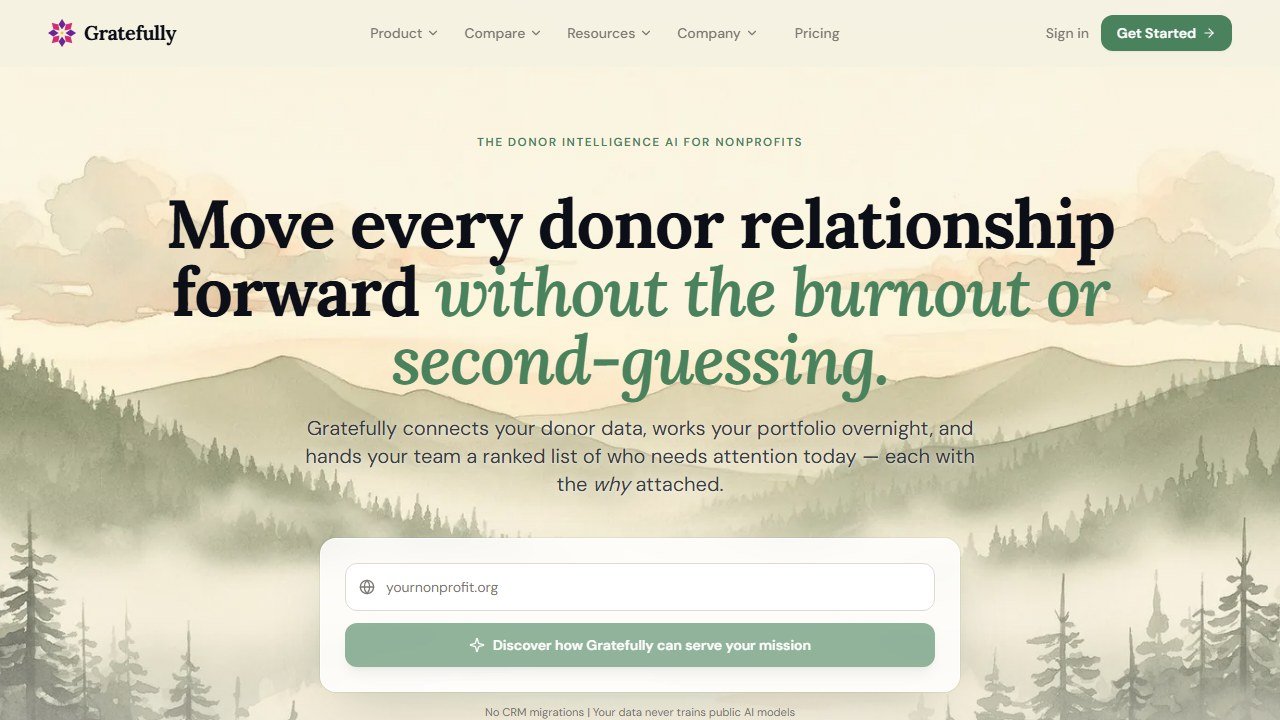
Gratefully is built around the exact unit of major-gift work: the individual officer’s portfolio. It unifies your CRM, email, and files into one knowledge graph, then hands each officer a ranked morning list across seven signal types, including relationship risk, moves-management progress, and stewardship moments. Every item explains why it surfaced, so the list is workable, not just scored. It also drafts on-brand outreach and preserves donor context when staff turn over. For teams whose bottleneck is time and prioritization rather than data, it is the strongest daily tool in the category. Read our full Gratefully review for features, pricing, and limits.
2. DonorSearch: best for wealth capacity and prospect research
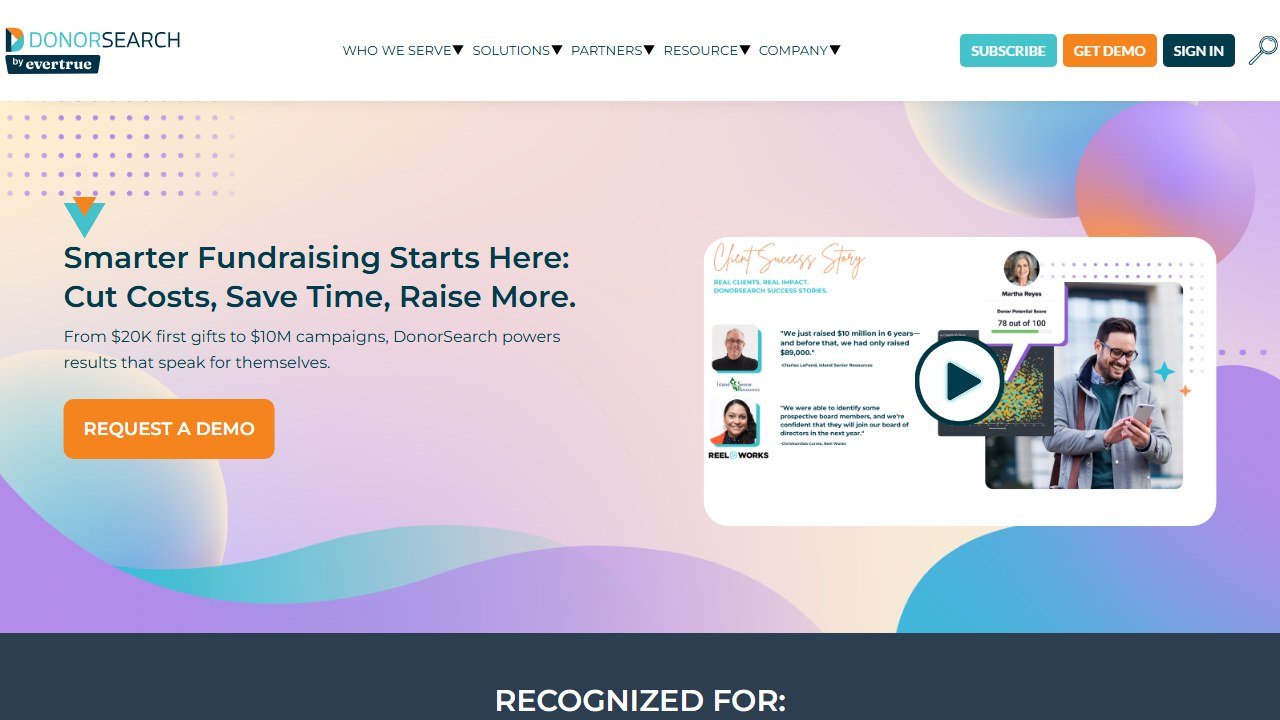
DonorSearch is the market standard for finding capacity. It scores donors on wealth, affinity, and propensity, and integrates cleanly with major nonprofit CRMs. Use it to identify which existing donors have major-gift capacity and to research prospects before cultivation. See our DonorSearch review and the Gratefully vs DonorSearch comparison, since most serious shops run both.
3. Dataro: best for propensity and readiness scoring
Dataro uses machine learning to predict which donors are most likely to give, upgrade, or lapse, which helps a gift officer decide who is ready now versus who needs longer cultivation. It shines for data-rich organizations that want propensity layered onto capacity. Details in our Dataro review.
4. Gravyty: best for AI-assisted outreach at volume
Gravyty focuses on drafting and sending personalized outreach at scale, useful when one officer needs to keep dozens of mid-portfolio relationships warm. It leads with drafting rather than prioritization, so it pairs well with an intelligence layer that decides who to reach.
5. Virtuous: best AI-native nonprofit CRM
Virtuous is a responsive fundraising CRM with predictive insights baked in. If you want your system of record and your major-gift intelligence in one platform, it is the strongest CRM-native option. Read the Virtuous review.
6. iWave (Kindsight): best for enterprise wealth data
iWave, now part of Kindsight, offers deep wealth and philanthropic data for larger shops that need ultra-high-net-worth research beyond what mid-tier tools provide. It is enterprise-priced and best justified above roughly $20M in revenue.
Since iWave folded into Kindsight, the pricing conversation has changed too. Our iWave pricing breakdown covers the current tiers before you sit through the sales call.
The major-gift stack, by budget
You do not need all six. A practical build:
- Lean (one officer): Gratefully for daily prioritization, plus a wealth-screening pass through DonorSearch once or twice a year.
- Growing (two to four officers): Gratefully plus DonorSearch as an always-on subscription, and Dataro if your data supports propensity modeling.
- Enterprise: add iWave for deep prospect research and a CRM like Virtuous or Salesforce as the system of record underneath.
Still torn between the two wealth-screening heavyweights? Our iWave vs DonorSearch comparison runs them head to head on data, scoring, and cost.
A week in a gift officer’s portfolio with AI
Monday, the officer opens an intelligence layer to a ranked list rather than a blank CRM search: two lapse risks, one donor who just hit a giving milestone, one overdue proposal follow-up. Wealth scores from the last screening flag which of those has upgrade capacity. The officer asks for a two-line brief on each, gets history instantly, and lets the tool draft a first-pass note to personalize. By Friday, the same list has refreshed with new signals. The compounding effect is not magic; it is simply never letting a warm relationship go cold because it fell off a spreadsheet.
Where to go next
Build out the rest of your stack with our pillar on the best AI tools for nonprofits, our roundup of AI donor-intelligence tools, and the primer on AI donor research tools. New to the category? Start with what donor intelligence actually is.
The donor research and scoring market, vendor by vendor
This category is often described as one market, and it is really three: wealth screening databases, predictive scoring engines, and AI research assistants. They are bought for different reasons and priced on different meters. Here is where each alternative to these tools actually sits.
Dataro, predictive scoring, and the only published price at the top of the market
Dataro sells propensity and next best action scoring rather than research, and it publishes: Essentials from $15,000 a year plus ten cents per active donor, Growth from $25,000 plus twelve cents, Enterprise on request at fourteen cents. Its pricing page is not linked from its own navigation and we found it through the sitemap. Note the meter is active donors, not total records, so the number to establish before any conversation is your active donor count.
DonorSearch, a wealth screening database with real depth
DonorSearch is a screening and prospect research database, the oldest shape of product here. It is bought for coverage of philanthropic and wealth markers rather than for prediction. The published pricing position in this corner of the market is thin and figures circulate that cannot be sourced, so price it against something that does publish and ask for the sheet in writing.
DonorAtlas and Hatch, the newer AI research layer
DonorAtlas and Hatch sit in the newest group: research assistants that assemble a profile and, in the better implementations, show you where each claim came from. Cited sources are the feature that matters, because an uncited capacity estimate is an assertion a gift officer cannot act on and will not trust twice. Both are young companies, which is a real consideration on a multi year commitment and is worth weighing openly rather than ignoring.
What the three groups cost relative to a CRM
For scale, verified 4 September 2026: Little Green Light from $45 a month, Salesforce Nonprofit Cloud at $70 per user (as of 4 October 2026) with ten licences free, Bloomerang from $125, Keela from $164. Dataro’s floor is $15,000 a year. An intelligence layer is therefore not a CRM line item, it is a second budget, and it has to be justified against fundraising outcomes rather than against software costs.
Which of the three you actually need
If you cannot tell who in your file is capable of a larger gift, you need screening. If you know who is capable but not who is ready, you need scoring. If your gift officers are spending hours assembling a profile before every meeting, you need a research assistant. Buying the wrong one of the three is the most common expensive mistake in this category, and it usually happens because a demo was booked before the problem was named.
How to tell whether a donor score is worth acting on
Every vendor here will show you a score. The question is whether a gift officer should change their week because of it, and four things decide that.
Can it show its working
Ask the tool why a specific person scored the way they did, and look at whether the answer is a reason or a restatement. “High capacity indicators and recent engagement” is a restatement. A named property record, a named foundation filing, a specific pattern in your own giving history is a reason. Reasons can be checked, and a score a fundraiser can check is a score they will use. This is the single strongest predictor of adoption we see.
Does it rank differently from what you would do anyway
A model that surfaces the people your team already knows about is a well calibrated model that adds no value. Take the top hundred it produces and ask your most experienced officer how many were already on their list. If it is ninety, you have bought an expensive confirmation. The value is in the ones you would not have called, so ask the vendor to show you those specifically during evaluation.
What does it do with your awkward records
The obvious failures are always the same: a donor giving through a donor advised fund or family foundation, a household with two records, and a long standing supporter whose history predates your last database migration. Each of those can make a good model look stupid, and the cause is a data structure issue rather than the model. Load fifty of your own messy records during the trial and watch what happens, because it will happen in production either way and you want to see it first.
Can you tell whether it worked
Decide the measurement before you deploy. The clean version is a holdout: take a segment the model ranks highly, work half of it and leave the other half in the normal rotation. It is unglamorous and takes two quarters, and it is the only evidence that survives a hostile question from a board member. Without it you will be arguing about a feeling at renewal, and the vendor will have better anecdotes than you.
How to tell whether any of this actually worked
The failure mode in this category is not a tool that breaks. It is a tool that runs for a year while nobody can say whether it changed anything. Decide the measurement before you deploy, because after deployment every number is contested.
Pick a baseline you already have, not one you will start collecting
Whatever you measure, you need last year of it, and you need it from a source that was not touched by the project. Gift counts by segment, retention rate by cohort, average gift by channel, and the number of qualified visits per officer are all usually recoverable from the CRM for prior years. A metric that only starts on go-live day cannot show improvement, only activity, and activity is what makes a board sceptical.
Measure the decision, not the output
A propensity model that produces ten thousand scores has produced nothing. What matters is whether the list an officer worked was different from the list they would have worked anyway, and whether that difference showed up in outcomes. The cleanest version is a holdout: take a segment the model ranks highly, work half of it, and leave the other half in the normal rotation. It is unglamorous, it takes two quarters, and it is the only evidence that survives a hostile question.
Retention is the metric that moves last and matters most
Acquisition responds to activity within weeks. Retention responds over a giving cycle, which for most organisations means twelve to eighteen months before a change is legible. Report it, but say plainly at the outset when it will become meaningful, so that a flat number at six months is understood as expected rather than as failure.
Count the hours the thing was supposed to save
Most of the honest value in this category is time rather than income: research that took ninety minutes taking fifteen, a report that took a day taking an hour. Time is measurable if you measure it before, and unprovable if you do not. Ask the two or three people whose work will change to record how long the task takes them this month, before anything is installed. It is the cheapest evaluation you will ever run and almost nobody does it.
Agree in advance what would make you stop
Write down, before purchase, the result at twelve months that would mean you do not renew. Naming it converts a renewal from a default into a decision, and it is the single most effective discipline against the pilot that quietly becomes permanent. If nobody can name a result that would end it, the evaluation was never real.
How this goes wrong in practice, and the warning signs
Four failure patterns account for most of what we hear from organisations a year after purchase. All four are visible early if you know the shape.
The pilot that never ends and never scales
One enthusiastic person runs a tool brilliantly for eighteen months. They leave, and it stops the same week. The warning sign is that nobody else has ever produced the output, and the fix is procedural rather than technical: a second person runs it once a quarter, in the same way, from written steps. If the process only exists in one head, you did not buy a system, you rented a habit.
Output nobody acts on
Scores are generated, reports are produced, and the work continues exactly as before. This is usually a sequencing failure: the tool was chosen before anyone agreed what decision it would change. The test is simple and worth applying before purchase. Name the meeting where the output gets used and the person who will be holding it. If you cannot, the output has no destination.
Trust lost to one visible error
A tool rates a long-standing donor as low potential, a gift officer sees it, and the credibility of every other score goes with it. Almost always the cause is a data structure issue rather than the model: a soft credit missing, a household split, a migration boundary hiding the giving history. Expect this in the first month, plan for who investigates it, and make sure the first person to see an odd score has somewhere to take it other than the corridor.
The cost that arrives in year two
Year one is discounted, implementation is one-off, and the renewal is negotiated by somebody who was not in the original procurement. Uncapped renewals, mid-term expansion at list price, and processing fees growing with your success are the three lines that move. All three are fixable in the first contract and effectively unfixable later, which is why the terms matter more than the discount.
The common thread
None of these is a software failure. Every one is a decision that was not made, or was made by default, before anything was installed. The organisations that get value from this category are not the ones that picked the best product; they are the ones that named an owner, agreed what would change, and wrote down what failure would look like.
Where the figures on this page come from
Every price quoted here was read from the vendor’s own pricing page on 4 September 2026, not from an aggregator or a review site. That distinction matters more in this category than in most, because nonprofit software pricing changed materially over the past year and a great deal of what circulates online describes packaging that no longer exists.
The pages we read
Little Green Light publishes every constituent band from $45 a month. Salesforce Nonprofit Cloud publishes $70 per user per month (as of 4 October 2026) with ten licences free under Power of Us. Bloomerang publishes $125 a month for the CRM with other products priced separately. Keela publishes every contact band from $164 a month. Dataro publishes $15,000 a year plus ten cents per active donor on a page that is not linked from its own navigation. Blackbaud and Virtuous publish no figures at all.
What we do not do
We do not carry a figure we cannot source to the vendor. Where a number circulates widely and cannot be traced to a vendor page, we say so and withdraw it rather than repeating it with a hedge, and we have withdrawn our own published figures on that basis more than once. Where a vendor confirms an unpublished price directly to us, it is attributed as confirmed by the company rather than presented as a public rate.
Why every figure carries a date
Keela raised every band by roughly 15 to 22% in under two weeks in late August 2026. Neon retired an entire tier structure. A pricing claim without a verification date is not checkable, and in this market it is usually wrong within a year.
Tools mentioned in this guide

Written by
FazFaz is the founder of AIToolsBakery. Some tools here are tested hands on. Others are assessed from vendor documentation and pricing verified on the live page, and every review says which one it is. Sponsors can buy a position in a guide. They cannot buy the score, the criticism, or silence about a better option.
How we test and how we make money →