Every agent has felt it: a lead comes in, you are mid-showing, and by the time you reply the buyer has moved on. Speed and persistence win real estate leads, and both are exactly where humans fail and software excels. Structurely, through its AI inside sales agent Aisa Holmes, is one of the most established tools built to close that gap, replying in minutes and nurturing leads for a year or more so none go quietly cold.
Verdict: Structurely is a proven AI inside sales agent for real estate, with human-like SMS and voice follow-up that nurtures leads for 12 or more months. Best for teams that generate their own leads and need tireless qualification. Weigh the $1,500 setup fee, three-month minimum, and its recent acquisition before committing.
What Structurely does
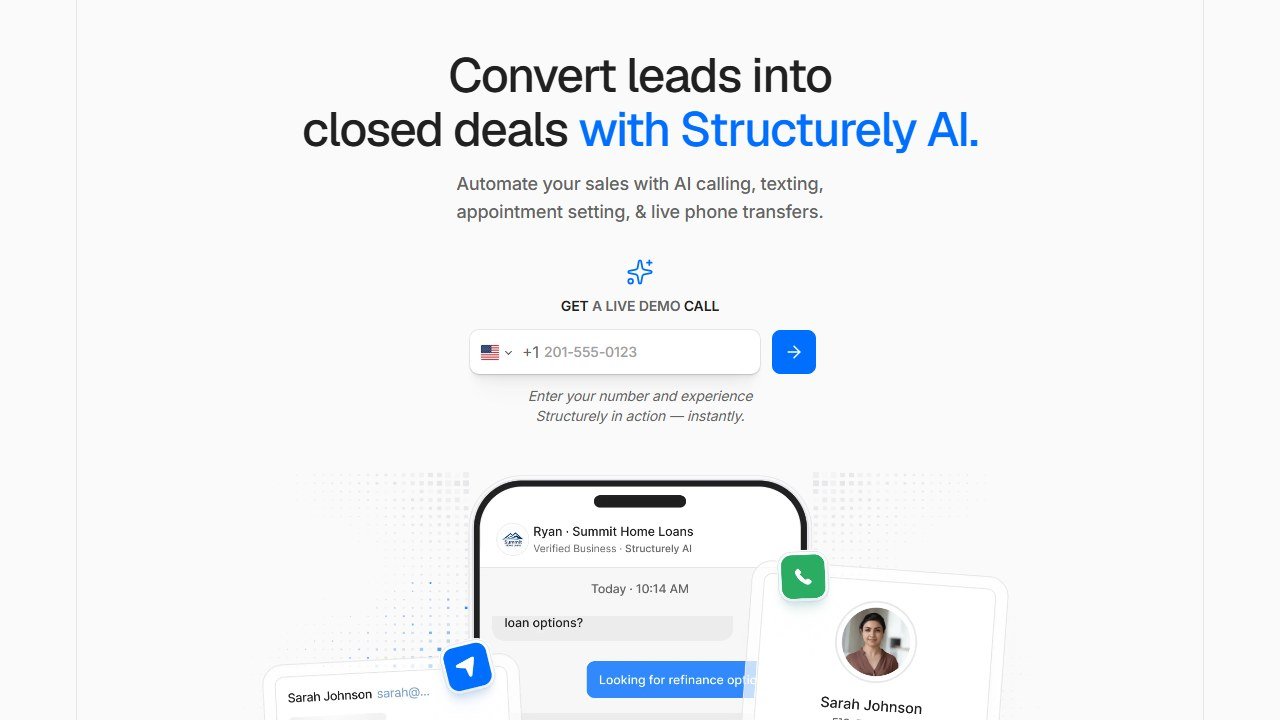
Structurely is a conversational AI platform that automates sales follow-up through AI-powered texting, email, and voice calling. Its AI assistant, Aisa Holmes, whose name stands for Artificial Intelligence Inside Sales Agent, engages new leads within about five minutes of contact, qualifies them, nurtures them through campaigns that can run twelve months or longer, and hands them to a human agent when they are ready to act. It works around the clock without breaks, which is the entire point of an AI ISA: it does the patient, repetitive follow-up that human agents drop when they get busy.
The conversations are designed to feel human. Aisa Holmes uses deliberate response delays and natural phrasing so that leads engage as they would with a real assistant, and the platform reports a 57 percent response rate across its client base. On higher tiers it can also place true AI voice calls that sound remarkably human, going beyond the text-only automation most competitors stop at. The result is a system that catches leads fast and keeps working them long after a human would have given up.
Track record and ownership
Structurely is one of the more battle-tested tools in this category. The company reports having handled over 13 million conversations and 75 million messages, with clients citing outcomes like a jump in appointment conversion from 5 to 15 percent and large lifts in lead volume and conversion. Those are the kind of numbers that come from years in market, not a recent launch.
One development buyers should know: Structurely was acquired by CapStone Holdings in January 2026, with a new CEO, Corey Welch, appointed shortly after. Acquisitions can bring investment and stability or disruption and pricing changes, and it is too early to say which this will be. It does not change the product’s current strength, but it is a reason to ask about roadmap and pricing commitments before signing a longer arrangement.
Key features
Five-minute lead response, 24/7
Aisa Holmes engages new leads within minutes at any hour, which is the single highest-leverage moment in lead handling and the one humans miss most often.
Long-cycle nurture
The platform nurtures leads through campaigns of 12 or more months, staying in the conversation until a lead is ready, then handing off to the agent. This patient persistence is its core strength.
Human-like AI voice calling
On the Elevate plan and above, Aisa Holmes can place voice calls that sound convincingly human, adding a channel most text-only ISA tools lack.
Pricing
Structurely moved to an action-credit model in 2026, after the January 2026 CapStone Holdings acquisition. The current official pricing (verified July 2026): Team plan $499 per month for 2 to 10 person teams, Company plan $999 per month for larger groups, plus action credits billed at $0.08 per credit on Team and $0.06 on Company. One credit covers one SMS response, ten seconds of AI call time, or two emails.
Two things to budget beyond the monthly fee: a one-time onboarding charge of $2,000 (Team) or $2,500 (Company), and the contract structure, which is annual at the listed price with month-to-month carrying a roughly 20 percent premium. The old lead-tier plans ($179 to $499 per month with a $1,500 setup fee) no longer exist, so ignore any page still quoting them.
For worked cost-per-lead examples under the credit system and the full pricing history, see our dedicated Structurely pricing breakdown.
Pros and cons
What we like: a genuinely proven platform with years of data behind it; fast, five-minute response that captures leads at the right moment; long-cycle nurture that runs for a year or more; human-like conversations including real AI voice on higher tiers; and reported results strong enough to justify the cost for many teams.
What to weigh: the $2,000 to $2,500 onboarding fee and annual contract make it a serious commitment rather than a casual trial; voice calling is gated to higher plans; the recent acquisition adds some uncertainty about roadmap and pricing; and as with any AI contacting your leads, you remain responsible for consent and compliance, so confirm how it handles opt-outs. It is a powerful tool, but it asks for a real decision up front.
Who should use Structurely
Structurely fits teams and agents who already generate their own leads and need a tireless, proven ISA to work them, especially those with enough lead volume to justify the setup fee and commitment. It is a strong choice for a growing team replacing or supplementing a human ISA. It is a weaker fit for a brand-new agent with a trickle of leads, who would be better served by a cheaper answering or qualification tool first, and for anyone who wants to test an ISA with no upfront cost or lock-in.
One place you may already be using Structurely without knowing it: CINC AI, the $200-a-month add-on on CINC’s platform, is built in partnership with Structurely. Our CINC pricing breakdown covers what that bundle costs all-in.
How Structurely compares
Structurely competes with tools like Ylopo, whose rAIya assistant pairs nurture with paid-ad lead generation, and lighter chat-first qualifiers like Roof AI. Its edge is the depth and track record of its long-cycle nurture and the strength of its voice capability. If you need lead generation bundled in, an all-in-one may fit better; if you only need the nurture engine, Structurely’s focus is the advantage. See our roundup of the best AI inside sales and lead qualification tools for the full comparison, and our guide to the best AI tools for real estate agents for where it sits overall.
If the post-acquisition pricing moved Structurely out of your budget, our guide to the best Structurely alternatives maps the replacements by what you are actually switching for.
What it costs to leave, which no pricing page mentions
Switching cost is why landlords and managers stay on systems they have outgrown. In this category it is unusually concrete, which means you can ask about it precisely.
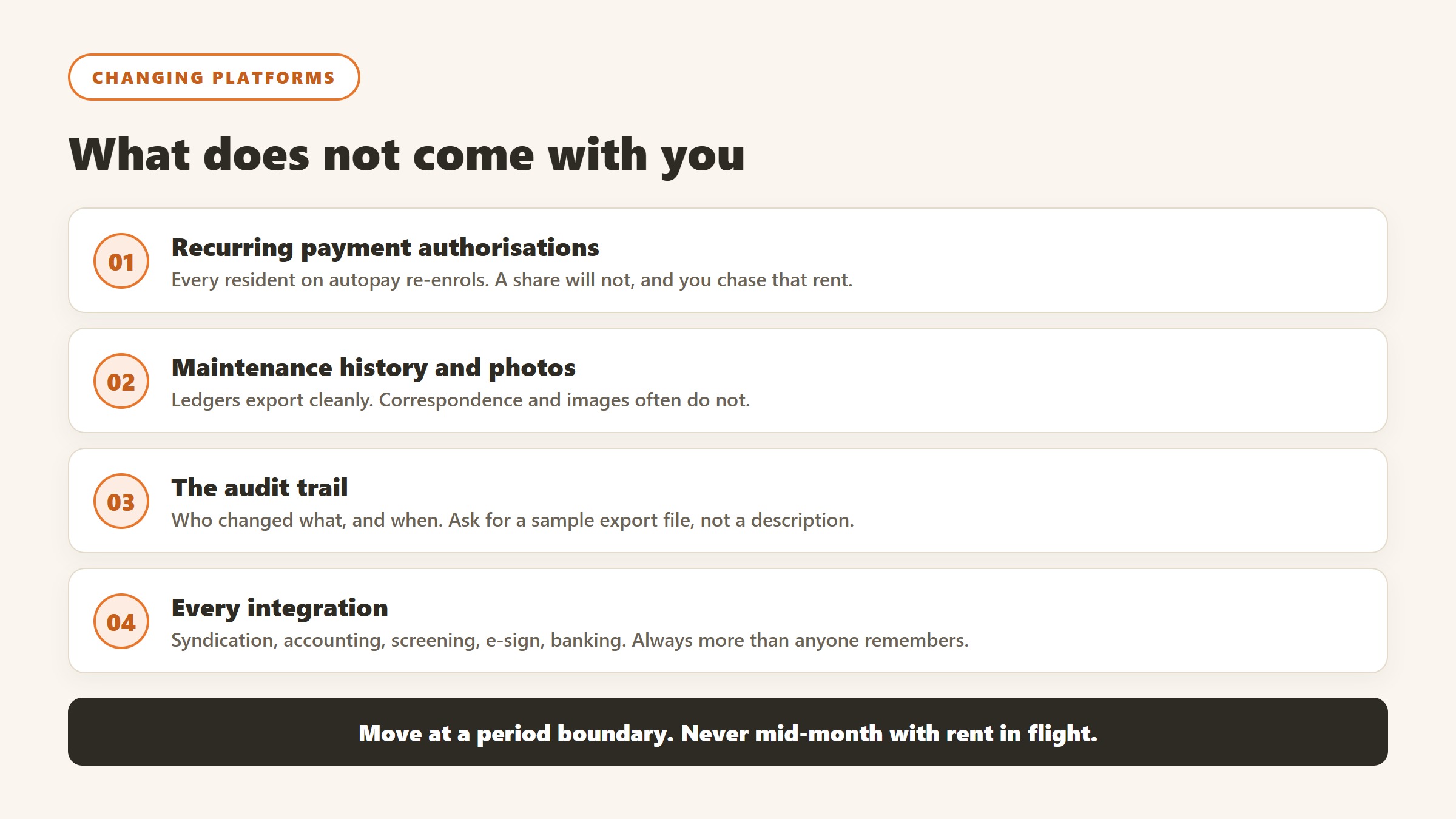
Recurring payment authorisations rarely transfer
This is the big one. Tenant records, leases and ledgers export from almost any platform. Live recurring payment authorisations and the stored bank or card details behind them generally do not, which means every resident on autopay has to re-enrol. A share will not, and you will chase rent you were previously collecting automatically. Ask about this in writing during procurement, when you still have leverage.
Ask exactly what a full export contains
Standard fields usually come out cleanly. What often does not is the maintenance history with its photographs and correspondence, the document store of signed leases and addenda, the accounting history in a form your accountant can actually use, and the audit trail of who changed what. Ask for a sample export file during the trial rather than a description of one.
The accounting cutover has a right time and many wrong ones
Move at a period boundary, ideally the start of a financial year, and never mid-month with rent in flight. Plan to run a parallel reconciliation for one full cycle, and budget the hours for it. Migrations that go badly almost always went live at a convenient calendar date rather than a sensible accounting one.
Count the integrations before you sign, not when you leave
Listing syndication, accounting, screening providers, e-signature, banking, insurance and any owner portal are each work to disconnect and reconnect elsewhere. The count is always higher than anyone remembers, and it is the part that turns a two week migration into a six month one.
Where the figures on this page come from
Every price here was read from the vendor’s own pricing page on 4 September 2026, not from an aggregator or a review site. Each figure carries that date, because pricing in this market moves and a claim without a date is not checkable.
The pages we read
Buildium publishes $62, $192 and $400 a month plus a detailed fee schedule. DoorLoop publishes $69, $149 and $209 a month billed yearly with per unit equivalents. TurboTenant publishes a free tier plus $12.42 and $16.48. TenantCloud publishes $15 to $50 a month on annual billing. RentRedi publishes $12 a month on the annual plan. Hemlane, Rentec Direct and Landlord Studio all publish in full, as do Follow Up Boss at $69 per user, Wise Agent at $49, and Placester from $59.
The ones we could not read
AppFolio, Innago, Top Producer and Hostaway did not yield a figure to the same method that read every vendor above, and Lofty’s pricing page carried no plan rates. We are not presenting that as proof they publish nothing, because a failed read is not evidence of absence. Treat any figure for those five from elsewhere as unverified.
What we do not do
We do not carry a figure we cannot source to the vendor. Where a number circulates and cannot be traced, we say so and withdraw it rather than repeating it with a hedge, and we have withdrawn our own published figures on that basis more than once.
What agent CRMs and lead platforms actually charge
This half of the market divides into CRMs you fill with your own leads and platforms that sell you the leads as well, and the second is several times the price of the first. Here is each alternative to structurely review, read on 4 September 2026.
Follow Up Boss, $69 per user per month, published plainly
Follow Up Boss publishes $69 per user per month plus tax, with a yearly option giving two months free and calling as a $39 per user add-on. It is a CRM rather than a lead source, which is the important distinction: you are buying the system that works leads you already have. At five agents that is $4,140 a year before the calling add-on, so price it at your real headcount rather than at one seat.
Wise Agent, $49 a month, and the cheapest published option here
Wise Agent publishes $49 a month, falling to $42 billed annually at $499 a year, with a higher tier at $69 and $59. Its annual toggle is marked as saving 15% and the saving holds. For a solo agent or a small team this is the published floor of the category, and the gap to a lead platform is an order of magnitude rather than a percentage.
Placester, from $59 a month, sold around the website
Placester publishes $59, $79 and $129 a month with a 20% annual discount, positioned around IDX websites and marketing rather than lead generation. If your gap is presence rather than pipeline, that is a materially cheaper problem to solve than buying leads, and it is worth being honest with yourself about which one you actually have.
The lead platforms, where almost nobody publishes
The platforms that sell leads alongside software, Lofty, CINC, Ylopo, Zurple, Sierra Interactive, Real Geeks, Market Leader and BoldTrail among them, largely quote rather than publish. We could not read a plan figure from Lofty’s own pricing page on 4 September 2026. That is normal in this corner of the market and it means your only real leverage is a published CRM priced at your team size, plus a clear view of what you currently pay per closed transaction.
Work out your cost per closing before any demo
Take last year: total spend on leads and CRM, divided by transactions closed from those leads. That single number is the benchmark every quote has to beat, and most agents have never calculated it. Without it you are comparing monthly figures against each other rather than against the thing that pays for them, which is how a $2,000 a month platform gets renewed for three years on the strength of a feeling.
Buying leads honestly: what the conversion numbers actually mean
Every platform in this category quotes conversion figures. Almost none of them mean what a reader assumes, and the differences are large enough to reverse a purchase decision.
Ask what the denominator is
A conversion rate can be measured against leads delivered, leads contacted, leads that answered, or appointments set. Those four produce wildly different percentages from the same underlying performance. When a vendor quotes a rate, ask which one it is, and ask for the number of days over which it was measured. A rate with no denominator and no window is a marketing figure rather than a metric.
Speed to lead is the variable that actually moves conversion
The single largest controllable factor in internet lead conversion is how fast the first contact happens, and it is measured in minutes rather than hours. That is a staffing and process question, not a software one. A platform that routes leads instantly to an agent who checks their phone twice a day will underperform a spreadsheet worked by someone answering in five minutes. Fix the response process before buying anything that increases lead volume.
More leads at the same conversion is not obviously good
Doubling lead volume doubles the work and, unless response times hold, usually reduces conversion. Teams that buy volume without adding capacity get a lower conversion rate on a bigger number and conclude the leads were bad. Before increasing volume, work out how many new leads your current team can genuinely contact within the window that matters.
The contract term is where the risk sits
Lead platforms frequently ask for six or twelve month commitments, sometimes with a territory or exclusivity element. That is defensible, because a pipeline takes time to season. It is also a lock-in on performance you have not seen. Ask for a defined review point in writing, agree in advance what result would end the arrangement, and be sceptical of any exclusivity you are paying a premium for without a written definition of the area it covers.
The verdict
Structurely is one of the most credible AI inside sales agents in real estate, backed by years of data and a genuinely strong long-cycle nurture engine that does the patient follow-up humans abandon. The upfront setup fee and three-month minimum make it a considered purchase, and the recent acquisition is worth a question or two before you sign, but neither undercuts what the product does well today. For a team with real lead flow that wants to stop losing deals to slow or forgotten follow-up, Structurely remains a top pick, and the reported returns suggest that for the right buyer, the commitment pays for itself.
More AI tool guides worth reading: Best AI Answering Services for Realtors, Perspective AI Review and Reel-E Review.

Written by
FazFaz is the founder of AIToolsBakery. Some tools here are tested hands on. Others are assessed from vendor documentation and pricing verified on the live page, and every review says which one it is. Sponsors can buy a position in a guide. They cannot buy the score, the criticism, or silence about a better option.
How we test and how we make money →