A missed call is a lost deal. When a buyer or seller phones an agent and reaches voicemail, they usually just call the next name on the list. The problem is that calls arrive exactly when you cannot answer them, mid-showing, mid-closing, mid-life. AI voice agents solve this by answering every call, qualifying the caller, booking the appointment, and logging it, around the clock. This guide ranks the best AI answering tools for realtors and explains which type fits your business.
Short answer: The best AI voice answering tools for realtors in 2026 are Smith.ai for AI plus human backup, Allo for solo agents wanting phone and AI in one, Retell AI and Synthflow for build-your-own voice agents, and packaged options like NLPearl, ContactSwing, and Pete and Gabi for real-estate-tuned voice without the setup.
Two kinds of AI voice tool
Before the rankings, understand the split. Packaged answering services are ready to use with light setup and priced per month, ideal for agents who want to switch it on and move on. Developer or build-your-own platforms are configured to your workflow and priced by the minute or usage, cheaper at scale but demanding real setup time. Neither is better in the abstract; the right one depends on how much you want to tune versus how fast you want to launch. We take no payment for placement, and where we have not fully tested a tool we say what it claims and what to verify.
Quick comparison
| Tool | Best for | Starting price |
|---|---|---|
| Smith.ai | AI answering with human backup | ~$95/mo |
| Allo | Solo and small teams wanting phone plus AI | ~$45/user/mo |
| Retell AI | Build-your-own voice agents | ~$0.07/min |
| Synthflow | No-code voice agent building | ~$29/mo |
| NLPearl / ContactSwing / Pete and Gabi | Packaged real-estate voice | Varies |
1. Smith.ai: best AI answering with human backup
Smith.ai blends AI with real human agents, so complex or high-value calls escalate to a person instead of frustrating a serious caller with a bot that cannot help. For agents whose calls include delicate conversations that must never be fumbled, the hybrid model is the safe default, commonly starting around $95 per month and scaling by call volume. You pay more per call than a pure-AI service, and that premium is exactly what you are buying: a human safety net on the calls that matter most.
2. Allo: best for solo agents and small teams
Allo bundles an AI receptionist with a full phone system, aimed at solo agents and small teams, with unlimited AI answering at a low per-user price near $45 per month. If you want one tool that both replaces your carrier and answers with AI, this is the cleanest, most affordable fit, and the flat unlimited pricing removes the per-minute anxiety of usage-based tools. It is less suited to a large brokerage needing deep enterprise routing, but for the individual agent it is hard to beat on simplicity and value.
3. Retell AI: best build-your-own voice agent
Retell AI is a voice-agent platform you configure for inbound and outbound real estate calls, priced around $0.07 per minute. It rewards teams willing to build and tune a workflow, and at volume it can be far cheaper than a packaged service. The cost is setup time and a little technical comfort, so budget the hours before assuming the low per-minute rate is the whole story. For a team that wants control and low marginal cost, it is the strongest developer-grade option.
4. Synthflow: best no-code voice building
Synthflow offers no-code voice-agent building starting near $29 per month, a middle path between packaged services and raw developer platforms. You get more customization than a flat answering service without needing to write code, which suits agents who want to shape the conversation but do not want an engineering project. It is a sensible pick for the tinkerer who wants control without complexity.
5. NLPearl, ContactSwing, and Pete and Gabi: packaged real-estate voice
A growing group of packaged voice agents is built specifically for real estate. NLPearl offers a real-estate-focused voice solution, while ContactSwing and Pete and Gabi provide real-estate-tuned AI voice agents for 24/7 lead capture and appointment scheduling. These give you a working real-estate voice agent without the build time of a developer platform. Voice quality and conversational naturalness vary more between them than the marketing admits, so trial two or three on your own call flow before committing.
Voice answering overlaps heavily with AI ISA tools, and that market just shifted: our guide to the best Structurely alternatives covers the conversational AI options after Structurely’s 2026 price restructure.
Which one should you choose?
- You want a human safety net on important calls: Smith.ai.
- You are solo and want phone plus AI in one cheap tool: Allo.
- You will build and tune for low cost at scale: Retell AI.
- You want customization without code: Synthflow.
- You want a real-estate-ready agent fast: NLPearl, ContactSwing, or Pete and Gabi.
A word on compliance
Any AI that calls consumers on your behalf touches consent law. Make sure your chosen tool honors opt-in and opt-out rules, keeps records of consent, and respects calling-time limits, and remember that the legal responsibility stays with you, not the vendor. Ask each provider directly how they handle this before you switch it on.
Buying leads honestly: what the conversion numbers actually mean
Every platform in this category quotes conversion figures. Almost none of them mean what a reader assumes, and the differences are large enough to reverse a purchase decision.
Ask what the denominator is
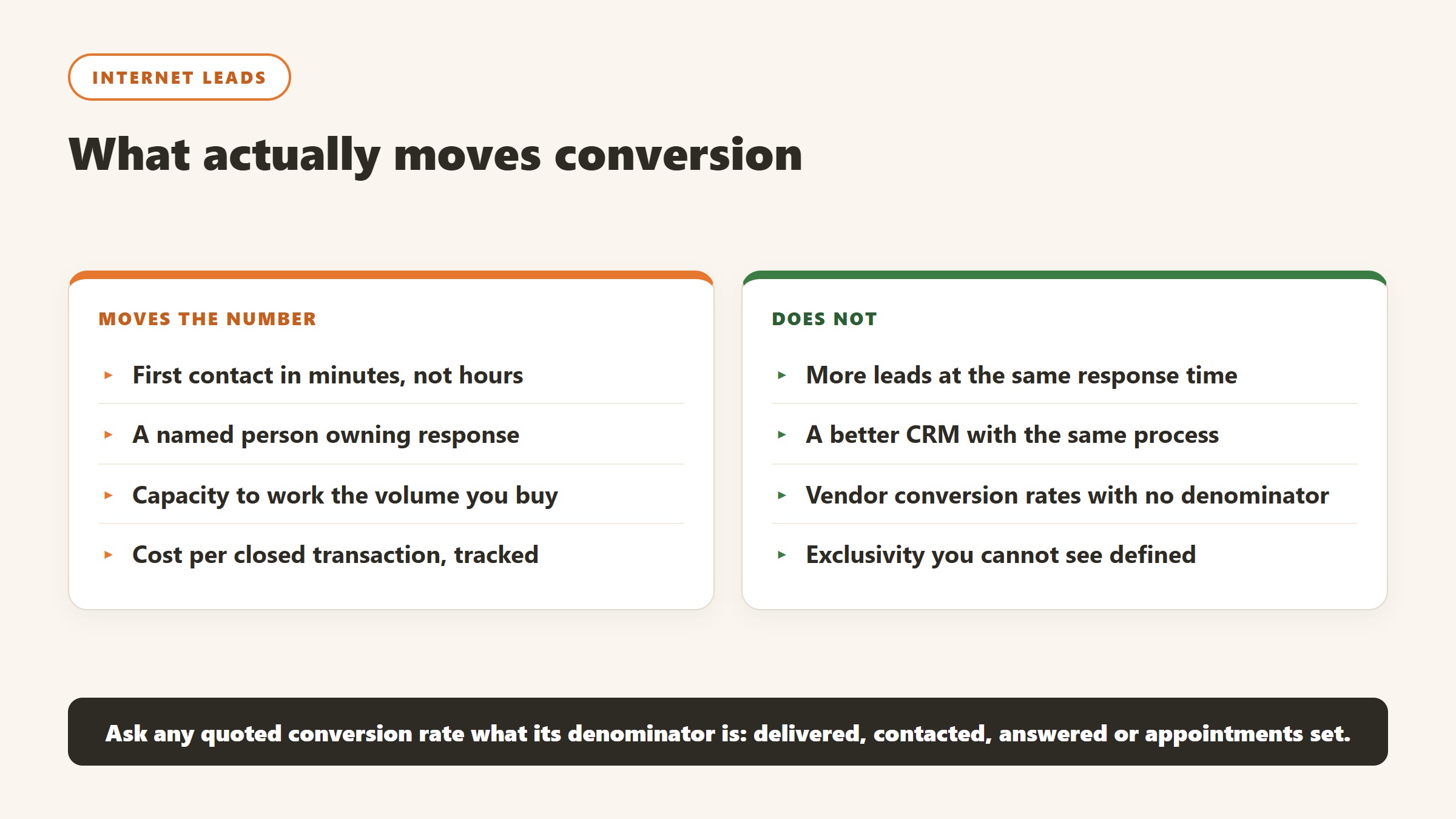
A conversion rate can be measured against leads delivered, leads contacted, leads that answered, or appointments set. Those four produce wildly different percentages from the same underlying performance. When a vendor quotes a rate, ask which one it is, and ask for the number of days over which it was measured. A rate with no denominator and no window is a marketing figure rather than a metric.
Speed to lead is the variable that actually moves conversion
The single largest controllable factor in internet lead conversion is how fast the first contact happens, and it is measured in minutes rather than hours. That is a staffing and process question, not a software one. A platform that routes leads instantly to an agent who checks their phone twice a day will underperform a spreadsheet worked by someone answering in five minutes. Fix the response process before buying anything that increases lead volume.
More leads at the same conversion is not obviously good
Doubling lead volume doubles the work and, unless response times hold, usually reduces conversion. Teams that buy volume without adding capacity get a lower conversion rate on a bigger number and conclude the leads were bad. Before increasing volume, work out how many new leads your current team can genuinely contact within the window that matters.
The contract term is where the risk sits
Lead platforms frequently ask for six or twelve month commitments, sometimes with a territory or exclusivity element. That is defensible, because a pipeline takes time to season. It is also a lock-in on performance you have not seen. Ask for a defined review point in writing, agree in advance what result would end the arrangement, and be sceptical of any exclusivity you are paying a premium for without a written definition of the area it covers.
How to tell whether the tool paid for itself
Real estate software is unusually easy to evaluate honestly, because the outcomes are countable. Most teams still do not do it, and the renewal conversation becomes an argument about impressions.
Pick the metric the tool is supposed to move
For a lead platform it is cost per closed transaction. For property management software it is hours of admin per unit per month, and days to fill a vacancy. For staging it is days on market and list-to-sale ratio. For screening it is time to approve and the rate of problem tenancies. Each of those is available from records you already keep, and each needs a figure from before you started.
Take the baseline before you switch anything on
You need last year of the metric from a source the project did not touch. This is the step that gets skipped and it is the reason most of these purchases can never be evaluated. It costs an hour. Ask the two or three people whose work will change to record how long the target task takes them this month, because time saved is measurable in advance and unprovable afterwards.
Give it a full cycle before judging
Leasing and transactions are seasonal, so a six week read tells you very little. Judge lead tooling over at least two quarters, and property management tooling over a full turnover cycle, because the value shows up at move-out and move-in rather than in the quiet middle. Say that at the outset so an unremarkable month one is understood as expected.
Write the stop condition down first
Before purchase, name the result at twelve months that would mean you do not renew. It converts renewal from a default into a decision and it is the most effective discipline against a subscription that quietly becomes permanent. If nobody can name a result that would end it, the evaluation was never real.
How these purchases go wrong, and the early warning signs
Four patterns cover most of what we hear a year after a real estate software purchase, and all four are visible in the first month.
The migration that never finishes
The new system goes live, the old one stays open “for historical records”, and eighteen months later half the team still works in both. This is the most common and most expensive failure in property management software. Before signing, agree a cutover date, a named owner, and what specifically will not be migrated. Running two systems is worse than either.
Tenant-facing features nobody told the tenants about
Online payments, maintenance portals and application flows only save time when residents actually use them, and adoption depends entirely on how the change is communicated. A portal with 20% adoption creates more work than paper did, because you now run two processes. Plan the resident communication before go-live and measure adoption at thirty days.
The tool one person runs
One capable person builds the workflows and produces every report. They leave and it stops the same week. The warning sign is that nobody else has ever done a full month-end in the system. Have a second person do it once a quarter from written steps.
The fees that arrive after the subscription
Payment processing, screening, e-signatures, bank account setup and inspections are all charged separately by most vendors in this category and all of them are published. A business case built on the subscription alone will be wrong in year one, usually by a four figure sum. Build the model from the fee schedule, not the plan cards.
What it costs to leave, which no pricing page mentions
Switching cost is why landlords and managers stay on systems they have outgrown. In this category it is unusually concrete, which means you can ask about it precisely.
Recurring payment authorisations rarely transfer
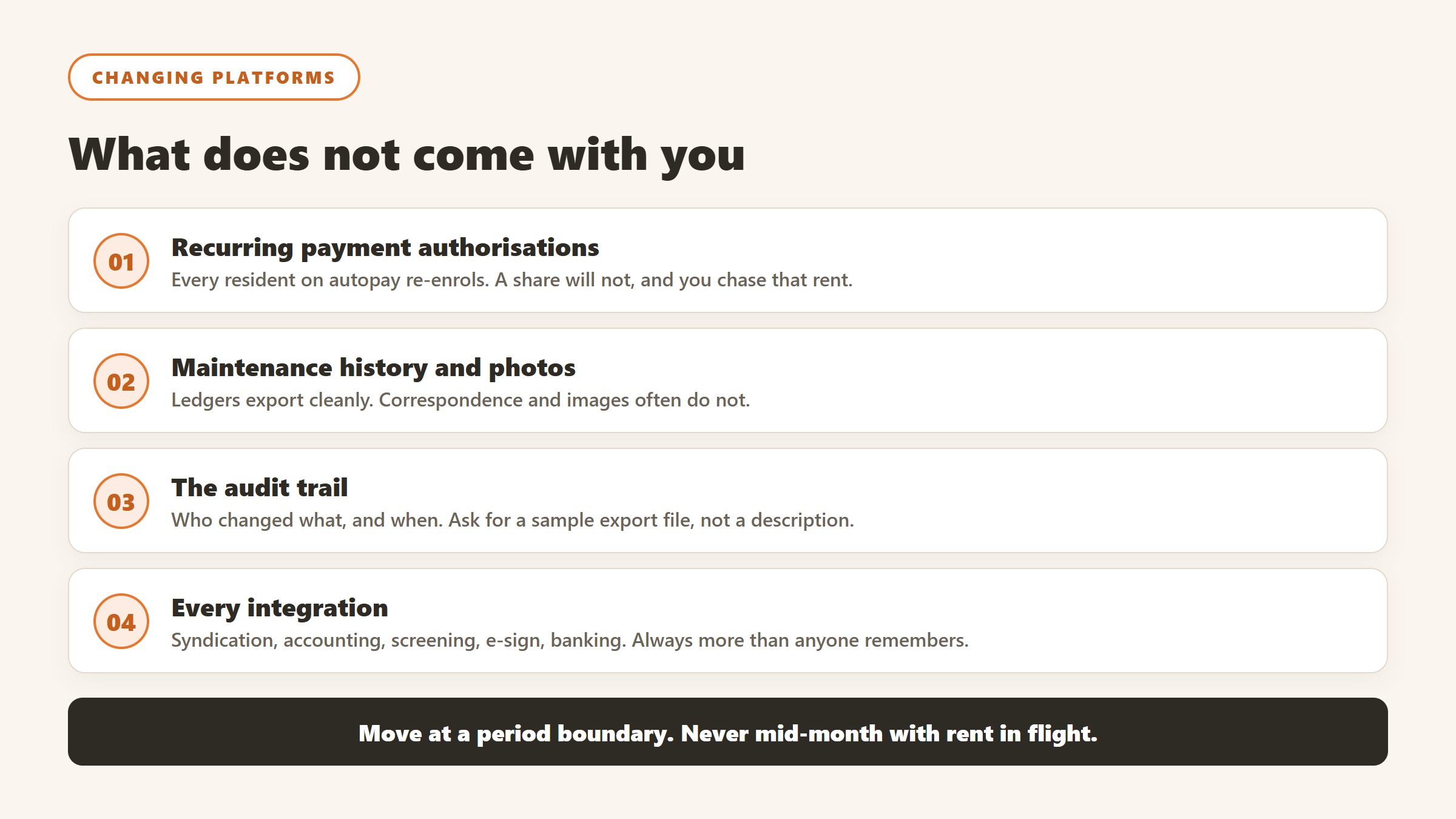
This is the big one. Tenant records, leases and ledgers export from almost any platform. Live recurring payment authorisations and the stored bank or card details behind them generally do not, which means every resident on autopay has to re-enrol. A share will not, and you will chase rent you were previously collecting automatically. Ask about this in writing during procurement, when you still have leverage.
Ask exactly what a full export contains
Standard fields usually come out cleanly. What often does not is the maintenance history with its photographs and correspondence, the document store of signed leases and addenda, the accounting history in a form your accountant can actually use, and the audit trail of who changed what. Ask for a sample export file during the trial rather than a description of one.
The accounting cutover has a right time and many wrong ones
Move at a period boundary, ideally the start of a financial year, and never mid-month with rent in flight. Plan to run a parallel reconciliation for one full cycle, and budget the hours for it. Migrations that go badly almost always went live at a convenient calendar date rather than a sensible accounting one.
Count the integrations before you sign, not when you leave
Listing syndication, accounting, screening providers, e-signature, banking, insurance and any owner portal are each work to disconnect and reconnect elsewhere. The count is always higher than anyone remembers, and it is the part that turns a two week migration into a six month one.
Where the figures on this page come from
Every price here was read from the vendor’s own pricing page on 4 September 2026, not from an aggregator or a review site. Each figure carries that date, because pricing in this market moves and a claim without a date is not checkable.
The pages we read
Buildium publishes $62, $192 and $400 a month plus a detailed fee schedule. DoorLoop publishes $69, $149 and $209 a month billed yearly with per unit equivalents. TurboTenant publishes a free tier plus $12.42 and $16.48. TenantCloud publishes $15 to $50 a month on annual billing. RentRedi publishes $12 a month on the annual plan. Hemlane, Rentec Direct and Landlord Studio all publish in full, as do Follow Up Boss at $69 per user, Wise Agent at $49, and Placester from $59.
The ones we could not read
AppFolio, Innago, Top Producer and Hostaway did not yield a figure to the same method that read every vendor above, and Lofty’s pricing page carried no plan rates. We are not presenting that as proof they publish nothing, because a failed read is not evidence of absence. Treat any figure for those five from elsewhere as unverified.
What we do not do
We do not carry a figure we cannot source to the vendor. Where a number circulates and cannot be traced, we say so and withdraw it rather than repeating it with a hedge, and we have withdrawn our own published figures on that basis more than once.
The bottom line
Never missing a call is one of the highest-return upgrades an agent can make, because the leak is invisible and constant. Pick Smith.ai for a human safety net, Allo for solo simplicity, Retell or Synthflow to build your own, or a packaged real-estate agent to launch fast. Whichever you choose, trial it on real calls and confirm the compliance details first. For the full agent toolkit, see our guide to the best AI tools for real estate agents.

Written by
FazFaz is the founder of AIToolsBakery. Some tools here are tested hands on. Others are assessed from vendor documentation and pricing verified on the live page, and every review says which one it is. Sponsors can buy a position in a guide. They cannot buy the score, the criticism, or silence about a better option.
How we test and how we make money →