Structurely and Ylopo are two of the best-known names in AI-powered real estate lead handling, and agents often weigh them against each other. But they are not really the same product, and choosing well comes down to understanding one difference: whether you need the leads generated for you, or only nurtured once you have them. This comparison breaks down how they differ, what they cost, and which one fits your business.
Short answer: Choose Ylopo if you want lead generation and AI nurture from one vendor, since it runs your Facebook and Google ads and then nurtures the leads with its rAIya assistant. Choose Structurely if you already generate leads and want a proven, dedicated AI inside sales agent focused purely on qualifying and nurturing them over the long haul.
The core difference
Structurely is a dedicated AI inside sales agent. Its assistant, Aisa Holmes, takes leads you already have and qualifies and nurtures them over text, email, and voice for 12 months or more. It does not generate leads; it works the ones you feed it, and it does that one job with more depth and track record than almost anyone.
Ylopo is a lead-generation platform first. It runs your Facebook and Google advertising to produce leads, then hands them to its AI assistant, rAIya, for qualification and nurture by text and voice. You are buying the whole machine: the ads that create the leads and the AI that works them.
That single distinction drives the entire decision. If you need leads, Ylopo offers an end-to-end engine. If you already have a lead source and only need the nurture, Structurely’s focus makes it a better and often better-value fit, because you are not paying for a lead-gen engine you will not use.
Head to head
| Structurely | Ylopo | |
|---|---|---|
| Primary job | AI inside sales agent (nurture) | Lead generation plus AI nurture |
| Generates leads? | No, works your existing leads | Yes, via Facebook and Google ads |
| AI assistant | Aisa Holmes | rAIya |
| Channels | Text, email, voice | Text, voice |
| Nurture length | 12+ months | Long-cycle, ad-driven |
| Starting price | $499/mo + credits (official 2026) | Quote-based (reported ~$345 to $545+/mo) |
| Best for | Teams with their own lead source | Teams wanting leads and nurture in one |
Lead generation
This is the clearest split. Ylopo generates leads; Structurely does not. If lead volume is your bottleneck and you want a vendor to run your paid advertising and feed the results into AI nurture automatically, Ylopo is built for exactly that and Structurely simply does not compete, because it is not trying to. If you already have a reliable lead source, this advantage does not apply to you.
Nurture depth and track record
Both nurture with AI, but Structurely’s entire product is the nurture engine, and it shows in the depth and the data behind it: over 13 million conversations, a reported 57 percent response rate, and human-like touches including AI voice on higher tiers. Ylopo’s rAIya is strong and tightly integrated with its ad engine, but nurture is one part of a broader platform rather than the whole product. For pure nurture sophistication on leads you already own, Structurely has the edge.
Pricing
Both vendors changed their numbers in 2026, so treat older figures with suspicion. Ylopo publishes no rate card at all: third-party estimates put the platform around $345 to $545 plus per month before ad spend, and it bundles lead generation, so the higher price buys more scope. Structurely now runs an action-credit model: $499 per month for teams plus $0.08 per credit, with a $2,000 onboarding fee and annual contracts. Neither is cheap, and the real comparison is what each dollar buys.
Both vendors’ numbers moved in 2026. Structurely now runs an action-credit model (our Structurely pricing breakdown has the current math) and Ylopo remains quote-only, with our Ylopo pricing guide collecting the reported ranges.
Which should you choose?
- Choose Ylopo if: you need more leads and want advertising plus AI nurture from a single vendor, and you are ready to fund ad spend on top of the subscription.
- Choose Structurely if: you already generate leads and want the most proven, focused AI inside sales agent to qualify and nurture them for the long haul.
- Consider both if: you are a larger team that could use Ylopo for generation and still want a dedicated nurture specialist, though most teams should start with one.
There is a third shape to this decision: an all-in-one CRM instead of a stacked specialist. Our Lofty vs Ylopo comparison covers that consolidate-or-stack call, and our Lofty pricing breakdown runs the numbers on the all-in-one side.
What agent CRMs and lead platforms actually charge
This half of the market divides into CRMs you fill with your own leads and platforms that sell you the leads as well, and the second is several times the price of the first. Here is each alternative to structurely vs, read on 4 September 2026.
Follow Up Boss, $69 per user per month, published plainly
Follow Up Boss publishes $69 per user per month plus tax, with a yearly option giving two months free and calling as a $39 per user add-on. It is a CRM rather than a lead source, which is the important distinction: you are buying the system that works leads you already have. At five agents that is $4,140 a year before the calling add-on, so price it at your real headcount rather than at one seat.
Wise Agent, $49 a month, and the cheapest published option here
Wise Agent publishes $49 a month, falling to $42 billed annually at $499 a year, with a higher tier at $69 and $59. Its annual toggle is marked as saving 15% and the saving holds. For a solo agent or a small team this is the published floor of the category, and the gap to a lead platform is an order of magnitude rather than a percentage.
Placester, from $59 a month, sold around the website
Placester publishes $59, $79 and $129 a month with a 20% annual discount, positioned around IDX websites and marketing rather than lead generation. If your gap is presence rather than pipeline, that is a materially cheaper problem to solve than buying leads, and it is worth being honest with yourself about which one you actually have.
The lead platforms, where almost nobody publishes
The platforms that sell leads alongside software, Lofty, CINC, Ylopo, Zurple, Sierra Interactive, Real Geeks, Market Leader and BoldTrail among them, largely quote rather than publish. We could not read a plan figure from Lofty’s own pricing page on 4 September 2026. That is normal in this corner of the market and it means your only real leverage is a published CRM priced at your team size, plus a clear view of what you currently pay per closed transaction.
Work out your cost per closing before any demo
Take last year: total spend on leads and CRM, divided by transactions closed from those leads. That single number is the benchmark every quote has to beat, and most agents have never calculated it. Without it you are comparing monthly figures against each other rather than against the thing that pays for them, which is how a $2,000 a month platform gets renewed for three years on the strength of a feeling.
Buying leads honestly: what the conversion numbers actually mean
Every platform in this category quotes conversion figures. Almost none of them mean what a reader assumes, and the differences are large enough to reverse a purchase decision.
Ask what the denominator is
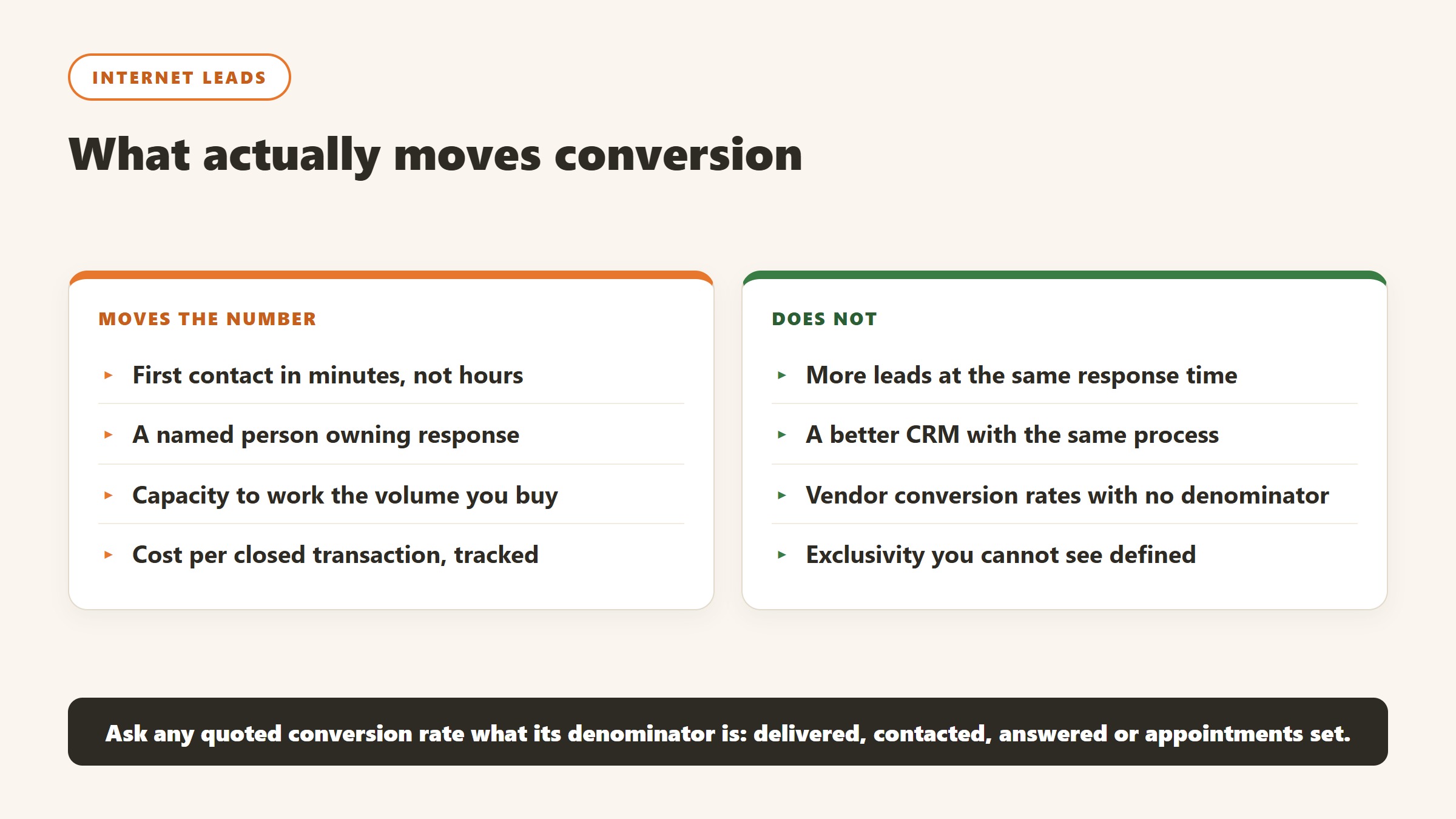
A conversion rate can be measured against leads delivered, leads contacted, leads that answered, or appointments set. Those four produce wildly different percentages from the same underlying performance. When a vendor quotes a rate, ask which one it is, and ask for the number of days over which it was measured. A rate with no denominator and no window is a marketing figure rather than a metric.
Speed to lead is the variable that actually moves conversion
The single largest controllable factor in internet lead conversion is how fast the first contact happens, and it is measured in minutes rather than hours. That is a staffing and process question, not a software one. A platform that routes leads instantly to an agent who checks their phone twice a day will underperform a spreadsheet worked by someone answering in five minutes. Fix the response process before buying anything that increases lead volume.
More leads at the same conversion is not obviously good
Doubling lead volume doubles the work and, unless response times hold, usually reduces conversion. Teams that buy volume without adding capacity get a lower conversion rate on a bigger number and conclude the leads were bad. Before increasing volume, work out how many new leads your current team can genuinely contact within the window that matters.
The contract term is where the risk sits
Lead platforms frequently ask for six or twelve month commitments, sometimes with a territory or exclusivity element. That is defensible, because a pipeline takes time to season. It is also a lock-in on performance you have not seen. Ask for a defined review point in writing, agree in advance what result would end the arrangement, and be sceptical of any exclusivity you are paying a premium for without a written definition of the area it covers.
How to tell whether the tool paid for itself
Real estate software is unusually easy to evaluate honestly, because the outcomes are countable. Most teams still do not do it, and the renewal conversation becomes an argument about impressions.
Pick the metric the tool is supposed to move
For a lead platform it is cost per closed transaction. For property management software it is hours of admin per unit per month, and days to fill a vacancy. For staging it is days on market and list-to-sale ratio. For screening it is time to approve and the rate of problem tenancies. Each of those is available from records you already keep, and each needs a figure from before you started.
Take the baseline before you switch anything on
You need last year of the metric from a source the project did not touch. This is the step that gets skipped and it is the reason most of these purchases can never be evaluated. It costs an hour. Ask the two or three people whose work will change to record how long the target task takes them this month, because time saved is measurable in advance and unprovable afterwards.
Give it a full cycle before judging
Leasing and transactions are seasonal, so a six week read tells you very little. Judge lead tooling over at least two quarters, and property management tooling over a full turnover cycle, because the value shows up at move-out and move-in rather than in the quiet middle. Say that at the outset so an unremarkable month one is understood as expected.
Write the stop condition down first
Before purchase, name the result at twelve months that would mean you do not renew. It converts renewal from a default into a decision and it is the most effective discipline against a subscription that quietly becomes permanent. If nobody can name a result that would end it, the evaluation was never real.
How these purchases go wrong, and the early warning signs
Four patterns cover most of what we hear a year after a real estate software purchase, and all four are visible in the first month.
The migration that never finishes
The new system goes live, the old one stays open “for historical records”, and eighteen months later half the team still works in both. This is the most common and most expensive failure in property management software. Before signing, agree a cutover date, a named owner, and what specifically will not be migrated. Running two systems is worse than either.
Tenant-facing features nobody told the tenants about
Online payments, maintenance portals and application flows only save time when residents actually use them, and adoption depends entirely on how the change is communicated. A portal with 20% adoption creates more work than paper did, because you now run two processes. Plan the resident communication before go-live and measure adoption at thirty days.
The tool one person runs
One capable person builds the workflows and produces every report. They leave and it stops the same week. The warning sign is that nobody else has ever done a full month-end in the system. Have a second person do it once a quarter from written steps.
The fees that arrive after the subscription
Payment processing, screening, e-signatures, bank account setup and inspections are all charged separately by most vendors in this category and all of them are published. A business case built on the subscription alone will be wrong in year one, usually by a four figure sum. Build the model from the fee schedule, not the plan cards.
What it costs to leave, which no pricing page mentions
Switching cost is why landlords and managers stay on systems they have outgrown. In this category it is unusually concrete, which means you can ask about it precisely.
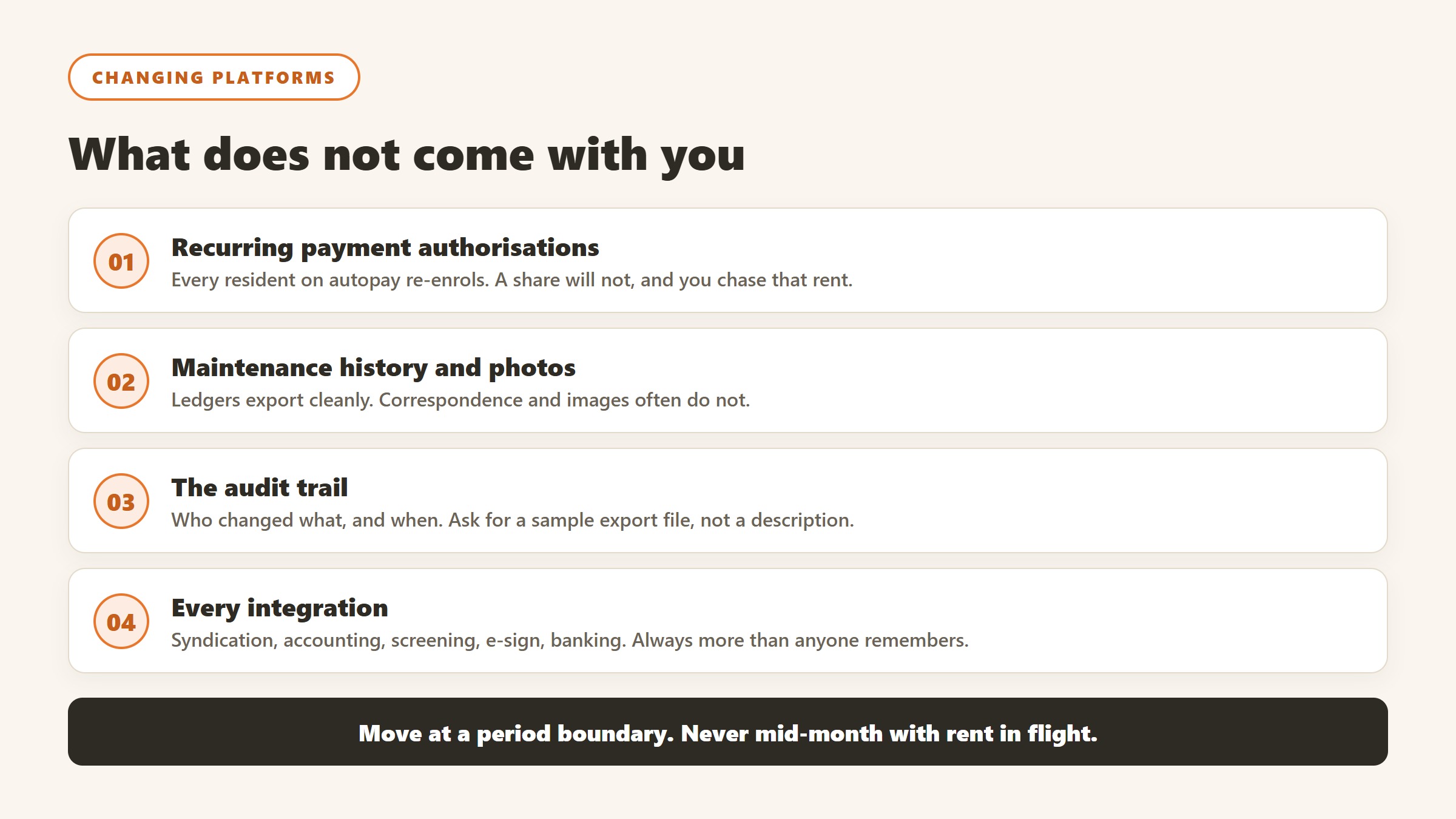
Recurring payment authorisations rarely transfer
This is the big one. Tenant records, leases and ledgers export from almost any platform. Live recurring payment authorisations and the stored bank or card details behind them generally do not, which means every resident on autopay has to re-enrol. A share will not, and you will chase rent you were previously collecting automatically. Ask about this in writing during procurement, when you still have leverage.
Ask exactly what a full export contains
Standard fields usually come out cleanly. What often does not is the maintenance history with its photographs and correspondence, the document store of signed leases and addenda, the accounting history in a form your accountant can actually use, and the audit trail of who changed what. Ask for a sample export file during the trial rather than a description of one.
The accounting cutover has a right time and many wrong ones
Move at a period boundary, ideally the start of a financial year, and never mid-month with rent in flight. Plan to run a parallel reconciliation for one full cycle, and budget the hours for it. Migrations that go badly almost always went live at a convenient calendar date rather than a sensible accounting one.
Count the integrations before you sign, not when you leave
Listing syndication, accounting, screening providers, e-signature, banking, insurance and any owner portal are each work to disconnect and reconnect elsewhere. The count is always higher than anyone remembers, and it is the part that turns a two week migration into a six month one.
The bottom line
Structurely and Ylopo both use AI well, but they solve different problems. Ylopo is the choice when you need the leads created and worked in one system; Structurely is the choice when you have leads and want the deepest, most proven nurture engine pointed at them. Diagnose your own funnel first, and the winner is obvious. For the wider field, see our roundup of the best AI inside sales and lead qualification tools and our guide to the best AI tools for real estate agents, and read our full Structurely review for a deeper look at the nurture specialist.
More AI tool guides worth reading: REimagineHome Review.

Written by
FazFaz is the founder of AIToolsBakery. Some tools here are tested hands on. Others are assessed from vendor documentation and pricing verified on the live page, and every review says which one it is. Sponsors can buy a position in a guide. They cannot buy the score, the criticism, or silence about a better option.
How we test and how we make money →