Quick answer: This is no longer a comparison of two standalone platforms. chorus.ai now redirects to a ZoomInfo product page, so the real choice is Gong as its own platform against Chorus as a module inside ZoomInfo. If you do not run ZoomInfo, that mostly settles it. Checked 12 August 2026.
Why most Gong vs Chorus comparisons are out of date
Search this question and you will find a lot of pages weighing two independent conversation intelligence platforms against each other on transcription accuracy and feature grids.
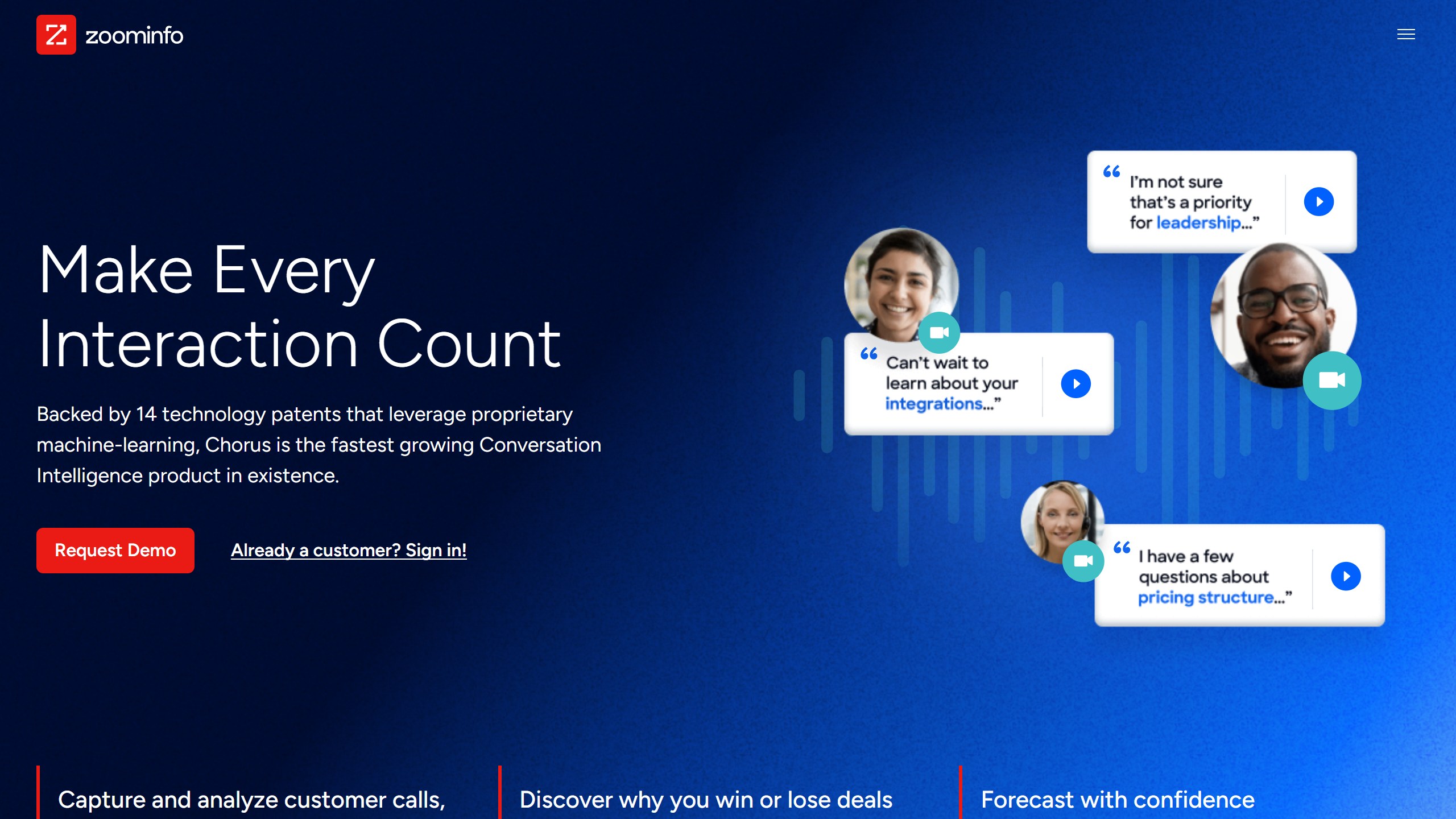
That is not the decision any more. Type chorus.ai into a browser today and you land on zoominfo.com/products/chorus, under ZoomInfo branding, with ZoomInfo’s navigation. The standalone brand has been absorbed.
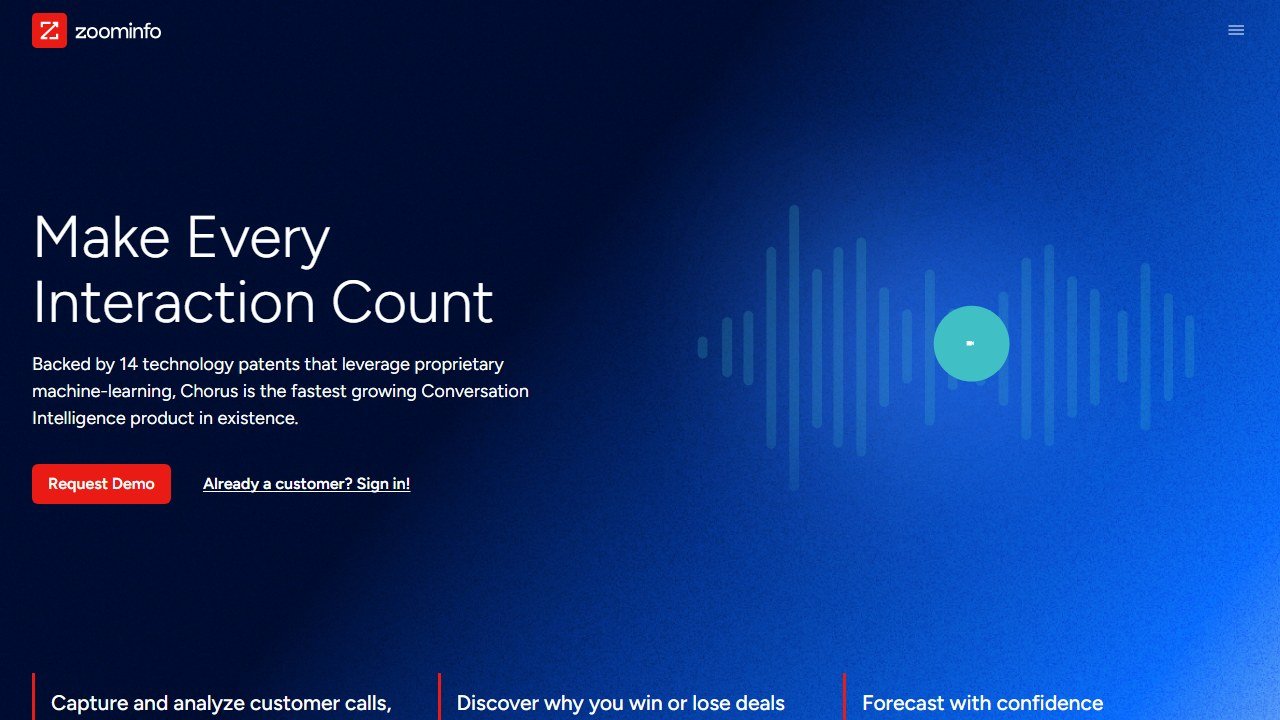
So the honest framing of this comparison is not Gong versus Chorus. It is Gong, a standalone platform you buy on its own merits, versus Chorus, a capability you get inside ZoomInfo. Framed that way, the deciding question is not which has better trackers. It is whether you already pay for ZoomInfo.
How we researched this
We did not run either product. This is built from both vendors’ published pages, read in a browser on 12 August 2026, plus a check of where chorus.ai actually resolves. It is not a hands-on test and neither product is scored. For the individual write-ups see our Gong review and Chorus review.
Side by side on what is actually published
| Gong | Chorus by ZoomInfo | |
|---|---|---|
| Sold as | Its own platform | A ZoomInfo module. chorus.ai redirects to zoominfo.com |
| Published price | No | No |
| Pricing model published? | Yes. Per user, plus a platform fee based on users supported. Integrations free | No. Custom plans |
| Quote gating | Team size, four bands from 1 to 50 up to 10,000+ | Form |
| Call recording and transcription | Core capability | Stated as unlimited, available within minutes of a call ending |
| Reporting | Deal and revenue intelligence | More than twenty out of the box reports, plus custom objects |
| Strongest case | Category default for large B2B teams, bought independent of your data vendor | Conversation intelligence sitting directly on ZoomInfo data you already own |
Gong tells you more about how it charges
Neither publishes a number, but Gong publishes the formula and ZoomInfo does not. Gong states that licences are priced per user, that there is a separate platform fee based on the number of users supported, and that integrating your existing stack is free.
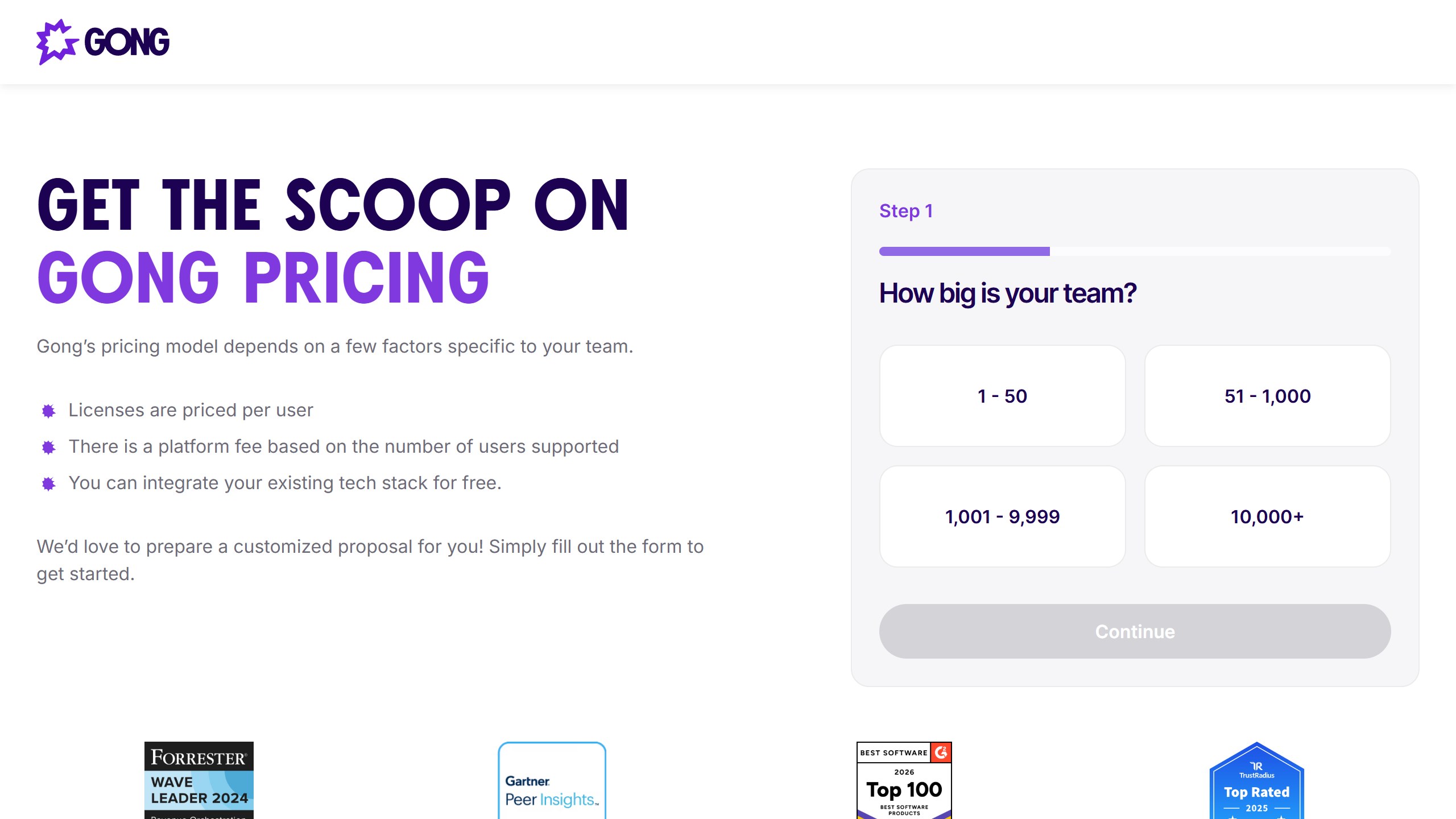
That middle clause is the one to carry into any comparison. A per seat estimate for Gong prices the licences and none of the platform, so buyers routinely model it low. Detail in our Gong pricing guide.
For Chorus, the question we could not answer from published material is more fundamental: can you buy it at all without a broader ZoomInfo subscription, and if so what does that cost relative to the bundle? Nothing public settles it. That is the first thing to establish on a call, because the answer changes whether this is a two vendor comparison or a decision about your data platform.
The unlimited recording point is real
One published difference worth taking seriously: ZoomInfo states Chorus includes unlimited call recordings and transcriptions, with recordings available within minutes of a call ending.
Metering on recording and transcription is common in this category, and it is the kind of limit that only becomes visible in month four when a quarter-end call volume spike blows through an allowance. If your team’s call volume is high or spiky, get the equivalent number from Gong in writing rather than assuming parity.
How to decide
You already run ZoomInfo. Chorus is the obvious first look. The integration with data you already own is the whole argument and it is a good one. Establish the incremental cost on top of your existing subscription rather than a standalone figure.
You do not run ZoomInfo. Gong, in most cases. Buying Chorus means buying into ZoomInfo’s commercial relationship and account team, which is a much larger decision than picking a coaching tool. If you were going to evaluate ZoomInfo anyway, fine. If not, the tail is wagging the dog.
You are mid-contract with ZoomInfo and unhappy. Worth knowing that Allego runs a competitor buyout programme, offering to help cover the cost of exiting an incumbent enablement contract. It is a different shape of product, broader and training-led rather than conversation intelligence, but it is the only vendor in the category that will help pay to get you out.
What you actually want is rehearsal, not review. Neither of these is the right tool. Both analyse conversations that already happened. See our AI sales roleplay tools guide, or Hyperbound vs Yoodli for the two most-compared rehearsal platforms.
What we could not verify
Transcription accuracy on either platform, tracker quality, whether Chorus can be licensed independently of ZoomInfo, and any actual figure from either vendor. Every capability described above is the vendor’s own published claim and we have not tested any of it.
We are also not scoring these products, because scoring things we have not run is how sites end up with claims they cannot defend.
The decision reduces to one question
Strip out the feature tables and this comparison collapses into a single fact about your own stack.
Do you already pay for ZoomInfo?
If yes, Chorus is the sensible default and the burden of proof shifts to Gong. Connected Intelligence, ZoomInfo’s published capability joining its contact and company data to conversation history, is a real thing you cannot buy from Gong at any price. The commercial relationship already exists, the module lands on an existing contract, and bundling gives you renewal leverage.
If no, the calculus inverts completely. Choosing Chorus means acquiring a data platform relationship in order to get a coaching tool, and the module’s headline advantage is inert for you. At that point you are comparing conventional conversation intelligence against a vendor whose entire company is pointed at that one job.
Everything else is a tiebreaker
Transcription quality, tracker configuration, dashboard design: all of these matter, all of them are close enough between the two that they will not decide a purchase, and none of them survive contact with the ZoomInfo question above. Answer that first and the shortlist usually has one name on it.
Where they genuinely differ
| Gong | Chorus (ZoomInfo) | |
|---|---|---|
| Sold as | Standalone platform | Module inside ZoomInfo |
| Own domain | gong.io, live | chorus.ai redirects to ZoomInfo |
| Publishes a price | No | No |
| Publishes the pricing model | Yes, per-user licence plus platform fee | No |
| Data platform included | No | Yes, if you license ZoomInfo |
| Company focus | Single product line | One module among many |
| Best case for it | You want the deepest dedicated tool | You already run ZoomInfo |
The row that decides most purchases is the last one, not the feature rows above it.
What neither of them will tell you
Neither publishes a number
This is not a transparency contest with a winner. Gong publishes the shape of the bill and no figure. ZoomInfo publishes neither, across more than 12,000 characters of pricing page. For context on how normal that has become in this category, Salesloft no longer maintains a pricing page at all: the URL redirects to a page titled “Talk to Sales”.
Which means the quotes are not comparable by default
A Gong quote is a licence plus a platform fee. A Chorus quote is a line inside a ZoomInfo package whose size depends on the data licence next to it. Putting those two numbers side by side tells you almost nothing unless you force them into the same shape first: same seat count, same contract length, implementation separated out, and every add-on itemised.
Ask both for a three-year view
Year one is where discounting lives and year three is where the real cost sits. Ask both vendors for the same seat count priced across three years with the renewal uplift capped in writing. The vendor that will not do that is telling you something useful.
If neither fits
Both are enterprise purchases with quote-gated pricing, annual commitments and implementation effort. A five-person team doing its first call reviews is not the buyer either was designed for, and paying enterprise prices to find out whether call coaching works for you is an expensive experiment.
Our conversation intelligence guide covers the smaller end, and the Chorus review and Gong review go deeper on each individually.
What the rest of this market charges, vendor by vendor
A table gives you the number. What decides your bill is the meter behind it and the limit that binds first. Here is each comparable vendor to Gong and Chorus, read from their own pricing page on 4 September 2026.
Apollo.io, from $49 per seat, and it publishes the allowances too
Apollo is the transparency benchmark in this category. Basic is $49 per seat per month billed annually and $65 billed monthly, Professional $79 and $99, Organization $119 and $149 with a three-seat minimum, plus a free tier at $0. Crucially it also publishes the credit allowance, 30,000 per seat per year on Basic, which almost nobody else does. That means you can divide the allowance by your real monthly reveal volume and know whether the plan fits before speaking to anyone.
Lavender, from free to $89 a seat, and free for students and jobseekers
Lavender publishes every tier: Basic free forever but capped at five emails analysed a month, Starter $27, Individual Pro $45 and Team $89 per seat, all billed annually. Note the URL, because lavender.ai/pricing now returns a 404 after the company split into two products. It also gives the Email Coach away free to students, jobseekers and bootstrapped founders, which is unusually generous and worth knowing if you hire from a graduate pipeline.
Instantly and Smartlead, published, and metered on sending
Instantly and Smartlead both publish figures openly. For cold email tooling the binding constraint is usually monthly sending or active-lead volume rather than seats, so a plan can look generous per user and still stop you at the volume your campaign needs. Smartlead runs a working monthly and annual toggle that changes every figure, so check which state you are reading.
Clay, published but on a slider
Clay publishes real numbers, but they sit on a credit slider with a monthly and annual toggle marked “Save 10%”, so the figure changes as you move the credit volume. Any article quoting a single flat Clay price has taken one position on that slider and presented it as the price. Always pair a Clay figure with the credit volume it assumes, or it cannot be compared to anything.
Cognism, no price, but it publishes the packaging
Cognism publishes no figure in any currency. It does publish that Standard and Pro both include five seats, which is a floor worth knowing, and that its credits model only spends a credit again if a contact changes jobs. A two-person team should expect to be quoted for five.
Gong, no price, but it publishes the formula
Gong publishes no figure either, but it does publish the model: licences priced per user plus a separate platform fee based on the number of users supported. Two components, both scaling with headcount, which at least lets you model the shape of the bill.
ZoomInfo, Outreach and Salesloft publish nothing at all
ZoomInfo renders over 12,000 characters of pricing page with no currency figure anywhere. Outreach sets out packaging but no numbers, and note the domain moved from outreach.io. Salesloft has gone furthest: its pricing URL now redirects to a page titled “Talk to Sales”, so there is no pricing page at all. Artisan has also removed its figures, its cards now reading “Pricing scoped on your plan”.
Running the evaluation so the quote means something
Normalise every quote before you compare
Ask each vendor, Gong and Chorus included, for the same seat count, the same term, implementation quoted separately, every add-on itemised, and any usage meter stated with its included allowance and top-up rate. A blended annual figure is not comparable to anything and vendors know it.
Bring your own data to the demo
Vendor demos run on datasets chosen because the product handles them well. Ask to load your own: a messy account list, a call on a poor line, a technical conversation full of your product jargon. How a tool performs on your actual data is what decides whether reps adopt it, and it is invisible in a scripted walkthrough.
Test the thing people will do fifty times a day
Dashboards demo beautifully and get opened rarely. The feature that decides adoption is the one used constantly: finding a contact, building a list, locating a moment in a call. Time that specific task during the evaluation and count the clicks.
Agree the expansion price before you need it
Seat creep is the standard overrun in this category. Agree in writing what an additional seat costs, and whether the discount you negotiated applies to seats added mid-term. Discovering it does not is how a good first-year deal becomes an expensive second year.
Cap the renewal in the first contract
At renewal the vendor knows your usage, your dependency and your switching cost, and with no public rate card you have nothing to anchor against. A capped uplift stated as a percentage is worth more than a larger first-year discount, and it is only negotiable while you still have a choice.
Verdict
Treat this as a decision about your data platform rather than a features bake-off. Chorus is a strong argument if ZoomInfo is already in your stack and a strange one if it is not, because you would be adopting a data vendor to get a coaching tool. Gong is the standalone answer, still the category default, and more open about how it charges, as long as you remember to ask about the platform fee.
Full category comparison in our best AI sales coaching software guide.
Checked on gong.io and zoominfo.com on 12 August 2026.

Written by
FazFaz is the founder of AIToolsBakery. Some tools here are tested hands on. Others are assessed from vendor documentation and pricing verified on the live page, and every review says which one it is. Sponsors can buy a position in a guide. They cannot buy the score, the criticism, or silence about a better option.
How we test and how we make money →