If you run Salesforce with the Nonprofit Success Pack, you have probably been told you need to move to Nonprofit Cloud. Most of the pages telling you that are written by partners who sell the migration. This page starts from what Salesforce itself says, in its Power of Us help article and its June 2026 migration guide, and then sets out what changes, what it costs and how to decide. If your real goal is better insight into your donors, Gratefully, our top-ranked donor intelligence tool, connects to both NPSP and Nonprofit Cloud, so that part does not have to wait for a migration.
How we put this together. Every fact below comes from Salesforce’s own pages and documents, read on 17 September 2026, and each is dated. We have not run a migration or used either product hands-on. Where Salesforce has not published something, such as an end-of-life date, we say so.
The short answer: NPSP is supported, but no longer developed
Salesforce’s Power of Us help article, published on 27 April 2026, says “NPSP remains fully supported, meaning organizations can continue to use it without any disruption.” It also says NPSP is no longer receiving new features or enhancements, a stage Salesforce calls “End of Innovation”, and that there is “no requirement to migrate” to Agentforce Nonprofit, formerly called Nonprofit Cloud, until organisations are ready. The same article says the NPSP packages can still be installed.
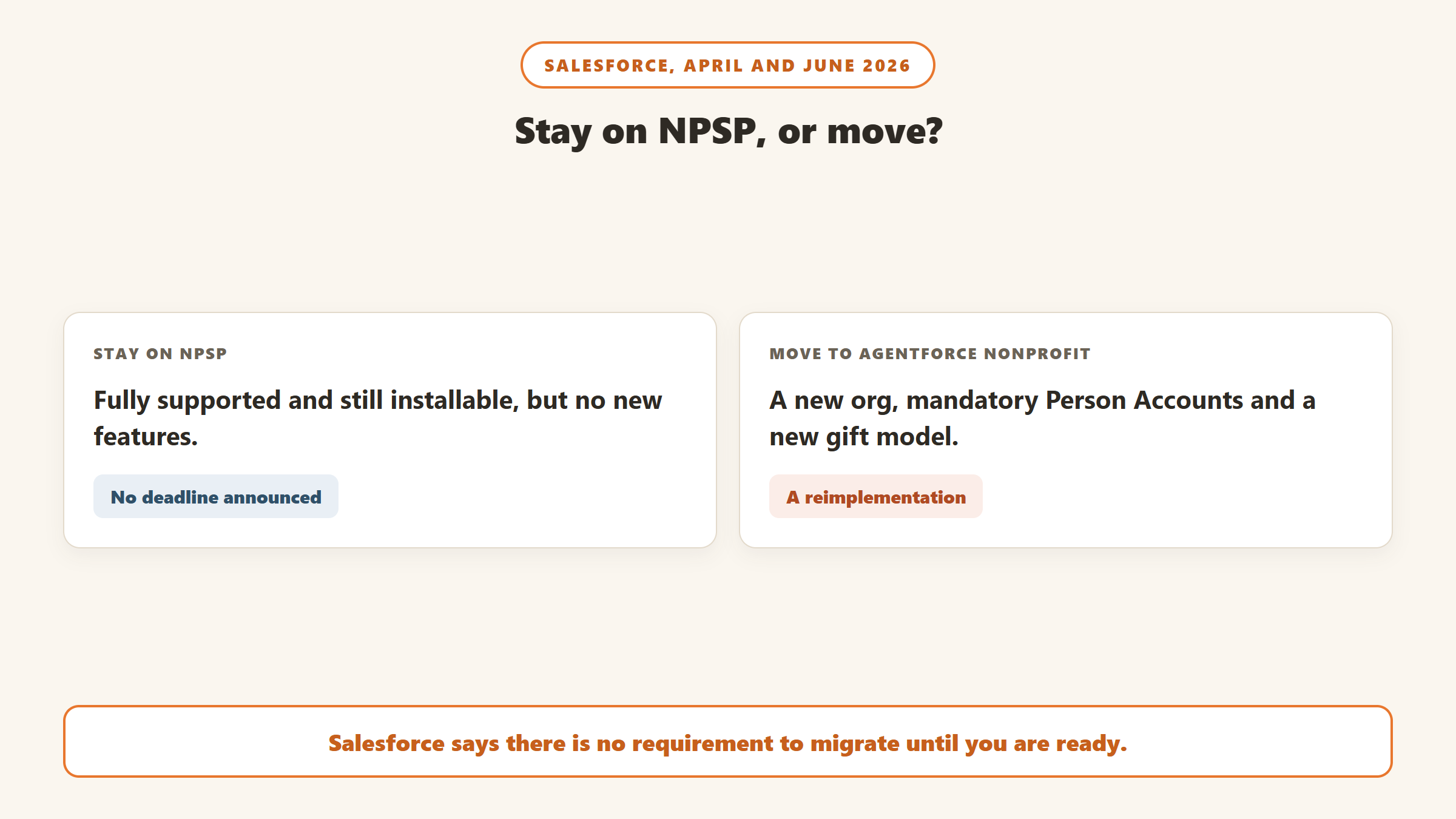
Salesforce’s managed packages page adds that NPSP “will continue to be supported”, while recommending Nonprofit Cloud for new customers. We found no end-of-sale or end-of-life date for NPSP on any Salesforce page. Third-party sites give different years for when innovation stopped; Salesforce’s own pages give none, so treat any date you see as unofficial.
In practice that means there is no deadline forcing your hand today, but every new Salesforce nonprofit feature, including the AI agents, is being built for the newer product. The migration guide says new Agentforce Nonprofit implementations now outpace new NPSP implementations.
First, the name: Nonprofit Cloud is now Agentforce Nonprofit
On 2 December 2025, Salesforce announced Agentforce Nonprofit “(formerly Nonprofit Cloud)”. Its Help landing page now says Nonprofit Cloud is Agentforce Nonprofit and warns that you may still see the old name in applications and documentation. The pricing page still uses Nonprofit Cloud. They are the same product, and this page uses both names for that reason.
What NPSP and Nonprofit Cloud actually are
They are not two versions of one product. NPSP, according to Salesforce’s help article, “is not a Salesforce license type”; it is a suite of six managed packages installed on Sales Cloud licences in Enterprise or Unlimited orgs, and it is listed as a free add-on. Nonprofit Cloud is built into the core Salesforce platform and delivered through licences and settings. The migration guide says its fundraising, programme and case management, and outcomes features are available within a single licence, where NPSP split them between multiple packages.
| Area | NPSP | Agentforce Nonprofit (Nonprofit Cloud) |
|---|---|---|
| Delivery | Six managed packages on Sales Cloud | Built into the core platform |
| People | Contacts with Household Accounts by default | Person Accounts, mandatory; Household Account model not supported |
| Households | Household Account record type | Party Relationship Group of type Household |
| Gifts | Opportunities, Payments, Recurring Donations | Gift Transactions, Gift Commitments and Schedules |
| Funds | General Accounting Units and Allocations | Gift Designations |
| Soft credits | Account, partial and contact role soft credits | One Gift Soft Credit object |
| Programmes | Program Management Module, a separate free package | Program, case and outcome management built in |
| Grantmaking | Outbound Funds Module, free | Nonprofit Cloud for Grantmaking, priced separately |
| AI | None documented in NPSP | Named Agentforce agents |
What changes in the data model
This is where the work is. The Agentforce Nonprofit Migration Guide, version 2 dated 1 June 2026, is 79 pages long and aimed at experienced admins and consultants. The changes that matter most:
People become Person Accounts
The guide says migrating all existing Contacts into Person Accounts “is mandatory”, and that Agentforce Nonprofit does not support the Household Account model that is NPSP’s default. Households are rebuilt as relationship groups, which the guide says can be time-bound, merged or split, and a person can belong to more than one. Every report, list view and integration that assumes the household account structure will need rework.
Gifts are split across new objects
In NPSP, a gift is an Opportunity with Payments. In Agentforce Nonprofit, received gifts are Gift Transactions, recurring gifts and pledges are Gift Commitments with schedules, and Opportunities are kept for gifts still in cultivation. The guide says migrating NPSP Opportunities involves splitting records into multiple destination records across different objects. Soft credits move into a single Gift Soft Credit object, and General Accounting Units map one to one to Gift Designations.
Some things do not come across
The guide lists Engagement Plans, Levels, the Recurring Donation Change Log, and batch and data import batch records under objects not recommended for migration. It describes Engagement Plans as substantially similar to Action Plans in the new product. It also says migrating emails and files is often a project in itself. If your team relies on engagement plans or donor levels, plan their replacements before you move.
It is a new org, not an upgrade
The guide says the migration “more closely resembles a reimplementation than a traditional software upgrade”, and that Salesforce strongly recommends implementing Agentforce Nonprofit in a new org. It says the two products cannot actively coexist in one org, and that Agentforce Nonprofit features activated by accident before migration is complete cannot be reverted. It also warns that many platform licences are incompatible with the new product. The guide does not assume any particular migration tool and gives no timeline or effort estimate.
Relationships, addresses and permissions change too
NPSP’s Relationships and Affiliations are replaced by Account Contact Relationships, Contact Contact Relationships and Party Role Relationships. NPSP’s Address object gives way to separate contact point records for addresses, phone numbers and emails. Access moves from profiles to permission set licences and groups, including managed persona sets. None of these is hard on its own, but together they touch almost every screen and report your staff use.
What Agentforce Nonprofit adds
The case for moving rests on what the newer product can do that NPSP cannot. From Salesforce’s own pages:
- One licence for more of the work. Fundraising, programme management, case management and outcome management sit in the same product, where NPSP relied on separate packages.
- AI agents. The December 2025 announcement named four: Prospect Research and Participant Management, both generally available at the time, plus Volunteer Capacity and Coverage and Donor Support, both in beta with general availability announced for 2026. We have not confirmed that those later releases shipped on schedule.
- Volunteer management built in, including an Experience Cloud portal for sign-ups.
- Gift entry with RFM scoring, covered in Salesforce’s fundraising guide.
- Outreach Source Codes alongside campaigns, for tracking which appeal a gift came from.
- Flexible households, where a person can belong to several groups over time.
If none of these solves a problem you have today, that is a strong sign the move can wait. If one of them is the reason your team keeps building workarounds, it is a sign to start planning.
What it costs
Salesforce’s nonprofit pricing page, read on 17 September 2026, lists these Nonprofit Cloud editions, all per user per month billed annually, and says they require an annual contract:
| Edition | List price |
|---|---|
| Enterprise | $60 USD |
| Unlimited | $100 USD |
| Agentforce 1 for Sales | $135 USD |
| Agentforce 1 for Service | $135 USD |
| Grantmaking Enterprise / Unlimited | $175 / $225 USD |
Standard support is included; the Premier Success Plan is listed at 30% of net licence fees. NPSP itself is a free add-on, so an NPSP org pays for the underlying Sales Cloud licences rather than for NPSP.
The free licences
Through the Power of Us Program, the help article says eligible nonprofits can request one of two bundles: 10 Agentforce Nonprofit Enterprise Edition licences, or 10 Sales and Service Enterprise Edition licences. It says the donated licences are free of charge and do not expire, that Salesforce generally provides one donation per Employer Identification Number, and that approval can take up to three business days. Organisations on Unlimited Edition are told to select product discounts only. Some partner sites describe 10 licences of each; Salesforce’s article says one bundle or the other.
The cost Salesforce does not publish
The biggest cost is the reimplementation itself, and Salesforce publishes no figure for it. The guide assumes partner involvement and a new org. Budget for discovery, data mapping, rebuilding reports and automations, retraining staff, and a period of running both orgs. Ask at least two partners for a fixed-scope quote based on your own object counts and integrations, and ask each what they would leave behind. Our Salesforce Nonprofit Cloud pricing guide covers licence costs in more depth.
As a simple illustration using list prices: an organisation with 15 users on Enterprise pays for five licences beyond the 10 donated ones, which at $60 a month is $3,600 a year before any Power of Us discount. That is our arithmetic. Salesforce publishes no implementation figure to set beside it, so get partner quotes before you decide, and base the decision on need rather than on the licence bill alone.
Stay or move: a decision table
| Your situation | Leaning |
|---|---|
| NPSP works, few customisations, no budget for a project this year | Stay, and review annually |
| You need programme, case or outcome management in one place | Move, or plan to |
| You want Salesforce’s new AI agents | Move; they are built for Agentforce Nonprofit |
| Heavy use of engagement plans, levels or custom household logic | Stay until you have designed replacements |
| Your org is a tangle of old customisations | A move is a chance to rebuild cleanly |
| You are considering leaving Salesforce entirely | Compare alternatives before you reimplement |
If the last row applies, a reimplementation is the natural moment to reconsider the platform. Our guide to Salesforce Nonprofit Cloud alternatives prices simpler donor CRMs.
Get donor insight now, whichever you choose
Many teams put off improving their fundraising until the migration is done, which can mean a year or more of the same blind spots. Gratefully sits beside Salesforce rather than inside it, and connects to Salesforce for Nonprofits whether you run NPSP or Nonprofit Cloud. Its own Salesforce comparison page describes Salesforce as the system of record and Gratefully as the layer that reads those records alongside staff notes, emails and documents, answers questions in plain English with citations to the source records, and flags churn risk overnight. It says setup takes under 60 minutes, compared with weeks to months for Salesforce. It deduplicates donors as it reads them, which also gives you a useful preview of the data quality problems a migration will surface. Its free plan, read on its pricing page on 17 September 2026, includes data clean-up and downloads, and new accounts start with a 14-day trial of its top plan before dropping to Free. Paid plans start at $79 a month billed yearly.
Gratefully is not a CRM and does not replace Salesforce or write your migration. Because it connects to both products, the view your team relies on can stay the same while the org underneath changes. Our Gratefully review covers the product, and the CRM versus donor intelligence guide explains where each fits.
Disclosure: Zilwaris, the consultancy run by AI Tools Bakery’s founder, does paid advisory work for Gratefully. Gratefully did not pay for this placement, and it is assessed on the same criteria as everything else on this site.
If you decide to move: a preparation checklist
- Read the guide yourself. Do not rely on a partner’s summary of the June 2026 migration guide.
- Inventory your org. Objects, record counts, custom fields, flows, integrations, and which reports people actually use.
- Clean the data first. Merge duplicates and close out stale recurring donations before mapping. Our guide to duplicate donor records covers the merge rules, and why most merges cannot be undone.
- Design the replacements for engagement plans, levels and anything else the guide says will not migrate.
- Check your licences against the guide’s compatibility warning before you sign.
- Protect the new org. Do not activate Agentforce Nonprofit features in an org you still need for NPSP, because the guide says that cannot be reverted.
- Plan reporting continuity. Year-on-year retention and LYBUNT reports will break when the gift objects change. Export baselines first; our LYBUNT and SYBUNT guide shows what to capture.
Questions to ask a migration partner
- Have you read version 2 of Salesforce’s migration guide, and what in it changed your approach?
- How will you split our Opportunities into gift transactions and commitments, and how will you test that totals still match?
- What will you rebuild for engagement plans and levels, and what will you drop?
- Which of our current licences and apps are incompatible with the new product?
- How long will we run both orgs, and who pays for that overlap?
- Which reports will show different numbers after the move, and why?
- Is the quote fixed scope, and what counts as a change request?
A partner who answers these with specifics from your own org is worth more than one with a lower day rate. A partner who cannot explain the gift model change clearly is a warning sign.
Our nonprofit CRM migration guide covers the general checklist for any platform change.
Where the facts on this page come from
- Salesforce Power of Us help article on NPSP, Nonprofit Cloud and licence donations, published 27 April 2026.
- Salesforce Agentforce Nonprofit Migration Guide, version 2, dated 1 June 2026.
- Salesforce newsroom announcement of Agentforce Nonprofit, 2 December 2025.
- Salesforce Help landing page for Agentforce Nonprofit, managed packages page, and nonprofit and grantmaking pricing pages, read on 17 September 2026.
- Gratefully: Salesforce comparison, how-it-works and pricing pages, read on 17 September 2026.
- Not published by Salesforce: an end-of-life date for NPSP, a start date for End of Innovation, and any migration cost or timeline.
The bottom line
NPSP is still fully supported and Salesforce says there is no requirement to migrate until you are ready, but new development goes into Agentforce Nonprofit, formerly Nonprofit Cloud. Moving is a reimplementation in a new org, with mandatory Person Accounts and a new gift model, and Salesforce publishes no cost for that work. Decide on need, clean your data first, and use a layer such as Gratefully, which connects to both, to improve donor insight while you decide.

Written by
FazFaz is the founder of AIToolsBakery. Some tools here are tested hands on. Others are assessed from vendor documentation and pricing verified on the live page, and every review says which one it is. Sponsors can buy a position in a guide. They cannot buy the score, the criticism, or silence about a better option.
How we test and how we make money →Frequently Asked Questions