Keela and Bloomerang are both donor CRMs aimed at small and mid-sized nonprofits that want fundraising, email and reporting in one place without an enterprise price. They are close enough on features that most buyers end up deciding on cost, support and the company behind the product. Both of those have changed recently: Keela raised its prices in late August 2026 and now sits inside a larger suite called Velora, while Bloomerang has expanded into a platform with separate fundraising and volunteer products.
This page puts the two side by side on published price at the same list size, processing fees, contract terms, support and features, using each vendor’s own pages. If you already use one and your main frustration is not knowing which donors to focus on, Gratefully is worth trying first: it connects live to Bloomerang, takes Keela data by CSV import, and has a free plan.
How we put this together. Prices, fees and terms were read on each vendor’s pricing page, terms and help centre on 17 and 18 September 2026, from India, and are shown as displayed. Keela’s pricing page does not name a currency, so confirm the figure shown in your region. We have not used either CRM hands-on or moved a database between them.
Keela vs Bloomerang at a glance
| Keela | Bloomerang | |
|---|---|---|
| Starting price | $164 a month billed annually, $190 billed monthly, up to 1,000 contacts | CRM from $125 a month, billed annually |
| Published up to | 10,000 contacts; custom above | Starting prices only |
| What sets the price | Contacts: “anyone your organization interacts with” | Constituents (“constituent-based”) |
| Card processing | Stripe or PayPal at 2.2% + 30 cents; Keela adds nothing | 3.95% + $0.30 on Fundraising forms; 3.2% + $0.30 on CRM forms |
| Support | Email support included; Premium Care from $200 a month adds chat, phone and training | Training and onboarding in proposals |
| Contract | Monthly or annual, auto-renews | Default two-year term, then yearly; 45 days’ notice |
| Owner | Part of Velora, with Aplos and Raisely | Bloomerang |
| Capterra (18 Sep 2026) | 4.3 from 314 reviews | 4.7 from 1,287 reviews |
| G2 (18 Sep 2026) | 4.6 from 103 reviews | 4.6 from 922 reviews |
What each costs at the same list size
Keela’s published ladder
Keela’s pricing page prices by contact count. On 18 September 2026 it showed:
| Contacts | Billed annually, per month | Per year | Billed monthly, per month |
|---|---|---|---|
| Up to 1,000 | $164 | $1,968 | $190 |
| 1,001 to 2,500 | $243 | $2,916 | $259 |
| 2,501 to 5,000 | $316 | $3,792 | $357 |
| 5,001 to 7,500 | $379 | $4,548 | $420 |
| 7,501 to 10,000 | $438 | $5,256 | $489 |
| More than 10,000 | Custom pricing by form | ||
The yearly column is our arithmetic. Keela counts “anyone your organization interacts with”, so donors, volunteers, members and other stakeholders all count. These prices are new: when we read the page on 24 August 2026 the entry tier was $134 a month, and by 4 September it was $164. Keela’s own Keela vs Bloomerang landing page still quoted $134 when we read it, so rely on the pricing page. The page’s “Save up to 23%” annual badge is generous; on the figures above, the biggest saving we can calculate is 13.7%, at the 1,000-contact tier. Our Keela pricing guide tracks the change.
Bloomerang’s starting prices
Bloomerang’s pricing page lists the CRM from $125 a month, Bloomerang Fundraising from $40 a month (sold only with the CRM), the combined Giving Platform from $242 a month and Bloomerang Volunteer from $119 a month, all billed annually and with unlimited users. It does not say how many constituents the starting price covers or publish any higher band. Our Bloomerang pricing guide has more.
Side by side
| List size | Keela, annual billing | Bloomerang CRM | Bloomerang Giving Platform |
|---|---|---|---|
| Up to 1,000 | $1,968 a year | From $1,500 a year (band size not published) | From $2,904 a year |
| 5,000 | $3,792 a year | Quote only | Quote only |
| 10,000 | $5,256 a year | Quote only | Quote only |
At the entry level Bloomerang’s CRM is $468 a year cheaper than Keela on list price. The comparison is not like for like, though. Keela’s plans include donation forms, email marketing, memberships, automatic receipts and automation, while Bloomerang’s donation forms, events and text giving sit in Bloomerang Fundraising. Bloomerang’s CRM does have its own forms, charged at the CRM processing rate, but the fuller fundraising toolset is the bundle. Priced as the Giving Platform, Bloomerang is $936 a year more than Keela’s entry tier.
Processing fees change the answer
Keela’s pricing page says it uses PayPal and Stripe, “which each have a nonprofit rate of 2.2% + 30 cents”, and that Keela “does NOT take anything on top of these fees”. Bloomerang’s help centre, in an article dated 20 July 2026, lists 3.95% + $0.30 on Visa, Mastercard and Discover through Bloomerang Fundraising, 4.95% + $0.30 on American Express, and 3.2% + $0.30 on cards through the CRM’s own forms.
On a $100 card gift that is $2.50 through Keela, $3.50 through Bloomerang CRM forms and $4.25 through Bloomerang Fundraising. Here is how that adds up over a year, using our arithmetic on those published rates:
| Online card gifts a year | Keela | Bloomerang CRM forms | Bloomerang Fundraising |
|---|---|---|---|
| 250 gifts of $100 | $625 | $875 | $1,063 |
| 1,000 gifts of $100 | $2,500 | $3,500 | $4,250 |
| 2,500 gifts of $100 | $6,250 | $8,750 | $10,625 |
At 1,000 online gifts a year, the processing gap between Keela and Bloomerang Fundraising is $1,750, which is larger than the entry subscription gap either way. Stripe’s 2.2% is a discounted nonprofit rate you apply for, and donors who cover fees narrow the difference, but the direction holds: the more you raise online, the more Keela’s zero platform fee is worth.
Contracts, renewal and leaving
Keela’s billing article says all subscriptions auto-renew, and are charged again unless you give notice before the monthly or annual renewal date. You cancel by emailing Customer Care before that date and completing a short survey, and its subscription article says that once the account is closed you no longer have access to your data. Keela’s help centre documents self-serve exports of contacts, groups, transactions, receipts, reports, memberships and interactions, so export before you email.
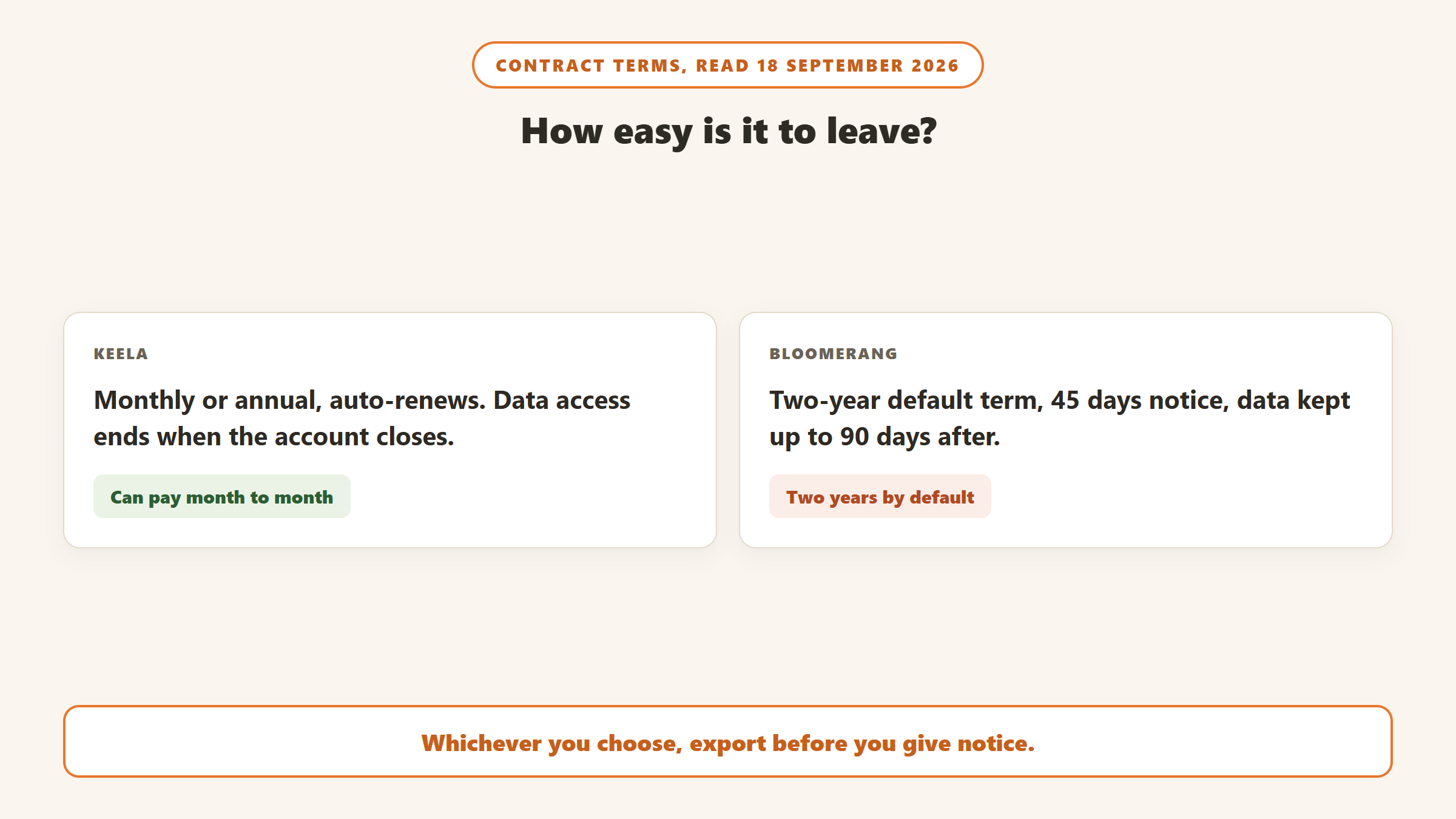
Bloomerang’s terms set a default initial term of two years unless your proposal says otherwise, then one-year renewals unless either side gives written notice at least 45 days before the term ends. You can download your data free during the term, and Bloomerang says it keeps it no more than 90 days after termination.
Keela can be bought month to month at the higher monthly price, which is a real advantage if you are unsure. Bloomerang’s commitment is longer by default, and worth negotiating.
Features compared
Fundraising and giving
Every Keela plan lists unlimited donation forms, automatic and compliant tax receipts, membership management and no transaction fees. Keela markets “Smart Ask”, which suggests donation amounts from giving history, demographics and wealth data, and donor scores for engagement and potential. Bloomerang Fundraising adds donation forms, event management, text fundraising and mobile apps for fundraisers and donors, with auctions and peer-to-peer as add-ons. Keela’s comparison page says Bloomerang lacks built-in forms; Bloomerang’s current pricing page lists donation forms, so that claim is out of date.
Donor insight and stewardship
Bloomerang’s CRM plan lists predictive giving insights, and it sells intelligent prospect research as an upgrade. It publishes a vendor claim that its top 20% of customers keep 47% of first-time donors, against an industry average of 19%; the average matches the Fundraising Effectiveness Project’s full-year 2025 new donor figure of 18.9%, but the 47% is about Bloomerang’s best customers, not its average. Keela offers a pipeline for prospecting, cultivation, solicitation and impact, plus automation on every plan, although its help centre labels automations a premium feature, so ask which automations your plan includes. Our donor retention rate guide explains which benchmark to compare against.
Email, memberships and volunteers
Keela includes email marketing with a built-in template builder, membership management and volunteer management in every plan, and offers texting, pipelines and wealth screening as extras. Bloomerang includes email in the CRM, lists membership management among its CRM tools, and sells Bloomerang Volunteer as a separate product from $119 a month with scheduling and screening. If you manage volunteers seriously, Keela’s inclusion is worth pricing against Bloomerang’s add-on.
The company behind it
Keela announced in June 2024 that it had joined Aplos, the fund accounting company, and its pricing page now describes Velora as “an integrated suite built for nonprofit operations” powered by Aplos, Raisely and Keela. G2 lists the product as “Keela, by Velora”. For a Keela customer, that may mean accounting and fundraising tools from the same group; for a new buyer, it is worth asking what the roadmap for the standalone CRM looks like. Bloomerang has also grown by acquisition and now sells a family of fundraising, CRM and volunteer products.
Support
Keela’s standard plan includes unlimited email support from 9am to 5pm Pacific, plus a knowledge base, videos and Keela U courses. Premium Care, from $200 a month, adds unlimited live chat, scheduled phone support and monthly training. Bloomerang’s proposals include training and onboarding, and the Giving Platform adds ongoing guidance and support. On Capterra, Bloomerang scores 4.8 for customer service and Keela 4.5.
What reviewers say
On Capterra, read on 18 September 2026, Bloomerang scores 4.7 from 1,287 reviews and Keela 4.3 from 314, with Keela lowest on functionality, 4.0 against Bloomerang’s 4.3. On G2 they tie at 4.6, from 922 reviews for Bloomerang and 103 for Keela. The gap between the two sites is a reminder that ratings from a few hundred reviewers move easily; read recent reviews from organisations your size.
Questions to settle before you choose
- How many contacts or constituents will you really have? Keela counts everyone you interact with, including volunteers and members. Bloomerang counts constituents, and an older Bloomerang article says household members count once. Clean duplicates first; our duplicate donor records guide shows how.
- How much do you raise online, and in how many gifts? Multiply by each vendor’s processing rate. It is often the biggest line in the comparison.
- What does Bloomerang quote for your band? Ask for the CRM alone and the Giving Platform, with the term, notice period and price-rise cap in the proposal.
- Which Keela features are extras? Texting, pipelines, wealth screening and Premium Care are listed as additional. Ask which automations your plan includes, because Keela’s help centre and pricing page describe them differently.
- What does Keela’s renewal look like after the August 2026 rise? Existing customers should ask when the new prices apply to them.
- Who moves the data? Keela lists flexible onboarding programmes; Bloomerang includes onboarding in proposals. Ask who maps fields and who moves recurring gifts.
Switching between them
Moving either way follows the same order. Export everything from the outgoing CRM first, since Keela ends data access when the account closes and Bloomerang keeps data for up to 90 days after termination. Check the exports open and include custom fields, notes and soft credits. Then deal with recurring gifts separately: a monthly gift is an authorisation held by the payment processor, not a row in the export, so ask both vendors in writing whether card tokens can move between processor accounts or whether donors will need to sign up again.
Run a test import of a few hundred records and compare giving totals before the full load, then keep both systems running for a short overlap and give notice before the renewal date. Our nonprofit CRM migration guide has the full checklist.
Which one should you choose?
- Choose Keela if you take a lot of gifts online and want the processor’s rate with no platform fee, want the price published before you talk to sales, need memberships and volunteers included, or want the option to pay monthly.
- Choose Bloomerang if you value higher-rated support and guided onboarding, want text giving and donor apps, and your file is small enough for its entry band. Negotiate the two-year default and ask how households are counted.
- Run the numbers with your own contact count and last year’s online gift volume. For many organisations, processing costs decide this comparison, not the subscription.
For more, see our Keela review, Bloomerang review, Keela alternatives and Bloomerang alternatives.
Donor insight on top of either CRM
If your current CRM holds the data well and the problem is deciding who to contact, Gratefully works alongside it. Its product page lists a live connector for Bloomerang that syncs donor records, gift history and interactions automatically; Keela is not on the connector list, so Keela users bring data in through CSV import with smart field mapping. It ranks which donors need attention with a reason for each and drafts outreach from each donor’s history for you to review. It is not a CRM and does not replace either system.
Gratefully’s pricing page, read on 18 September 2026, has a Free plan with integrations included, and new accounts start on a 14-day trial of its Advanced plan with no card required, then move to Free. Paid plans start at $79 a month billed yearly. Our Gratefully vs Bloomerang page explains how it sits alongside a CRM.
Disclosure: Zilwaris, the consultancy run by AI Tools Bakery’s founder, does paid advisory work for Gratefully. Gratefully did not pay for this placement, and it is assessed on the same criteria as everything else on this site.
Where the facts on this page come from
- Keela: pricing page (read 24 August, 4 September, 17 and 18 September 2026), CRM features page, Keela vs Bloomerang landing page, help centre articles on billing, subscriptions and exports, and its June 2024 announcement about Aplos.
- Bloomerang: pricing page, terms and conditions, and payment processing pricing article dated 20 July 2026, read 18 September 2026.
- Fundraising Effectiveness Project: full-year 2025 retention by donor type.
- Capterra and G2 ratings, read 18 September 2026.
- Gratefully: product and pricing pages, read 18 September 2026.
The bottom line
Bloomerang’s CRM starts lower on list price, $125 a month against Keela’s $164, but Keela publishes every tier to 10,000 contacts, includes forms, email, memberships and volunteers, and adds no platform fee to the processor’s 2.2% + 30 cents. Bloomerang charges 3.2% to 3.95% plus $0.30 on card gifts through its own forms, scores higher on support, and defaults to a two-year agreement. If you raise a meaningful share online, Keela is usually cheaper in total; if support and fundraising tools matter more, Bloomerang earns its price. Either way, work it out at your list size with your own gift volume.

Written by
FazFaz is the founder of AIToolsBakery. Some tools here are tested hands on. Others are assessed from vendor documentation and pricing verified on the live page, and every review says which one it is. Sponsors can buy a position in a guide. They cannot buy the score, the criticism, or silence about a better option.
How we test and how we make money →Frequently Asked Questions