Bloomerang and Neon CRM compete for the same buyer: a nonprofit that has outgrown spreadsheets or a basic database and wants donor management, online giving and email in one system. On features they overlap more than they differ. The real difference is in how you are billed, and that difference can swing the cost a long way in either direction depending on the shape of your organisation.
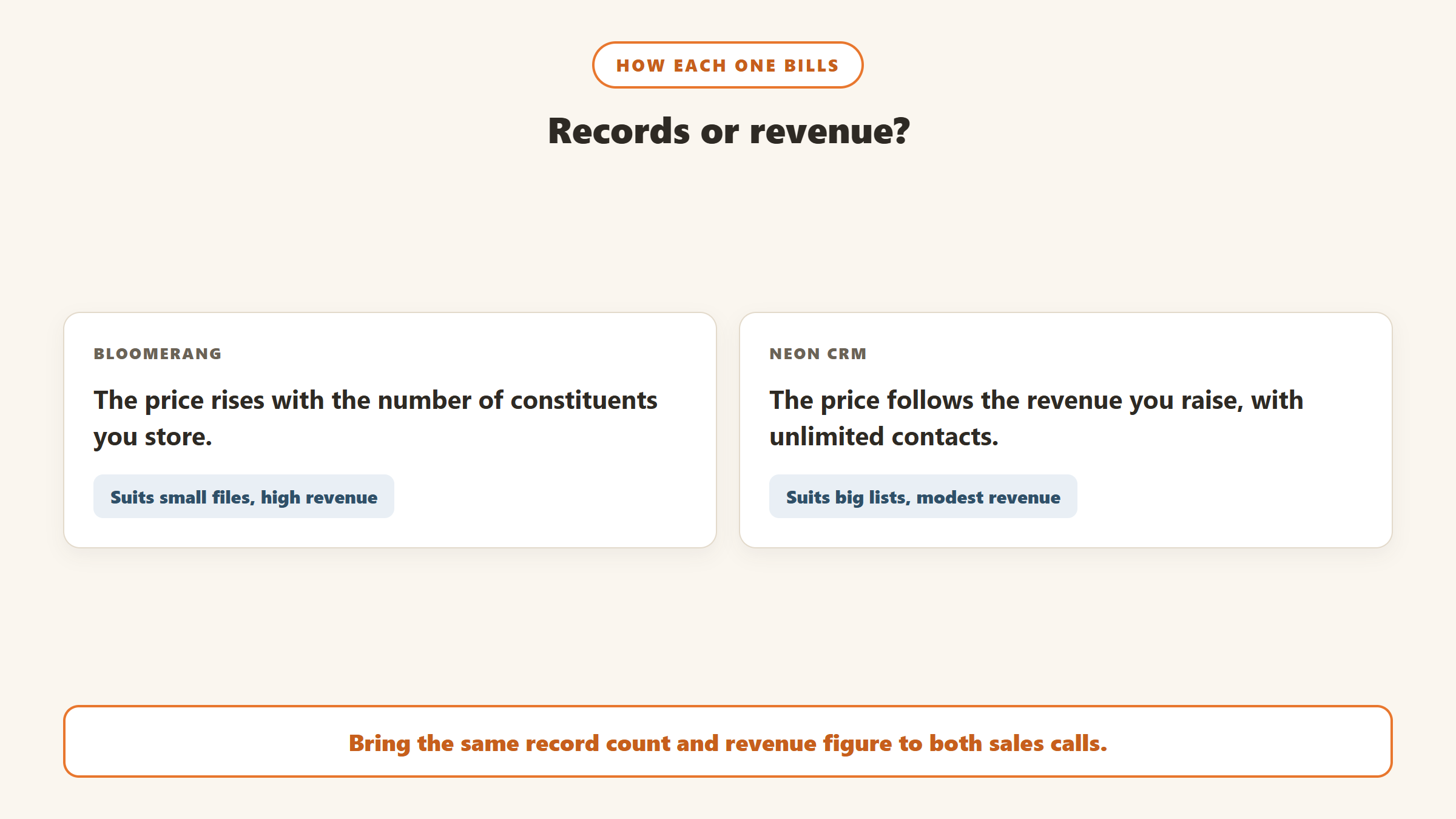
Bloomerang charges by the number of constituents in your database. Neon charges by your revenue and lets you store as many contacts as you like. This page explains which model works in your favour, what each vendor actually publishes, how the add-ons and contracts work, and where the two products differ. If you already run one of them and the real gap is knowing which donors need attention, Gratefully is worth a look first: it connects live to Bloomerang and takes Neon data by CSV import, and it has a free plan.
How we put this together. Prices, terms and features below were read on each vendor’s pricing page, terms of service and help centre on 18 September 2026, from India, and are shown as displayed. Neon’s pricing page showed a site maintenance notice on the first attempt that morning and loaded normally later. We have not used either system hands-on or run a migration between them. Where a vendor does not publish a figure, we say so.
Bloomerang vs Neon CRM at a glance
| Bloomerang | Neon CRM | |
|---|---|---|
| What sets the price | Number of constituents (“constituent-based”) | Your revenue (“based on revenue, not record counts”) |
| Starting price | CRM from $125 a month, billed annually | From $99 a month |
| Prices above the start | Not published, by proposal | Not published, gated pricing guide |
| Contacts and users | Unlimited users; constituent count sets the band | Unlimited records, users, emails and forms |
| Add-ons | Fundraising from $40 a month (bundled with CRM); Volunteer from $119 a month; prospect research priced separately | Memberships +10%, Volunteers +10%, Events +20% of the CRM fee |
| Default contract | Two years, then yearly; 45 days’ notice | 12 months, auto-renews; 30 days’ notice |
| Support | Training and onboarding in proposals; guidance and support in the Giving Platform | Free live chat, email and phone support; 24/7 virtual agent |
| Capterra (18 Sep 2026) | 4.7 from 1,287 reviews | 4.3 from 620 reviews |
| G2 (18 Sep 2026) | 4.6 from 922 reviews | 4.2 from 443 reviews |
Records pricing vs revenue pricing: which costs you less
Neither vendor publishes a full price ladder, so no one outside a sales call can give you an exact figure at your size. What you can do is work out which model is structurally on your side before you ask for quotes.
How Bloomerang bills
Bloomerang’s pricing page describes “a predictable, constituent-based pricing model”. The CRM starts at $125 a month billed annually, Bloomerang Fundraising adds from $40 a month and is only sold with the CRM, the combined Giving Platform starts at $242 a month, and Bloomerang Volunteer starts at $119 a month. The page does not say how many constituents the starting price covers. Bloomerang’s terms also allow additional fees for use above your subscription amounts, naming constituents, emails sent and attachment storage. So the number to watch is your record count, and every name you add, including event guests and one-off contacts, moves you toward the next band.
How Neon bills
Neon’s pricing page says the subscription “is based on how much money you’re bringing in”, in contrast to “the records-based pricing model that most software providers in the sector use”. It starts at $99 a month and lists unlimited records, users, emails and forms. Three modules cost extra as a share of your CRM fee: Memberships and Volunteers at 10% each, Events at 20%. Taking all three makes your bill 1.4 times the CRM fee, so the $99 entry becomes $138.60 a month. That multiplication is ours; Neon shows only the percentages. The revenue bands and the prices above $99 are in a pricing guide you have to request.
Which shape of nonprofit each model suits
- Large list, modest revenue: revenue pricing tends to win. A community group with 20,000 contacts from events, petitions and newsletters but $150,000 a year in gifts pays for every one of those records on a records model. On a revenue model the list size does not move the price.
- Small list, high revenue: records pricing tends to win. A foundation-funded or major-gift organisation with 1,500 donors raising $3 million pays for its revenue on Neon, while on Bloomerang the small file keeps it in a low band.
- Fast-growing lists. If you are about to run a large peer-to-peer or advocacy campaign that will add thousands of one-time contacts, revenue pricing protects you from the jump. Records pricing rewards regular cleanup.
- Revenue that swings. A capital campaign or a large bequest can lift revenue for a year. Ask Neon how a one-off year affects your band at renewal, and get the answer in writing.
The practical step is to bring the same two numbers to both calls: your current record count after deduplication, and your total revenue for the last full year. Our guide to duplicate donor records helps with the first. Then compare the quotes side by side with the add-ons you actually need.
Contracts and price increases
Bloomerang’s terms and conditions state: “Unless otherwise specified in your proposal, the initial term of this Agreement is two (2) years.” The agreement then renews for one-year terms unless either side gives written notice at least 45 days before the term ends. Bloomerang can change fees at the end of any contract period. You can download your data free during the term, and Bloomerang says it is not responsible for keeping it more than 90 days after termination.
Neon’s terms of service, last updated 24 June 2025, set a 12-month initial term where the sales order does not specify one. Orders renew automatically for the same length unless notice is given at least 30 days before expiry. Neon “may increase the Fees once per calendar year” with at least 30 days’ notice, and quantities you have bought cannot be reduced during a term.
So Bloomerang’s default commitment is twice as long, with a longer notice period, while Neon’s allows a yearly fee increase within the term cycle. Both defaults can be changed in the order you sign. Ask each for the term length, the notice period and a cap on price increases, in the proposal itself.
Features side by side
Fundraising and giving
Neon’s core plan lists fundraising campaigns and forms, peer-to-peer, recurring gifts and donor-advised fund giving, payment processing through Neon Pay, and a donor portal. Neon describes Neon Pay as giving real-time data, reconciliation and a donor fee-cover option, but its pricing page does not show the processing rate, and the support article that does is behind a login, so we do not quote one here. Bloomerang puts donation forms, event management, text fundraising and mobile apps for fundraisers and donors in Bloomerang Fundraising, with auctions and peer-to-peer as add-ons. Its help centre publishes the rates: 3.95% + $0.30 on card gifts through Fundraising forms, and 3.2% + $0.30 through the CRM’s own forms. Ask Neon for its Neon Pay rate card in writing before you compare the two on total cost.
Communication and stewardship
Neon’s CRM plan includes email marketing, text messaging and “Stewardship Journeys”, automated sequences for moving donors through a series of touches, plus automated workflows. Bloomerang’s CRM plan lists marketing and engagement tools, and “predictive giving insights” alongside reporting and data management. Bloomerang publishes a vendor claim that the top 20% of its customers retain 47% of first-time donors against an industry average of 19%; that is a claim about its best customers, not an average, and our first-time donor retention guide sets it against the sector benchmark.
Memberships, events, volunteers and grants
Neon sells memberships, volunteers and events as percentage add-ons and includes grant management in the core plan. Bloomerang lists event management in Fundraising, membership management among its CRM tools, and volunteer management as a separate product with scheduling and screening. If you run memberships and events, price Neon with those modules added and Bloomerang with Fundraising added, because both base prices leave them out.
Integrations and data access
Neon offers an open API to CRM customers and lists an integration with Windfall for wealth data. Bloomerang publishes API documentation and a QuickBooks Online integration, and offers intelligent prospect research as a paid upgrade. Both work with Mailchimp; our guide to Mailchimp and your donor CRM shows what each sync carries.
Support and onboarding
Neon lists free live chat, email and phone support, plus a virtual agent available 24 hours a day, with human channels in business hours. It offers onboarding packages “ranging from guided self-service to full-service data migration”, without a published price. Bloomerang includes training and onboarding in its proposals, and the Giving Platform adds ongoing guidance and support. On review sites Bloomerang scores higher on service: 4.8 on Capterra, against Neon’s 4.3.
Questions to put to both vendors
Because neither vendor publishes its full pricing, the sales call is where the comparison is really made. These questions come straight from the gaps in what each one publishes:
- What band am I in, and what moves me to the next one? For Bloomerang, the constituent count and whether household members count once. For Neon, the revenue figure used, which year it is measured on, and whether restricted grants or one-off bequests count.
- What is the total for my modules? Ask Bloomerang to price the CRM with Fundraising and, if needed, Volunteer. Ask Neon to price the CRM with the Memberships, Events and Volunteers modules you use, so the 10% and 20% uplifts are in the figure.
- What does processing cost? Bloomerang publishes its card rates; ask Neon for the Neon Pay rate card in writing, and ask both whether you can bring your own processor and what platform fee applies if you do.
- What is the term, the notice period and the price-rise cap? Bloomerang’s default is two years with 45 days’ notice. Neon’s is 12 months with 30 days and a possible yearly increase. Both can be changed in the order form.
- What does onboarding include, and what does it cost? Neon’s packages run from self-service to full migration without a published price. Bloomerang includes onboarding in proposals. Ask who maps the fields, who moves recurring gifts and how many training hours are included.
- How do I get my data out? Bloomerang says it keeps data for up to 90 days after termination. Ask Neon the same, and ask both for the export format.
If you are moving from one to the other
Most nonprofits comparing these two already use one of them. The move itself is where the risk sits, and three things decide how painful it is.
First, recurring gifts. A monthly gift is not really stored in your CRM; it is an authorisation held by the payment processor against a stored card. Moving the CRM does not move that authorisation. Ask the outgoing and incoming vendors, in writing, whether the card tokens can be transferred between processor accounts, or whether donors will have to sign up again. Losing even a fraction of your monthly donors in a migration can cost more than a year of subscription savings.
Second, history and relationships. Soft credits, household links, pledges and notes are the fields most likely to arrive broken. Ask the incoming vendor which record types its importer can create, and test a sample import of a few hundred records before the full move.
Third, timing. Line the move up with your contract dates, not against them. With a two-year Bloomerang term or a 12-month Neon term, the cheapest time to switch is just before the notice deadline, with a few weeks of both systems running side by side. Our nonprofit CRM migration guide has the full checklist.
Which one should you choose?
- Choose Neon CRM if your contact list is large relative to your revenue, you want memberships, events or grants in the same system, you want phone support on the base plan, or you prefer a 12-month default term.
- Choose Bloomerang if your file is small relative to your revenue, you value the higher service ratings and guided onboarding, and you want its fundraising tools and donor apps from one vendor. Negotiate the two-year default.
- Get both quotes in any case. With neither vendor publishing its bands, the only fair comparison is two written proposals for the same record count, revenue and modules.
Our Bloomerang review, Neon CRM review, Neon CRM pricing guide and Bloomerang pricing guide go deeper on each, and Neon CRM alternatives and Bloomerang alternatives cover the wider field.
Add donor intelligence before you switch
A CRM switch costs months of staff time, so check what you are trying to fix. If the data is in reasonable shape and the gap is knowing who to contact this week, Gratefully works on top of the CRM you already run. Its product page says live connectors cover Salesforce, Bloomerang and Little Green Light, and “anything else arrives through compliance-aware CSV import with smart field mapping”, which is the route for Neon. It builds one view of each donor, ranks who needs attention with a reason for each, and drafts outreach for you to review. It is not a CRM and does not replace Bloomerang or Neon.
Its pricing page, read on 18 September 2026, has a Free plan, with integrations included on every plan. New accounts get a 14-day trial of its Advanced plan with no card required, then move to Free. Paid plans start at $79 a month billed yearly. See our Gratefully review for the detail.

Disclosure: Zilwaris, the consultancy run by AI Tools Bakery’s founder, does paid advisory work for Gratefully. Gratefully did not pay for this placement, and it is assessed on the same criteria as everything else on this site.
Where the facts on this page come from
- Bloomerang: pricing page, terms and conditions, and the payment processing pricing article dated 20 July 2026, read 18 September 2026.
- Neon One: Neon CRM pricing page and terms of service (last updated 24 June 2025), read 18 September 2026.
- Capterra and G2 ratings, read 18 September 2026.
- Gratefully: product and pricing pages, read 18 September 2026.
The bottom line
Bloomerang and Neon CRM do similar jobs and are billed on opposite logic. Neon’s revenue-based pricing, from $99 a month with unlimited contacts, suits organisations with big lists and modest revenue, and its modules add 10% to 20% each. Bloomerang’s constituent-based pricing, from $125 a month for the CRM, suits smaller files with higher revenue, and it scores better on service. Neither publishes its full price list, and their default contracts differ: two years and 45 days’ notice for Bloomerang, 12 months and 30 days for Neon. Bring the same record count and revenue to both, get written quotes with the modules you need, and negotiate the term before you sign.

Written by
FazFaz is the founder of AIToolsBakery. Some tools here are tested hands on. Others are assessed from vendor documentation and pricing verified on the live page, and every review says which one it is. Sponsors can buy a position in a guide. They cannot buy the score, the criticism, or silence about a better option.
How we test and how we make money →Frequently Asked Questions