
Search for an AI app to pass the NREMT and the first page is mostly app store listings, each promising a first-time pass and each with a year in its name. None of them mentions a change that matters to anyone sitting the EMT exam now. On 7 April 2025 the National Registry replaced the EMT exam’s five content areas with five new ones that follow the order of a call, and added interactive question types. Some prep products rebuilt around that change. Others still sort their questions, or score their practice exams, by the old categories.
This guide starts with what the National Registry itself says about the exam and what it gives you for free, then compares four products with an AI tutor on what the AI does, which plan it sits on and what the fine print says. Prep products with no AI come after that, followed by the apps we left out and a short guide to choosing. It is written for EMT students; AEMT and Paramedic candidates sit different exams and should read their own handbooks.
How we put this together. We have not used these tools ourselves. Every price, rating and feature below comes from the vendor’s own website, legal pages or app store listing, and the exam facts come from nremt.org, all read on 11 November 2026 and linked in the text. App ratings are from the US App Store unless we say otherwise. None of these companies paid to appear on this page.
What the NREMT EMT exam looks like in 2026
Every product below should match this. These facts come from the National Registry of Emergency Medical Technicians, not from a prep company.
A computer adaptive test of 70 to 120 items
The EMT cognitive exam is a computer adaptive test, taken at a Pearson VUE test center or from home through Pearson’s online proctoring. The National Registry’s page on the updated EMR and EMT exams says it has 70 to 120 items, 10 of them unscored pilot items, and a two hour limit. You cannot tell which items are pilots, so the EMT candidate handbook tells you to answer every one as if it counts. Its explanation of adaptive testing says the exam starts with an item slightly below the passing standard, gets harder when you answer correctly and easier when you do not, and stops once the computer is 95% confident you are above or below the standard, or when time runs out. Candidates close to the line see more items. A short exam does not tell you whether you passed.
Five domains that follow a call, plus new item types
The current EMT test plan has five domains: Scene Size-Up and Safety, 15 to 19% of the exam; Primary Assessment, 39 to 43%; Secondary Assessment, 5 to 9%; Patient Treatment and Transport, 20 to 24%; and Operations, 10 to 14%. Items about children are spread through all of them. The old structure, used until 4 April 2025, was Airway, Respirations and Ventilation; Cardiology and Resuscitation; Trauma; Medical, Obstetrics and Gynecology; and Operations. The exam now also includes technology enhanced items, which the National Registry lists as Build List, where you put options in order; Drag and Drop, where you sort options into categories; and Option or Check Box, where you classify options in a table. A tutorial at the start explains each type.
The practical point for choosing an app: Primary Assessment alone is around two fifths of your exam, and an app that still reports your progress under Airway, Cardiology, Trauma and Medical is describing an exam you will not sit. That does not make its questions wrong, since the clinical content overlaps, but its readiness score is measured against the old map.
Scoring, fees and retakes
The handbook says your score is reported on a scale from 100 to 1500, and 950 is the passing point. If you pass, you get no detailed breakdown; if you fail, you see your score and a graph of how far you were from the standard. Results usually post to your National Registry account within two business days. According to the certification process page, the EMT application fee is $104 and you pay it for each attempt. Rescheduling or cancelling costs $30 and must be done at least 24 hours ahead, and a no-show forfeits the fee.
If you fail, you can reapply as soon as results post but must wait 15 days from your last exam. You get six attempts in total. After three failures, the National Registry requires remedial education before the fourth, such as a state or CAPCE approved EMT refresher or 20 credits of state approved education, and some states insist on a traditional refresher course. Your course completion is valid for two years and an Authorization to Test for 90 days, so a long gap between attempts can run you out of eligibility.
The official benchmark: what the National Registry gives you
The National Registry does not sell a practice test or a prep app, and its handbook is explicit: “The National Registry does not recommend any particular examination preparation materials.” What it does give you is free, and every paid product below should be judged against it.
Free sample items and the sample packet
On its updated exam page, the National Registry links an interactive EMT sample items site and a downloadable EMT sample item packet. The packet, from November 2024, shows sample screens for each of the five domains and for each new item type, with definitions. The sample items let you click through Build List, Drag and Drop and Option or Check Box questions before you see them for real. The National Registry suggests using a Windows or Mac computer for them, because a phone may not give the same experience, which also matters for practice in general: the real exam is on a computer, and many prep apps are built for a phone first.
The test plan and the handbook
The EMT test plan is the document every prep vendor should be following. The handbook also points candidates to their own course textbook, the National EMS Education Standards and the current American Heart Association CPR guidelines. Its examination structure page says every correct answer can be found in commonly available, up to date EMS textbooks. The NREMT app on the App Store, rated 4.7 from 7,970 ratings, is for managing your account, checking status and recertifying; it has no study content.
What a pass rate claim is worth
Prep vendors quote high pass rates for their users. For context, a Florida Department of Health report on EMT program pass rates, built from National Registry data as of March 2026, gives the 2025 national average first-attempt pass rate for EMT programs as 73%. A vendor figure measured on its own active users is not comparable with that, and none of the vendors below says how it measures its rate.
AI EMT exam prep tools compared
| Product | What the AI does | Where the AI sits | Price (11 November 2026) | Catch to check |
|---|---|---|---|---|
| Pocket Prep EMS | Tutor chat tied to the quiz question; prompts you to reason rather than giving the answer | Every quiz mode except Mock Exams and Assignments | $15.99 a month, $39.99 for 3 months, $95.99 a year | Plan tier for Tutor not stated |
| MedicTests | M.A.C.K. chat tutor trained on MedicTests content; explains, quizzes, builds study plans | Every membership | $34 a month, $69 for 90 days, $199 a year | Simulator runs to 130 items; guarantee wording conflicts |
| EMTprep.com | 24/7 AI tutor with explanations and study tips | Ultimate plans | $39 a month, $89 a quarter, $299 a year | Your inputs may go to third-party AI providers |
| Jones & Bartlett Learning Claire AI | Chat inside the Navigate eBook; flashcards, mnemonics, practice questions | Navigate eBook, through your program | Not published | Not sold directly to students as far as we could find |
How we chose and ordered these
Each product had to describe an AI feature in its own words, cover the EMT level of the NREMT, and be live and updated in 2026. We ordered them by how clearly the vendor explains what its AI does and where it sits, how closely the practice tracks the April 2025 test plan, and how clear the price is. We left out apps whose AI was only in the name, apps with very few ratings and apps not updated since the exam changed. This order says nothing about pass rates, and we found no independent study comparing these tools.
The four AI tools
1. Pocket Prep EMS: a question bank with a tutor that asks you questions back
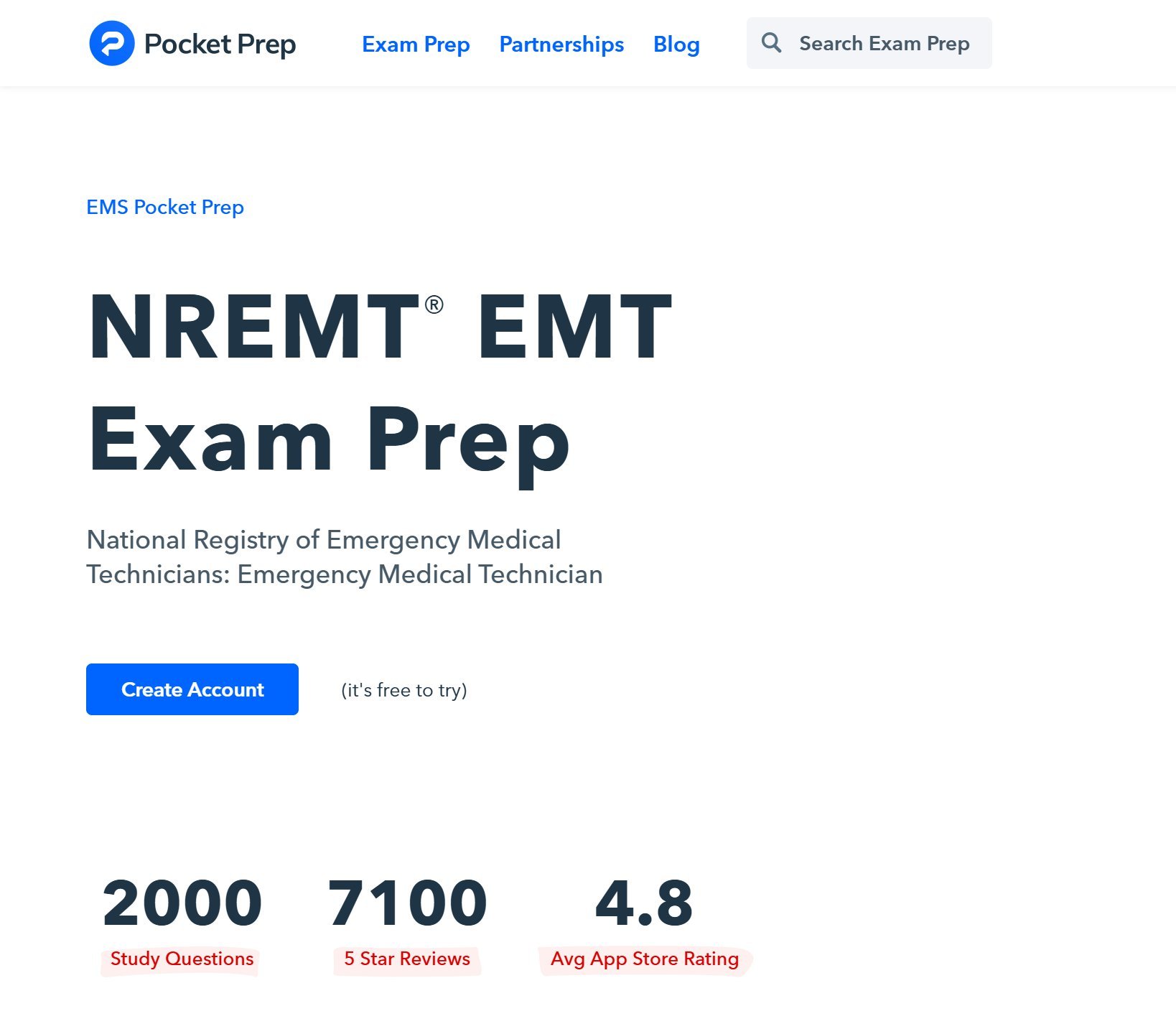
The AI. Pocket Prep’s AI feature is called Tutor. Its help article describes an AI chatbot in the web and mobile apps that opens on the question you are working on, draws from Pocket Prep’s own exam prep content, and can point you to textbook references. The design choice is deliberate: Pocket Prep says Tutor will not just hand you the answer, and may ask what you already know about the topic or why you chose your answer. It is available in every quiz mode except Mock Exams and Assignments, so the timed full-length practice runs without it.
Plans and price. The NREMT EMT exam page lists 2,000 EMT questions with explanations, and Premium at $15.99 a month, $39.99 every three months or $95.99 a year. One Premium subscription covers Pocket Prep’s whole EMS bundle, including EMR, AEMT, Paramedic and Firefighter I and II. You can try 65 questions free on the web page’s count; the App Store listing says 30 to 75 free questions and three study modes. Neither the help article nor the pricing says whether free users can open Tutor.
Fine print. Pocket Prep says it updated its EMT content to the April 2025 test plan, and its question bank shows it: 300 questions on Scene Size-up and Safety, 505 on Primary Assessment, 224 on Secondary Assessment and 304 on Operations. It splits Patient Treatment and Transport into five subjects that carry the old names (Airway, Cardiology, Medical, OB and pediatrics, and Trauma), which it says helps students focus their study and lets instructors align their teaching with it. The page also links to its introduction of technology enhanced items. The Pass Guarantee is three more months of Premium free if you do not pass, not a refund. On 11 November 2026 the app had a 4.8 rating from 15,980 US ratings, was updated on 29 October 2026, and on Google Play had 4.5 from 2,829 ratings and more than 100,000 downloads. Its privacy label lists purchase history, device ID and product interaction as linked to you.
Choose it if you want a low monthly price, a question bank mapped to the current domains, and an AI that makes you think rather than reads you the answer. Skip it if you want AI help inside a full practice exam.
2. MedicTests: an adaptive simulator with M.A.C.K. on every plan
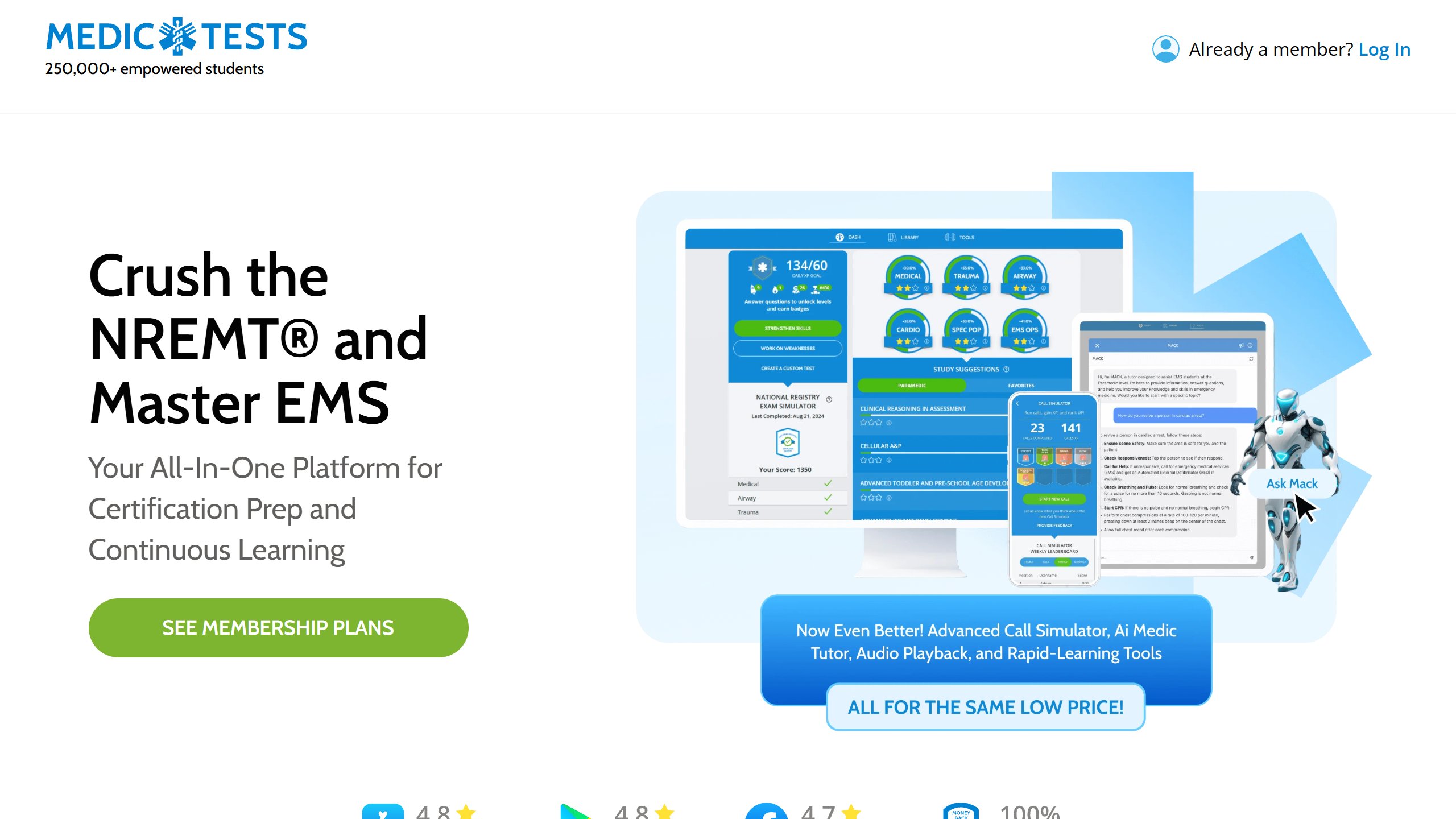
The AI. MedicTests calls its tutor M.A.C.K., short for MedicTests AI Clinical Knowledge. Its M.A.C.K. page describes a conversational tutor that draws on the MedicTests library, trained on what it calls a decade of paramedic-specific content, and adjusts to your level. Its own AI information page says M.A.C.K. explains clinical concepts, quizzes you, clarifies wrong answers and creates study plans. No model is named. Around it sit the National Registry Simulator, an adaptive practice exam, a Call Simulator where you run simulated 911 calls, flash cards with spaced repetition, and reference units with audio playback.
Plans and price. The sign-up page lists three plans, each with every feature: Full Access Monthly at $34, recurring until you cancel; a 90 Day Test Prep Special at $69, shown against a regular price of $102; and a Medic School Special at $199 for a year, shown against $408. M.A.C.K. is included at no extra charge. Bought inside the iOS app, the same plans list at $34.99, $69.99 and $199.99. There is no free tier, though some reference units can be read without an account.
Fine print. Three things deserve a careful read. First, MedicTests’ AI information page says its simulator stops between 70 and 130 questions; the National Registry’s EMT exam is 70 to 120. The same page lists the simulator’s score breakdown as Airway, Cardiology, Medical, Trauma, OB/Peds and Operations, which are not the five domains used since April 2025, though it does include technology enhanced items such as drag and drop, ordered lists and multiple response. MedicTests also says its questions are deliberately harder than the real exam. Second, the pass guarantee is worded two ways: the homepage says it will refund up to 90 days of your membership if you use the system regularly and do not pass, while the AI information page calls it a full refund, and the terms of use name the guarantee without setting out its conditions in the text we read. Ask in writing before you rely on it. Third, the terms say you must be 18 or older and in the United States. The 94% pass rate on the homepage is the vendor’s figure for its own users. The iOS app had a 4.8 rating from 2,097 ratings and was updated on 4 August 2026; its privacy label lists identifiers and usage data as used to track you.
Choose it if you want an adaptive practice exam, a tutor on every plan and scenario practice, and you are happy to pay $34 a month or $69 for three months. Skip it if you want progress reported under the current domains, or you are under 18 or outside the US.
3. EMTprep.com: an AI tutor on the Ultimate plans
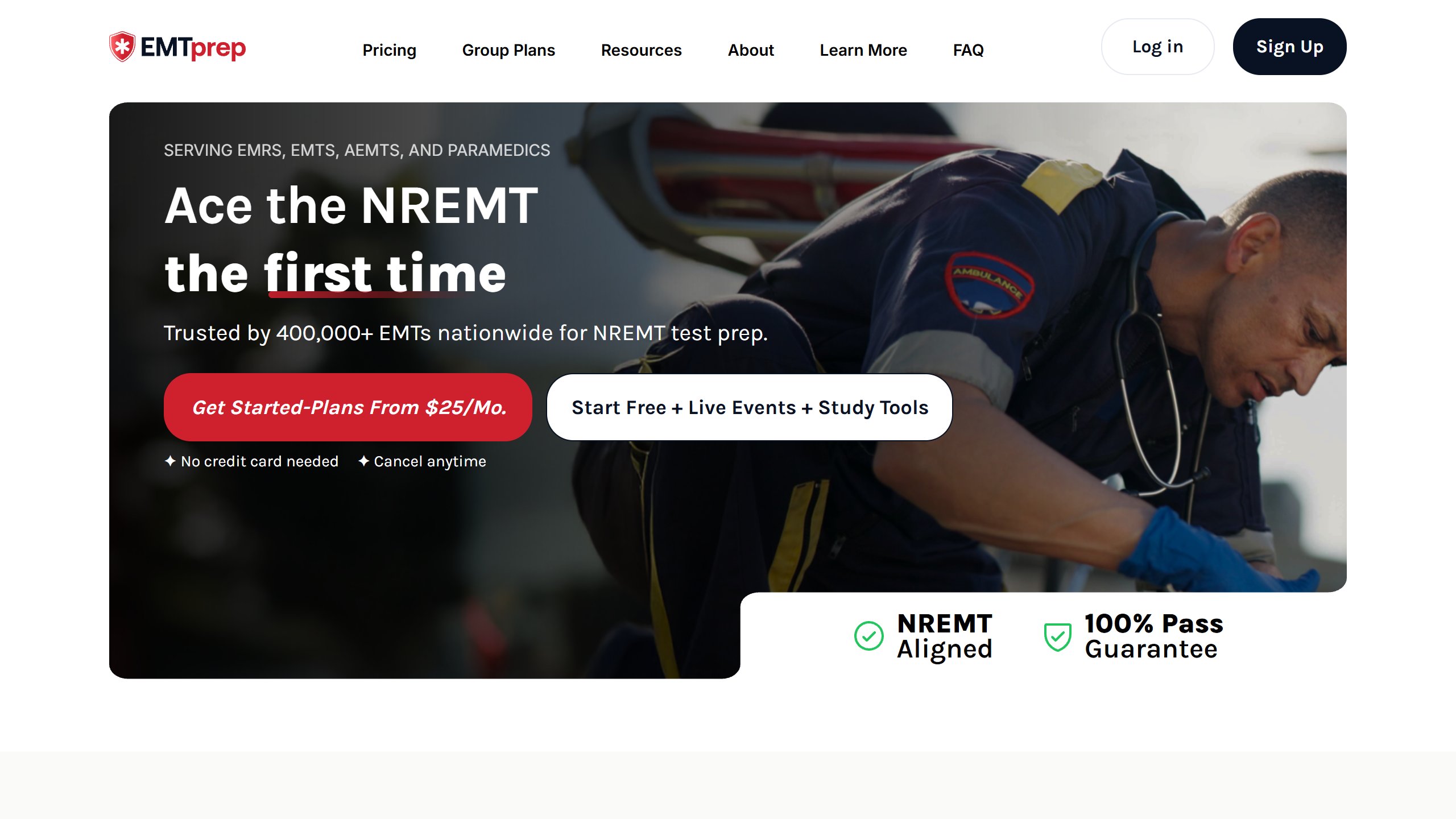
The AI. EMTprep, run by Classward, LLC, describes a 24/7 AI Tutor that takes unlimited questions, breaks down topics step by step, explains why each answer is correct or incorrect, and gives study tips based on your performance. The page’s examples are acid-base balance, cardiac rhythms and trauma protocols. Around it are simulated NREMT exams, flashcards, study guides, video lessons, worksheets and daily live events. The homepage lists technology enhanced items, including Build List, Drag and Drop and Option or Check Box, plus clinical judgement scenarios.
Plans and price. The pricing page shows three Ultimate plans, each listing the advanced AI tutor: $39 a month, $89 a quarter and $299 a year. The homepage’s “Plans From $25/Mo.” matches the annual plan divided by twelve; we found no cheaper plan on the pricing page. There is a free trial, and the homepage says no credit card is needed. The AI tutor page says the tutor is included with the Ultimate subscription.
Fine print. EMTprep’s terms and conditions are unusually direct about the AI. They say AI features use large language models, may produce inaccurate or outdated output, are not a substitute for training or a qualified instructor, and should not be relied on alone for exam preparation. They also say what you type into the AI features may be used to improve the service and may be processed by third-party AI providers. The membership agreement says monthly and quarterly memberships renew automatically. The homepage advertises a 100% pass guarantee, but we did not find its conditions on either legal page. EMTprep is mainly a website: its iOS app had 6 ratings and its Android app more than 10 downloads, so app store ratings tell you little here.
Choose it if you want a web course with video, live sessions and an AI tutor in one subscription. Skip it if you mainly study on your phone, or you would rather keep your questions away from third-party AI services.
4. Jones & Bartlett Learning Claire AI: an AI inside your course textbook
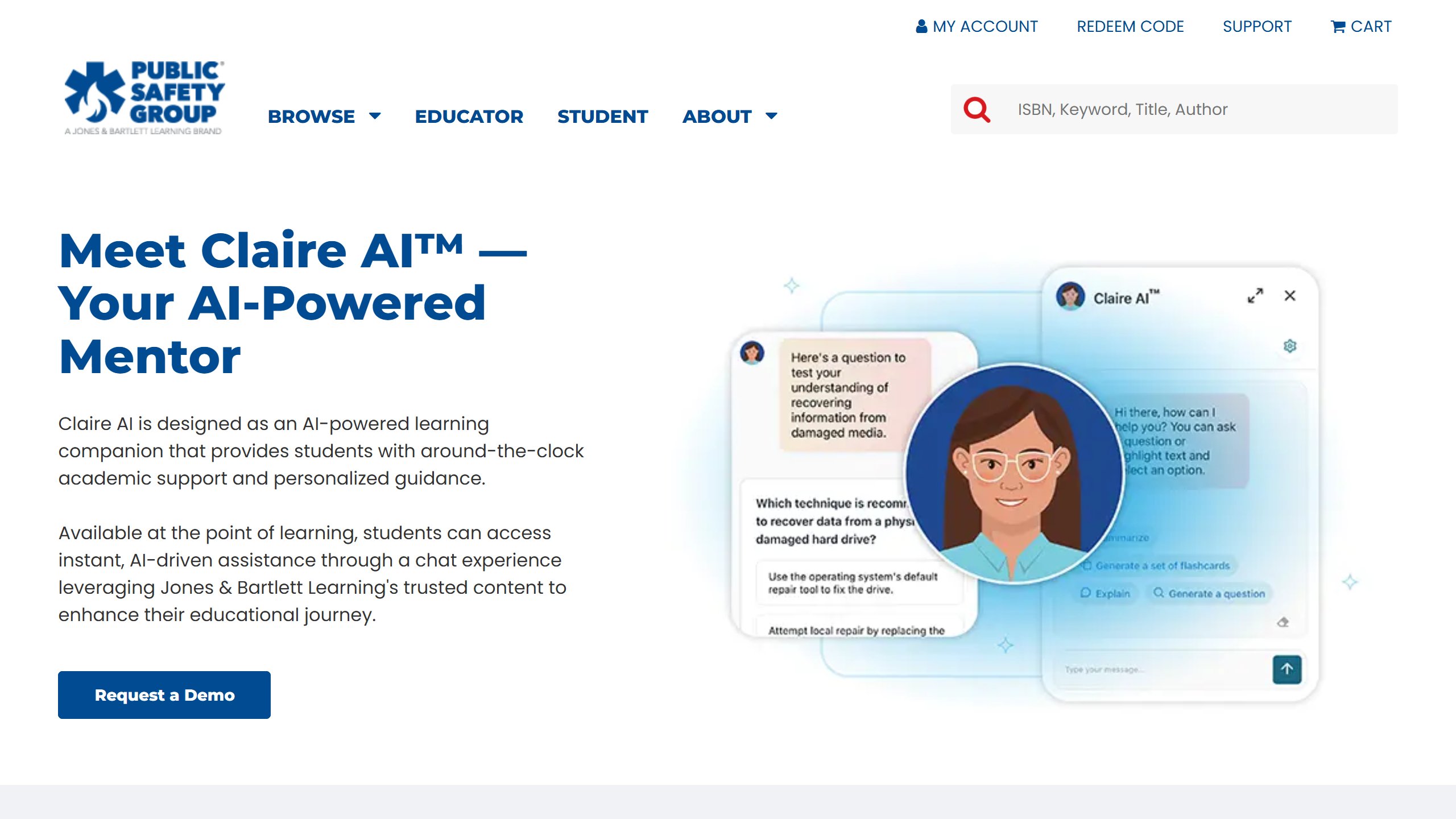
The AI. Jones & Bartlett Learning publishes EMT textbooks through its Public Safety Group and sells the Navigate learning platform to EMS programs. Its Claire AI page describes a chat assistant inside the Navigate eBook that uses the publisher’s own content. You can ask it to summarise or explain a section, generate flashcards, make mnemonics and jingles, and produce practice questions in multiple choice, true or false and multiple response formats, and you can highlight a passage to focus it.
Plans and price. No price is published. The page asks you to request a demo or contact an account manager, which points at programs rather than individual students. If your EMT course uses a Jones & Bartlett textbook with Navigate, ask your instructor whether Claire AI is switched on.
Fine print. The same publisher runs TestPrep and Fisdap. TestPrep generates practice exams by National Registry unit and is sold in some Navigate packages and on its own; Jones & Bartlett says its own study found TestPrep users had a 14% higher first-time pass rate than average, a vendor figure. Fisdap’s readiness exams are sold to institutions, except its Study Tools. Neither page describes an AI feature. Claire AI is the one AI product here tied to a specific textbook, which is useful if that is the book your course follows and less so if it is not.
Choose it if your program already gives you a Navigate eBook. Skip it if you are studying on your own, since there is no public way to buy it.
EMT prep with no AI worth comparing
These products describe no AI feature. They are not in the numbered list, but they are the fair comparison for anyone weighing a paid AI subscription.
Limmer Creative: EMT PASS and EMT Review Plus
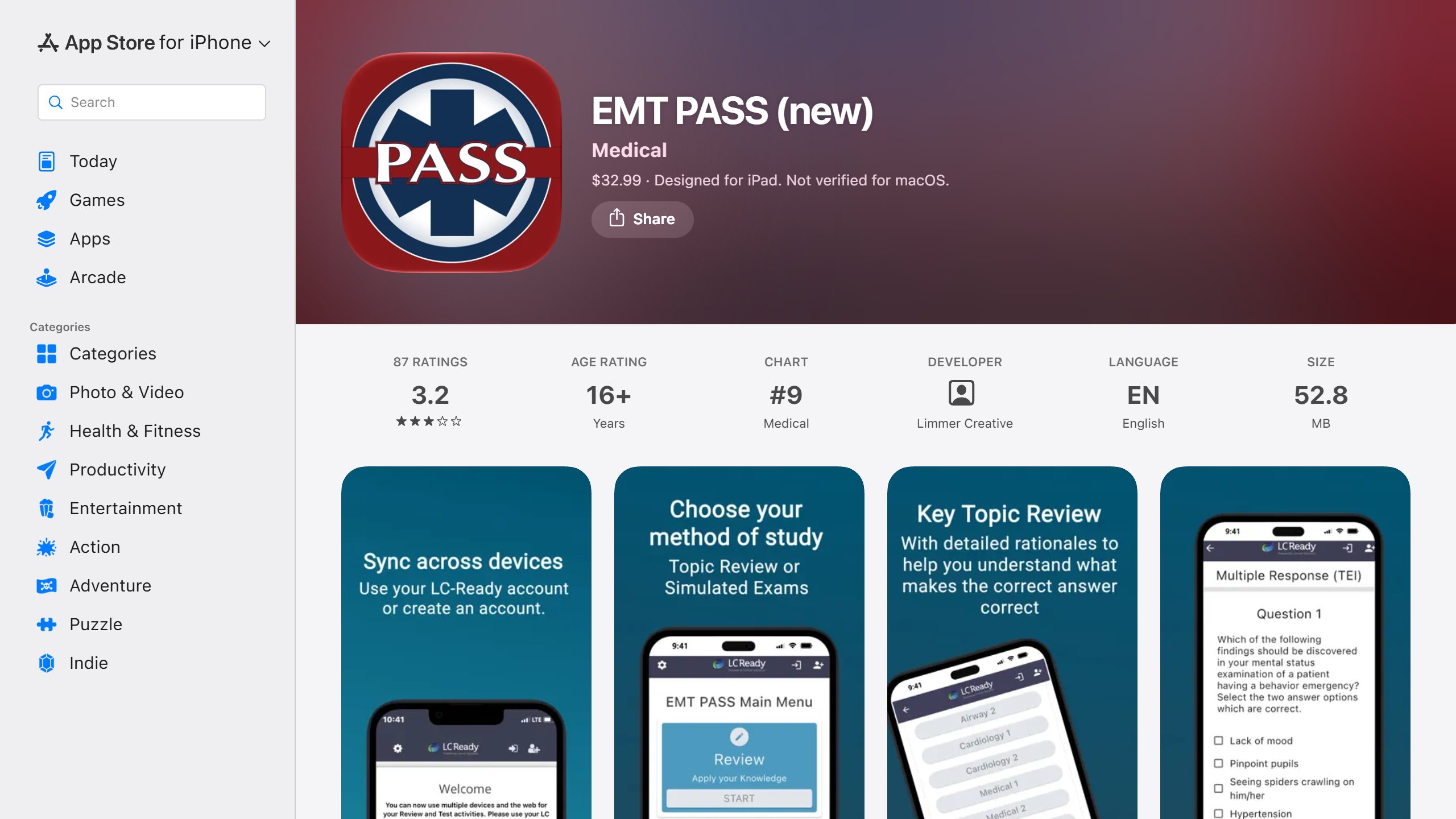
EMT PASS costs $32.99 once on the App Store, with no subscription. It has 700 questions, two full 120-question simulated exams and a Predictive Scoring system that estimates whether you are on track. Limmer says it was built with Bill Brown, a former Executive Director of the National Registry. Its topic list adds an Assessment section covering scene, primary and secondary assessment next to the older categories, and it includes multiple response and technology enhanced items. EMT Review Plus, at $13.99, has more than 1,200 study cards and questions and five full practice exams of 120 questions. Both were updated on 15 September 2026, but their ratings are low: 3.2 from 87 and 3.5 from 46. Limmer’s website showed us a bot check, so these details come from the App Store.
EMT Prep 2027 by Spurry
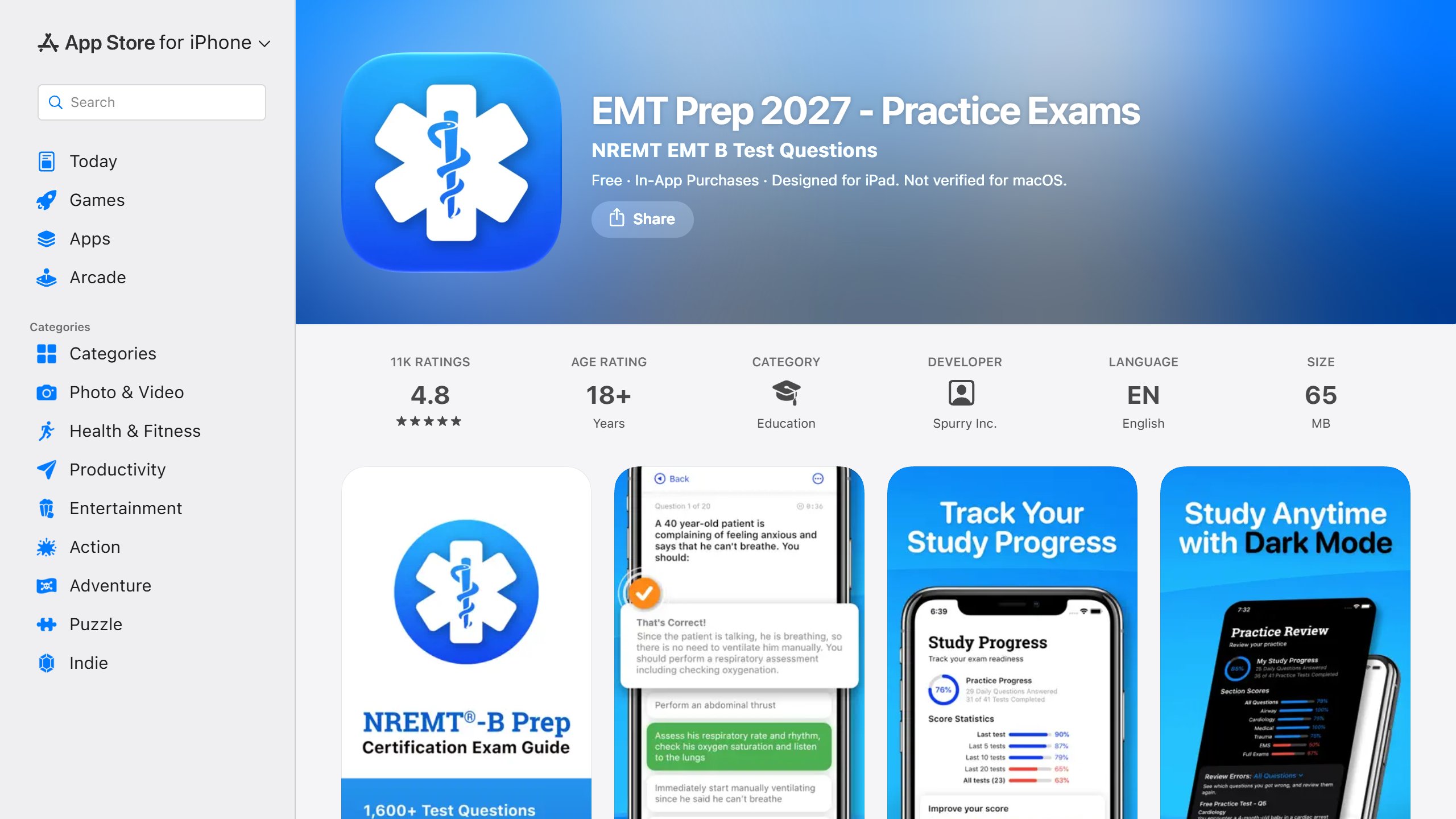
EMT Prep 2027 had a 4.8 rating from 11,370 US ratings and was updated on 7 November 2026. It lists more than 1,600 questions, 37 practice tests and six full-length exams, and its description uses the current five domains. No AI is described. Its App Store page lists ten in-app purchases from $1.99 to $17.99 under names like Full Premium Access (Discount) and Unlimited Access, without saying how they differ, so check what the app offers you before you buy.
Quizlet
Quizlet hosts many user-made EMT flashcard sets, and its upgrade page sells Quizlet Plus and Plus Unlimited with more practice tests and Learn rounds. From our connection in India the page showed regional prices of ₹2,287 and ₹2,999 a year; US prices will differ. The page names no AI tutor. User-made sets are not checked against the current test plan, so treat them as revision cards, not exam practice. Our AI flashcard apps guide covers tools that build cards from your own notes.
What about ChatGPT or another general chatbot?
A general chatbot is free or cheap and can explain why a patient with a given presentation needs a particular intervention, quiz you on vital sign ranges or turn your class notes into questions. Four limits matter for EMT students. First, it can be wrong with confidence, and EMS numbers are where that hurts: doses, compression rates and ratios change with guidelines, and the National Registry points you to the current American Heart Association guidelines and your textbook. Second, protocols differ by state and by medical director, while the NREMT tests the national standard; a chatbot may mix the two without telling you. Third, it does not know the April 2025 test plan or the new item types unless you give it them. Fourth, it has no place in the exam itself, which you sit under Pearson VUE’s security rules after signing a non-disclosure agreement. EMTprep’s own terms make the same point about its AI: do not rely on it alone. For general study habits with AI, see our guides to AI tutoring apps and AI tools for medical students.
What we left out, and why
EMS Mastery from MEDizzy describes an AI tutor and more than 3,200 questions, but had 30 US ratings, lists its categories as Airway Management, Cardiology, Trauma and Medical Emergencies, and shows ten in-app purchases from $8.99 to $239.99. The EMT-B Practice Test 2023 app from Easy Pass Company was last updated in October 2023 and still describes the old domains and an exam that can end after 60 questions; its AI tutor, Mentora, appears in the same developer’s Paramedic app, which had 14 ratings. Eastgate’s NREMT EMT Test Prep 2026 describes no AI and was last updated in December 2025. Prepia’s EMT app describes adaptive study plans but no AI. An app called Emergency Medical Technician from an individual developer had no ratings and warns that its AI-generated questions may be out of context. Medic Pass 2026 describes no AI. Heading for a nurse aide certificate instead? Our guide to AI CNA practice test apps compares the tools against each state’s test vendor.
How to choose an AI EMT exam prep tool
Start with the free NREMT material
Read the test plan, then click through the sample items on a computer so the new item types do not surprise you. Ask your instructor which textbook and protocols your course follows, because that is what any AI tutor should agree with.
Check the app against the current domains
Look at how the app reports your progress. If it scores you only under Airway, Cardiology, Trauma and Medical, its readiness number is built on the pre-April 2025 exam. Pocket Prep reports the five current domains with the treatment domain split into subjects; MedicTests’ simulator still reports the old categories on its own description; Limmer and EMTprep describe the new item types.
Find out where the AI sits
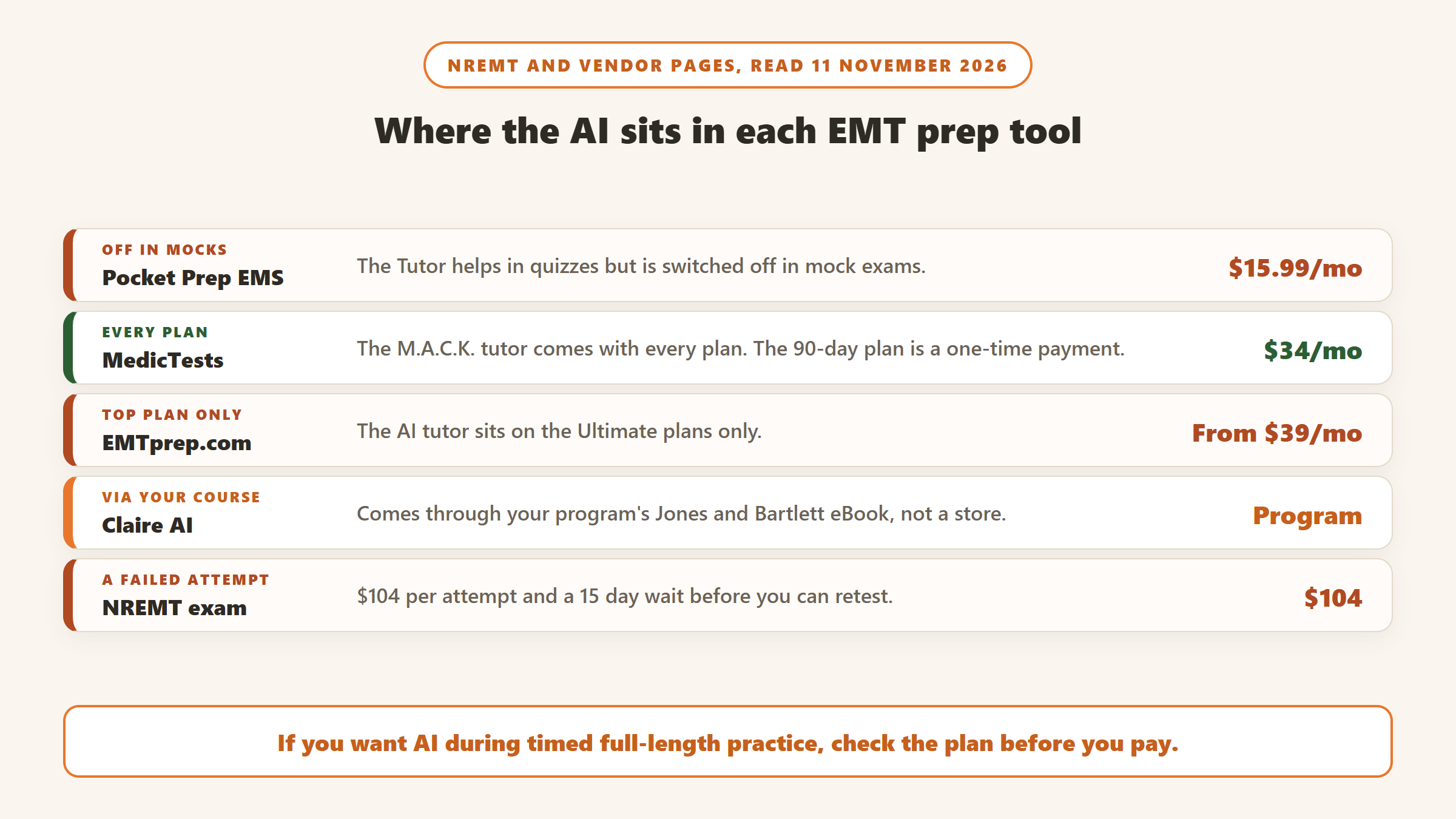
Pocket Prep’s Tutor is off in mock exams. MedicTests includes M.A.C.K. on every plan. EMTprep’s tutor needs an Ultimate plan. Claire AI comes through your program’s eBook. If you want help after you get a practice question wrong, any of them works; if you want AI during timed full-length practice, check before you pay.
Read the billing and guarantee terms
Most plans renew automatically. MedicTests’ 90-day plan is a one-time payment, and Limmer’s apps are a single purchase. Pocket Prep’s guarantee is three more months of access, MedicTests’ guarantee is described two ways, and EMTprep’s terms were not on its legal pages. With $104 per attempt, a 15 day wait and remediation after three failures, the cost of a failed attempt is often more than a few months of any plan here.
Verdict
Start with the National Registry’s free sample items and test plan, because no vendor’s practice exam is official. For many EMT students, Pocket Prep is a low-cost bank that has been rebuilt around the April 2025 domains, with a tutor that makes you reason through each question, though not inside mock exams. MedicTests is the pick if you want an adaptive simulator, scenario practice and an AI tutor on every plan, as long as you remember its simulator runs longer than the real exam and reports the old categories. EMTprep suits students who want a web course with video and live sessions, at a higher price and with the AI on its Ultimate plans. If your course uses a Jones & Bartlett textbook, ask whether Claire AI is turned on before you buy anything else. Whatever you use, check doses and protocols against your textbook and your state, not a chatbot.
Sources
- National Registry of Emergency Medical Technicians: EMT candidate handbook, the examination, EMT certification process and fees, updated EMR and EMT examinations, examination structure and adaptive testing, EMT test plan, EMT sample items, NREMT app.
- Pass rate context: Florida Department of Health, NREMT first attempt pass rates for EMT programs.
- AI tools: Pocket Prep NREMT EMT, Pocket Prep Tutor help article, Pocket Prep EMS, App Store, Pocket Prep EMS, Google Play, MedicTests, MedicTests plans, MedicTests M.A.C.K., MedicTests AI information page, MedicTests terms, MedicTests, App Store, EMTprep, EMTprep pricing, EMTprep AI Tutor, EMTprep terms, EMTprep membership agreement, Jones & Bartlett Learning Claire AI, Jones & Bartlett Learning EMS testing.
- No AI and left out: EMT PASS, App Store, EMT Review Plus, App Store, EMT Prep 2027, App Store, Quizlet upgrade page, EMS Mastery, App Store, EMT-B Practice Test 2023, App Store.
- All pages read 11 November 2026, except that dates in the text are those shown on each page.

Written by
FazFaz is the founder of AIToolsBakery. Some tools here are tested hands on. Others are assessed from vendor documentation and pricing verified on the live page, and every review says which one it is. Sponsors can buy a position in a guide. They cannot buy the score, the criticism, or silence about a better option.
How we test and how we make money →