Last refreshed: 20 May 2026
Last reviewed May 2026. Updated whenever Diffit ships something new.
Faz says: The cadence of shipped Diffit updates has accelerated noticeably this year. The product team is shipping faster on the AI side and pricing-page changes have been more frequent than they were in 2024-2025. This page is my running log of every change worth knowing if you are a teacher, instructional coach, or district leader making a procurement call. If you want the foundational review, see our full Diffit review; this page is the changelog you actually want bookmarked.
Quick answer: what is changing in Diffit in 2026
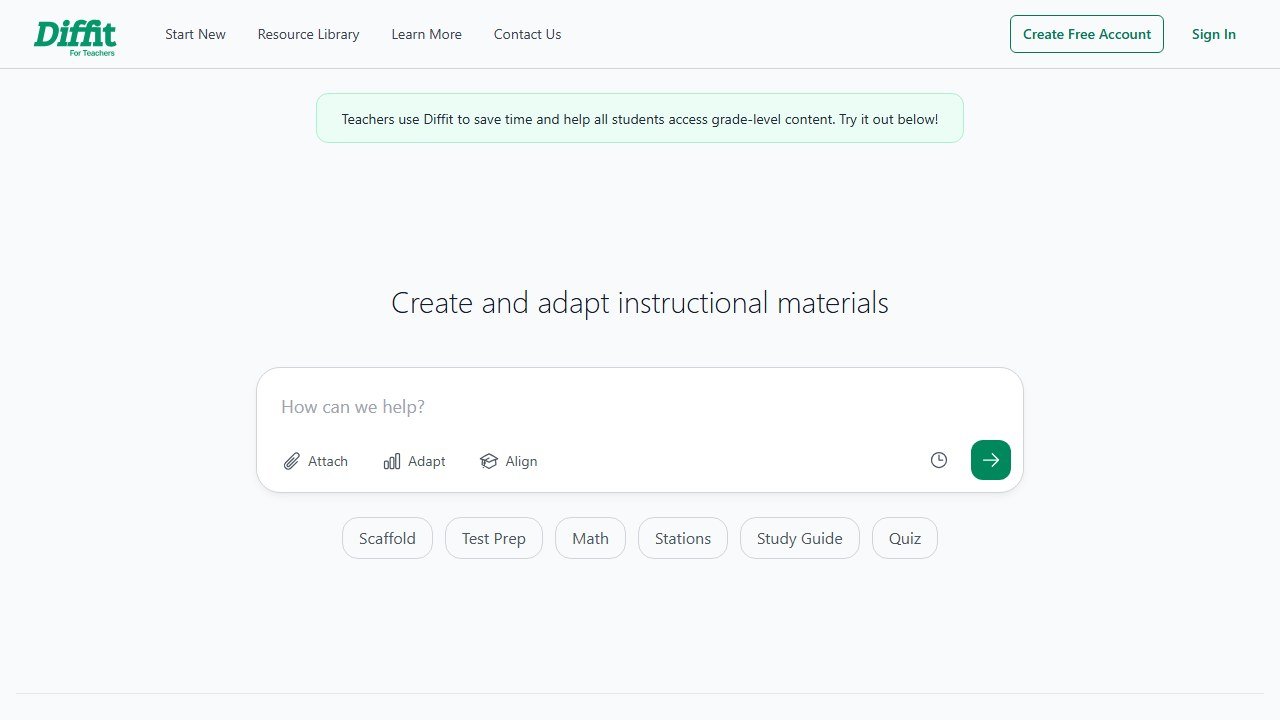
Diffit shipped meaningful upgrades to its differentiation engine, vocabulary builder, and assessment generator across 2026. The free tier is still usable for individual teachers, but the headline feature additions (custom student profiles, expanded language coverage, classroom analytics) sit behind the paid tier. Pricing increased on the school and district plans. The Chrome extension matured significantly. If you were on Diffit Free in 2025 and have not checked the paid tier yet, the gap is now meaningful enough to re-evaluate. If you are weighing Diffit vs MagicSchool vs Brisk for a 2026-2027 school-year rollout, the comparison has shifted: Diffit is now strongest for content adaptation; MagicSchool leads on tool breadth; Brisk leads on workflow speed.
What is new in Diffit (May 2026)
The current month's most relevant updates, refreshed monthly. If you are seeing this section but the date stamp at the top of the page is older than 60 days, the page is overdue for a refresh: flag it.
Areas with the most movement recently:
- Reading-level adaptation has expanded its accuracy across a wider range of grade levels. Adaptation between Lexile bands at the upper-elementary and middle-school levels (3rd-8th grade) is noticeably more reliable than in 2025.
- Vocabulary builder now generates multi-tier vocabulary lists (Tier 1 / Tier 2 / Tier 3 per the Beck & McKeown framework) more consistently. This matters for ELL teachers and special education contexts.
- Question generation added support for more rigorous question types beyond recall and basic comprehension. Bloom's Taxonomy levels above "remember" and "understand" now produce stronger output, though "evaluate" and "create" still need human cleanup.
- Multilingual support expanded, with stronger output quality in Spanish, Mandarin, and Arabic compared to early-2025 versions.
- Chrome extension stability improved. Many of the 2025-era crash reports on long pages were addressed.
The product team has been quiet about exact ship dates in public channels, so this section reflects what users have flagged in classroom communities.
Diffit pricing changes in 2026
Pricing in this category has been volatile. Here is what changed across 2026:
- Free tier: still exists, still usable for individual teachers, but daily usage caps and feature gating have tightened slightly. The free tier in 2025 supported more daily generations than it does in 2026.
- Teacher Pro / Plus: middle tier for individual paying teachers. Pricing sits in a familiar range for the EdTech category but has crept upward by a single-digit percentage from 2025 levels.
- School and District plans: enterprise tier. Pricing here is not published transparently; you have to request a quote. Schools in our network report quotes in the $X-per-teacher-per-year band, with volume discounts available.
- Free for Teachers / educator discounts: still in place for verified K-12 teachers. Verification flow has not changed materially.
If you are evaluating Diffit for 2026-2027 budget, request a current quote directly from the Diffit sales team. The number on their public pricing page is the starting point, not the final number.
Best new features in Diffit worth checking out in 2026
If you only have 30 minutes to update your understanding of Diffit, these are the features to test first.
Multi-tier vocabulary lists for ELL contexts
Diffit's vocabulary builder is now more reliably generating the three-tier breakdown that ELL specialists actually use: general high-utility academic words (Tier 2), domain-specific technical vocabulary (Tier 3), and high-frequency conversational words (Tier 1). In 2025 this often required manual cleanup; in 2026 the first-pass output is more often usable as-is.
Question generation at higher Bloom levels
The bottleneck for assessment generation has always been getting beyond recall questions. Diffit's question engine now produces application and analysis level questions with reasonably consistent quality, especially for nonfiction passages. Synthesis and evaluation questions still need a teacher pass before classroom use.
Custom student profiles (paid tier)
Paying teachers can save student-level profiles (reading level, IEP accommodations, ELL status) and generate adapted content per profile without re-entering the parameters each time. This is the kind of feature that gets used daily once it is set up, and it pays back the paid-tier price for any teacher who runs differentiated stations regularly.
Improved long-passage handling
Earlier versions struggled with long source texts (multi-page passages, long articles, full chapters). The adaptation engine now handles longer passages more reliably without losing key information or producing inconsistent reading levels mid-passage.
Long-passage handling matters most when you work with primary sources. See our guide to the best AI tools for history teachers for how Diffit and its rivals handle document-heavy lessons.
Where Diffit still falls short in 2026
An honest list of the limitations worth knowing before you commit.
- Math and STEM content: Diffit is built for text-based subjects. Math word problems work; conceptual math content and STEM diagrams do not.
- Source quality dependence: Like any AI adaptation tool, Diffit can only work with what you feed it. Adapting a poorly-written or factually shaky source text propagates the issue.
- No collaborative editing: If you co-plan with another teacher and want to iterate on a generated worksheet together, you cannot. Each teacher generates separately, then shares the output downstream.
- LMS integration depth: Direct integrations with Google Classroom, Canvas, and Schoology are functional but shallow. Export is reliable; deeper grade pass-back and assignment-level analytics are not Diffit's strength.
- High-stakes assessment usage: Diffit is not designed for, and should not be used for, high-stakes assessment generation. The output is great for formative assessment and differentiated practice; not for end-of-unit summative tests where stakes are real.
Diffit roadmap: what users are asking for in 2026
Public roadmap signals from the Diffit team plus what we hear in teacher communities. Treat as directional, not as committed shipping dates.
- Deeper AI tutor capability: Diffit is exploring conversational tutoring on top of the adapted content. The product positioning here would put it in adjacent territory to Khanmigo.
- Stronger LMS integrations: school-level customers continue to ask for tighter Google Classroom and Canvas integrations. The team has acknowledged this.
- Analytics for school accounts: aggregated usage data for school administrators (which teachers are using Diffit, what subjects, what reading levels) is a known feature request that has been mentioned publicly.
- Voice and audio adaptation: turning written content into adapted audio (for accessibility and lower-grade readers) has been discussed.
How Diffit compares to MagicSchool, Brisk, and Khanmigo in 2026
The four major EdTech AI tools have all evolved, and the picture is different than it was even six months ago.
Diffit's strength in 2026: content adaptation depth. If you need a text adapted to different reading levels with strong fidelity, Diffit is the most accurate tool in this category. The vocabulary tier-breakdown is the cleanest in the market.
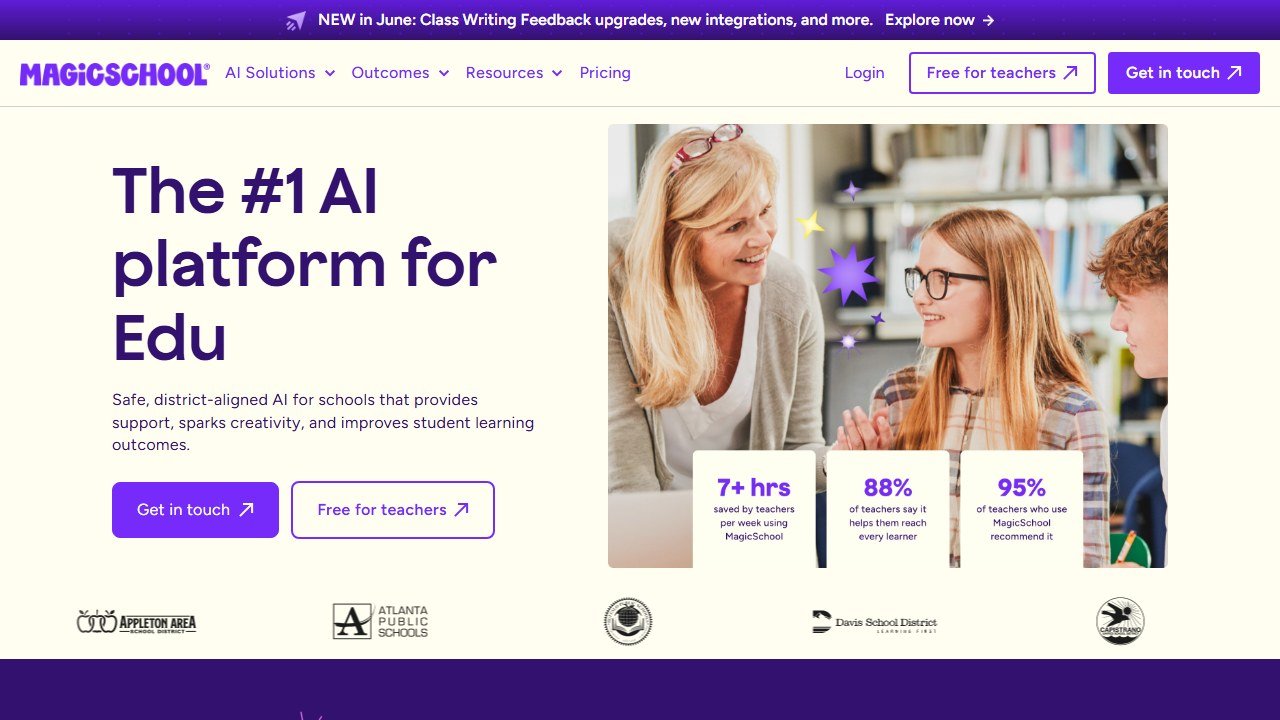
MagicSchool's strength in 2026: breadth. MagicSchool has the largest catalog of teacher-facing AI tools (80+ specific tools). If you want one platform that covers lesson planning, IEP draft writing, parent communication, and more, MagicSchool is the volume play. See our MagicSchool review for the full breakdown.
Brisk's strength in 2026: workflow speed inside the documents and slides teachers already have open. Brisk lives as a Chrome extension and excels at fast feedback, leveling, and quiz generation on the fly without leaving Google Docs.
Khanmigo's strength in 2026: tutoring. Khan Academy's AI tutor remains the strongest tool for student-facing tutoring within the Khan Academy ecosystem. See our Khanmigo review for the current 2026 picture (with notes on the changes Khan Academy has signaled for the platform).
If you can only afford one paid tier, the question is which strength matches your team's daily workflow. For teams that adapt a lot of source text → Diffit. For teams that need one platform covering many use cases → MagicSchool. For teams that work mainly in Google Workspace → Brisk. For students in Khan Academy → Khanmigo.
Should you switch or stick with Diffit in 2026
Three decision frames depending on where you are starting from.
You are a 2025 Diffit free-tier user, unsure whether to upgrade. Run the paid tier for two weeks during your next unit. If you find yourself using custom student profiles and the higher-Bloom question generation in a real-classroom workflow, the paid tier pays back. If you do not, free tier is still fine.
You are a 2025 Diffit paid user, unsure whether to renew in 2026. The 2026 product is materially better than the 2025 product at the same paid tier. Renew unless your workflow has shifted toward areas Diffit is weak at (math content, LMS-integrated assessments): in which case look at MagicSchool or Brisk respectively.
You are evaluating Diffit fresh in 2026 for the first time. Start with the free tier. Adapt three real source texts that match what you actually teach. If the output saves you 30 minutes per piece and the vocabulary tiers are correct, you have your answer. If you hit limitations, the framework above tells you which alternative to look at instead.
Saru says: Faz, the step to watch on Diffit in 2026 is the upgrade from free to paid. Tools that lose users at that step usually have feature parity issues, so before a district commits, check that the paid tier adds something your teachers will actually use rather than lifting a cap they rarely hit. Watch the pricing carefully for the 2026-2027 school year procurement cycle.
Bottom line on Diffit in 2026
Diffit is still the most accurate AI content adaptation tool we have reviewed for K-12. The 2026 updates have strengthened its core (adaptation depth, vocabulary tiers, question quality) without scattering into features the team cannot maintain. Pricing has crept up but stays in defensible range for the value delivered. The competitive picture against MagicSchool, Brisk, and Khanmigo is differentiated enough that all four can co-exist in a teacher's stack.
If you are running Diffit free-tier in 2026 and have not tested the paid tier in 6+ months, that is the action item. If you are running paid tier, you are probably fine until the 2026-2027 budget review. If you are not running Diffit and you adapt source texts weekly, the trial is worth a calendar block this week.
Sources
- U.S. Department of Education: guidance on AI in K-12
- Common Sense Education: AI tools ratings
- ISTE: International Society for Technology in Education
- Edutopia: AI in classrooms coverage
The 2026 Diffit feature deep dive
Diffit’s 2026 updates focused on three areas. First, expanded language support, with strong reading-level differentiation now available in Spanish, French, Mandarin, Arabic, and several additional ELL-relevant languages. Second, deeper scaffolding for English Language Learners, including vocabulary support, sentence frames, and translated student-facing materials. Third, improved Google Classroom and Schoology integrations so leveled materials can be assigned directly without manual file transfer.
Teachers in heavily multilingual classrooms report the biggest 2026 gains because the language expansion fills a real curriculum gap. Teachers in monolingual classrooms see smaller incremental gains because the core leveling features were already strong in 2025.
Diffit verdict for the 2026-2027 school year
Diffit remains the strongest reading-level differentiation tool for teachers in 2026. The 2026 language expansion makes it especially valuable for ELL classrooms. The case against Diffit: teachers who only need lesson planning will find broader platforms (MagicSchool, Brisk) more useful for their core workflow. Buyer profile: teachers in multilingual or differentiated classrooms where reading-level adaptation is a daily need.
What these tools actually cost, vendor by vendor
Education software prices unlike anything else, because the buyer is often a teacher paying personally while the vendor is really selling to a district. That produces a free tier that is genuinely usable and an enterprise tier with no published figure. Here is each alternative to diffit ai, read at source on 4 September 2026.
Chalkie, the most completely published rate card here
Chalkie publishes a free plan at US$0.00 a month covering five full lessons or activity sheets every seven days, then US$6.65 a month at US$79.80 paid yearly, and US$12.99 a month at US$155.88 yearly. Its annual toggle is marked as three months free and the arithmetic holds. Publishing the free tier’s exact limit, five resources per week rather than a vague “limited”, is rarer than it should be and worth rewarding.
Khanmigo, the cheapest paid option in this guide
Khanmigo publishes $44 a year, saving $4 against monthly billing, which works out around $4 a month. That is an order of magnitude below most of this category and reflects its position as a non-profit-backed product tied to an existing content library rather than a general purpose teacher toolkit. Judge it on whether that library matches your curriculum, because the price is not the deciding factor at that level.
MagicSchool and Curipod, free tiers with paid steps
MagicSchool publishes a free plan and Plus at $12.99 a month billed monthly, with a lower per user rate billed annually and volume-based discounts on district Enterprise licences that are quoted rather than published. Curipod publishes free at $0 a month and paid from $24 a month, with a yearly toggle marked as saving 21% and stated as $60 off against monthly. Both make the teacher tier genuinely usable, which is the commercial model rather than generosity.
CoGrader, where the free tier has a hard number on it
CoGrader publishes a free plan covering 100 student submissions a month with rubric building and FERPA compliance, then $15 a month billed annually. A hundred submissions is roughly three or four class sets, which makes the free tier a real trial for one teacher and clearly insufficient for a department. That is an honest place to draw the line and it lets you test properly before spending anything.
The ones that publish nothing, and what that tells you
Brisk Teaching publishes a free teacher plan at $0 but we could not read figures for its paid tiers. SchoolAI publishes tier names, Free Trial, Pro and Scale, with no figures attached, which is district-quoted pricing by design. Gradescope now sits on a Turnitin domain and its page is headed “Gradescope for Your Institution” with no rates. We also could not read pricing for Diffit, Quizlet, Photomath or Gauth. We are not claiming those publish nothing; a failed read is not evidence of absence.
Tools mentioned in this guide

Written by
FazFaz is the founder of AIToolsBakery. Some tools here are tested hands on. Others are assessed from vendor documentation and pricing verified on the live page, and every review says which one it is. Sponsors can buy a position in a guide. They cannot buy the score, the criticism, or silence about a better option.
How we test and how we make money →