Quick answer: Outreach is the enterprise sales engagement gold standard in 2026. We compared its documented capabilities, its published plan structure, and the public track record in case studies and verified reviews. We did not run a hands-on trial. The sequence builder is the deepest in the category, Salesforce integration is best-in-class, and Kaia conversation intelligence is competitive with Gong. The honest catch: opaque pricing typically lands $2,000+/seat/year. Below 25 reps, the math is hard to defend.
Outreach 2026 at a glance:
- Score: 4.3/5
- Best for: Enterprise sales teams of 25+ reps with complex motions and Salesforce-native CRM stack
- Starting price: Not published. Vendr puts the median Outreach contract at $45,600 a year
- Free trial: No, demo plus paid pilot
- Killer feature: Deepest sequence builder in the category plus Kaia conversation intelligence
- Research current to: March 2026
What Outreach does well
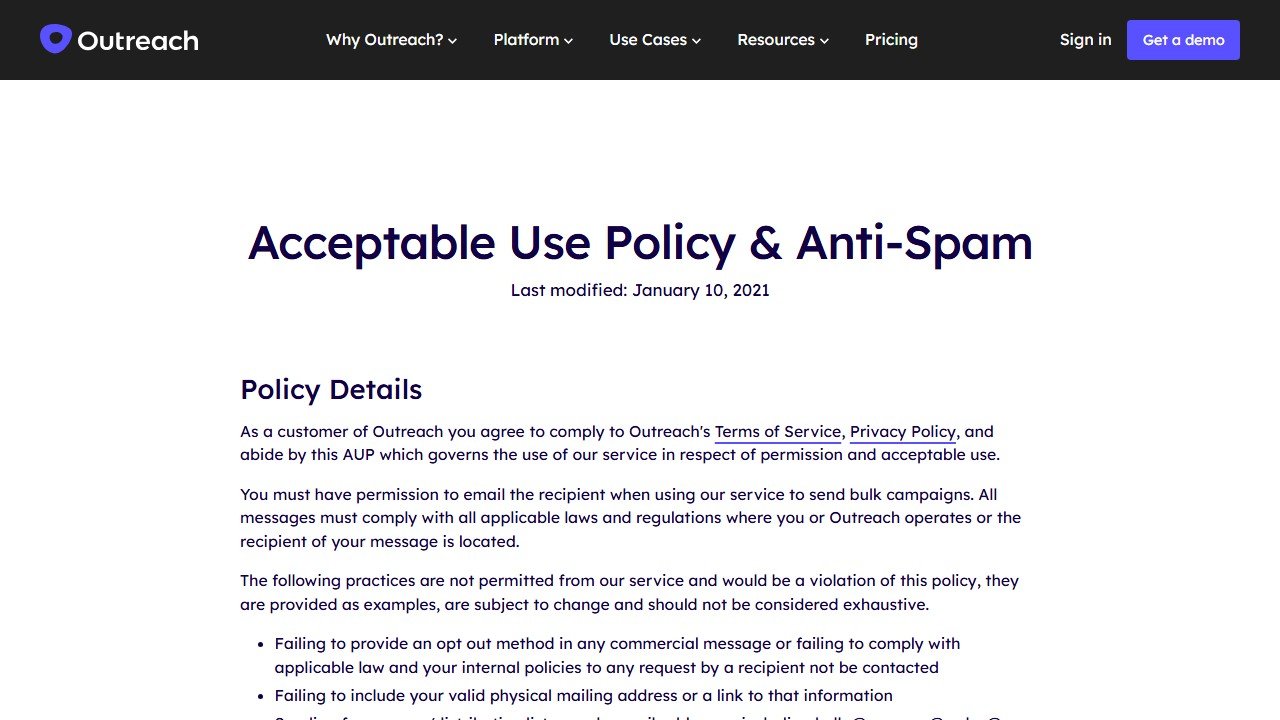
Website: outreach.ai (formerly outreach.io)
The sequence builder is the deepest in the category. Outreach’s “Sequences” let you build multi-channel cadences (email, phone, LinkedIn, SMS, custom tasks) with rules-based branching, content variants per persona, A/B testing, and AI-suggested next-best-action. Compared to Salesloft or Apollo, Outreach’s sequence engine handles complex sales motions that other platforms struggle with.
Kaia, Outreach’s conversation intelligence layer, is competitive with Gong on the basics. Call recording, transcription, AI-driven deal risk surfacing, manager coaching dashboards are all present and well-built. The integration with the sequence engine is the differentiator: Kaia signals can trigger sequence pauses, route to managers, or update Salesforce opportunity stages automatically.
The Salesforce integration is best-in-class. Activity logging is bidirectional, custom object sync handles complex CRM topologies, opportunity stage updates flow in real time. For Salesforce-native enterprise sales orgs, Outreach is the natural fit.
The 2026 product has shipped meaningful AI features. Outreach AI now drafts email variants per prospect using LinkedIn data plus historical engagement signals. Quality is competitive with Lavender and Salesforce’s Sales Cloud Einstein, though dedicated tools (Lavender for personalization, AiSDR for full autonomy) still out-feature on their specific axes.
What Outreach falls short on
Pricing transparency. Outreach publishes no price on any tier. The best public evidence comes from Vendr, which brokers software contracts and reports aggregates from 914 anonymised Outreach purchases: a median of $45,600 a year, across a range running from $8,560 to $213,832. That spread is the finding. What you pay turns on seat count, term and negotiation far more than on any list price.
Onboarding time is long. New reps take 3-4 weeks to feel productive, versus 3-5 days for Apollo or 2-3 weeks for Salesloft. The platform’s depth is the cause: there are more features to learn than reps need on day 1. Onboarding workflows that drip-feed features tend to land better than try-everything-at-once approaches.
The biggest gap in 2026 is the lack of integrated B2B database. Outreach is a pure sequencing-plus-engagement platform. You still need Apollo, ZoomInfo, or Clay to build prospect lists. For teams that want list build plus sending in one tool, Outreach is the wrong shape.
Buying signals and intent data are limited in Engage tier. Adding them requires Engage Plus (significantly more expensive) or external tools like 6sense or Bombora.
Outreach versus Salesloft: what the record actually shows
The question buyers actually ask is not whether Outreach works. It is whether Outreach beats Salesloft enough to justify switching. The public record is unusually clear on this.
Across customer case studies, G2 and TrustRadius reviews, and practitioner write-ups, sequencing alone reliably lifts activity volume and sequence completion rates on both platforms. What it does not reliably lift is win rate. The teams reporting win-rate improvement are consistently the ones using the conversation intelligence layer (Kaia on Outreach, the Drift-derived equivalent on Salesloft) inside a real manager coaching routine.
The headline: at the Plus tier, Outreach and Salesloft deliver functionally equivalent outcomes. The pick between them comes down to CRM stack, mobile UX preference, and prior team familiarity rather than feature differences.
Outreach pricing breakdown 2026
Outreach does not publish pricing, and Vendr confirms no list price is openly available. The figures below are Vendr aggregates, read on 1 September 2026, not figures from Outreach.
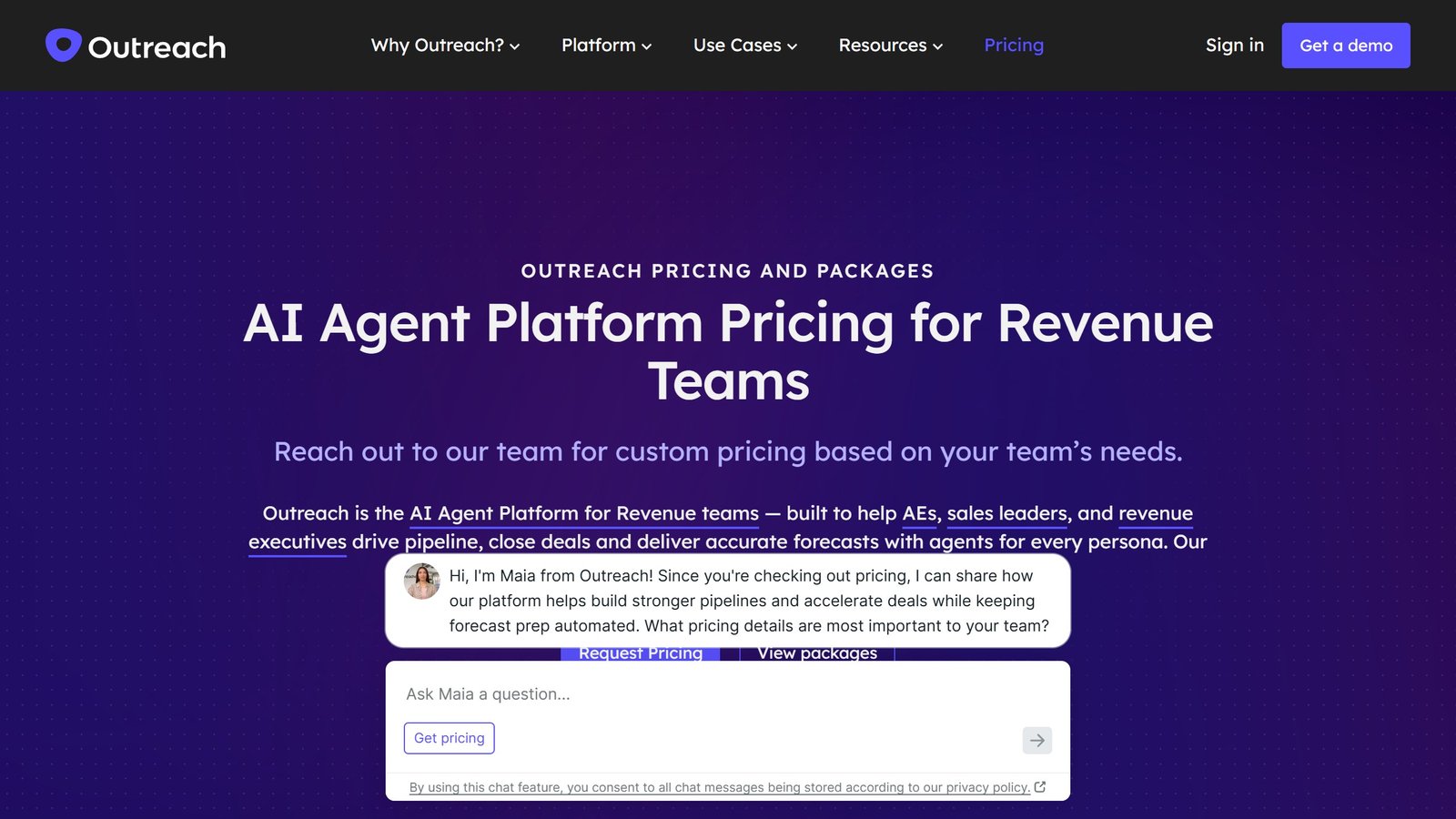
Packaging update, checked 1 September 2026. Outreach has moved to outreach.ai and repackaged. The plans it sells today are Essentials, Core, Amplify Plus and Enterprise, sized partly in AI credits, and it still publishes no price on any of them: every tier carries a Request pricing button. The Engage and Engage Plus names used below belong to the earlier packaging, and the figures that follow describe deals struck under it. Treat them as a historical guide to the order of magnitude, not as a current rate card, and get your own quote.
What the entry packaging covers. Cadence engine, email plus phone sequencing, standard CRM sync, basic reporting. Outreach has historically applied a seat minimum at this level, so the smallest teams cannot buy in at one or two seats.
What the mid packaging adds. Kaia conversation intelligence, AI deal risk surfacing, advanced reporting and intent data signals. This is the tier the coaching case rests on.
Enterprise: Custom. Adds dedicated CSM, custom AI models, SSO, governance, multi-region support, custom data integrations.
What sits on top of the subscription matters as much as the subscription. Vendr puts professional services for setup, CRM integration and training at $5,000 to $25,000 or more. Premium support often runs 10-15% of annual contract value, and add-on modules can add 20-40% to the total if they are bundled in late rather than negotiated up front.
Size your budget from the median, not from a seat price, because no reliable public seat price exists. Vendr reports its buyers saving 12% on average against the opening quote, so treat the first number you are shown as an opening position rather than a rate.
Outreach vs Salesloft vs Apollo
Salesloft is the direct competitor. Functionally equivalent at the Engage Plus tier. Salesloft tends to be 20-25% cheaper. Outreach has a slightly deeper sequence builder and a slightly more polished UX. The pick is mostly about prior team familiarity and CRM stack rather than capability gap.
Apollo wins on price (1/20th the cost) and bundled database. Apollo’s sequence builder is meaningfully less sophisticated but covers 70-80% of use cases for under-25-rep teams. The migration from Apollo to Outreach typically happens around 25-50 reps when sequence complexity outgrows Apollo.
Reply.io wins on multichannel depth (especially LinkedIn) and AI agent autonomy. Outreach is more enterprise-grade across the board. Right pick depends on whether your motion is LinkedIn-heavy (Reply) or Salesforce-heavy (Outreach).
Who should use Outreach
Enterprise sales teams of 25+ reps selling complex multi-stakeholder deals. Salesforce-native sales orgs where deep CRM integration matters. Teams running structured sequences with 8+ touches and conditional branching. Sales orgs with dedicated revenue operations functions that can extract value from the platform’s depth. Companies in regulated industries that need compliance features and call retention.
Who should NOT use Outreach
Teams under 25 reps. The price-per-seat and 5-seat minimum do not amortize, and the platform depth is overkill. Teams whose motion is LinkedIn-heavy (Reply.io is the better primitive). Teams already deeply invested in Salesloft (the migration cost rarely pencils out). Teams that need a database (Outreach is sequencing-only, need Apollo or Clay separately).
Common Outreach setup mistakes
Trying to use everything in week 1. Outreach has 50+ features. New reps who try to use all of them in week 1 burn out and disengage. Phase the rollout: weeks 1-2 sequences only, weeks 3-4 add Kaia, month 2 add advanced features. Adoption sticks better with phased onboarding.
Skipping the Salesforce object mapping. Outreach expects deep Salesforce integration. If opportunity, contact, and activity object mapping is incomplete, activity logging gets messy and reps lose trust in the platform.
Treating Kaia as a recording tool. The conversation intelligence ROI requires manager coaching workflows. Buying Engage Plus and not using Kaia’s manager dashboards wastes 80% of the upcharge.
Buying Engage Plus when Engage is enough. If your team does not run weekly call reviews, Engage tier covers most needs. Engage Plus’s coaching layer assumes coaching commitment.
Outreach integrations worth setting up
Salesforce or HubSpot. Bidirectional, deep, mandatory. Set up in week 1.
Slack. Routes Kaia signals and deal risk notifications. Adoption-critical.
Zoom and Microsoft Teams. Native call capture for Kaia.
LinkedIn Sales Navigator. Adds LinkedIn touchpoints to sequences. Engage Plus and above.
Snowflake or BigQuery. Data export for custom analytics. Enterprise tier.
6sense or Bombora. Intent data integration. Enterprise customers commonly pair these.
For the direct head-to-head against the multichannel SMB favorite, see our Reply.io vs Outreach comparison.
What the rest of this market charges, vendor by vendor
A table gives you the number. What decides your bill is the meter behind it and the limit that binds first. Here is each comparable vendor to Outreach, read from their own pricing page on 4 September 2026.
Apollo.io, from $49 per seat, and it publishes the allowances too
Apollo is the transparency benchmark in this category. Basic is $49 per seat per month billed annually and $65 billed monthly, Professional $79 and $99, Organization $119 and $149 with a three-seat minimum, plus a free tier at $0. Crucially it also publishes the credit allowance, 30,000 per seat per year on Basic, which almost nobody else does. That means you can divide the allowance by your real monthly reveal volume and know whether the plan fits before speaking to anyone.
Lavender, from free to $89 a seat, and free for students and jobseekers
Lavender publishes every tier: Basic free forever but capped at five emails analysed a month, Starter $27, Individual Pro $45 and Team $89 per seat, all billed annually. Note the URL, because lavender.ai/pricing now returns a 404 after the company split into two products. It also gives the Email Coach away free to students, jobseekers and bootstrapped founders, which is unusually generous and worth knowing if you hire from a graduate pipeline.
Instantly and Smartlead, published, and metered on sending
Instantly and Smartlead both publish figures openly. For cold email tooling the binding constraint is usually monthly sending or active-lead volume rather than seats, so a plan can look generous per user and still stop you at the volume your campaign needs. Smartlead runs a working monthly and annual toggle that changes every figure, so check which state you are reading.
Clay, published but on a slider
Clay publishes real numbers, but they sit on a credit slider with a monthly and annual toggle marked “Save 10%”, so the figure changes as you move the credit volume. Any article quoting a single flat Clay price has taken one position on that slider and presented it as the price. Always pair a Clay figure with the credit volume it assumes, or it cannot be compared to anything.
Cognism, no price, but it publishes the packaging
Cognism publishes no figure in any currency. It does publish that Standard and Pro both include five seats, which is a floor worth knowing, and that its credits model only spends a credit again if a contact changes jobs. A two-person team should expect to be quoted for five.
Gong, no price, but it publishes the formula
Gong publishes no figure either, but it does publish the model: licences priced per user plus a separate platform fee based on the number of users supported. Two components, both scaling with headcount, which at least lets you model the shape of the bill.
ZoomInfo, Outreach and Salesloft publish nothing at all
ZoomInfo renders over 12,000 characters of pricing page with no currency figure anywhere. Outreach sets out packaging but no numbers, and note the domain moved from outreach.io. Salesloft has gone furthest: its pricing URL now redirects to a page titled “Talk to Sales”, so there is no pricing page at all. Artisan has also removed its figures, its cards now reading “Pricing scoped on your plan”.
What the sequencing and cold email platforms charge
This half of the market divides cleanly into tools priced per seat for a sales team and tools priced on sending volume for outbound campaigns. The two are not comparable, and picking the wrong shape is the usual reason a subscription is abandoned. Here is each alternative to Outreach, read on 4 September 2026.
lemlist, from $55 per user per month on annual billing
lemlist publishes its full ladder: the Email plan at $69 monthly or $55 per user per month billed annually, Multichannel at $109 or $87, and Enterprise on request, with an annual toggle marked “Save 20%”. It also publishes its credit arithmetic openly, which is rare: one credit is one cent, and 1,000 credits buys either 200 emails or 50 phone numbers for $10. That lets you price a campaign before you commit to anything.
Reply.io, $29 and $69 per month per account
Reply.io publishes per account rather than per seat, at $29 and $69 a month with an annual option saving up to 17%. Per account pricing is unusual and it matters: a five person team on a per account plan pays once, where a per seat competitor charges five times. Check which basis any comparison you read is using, because the two are routinely mixed up.
Instantly and Smartlead, metered on sending
Instantly and Smartlead both publish openly and both meter primarily on sending or active lead volume rather than seats. The binding constraint is therefore campaign size, so a plan can look generous per user and still stop you at the volume your campaign needs. Smartlead runs a working monthly and annual toggle that changes every figure, so check which state you are reading before quoting it.
Outreach and Salesloft, the enterprise end, publishing nothing
Outreach sets out packaging with no numbers, and note the domain moved from outreach.io. Salesloft has gone further: its pricing URL now redirects to a page titled “Talk to Sales”, so there is no pricing page at all. Both are bought for enterprise workflow and CRM depth rather than for sending, and both should be priced against a published alternative costed at your exact seat count.
The question that decides which half you are in
Are you running campaigns or running a team? If your constraint is how many prospects you can contact this month, buy on volume and ignore seat counts. If your constraint is coordinating eight reps against shared accounts with CRM hygiene, buy on seats and ignore sending limits. Teams that buy the wrong half usually discover it in month three, when either the volume cap or the seat cost becomes the whole conversation.
undefined
The verdict for 2026
Outreach is the right enterprise sales engagement platform for teams of 25+ reps with complex sales motions and Salesforce-native CRM stacks. The sequence builder depth and Kaia conversation intelligence are best-in-class, and the coaching layer only earns its cost where managers genuinely run weekly call reviews. For teams under 25 reps, Apollo or Reply.io deliver more value per dollar. The Outreach vs Salesloft choice mostly comes down to CRM stack fit and prior team familiarity.
For the broader sales tool category, see our Best AI Sales Tools 2026 guide. For pure SDR motions, our Best AI SDR Tools 2026 covers AiSDR, Apollo, and Artisan. For cold email infrastructure, see Best AI Cold Email Tools 2026.
Outreach by sales role: who actually uses what
SDRs: The sequence builder is the killer feature. Multi-step, multi-channel sequences with conditional branching let SDRs run motions that other tools cannot support. The trade-off is steeper learning curve (3-4 weeks to proficiency vs 3-5 days for Apollo).
Account Executives: Kaia conversation intelligence plus the deal risk surfacing are the AE-facing differentiators. AEs running structured opportunity processes get measurable value from Outreach’s AI-driven next-step suggestions, particularly for multi-stakeholder enterprise deals.
Sales managers: The Kaia coaching dashboards make manager-led call reviews structured and repeatable. Managers who commit to weekly call reviews are the ones who report win-rate lift. The win-rate lift requires active coaching, not just recording.
Revenue Operations: Outreach’s RevOps tooling is enterprise-grade. Multi-quota tracking, complex territory routing, custom forecasting models, and Salesforce object-level activity attribution all work without custom development. For enterprise sales orgs with established RevOps functions, this is the headline value.
Customer Success and Account Management: Outreach for CS handles renewal and expansion motions. The platform is heavier than Gainsight or ChurnZero for pure CS, but the unified engagement view (sales + CS in one platform) is valuable for orgs that want to consolidate.
Enablement teams: Outreach’s content management, sequence templates, and rep onboarding flows are deep enough to handle 100+ reps without custom build-out. For sales orgs with dedicated enablement functions, this is a real value add.
Outreach pricing math at different team sizes
Rather than model seat prices nobody publishes, here is what the public contract data actually supports:
The middle of the market. Vendr’s median Outreach buyer pays $45,600 a year. That is the most useful single anchor to walk into a negotiation with, and it is usually below the first number a vendor quotes.
The spread. Across those 914 purchases the range runs from $8,560 to $213,832 a year. A ten-seat team and a global enterprise are not buying the same product on the same terms, which is exactly why a single per-seat figure would mislead both ends.
Year one is not the run rate. Add implementation of $5,000 to $25,000 or more, then support at 10-15% of contract value. Budget year one materially above the median and the steady state below it.
Discounting is routine rather than exceptional, and leverage grows with seat volume and term length. One 2026-specific ask: get the AI credit allowance written into the contract, because the current packaging meters credits separately from seats and that is where unbudgeted spend now appears.
The ROI test is simple enough to run before the demo. Outreach pays back only when the incremental revenue you can genuinely attribute to it clears its all-in annual cost per rep. Ask the vendor to show the attribution method behind any uplift figure it quotes you, rather than the figure alone.

Written by
FazFaz is the founder of AIToolsBakery. Some tools here are tested hands on. Others are assessed from vendor documentation and pricing verified on the live page, and every review says which one it is. Sponsors can buy a position in a guide. They cannot buy the score, the criticism, or silence about a better option.
How we test and how we make money →