Somebody on your team is going to resign this year. If you run a major gifts programme, the odds are close to certain: the average major gift officer tenure sits at around 18 months.
The resignation is not the expensive part. The expensive part is the ninety days afterwards, when a hundred and fifty donors quietly discover that the person who knew them has gone and nobody has replaced that knowledge. The gift that was six months into cultivation stalls. The donor who always gives in November does not get called. The one who told your predecessor, in confidence, that her husband died in March gets a cheerful renewal letter addressed to both of them.
Everyone in fundraising has watched this happen. Almost nobody has a process for it. More than half of fundraisers, 57%, say they have no formal process for handing off donors or that their process has significant gaps.
This is a guide to donor portfolio handover that actually works. It is deliberately practical, and it separates the part that is a process problem from the part that is genuinely a tooling problem, because most advice on this topic conflates them.
Quick answer: Build the handover before anyone resigns, not after. Capture relationship context continuously in a system, not in one person’s head or inbox. Run a structured 30-day transition with warm introductions, not a reassignment email. Gratefully is our pick for preserving that context automatically.
What actually walks out of the door
Be precise about what is lost, because it determines what you need to capture.
The CRM record does not leave. Giving history, contact details, gift dates, campaign codes. This is the part everyone assumes is the problem and it is not. That data is sitting exactly where it was.
The context leaves. All of it:
- Why this donor gives, in their own words, from a conversation three years ago
- What they said no to, and why, and whether that no was permanent
- Who introduced them, and whether that relationship is still warm
- The personal circumstances that determine timing: illness, a business sale, a difficult year
- What was promised informally that never made it into a record
- The stage the cultivation had actually reached, as opposed to the stage the CRM says
The trust leaves too, and this is the one nobody plans for. A major donor’s relationship is often with a person, not an institution. When that person goes without a proper handover, the donor experiences it as being dropped. Losing a gift officer can lead directly to poorer stewardship and, in the worst cases, to losing the donor and the funder relationship entirely.
The three windows, and what to do in each
Handover is not an event on somebody’s last day. It happens across three windows, and the earlier one you get right, the less the later ones matter.
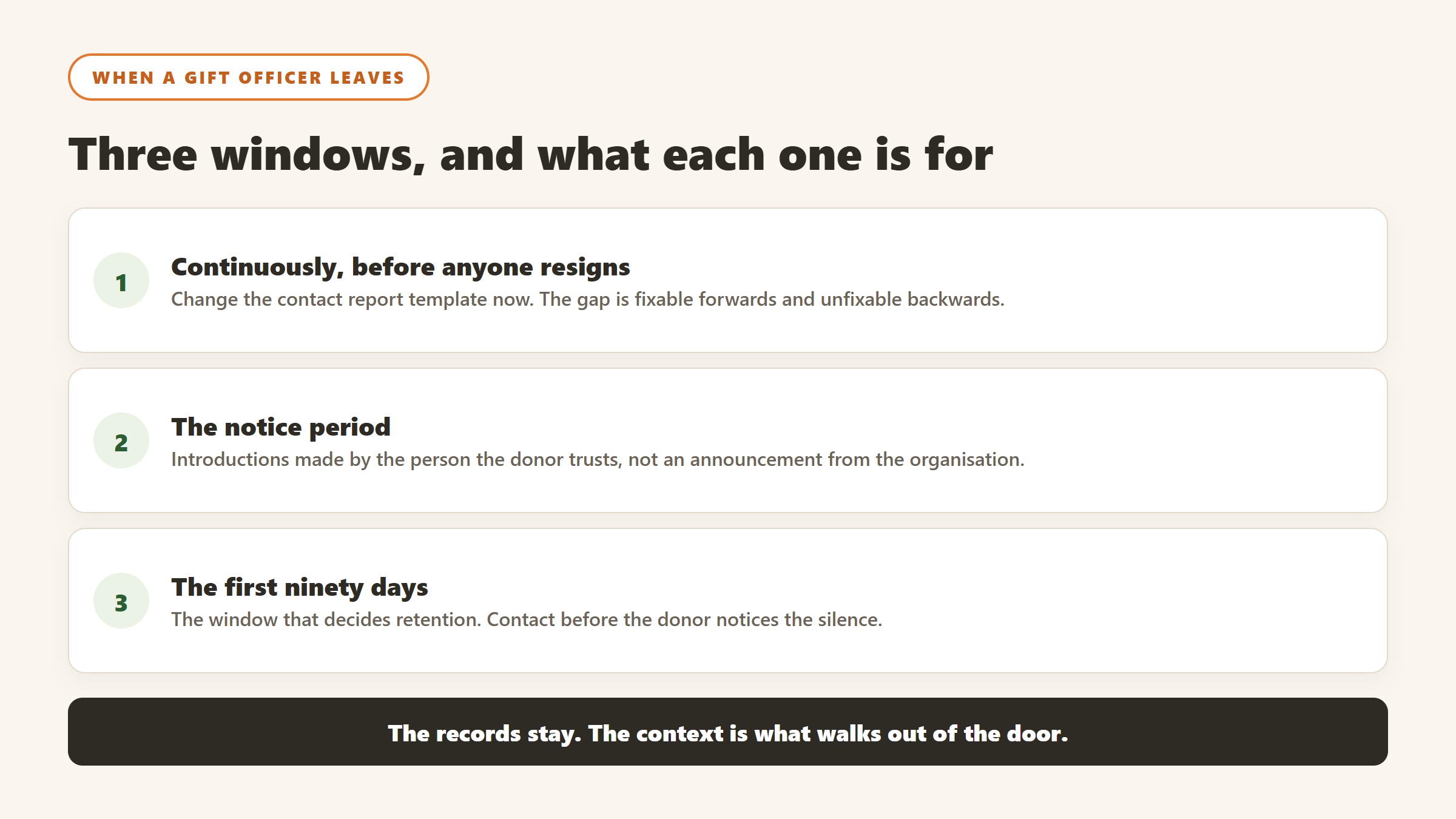
Window one: continuously, before anyone resigns
This is the only window that genuinely solves the problem, and it is the one almost everybody skips.
Make context capture part of the job, not an exit task. If your expectation is that a departing officer will spend their notice period documenting 150 relationships, you are asking someone with one foot out of the door to do the hardest writing task of their tenure. It will not happen well.
Decide where context lives. Not in an inbox. Not in a personal notes app. Not in a spreadsheet on a laptop that goes back to IT. A system the organisation controls, which everyone with the right permission can read.
Write down the intangibles, not just the interactions. Most CRMs are built to log that a meeting happened. The valuable record is what was said, what it implied and what you decided to do next. A contact report that reads “coffee, 45 mins, positive” is worth nothing to a successor.
Audit it periodically. Pick five donors at random from each portfolio and ask: if this officer left tomorrow, could a colleague pick this relationship up from what is recorded? The honest answer is usually no, and finding that out in a quiet quarter is much cheaper than finding out in a resignation week.
Window two: the notice period
You now have between two and eight weeks, and the departing officer is, at best, half present.
Triage the portfolio first. Do not attempt all 150 relationships equally. Sort into three tiers: active cultivations and asks in flight, warm relationships with no immediate ask, and everyone else. Tier one gets a real handover conversation. Tier two gets a written record. Tier three gets reassignment.
Do a live handover conversation for tier one, and record it. Fifteen minutes per donor with the incoming officer, the departing officer and a recording. Ask three questions: what do I need to know that is not in the file, what would you do next, and what should I absolutely not do. That last question saves more relationships than the other two combined.
Get the warm introductions out before the last day. A short, personal email from the departing officer introducing their successor is worth more than anything the organisation can send afterwards. It transfers a fraction of the trust, and it is the single highest-return task of the notice period.
Do not let the departing officer make the goodbye about themselves. It is a genuine risk, particularly with charismatic fundraisers who are moving to another cause. Frame every introduction around the donor’s relationship with the mission, not with the individual.
Window three: the first ninety days after
The successor now owns relationships they did not build, and this is where most transitions fail slowly rather than dramatically.
Prioritise contact, not comprehension. The instinct is to read everything before reaching out. Reverse it. A short call in week two, admitting you are new and asking what they care about, beats a perfectly briefed call in week nine.
Watch for the drift signals. Opens declining, events skipped, a renewal date passing quietly. These appear before the gift gap does, and after a transition they are the early warning that a relationship is slipping rather than pausing.
Do not re-litigate the strategy for six months. New officers often want to reorganise the portfolio immediately. Every reorganisation is another discontinuity from the donor’s point of view.
Where tools genuinely help, and where they do not
Now the honest part, because this is where most articles on the subject become a product pitch.
Tools do not fix a culture that does not record anything. If your team writes nothing down, software will have nothing to organise. That is a management problem with a management solution.
Tools do fix the two hardest mechanical problems, and both are real:
Problem one: context is scattered. The CRM has the gifts. The inbox has the conversations. A shared drive has the proposal. Somebody’s notes app has the detail about the husband. No human successor is going to reconstruct that across four systems for 150 donors.
Problem two: writing the dossier is the task nobody does. Even organisations with good records rarely produce a genuine handover document, because it takes hours per donor and always competes with something more urgent.
What to look for
- Reads across sources, not just the CRM. If it only reads the CRM, it only knows what was already easy to find.
- Generates a per-donor summary rather than a data export. A successor needs a narrative, not a field dump.
- Cites where each statement came from, so the successor can check rather than trust.
- Survives the departure. If the tool is tied to the individual’s mailbox and licence, it leaves with them.
- Permission control, because a handover dossier contains sensitive personal detail and should not be broadly readable.
Our pick
Gratefully is the tool built most directly for this problem, and as far as we can tell it is the only one that treats it as a first-class feature rather than a by-product. It unifies your CRM, email, documents and notes into one knowledge graph, then auto-generates handover dossiers containing the full relationship context when somebody departs. The vendor’s own claim is that “100% of donor knowledge survives a resignation”, which is a vendor claim and should be read as one, but the capability is real and specific rather than marketing gloss.
It is an intelligence layer, not a CRM, so it runs on top of what you already have rather than replacing it. Our full Gratefully review covers where it fits and its honest limitations, the main one being that it depends on the quality of the data you point it at.
The realistic alternative is your existing CRM plus discipline. Bloomerang, DonorPerfect and Virtuous all support structured contact reports and portfolio reassignment, and a team that genuinely fills them in will handle a transition adequately. The failure mode is not the software, it is that people do not write things down when they are busy, which is always.
For the wider category, see our best AI donor intelligence tools roundup and the moves management guide, which covers the related problem of deciding what to do next with a portfolio you have just inherited.
The handover checklist
Steal this. It works whether or not you buy anything.
Continuously
- Context lives in an organisational system, not an inbox
- Contact reports record what was said, not just that a meeting happened
- Quarterly spot check: could a colleague pick up five random relationships?
On resignation
- Portfolio triaged into three tiers within 48 hours
- Tier one handover conversations scheduled and recorded
- Warm introduction emails sent before the last day
- Sensitive personal circumstances flagged explicitly
- Anything promised informally written down
- Access to files, notes and shared drives transferred, not revoked and lost
First ninety days
- Contact attempted with every tier one donor inside three weeks
- Drift signals monitored for the whole portfolio
- No structural reorganisation for six months
- Thirty and ninety day reviews of what was lost, feeding back into the continuous list
How this goes wrong in practice, and the warning signs
Four failure patterns account for most of what we hear from organisations a year after purchase. All four are visible early if you know the shape.
The pilot that never ends and never scales
One enthusiastic person runs a tool brilliantly for eighteen months. They leave, and it stops the same week. The warning sign is that nobody else has ever produced the output, and the fix is procedural rather than technical: a second person runs it once a quarter, in the same way, from written steps. If the process only exists in one head, you did not buy a system, you rented a habit.
Output nobody acts on
Scores are generated, reports are produced, and the work continues exactly as before. This is usually a sequencing failure: the tool was chosen before anyone agreed what decision it would change. The test is simple and worth applying before purchase. Name the meeting where the output gets used and the person who will be holding it. If you cannot, the output has no destination.
Trust lost to one visible error
A tool rates a long-standing donor as low potential, a gift officer sees it, and the credibility of every other score goes with it. Almost always the cause is a data structure issue rather than the model: a soft credit missing, a household split, a migration boundary hiding the giving history. Expect this in the first month, plan for who investigates it, and make sure the first person to see an odd score has somewhere to take it other than the corridor.
The cost that arrives in year two
Year one is discounted, implementation is one-off, and the renewal is negotiated by somebody who was not in the original procurement. Uncapped renewals, mid-term expansion at list price, and processing fees growing with your success are the three lines that move. All three are fixable in the first contract and effectively unfixable later, which is why the terms matter more than the discount.
The common thread
None of these is a software failure. Every one is a decision that was not made, or was made by default, before anything was installed. The organisations that get value from this category are not the ones that picked the best product; they are the ones that named an owner, agreed what would change, and wrote down what failure would look like.
How to tell whether any of this actually worked
The failure mode in this category is not a tool that breaks. It is a tool that runs for a year while nobody can say whether it changed anything. Decide the measurement before you deploy, because after deployment every number is contested.
Pick a baseline you already have, not one you will start collecting
Whatever you measure, you need last year of it, and you need it from a source that was not touched by the project. Gift counts by segment, retention rate by cohort, average gift by channel, and the number of qualified visits per officer are all usually recoverable from the CRM for prior years. A metric that only starts on go-live day cannot show improvement, only activity, and activity is what makes a board sceptical.
Measure the decision, not the output
A propensity model that produces ten thousand scores has produced nothing. What matters is whether the list an officer worked was different from the list they would have worked anyway, and whether that difference showed up in outcomes. The cleanest version is a holdout: take a segment the model ranks highly, work half of it, and leave the other half in the normal rotation. It is unglamorous, it takes two quarters, and it is the only evidence that survives a hostile question.
Retention is the metric that moves last and matters most
Acquisition responds to activity within weeks. Retention responds over a giving cycle, which for most organisations means twelve to eighteen months before a change is legible. Report it, but say plainly at the outset when it will become meaningful, so that a flat number at six months is understood as expected rather than as failure.
Count the hours the thing was supposed to save
Most of the honest value in this category is time rather than income: research that took ninety minutes taking fifteen, a report that took a day taking an hour. Time is measurable if you measure it before, and unprovable if you do not. Ask the two or three people whose work will change to record how long the task takes them this month, before anything is installed. It is the cheapest evaluation you will ever run and almost nobody does it.
Agree in advance what would make you stop
Write down, before purchase, the result at twelve months that would mean you do not renew. Naming it converts a renewal from a default into a decision, and it is the single most effective discipline against the pilot that quietly becomes permanent. If nobody can name a result that would end it, the evaluation was never real.
Where the figures on this page come from
Every price quoted here was read from the vendor’s own pricing page on 4 September 2026, not from an aggregator or a review site. That distinction matters more in this category than in most, because nonprofit software pricing changed materially over the past year and a great deal of what circulates online describes packaging that no longer exists.
The pages we read
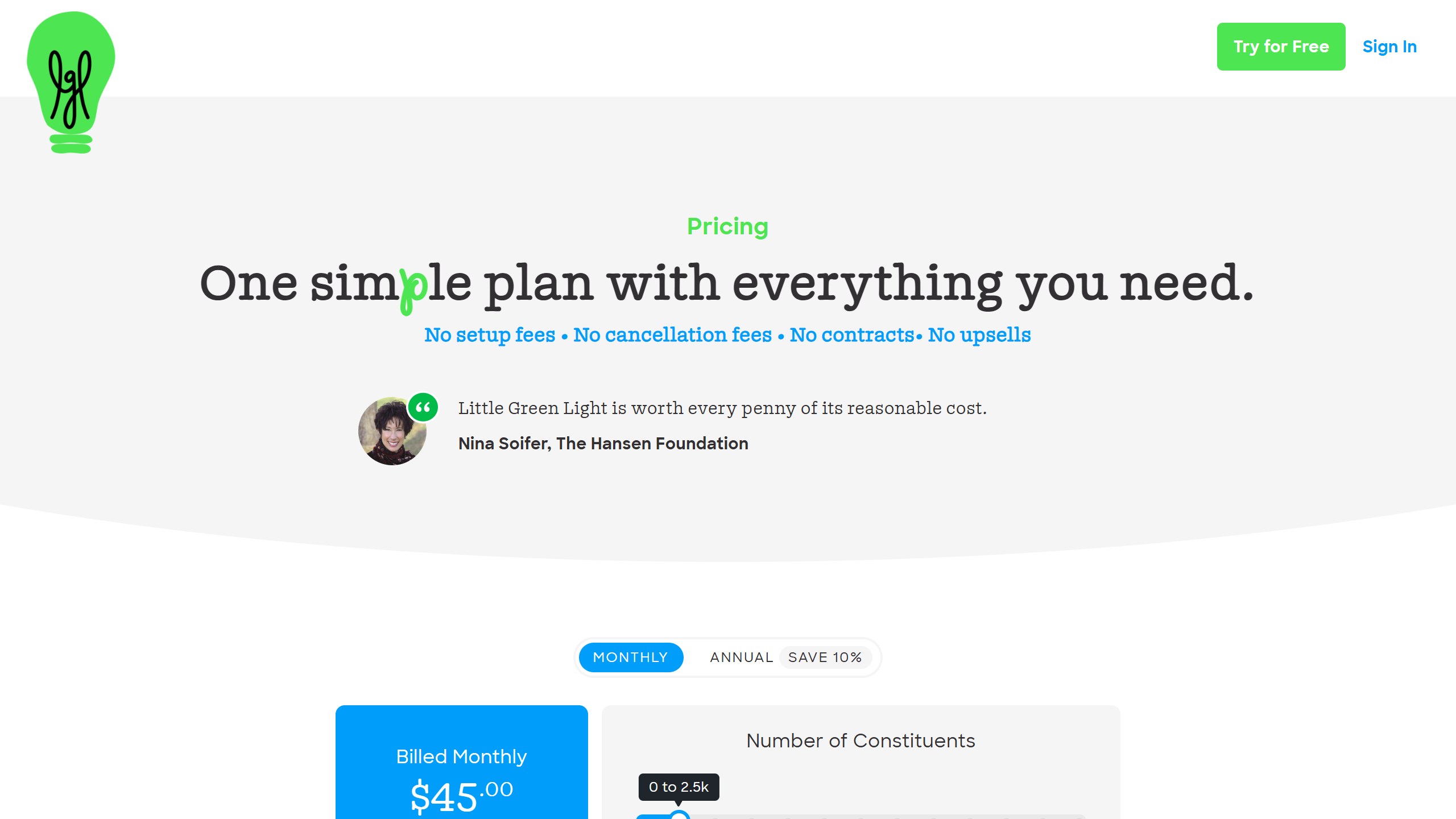
Little Green Light publishes every constituent band from $45 a month. Salesforce Nonprofit Cloud publishes $60 per user per month with ten licences free under Power of Us. Bloomerang publishes $125 a month for the CRM with other products priced separately. Keela publishes every contact band from $164 a month. Dataro publishes $15,000 a year plus ten cents per active donor on a page that is not linked from its own navigation. Blackbaud and Virtuous publish no figures at all.
What we do not do
We do not carry a figure we cannot source to the vendor. Where a number circulates widely and cannot be traced to a vendor page, we say so and withdraw it rather than repeating it with a hedge, and we have withdrawn our own published figures on that basis more than once. Where a vendor confirms an unpublished price directly to us, it is attributed as confirmed by the company rather than presented as a public rate.
Why every figure carries a date
Keela raised every band by roughly 15 to 22% in under two weeks in late August 2026. Neon retired an entire tier structure. A pricing claim without a verification date is not checkable, and in this market it is usually wrong within a year.
The bottom line
Turnover is not an exception to plan around, it is a permanent feature of fundraising, and the organisations that handle it well are simply the ones that stopped treating each resignation as a surprise.
The fix is mostly unglamorous: capture context continuously, in a system the organisation owns, in a form a stranger could use. Triage hard when someone resigns rather than attempting an even handover of 150 relationships. Get the warm introductions out before the last day. Then, in the first ninety days, prioritise making contact over being perfectly briefed.
Software genuinely helps with the two mechanical problems, gathering scattered context and writing the dossier nobody has time to write. It does not help at all with a team that records nothing. Fix that first, then buy the tool.

Written by
FazFaz is the founder of AIToolsBakery. Some tools here are tested hands on. Others are assessed from vendor documentation and pricing verified on the live page, and every review says which one it is. Sponsors can buy a position in a guide. They cannot buy the score, the criticism, or silence about a better option.
How we test and how we make money →