Contract review is repetitive, high-stakes, and slow. A lawyer reads the same indemnity, limitation-of-liability, and termination clauses hundreds of times, hunting for the one line that shifts risk the wrong way. Miss it and the consequences land months later. Do it carefully and it eats hours you could spend on judgment calls that actually need a human. That mismatch, high volume plus high stakes, is exactly what AI contract review software is built to fix.
The best tools redline an incoming contract against your playbook, flag risky or missing clauses, extract key terms like renewal dates and caps, and speed due diligence when you have to read a whole data room. What they do not do is replace a lawyer. They assist: they triage, surface, and draft a first-pass markup, and a qualified attorney still signs off. This ranking places tools by who they serve, from a solo lawyer working in Word to an enterprise running an M&A diligence exercise, with honest notes on where each one actually helps.
Top pick: Spellbook is the best AI contract review software for most solo and small firms because it works right inside Microsoft Word, redlining and flagging risk where you already draft. Ironclad is best for in-house teams and high volume, and Luminance is best for enterprise due diligence across large contract sets.
Faz says: The practical move here is to match the tool to the job, not to buy the most powerful thing on the list. A due-diligence engine that ingests thousands of contracts is overkill, and overpriced, for a solo lawyer reviewing a handful of agreements a week. And a slick Word add-in, as good as it is at redlining one contract at a time, will not run an M&A data room with hundreds of documents. Ask yourself what you are actually doing most days: redlining single contracts, pre-approving routine ones against a policy, or bulk-extracting terms across a huge set. Then buy for that. The wrong category is a more expensive mistake than the wrong brand.
Saru says: Rankings here are based on each vendor’s documented features, where the tool runs (Word add-in versus standalone platform), and stated use cases, cross-checked against multiple 2026 sources. Pricing is noted as of 2026 and shifts often, so confirm current numbers and free-trial terms directly with each vendor before you commit. One caveat that applies to every tool on this list: AI review is a first pass, not a verdict. It flags and drafts, but a qualified attorney must review its output and sign off. Treat the output as a smart assistant’s notes, not legal advice.
How We Ranked These
Contract review tools earn their place by catching risk you would otherwise miss and saving hours you would otherwise spend. We weighed five things:
1. Review accuracy. The core job is spotting the risky or missing clause. Tools with lawyer-trained models and clause-level parsing that reliably surface real issues rank higher than generic summarizers.
2. Playbook and risk features. The best tools redline against your own standards: your fallback positions, your must-have clauses, your risk thresholds. Auto-flagging against a playbook is what turns review from reading into triage.
3. Where it works. A Word add-in fits a lawyer who lives in Word and reviews one contract at a time. A standalone platform fits bulk ingestion and portfolio queries. Neither is better in the abstract, but one will fit your workflow and the other will not.
4. Scale. Reviewing a single NDA is a different problem from reviewing 500 contracts in a data room. We note which tools are built for volume and due diligence and which are built for the single-document flow.
5. Price and access. Costs run from per-seat monthly plans to quote-only enterprise contracts. We flag the model and, where published, starting prices as of 2026.
Review vs Drafting: What This List Covers
This roundup is about contract review and analysis: reading contracts that already exist and deciding what is in them and what is wrong with them. That means redlining an incoming agreement against your playbook, flagging risky clauses, extracting key terms, and running due diligence across large sets of existing documents.
It is not about drafting new contracts or general legal writing from scratch. Several tools here do both, and we note where they draft, but the ranking is scored on their review and analysis strength. If your main need is generating new agreements, clauses, or other legal documents from a blank page, that is a different job with different winners. See our companion guide, AI tools for legal writing and contract drafting, for that side of the work.
One matchup comes up constantly in this category: the small-firm favorite against the BigLaw platform. Our Spellbook vs Harvey comparison runs that head-to-head in full.
Comparison Table
| Tool | Best for | Where it works | Starting price (as of 2026) |
|---|---|---|---|
| Spellbook | Solo and small firms | Microsoft Word add-in | Quote-based, free trial |
| Ironclad | In-house teams, high volume | Standalone CLM platform | Quote-based |
| Luminance | Enterprise, due diligence | Standalone platform | Quote-based (enterprise) |
| LinkSquares | Legal ops and CLM | Standalone platform | Quote-based |
| Kira | Due diligence extraction | Standalone platform | Quote-based |
| Legora | Collaborative teams | Standalone platform | Quote-based |
| Lawgeex | Automated pre-approval | Standalone platform | Quote-based |
| Juro | Scaling companies (full CLM) | Standalone platform | Quote-based |
Most legal AI vendors do not publish per-seat pricing and route buyers to a demo or trial, so the smart move is to confirm current numbers directly. Estimates that circulate online for tools like Spellbook have ranged widely as plans changed through 2025 and into 2026, which is another reason to get a live quote.
1. Spellbook: Best for Solo and Small Firms
Spellbook is the strongest pick for solo practitioners and small firms because it meets you where you already work: inside Microsoft Word. It installs as an add-in and reviews the contract open on your screen, suggesting redlines, flagging risky or unusual clauses, comparing terms against market standards, and answering questions about the agreement in the margin. It also drafts new clauses and applies reusable playbooks, so the same tool that reviews an incoming contract can help you push back with your own language.
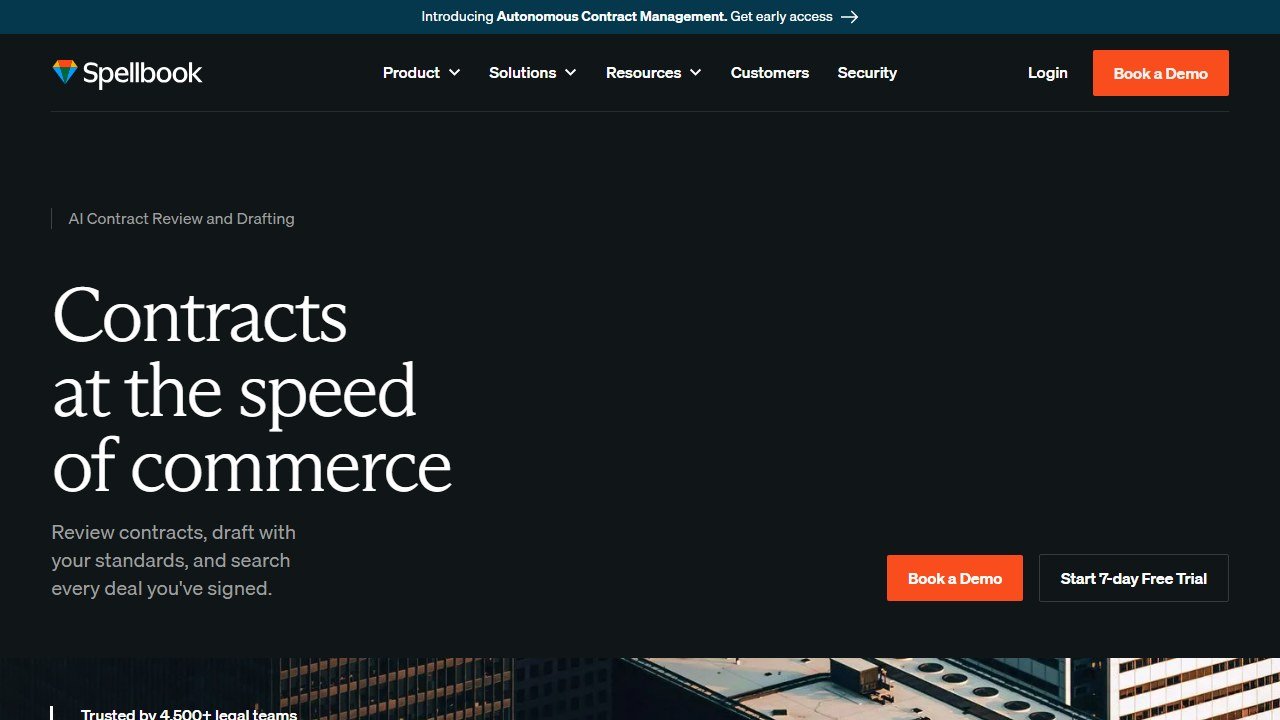
For a lawyer who does not want to learn a new platform or move contracts into a separate system, the Word-native workflow is the whole appeal. You review where you draft. Spellbook does not publish flat pricing and structures cost by team size, routing you to a free trial or a demo, so confirm current terms directly. It is built for the single-document review flow rather than bulk due diligence, which is exactly right for its audience.
Best for: solo lawyers and small firms who live in Word and review one contract at a time.
Watch out for: it is not a bulk due-diligence engine, and pricing is quote-based.
Spellbook’s per-seat cost looks simple until you factor in annual commitments and team tiers. Our Spellbook pricing breakdown runs the real math before you sit through the sales call.
2. Ironclad: Best for In-House Teams and High Volume
Ironclad targets in-house counsel, commercial lawyers, and deal teams who have to triage risk across a steady stream of contracts. It is a leading contract lifecycle management platform, and its AI layer does clause-level review with risk flags, suggests redlines tied to your company playbook, and lets you ask plain-language questions across your contract repository, so you can find what your agreements say about a given clause without opening each one. Smart Import pulls existing third-party contracts into the system and tags key terms automatically, which is what turns a pile of PDFs into a searchable, reportable set.
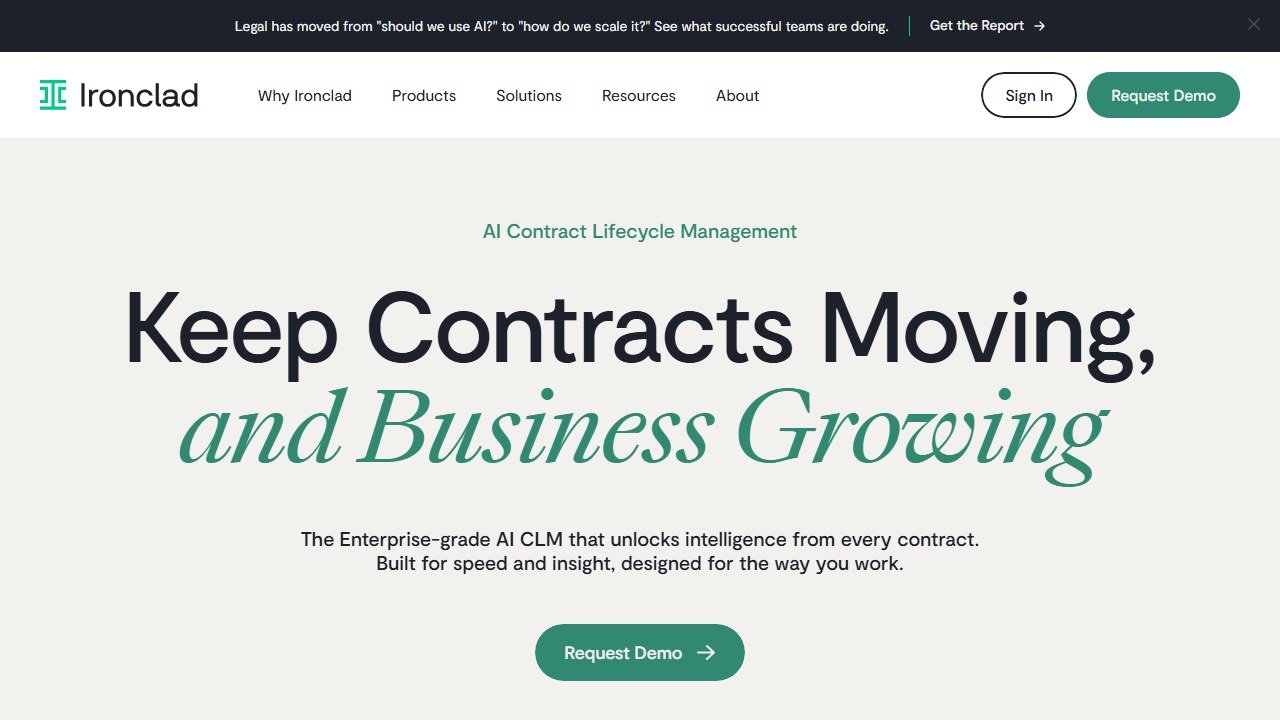
For a busy in-house team, the draw is that review sits inside the whole lifecycle: the same platform that flags risk on an incoming contract also routes approvals, tracks obligations, and stores the signed version. It handles volume and process, not just the first read. Ironclad is an enterprise platform, so it is more than a solo needs and pricing is quote-based, but for a legal-ops team standardizing how contracts move through the business, that scope is the point.
Best for: in-house and legal-ops teams handling high contract volume who want review inside a full lifecycle platform.
Watch out for: it is enterprise-scale and quote-based, so it is overkill for a solo reviewing the occasional contract.
3. Luminance: Best for Enterprise and Due Diligence
Luminance is the enterprise choice when the job is scale: reading thousands of contracts and surfacing risk patterns across the whole set. Founded by Cambridge AI researchers and lawyers, it built its own models rather than leaning entirely on general-purpose LLMs, and it is built for M&A due diligence, lease review, regulatory compliance checks, and repapering. It can process large document volumes quickly and organize, compare, and flag concepts across an entire dataset, which is what a diligence exercise actually needs. It serves major law firms and large corporate legal departments across many countries.
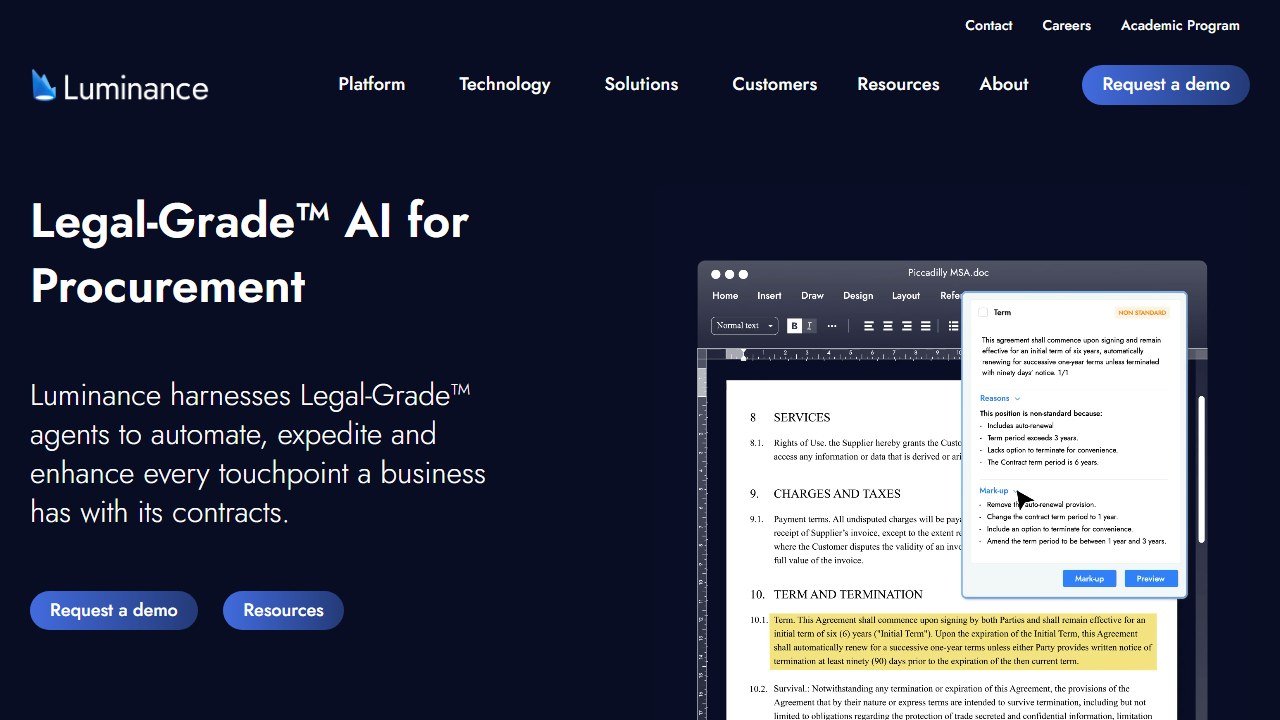
For a solo or small firm this is far more than needed, and pricing reflects it: Luminance does not publish rates, has no self-serve tier, and quotes enterprise deals based on users, volume, and modules. But for a firm or company running real due diligence at scale, the ability to review an entire contract set in a fraction of the usual time is the point. This is a due-diligence engine, not a single-document assistant.
Best for: enterprise legal teams and firms running M&A due diligence and large-scale review.
Watch out for: enterprise pricing and setup make it overkill for small teams and single contracts.
4. LinkSquares: Best CLM Plus AI for Legal Ops
LinkSquares sits at the intersection of contract lifecycle management and AI analysis, which makes it a strong fit for legal operations teams that want to manage contracts and understand them in one place. Its AI extracts key terms and data points from your executed and in-flight contracts, and layers analytics and reporting on top, so you can answer questions about your portfolio, such as which agreements are up for renewal or carry a given clause, without opening each one. For a legal ops function that owns the whole contract repository, that combination of storage, extraction, and reporting is the value.
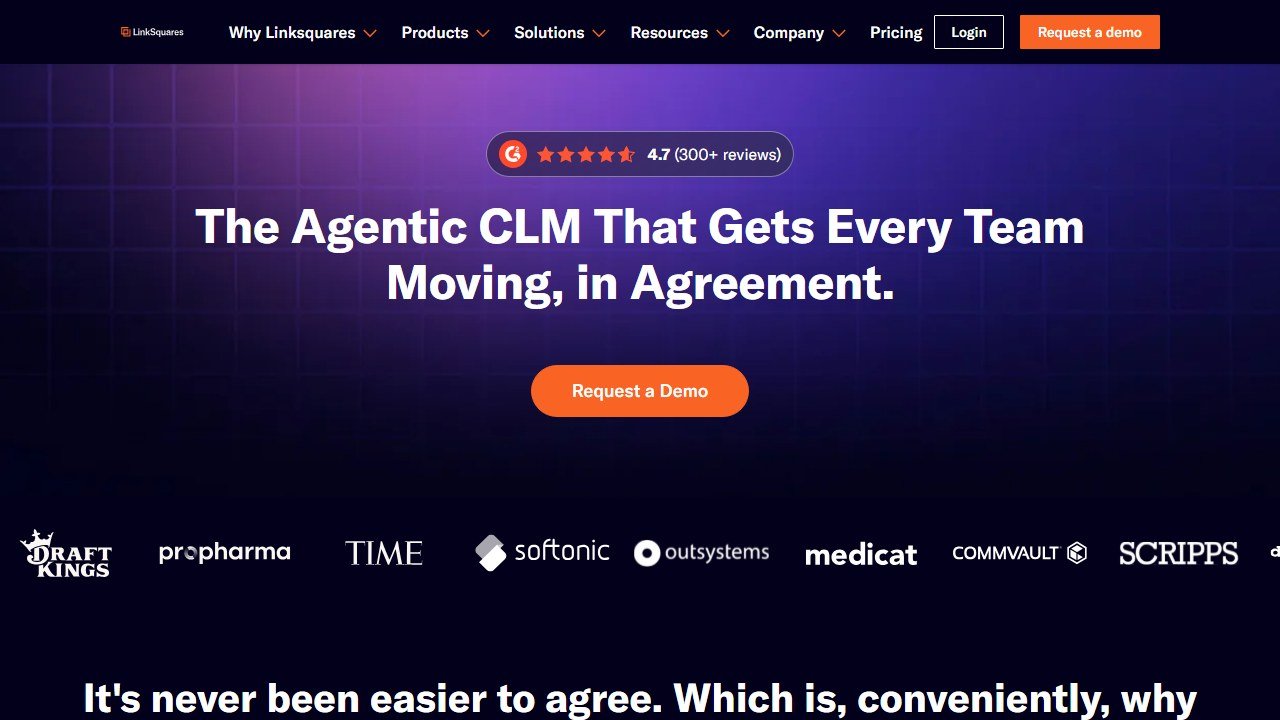
It is less a single-contract redlining add-in and more a system of record with intelligence built in. If your problem is not just reviewing one incoming contract but managing and reporting across everything you have signed, LinkSquares is built for that.
Best for: legal ops teams that want CLM and AI extraction and analytics together.
Watch out for: it is a platform to adopt, not a lightweight add-in for occasional review.
5. Kira: Best for Due Diligence Extraction
Kira, now part of Litera, is a specialist in one thing done very well: extracting clauses and data points from large sets of contracts. Its models are lawyer-trained over many years and a large volume of expert hours, and it is a long-standing reference point for accuracy in diligence extraction. When you are reviewing a data room of hundreds of contracts during an acquisition and need to pull specific provisions and terms out reliably, Kira is purpose-built for that task.
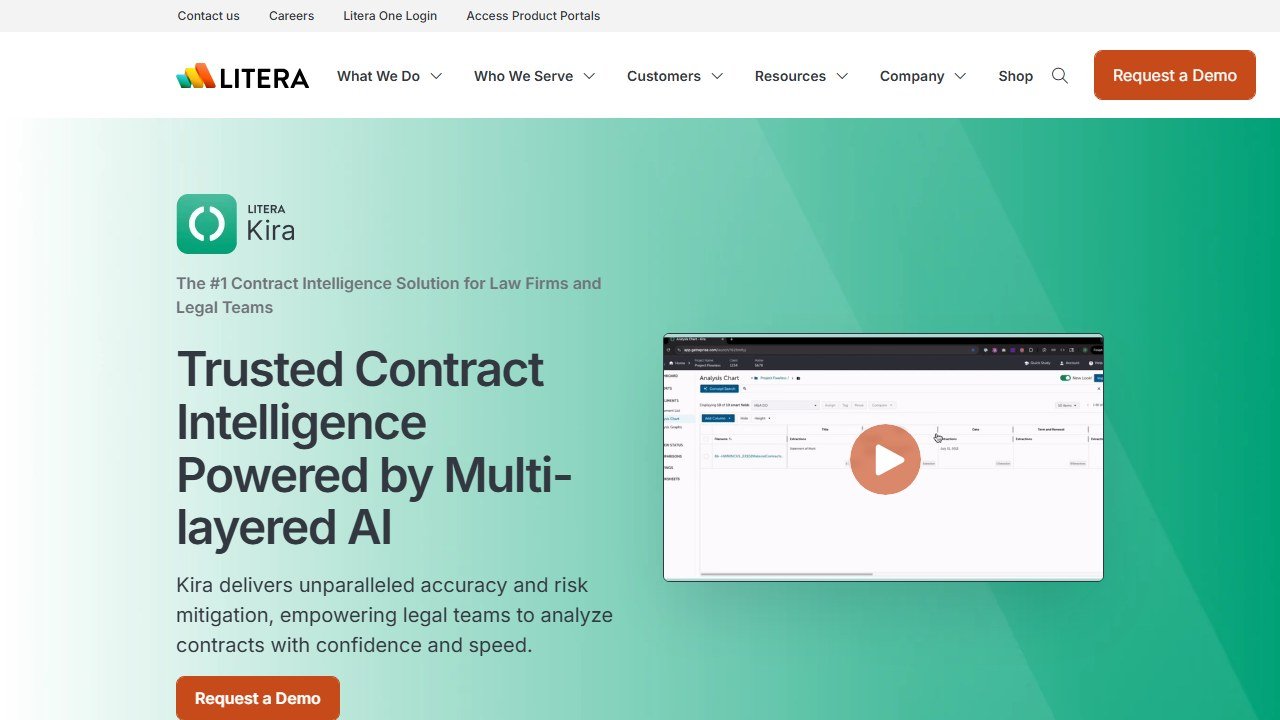
It overlaps with Luminance in the diligence space, and the choice between them often comes down to fit, existing tooling, and how each vendor’s models perform on your document types. As a standalone platform aimed at firms and large teams, it is not a casual single-contract tool. Its strength is high-accuracy extraction at scale.
Best for: firms and teams doing due diligence that need reliable clause and data-point extraction.
Watch out for: it is a specialist extraction platform, not an everyday single-contract redliner.
6. Legora: Best Collaborative Platform
Legora is an emerging entrant that positions itself as a collaborative AI workspace for legal teams, blending contract review with legal research and drafting. The pitch is teams working together in one environment: reviewing agreements, researching questions, and producing work product, with AI assisting throughout. For a team that wants review to sit alongside research and drafting rather than in a separate single-purpose tool, that integrated, collaborative approach is the appeal.

As a newer platform, it is worth evaluating hands-on against your actual documents and workflow, and confirming how its review and risk-flagging depth compares with the more established specialists. But the collaborative, multi-task framing is a genuine differentiator worth a look.
Best for: teams that want review, research, and drafting in one collaborative AI workspace.
Watch out for: as a newer platform, test its review depth against established tools first.
7. Lawgeex: Best for Automated Approval and Playbooks
Lawgeex focuses on a specific, high-value slice of review: automatically approving routine contracts against your policies. Instead of a lawyer reading every standard NDA or vendor agreement, Lawgeex auto-reviews the contract against your predefined playbook and can pre-approve or flag it for a human only when it falls outside policy. For an in-house team drowning in routine, repeatable agreements, that automation is the win: it removes the low-judgment reviews from the queue so lawyers spend time on the ones that matter.
It is strongest on standardized, high-volume commercial contracts where the rules are clear enough to encode in a playbook. It is less about deep M&A analysis and more about taking the repetitive pre-approval work off human hands.
Best for: in-house teams automating pre-approval of routine, policy-driven contracts.
Watch out for: it shines on standardized agreements, less so on bespoke, complex deals.
8. Juro: Best Contract Lifecycle for Scaling Companies
Juro is an all-in-one contract lifecycle platform: create, review, negotiate, sign, and manage, with an AI assistant built into the flow. It is aimed at scaling companies that want legal and business teams working in the same tool, so a contract can move from draft to signature to stored-and-searchable without hopping between systems. The AI assistant supports review and drafting inside that lifecycle, which suits a growing company standardizing how it handles agreements end to end.
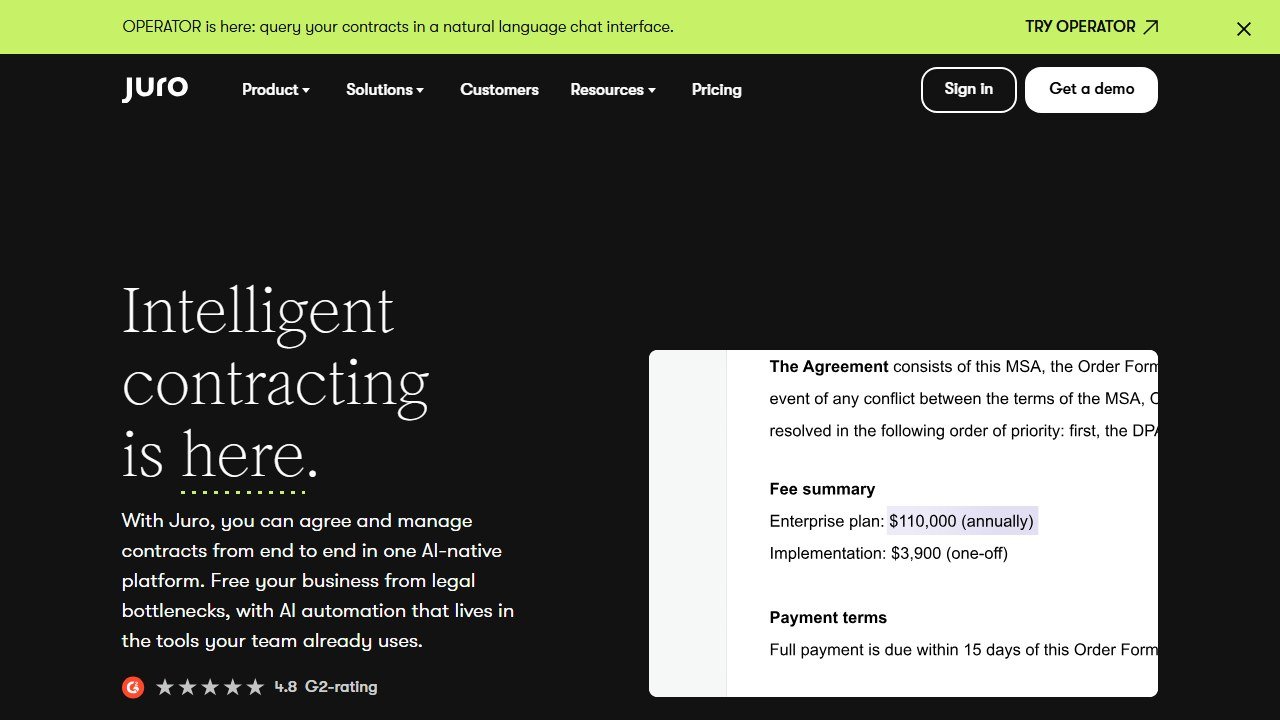
If your need is narrowly deep review of complex contracts, a specialist may go further. But if you want one place for the whole contract process with capable AI assistance along the way, Juro’s breadth is the selling point, especially for a company outgrowing email-and-Word contract handling.
Best for: scaling companies that want the full contract lifecycle plus AI in one tool.
Watch out for: breadth over depth, so specialists may go further on complex review alone.
How to Choose
Start with what you actually do most days, not with the brand. If you are a solo lawyer or small firm redlining single contracts in Word, Spellbook fits your workflow with the least friction. If you are an in-house or commercial team handling steady volume, Ironclad’s playbook review, repository search, and lifecycle workflow are built for that pace. If you are an enterprise running M&A or large-scale review, Luminance and Kira are the due-diligence engines that read thousands of documents and extract terms at scale.
Then layer in the other decisions. If your problem is managing and reporting across your whole contract repository, a CLM-plus-AI platform like LinkSquares or, for full lifecycle, Juro fits better than a review-only tool. If you are trying to take routine pre-approvals off your lawyers’ plates, Lawgeex’s automated playbook review targets exactly that. Weigh budget honestly, since most of these are quote-based and enterprise tiers get expensive fast, and confirm integrations: whether it lives in Word, connects to your CLM, and works with your document formats. Above all, run a trial against your own real contracts before you buy, because performance on your document types is what matters, not a demo on someone else’s.
Shopping specifically for a replacement for the category favorite? Our dedicated guide to the best Spellbook alternatives compares these tools through that exact lens, price point by price point.
Verdict
Spellbook is the best AI contract review software for most solo and small firms in 2026, because it redlines and flags risk right inside Microsoft Word, where those lawyers already work, with no separate platform to adopt.
The rest fit clear cases. Ironclad is the pick for in-house teams and high volume, with playbook review, repository search, and contract review built into a full lifecycle platform. Luminance and Kira are the enterprise due-diligence engines for reading and extracting across thousands of contracts. LinkSquares and Juro bring CLM plus AI for legal ops and full-lifecycle needs, Lawgeex automates routine pre-approval, and Legora is a promising collaborative workspace to watch. Match the category to your actual work, trial it on your own contracts, and remember that every one of these is a first pass that still needs a lawyer’s sign-off.
For the full picture, see our best AI tools for lawyers pillar, and for the other half of the work, generating new agreements from scratch, our guide to AI tools for legal writing.

Written by
FazFaz is the founder of AIToolsBakery. Some tools here are tested hands on. Others are assessed from vendor documentation and pricing verified on the live page, and every review says which one it is. Sponsors can buy a position in a guide. They cannot buy the score, the criticism, or silence about a better option.
How we test and how we make money →